Extend the service life of your concrete structure with MasterProtect 8500 CI

When concrete is reinforced with steel, the right method must be used to limit and prevent corrosion…
Corrosion is always a risk. This is particularly true of concrete reinforced with steel, where the right method must be used to limit and prevent corrosion. Corrosion can be defined as the conversion of a refined metal into its more stable oxides through the action of oxygen and water.
Concrete provides a natural shield that protects the reinforcing steel against corrosion. The highly alkaline environment created by the cement matrix around the reinforcing steel forms a passive layer around the bar, specifically an impermeable oxide layer that prevents further corrosion by completely isolating the steel surface.
However, this protective layer is maintained only as long as the highly alkaline environment of the concrete matrix remains. Carbonation caused by exposure to carbon dioxide dissolved in water reduces the pH of the cement matrix. Chloride ions also disrupt the passive layer and lead to corrosion. If the passive layer breaks down, corrosion reactions occur and damage the reinforcing steel.
Slowing the corrosion process
Although the corrosion process cannot be avoided, a great deal can be done to slow it down. Various types of corrosion inhibitors are available on the market. They consist of chemical compounds that prevent corrosion reactions in reinforcing steel. All inhibitors must reach the reinforcing steel within the concrete to protect it. Corrosion inhibitors can therefore be added to concrete admixtures and mixed directly into fresh concrete, or applied to the surface of hardened concrete (surface-applied corrosion inhibitors). The first type of corrosion inhibitor can be used only on new structures; the second is specifically designed for the refurbishment of existing structures.
State-of-the-art protection for reinforcing steel
There is no longer any need to choose between the ideal solution for new and existing structures. MasterProtect 8500 CI from Master Builders Solution is a new corrosion inhibitor designed for application to both new and existing structures. It has proven effective even when cracks form after the coating has been applied. MasterProtect 8500 CI is a dual-action, silane-based corrosion inhibitor that is applied to the surface. It is suitable for use as part of a corrosion prevention, protection or mitigation strategy. This revolutionary blend of high-performance silanes and selective corrosion inhibitors remains dormant in the concrete until activated by moisture entering the surface through cracking or concrete ageing.
In dry conditions, the inhibitor is invisible, as MasterProtect 8500 CI does not alter the appearance of the concrete. When the concrete is wet, however, its water repellency, or beading effect, is clearly visible on the concrete surface. MasterProtect 8500 CI also has very low viscosity, which improves penetration into concrete across a wide temperature range, a lower VOC content and a higher flash point. Taken together, these properties make the product much easier and safer to handle and apply than many other inhibitors.
MasterProtect 8500 CI applied in a car park.
What does dual action mean, and how does it work?
With conventional surface-applied corrosion inhibitors, the inhibitor must penetrate deep into the concrete to reach the reinforcing steel. There, its functional group acts directly on the surface of the bars, repassivating the steel and reducing active and future corrosion. MasterProtect 8500 CI goes a step further with its dual action.
One aspect of MasterProtect 8500 CI’s dual action is the water-repellent effect of its high-performance silane blend, which prevents moisture and chlorides from penetrating the concrete. Depending on the chemical reaction, silanes with different functions can be produced. MasterProtect 8500 CI uses several silane functions to achieve different effects on the concrete substrate. These include a corrosion-inhibiting effect and the formation of a water-repellent layer that protects the concrete against the ingress of liquids while allowing water vapour to pass through. This prevents new moisture from entering the concrete, while allowing moisture that may already be in the substrate to evaporate.
This keeps the concrete dry and increases its electrical resistance. Since concrete can be considered an electrolyte for reinforcing steel, higher resistance prevents electrochemical reactions. In dry, alkaline concrete, the reinforcing steel also passivates quickly. The lack of water and the high resistance of the concrete drastically reduce the rate of corrosion.
The reinforcing steel remains protected
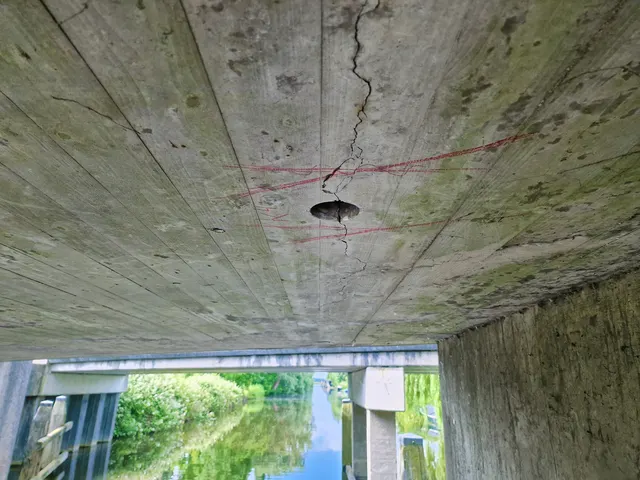
The dormant inhibitor is combined with the silanes that make up the second element of MasterProtect 8500 CI’s dual action. The presence of dormant inhibitors is crucial to protecting reinforced concrete structures against corrosion over the long term. Structures are very likely to develop cracks at some point, regardless of the age and quality of the concrete. Concrete reinforced with steel is prone to cracking for various reasons. Cracking also means that the water-repellent shield provided by the silanes in MasterProtect 8500 CI is no longer effective. Water and chloride ions can enter through the crack and damage the reinforcing steel. This is where the dual action comes into play, allowing MasterProtect 8500 CI to continue protecting the reinforcement. The latent inhibitors remain dormant in the concrete until the water-repellent properties diminish over time or the concrete cracks. They are then activated, become mobile and are carried deeper into the concrete by moisture. The reinforcing steel therefore remains protected.
MasterProtect 8500 CI stands out from the many existing inhibitors on the market thanks to its dual action: alongside the water-repellent shield created by its revolutionary silane blend, the dormant inhibitor provides long-lasting protection. This can extend the service life of all types of reinforced concrete structures. The effect has been demonstrated in several independent tests.
Vraag over dit verhaal? Stel je vraag
Blijf dit volgen
Bij een nieuw verhaal krijg je een e-mail. Geen account nodig.
- OnderwerpTreatment & protection