
Platform on concrete and steel in construction
This episode of Concrete & Steel Construction the Podcast focuses on Liemar's 40th anniversary, with founder Jan van Hapert and colleagues Barry van den Reek and Niels at the table. Jan talks about how Liemar started from the software world and through detours eventually found its focus in the steel construction industry. The choice for specialization proved crucial: Liemar did not want to do everything, but excel in one domain. That focus led to the development of an integrated ERP solution for steel construction, from calculation to delivery. Jan candidly shares lessons from the early years, including failures, legal conflicts and financial setbacks.
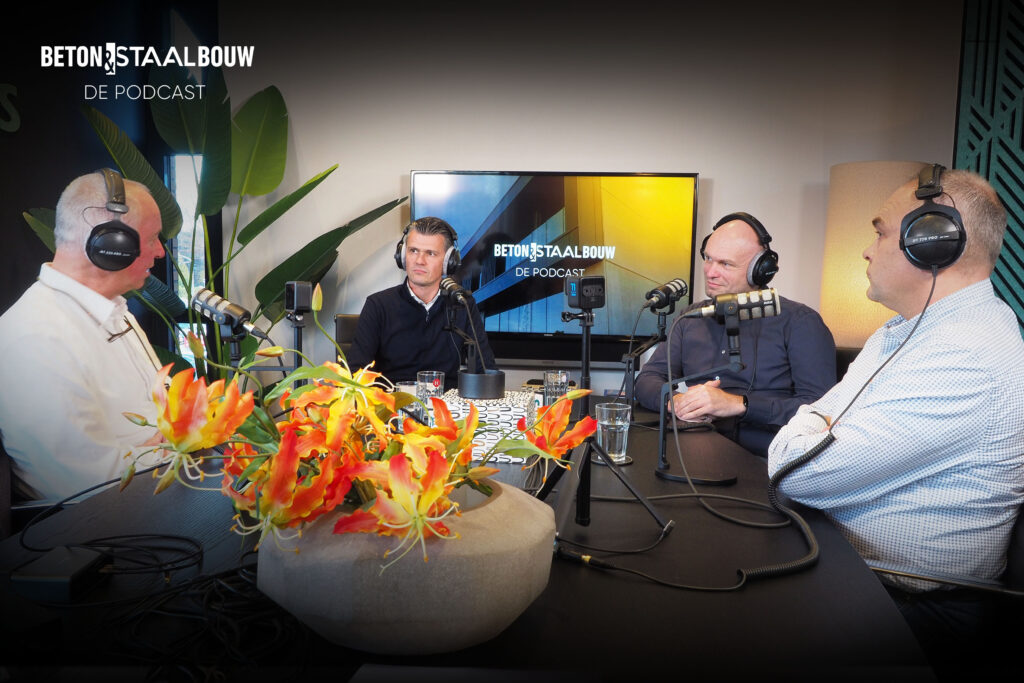
Barry looks back on his start at Liemar through a graduation internship and how customer questions formed the basis for, among other things, the planning module. He emphasizes that the core question from customers has remained the same for 27 years: more peace of mind, control, and overview in projects. Niels, with a background in operational steel construction, explains how he helps customers to actually experience that control. A recurring theme is that software only works if companies are willing to change their working methods.
According to them, the biggest inefficiencies in the sector lie in fragmented systems, Excel spreadsheets, and clinging to old ways of working. Time appears to be the most underestimated problem among steel constructors. Lean principles, good planning, and clear processes actually create more flexibility and job satisfaction. Liemar provides intensive support to customers and sees implementation as a long-term process, not a one-time installation.
Unique is the active cross-pollination between customers, who learn a lot from each other. Liemar develops its software in close collaboration with users, but maintains a clear vision. Technological choices, such as working locally versus cloud solutions, are made consciously and critically. After 40 years, Liemar is still evolving, driven by specialization, listening to customers, and the search for lasting peace of mind and returns in steel construction.
[00:07] Introduction to the podcast and guests
Roel van Gils: Welcome to Concrete & Steel Construction Podcast. This time we have the gentlemen from Liemar Software with us. I believe they have something to celebrate: forty years in business. Perhaps you could start by introducing yourselves. Shall I begin with Jan?
Jan van Hapert: My name is Jan van Hapert, and I started Liemar forty years ago. So I still enjoy my work every day.
Roel van Gils: Look at that.
Niels Oudenaarden: My name is Niels Oudenaarden. I have been working at Liemar Software for about four years and spend a lot of time in the field. So I am on the road a lot, see a lot of things, and have a lot of contact with customers.
Barry van den Reek: And I'm Barry van den Reek. I am the technical manager of Liemar Software. By now about twenty-seven years.
Roel van Gils: Okay, great. Welcome again, and congratulations on your anniversary, of course.
Barry van den Reek: Thank you very much.
[00:54] Reason for starting Liemar
Roel van Gils: Jan, what did you see forty years ago that made you feel: I have to build this myself? What was the actual reason for founding Liemar?
Jan van Hapert: Forty years ago, that was really not on the horizon. If you look at the market we are in now and the solutions we offer there, they only started 37 years ago. So we haven't been doing this for very long. In the first few years, we had different solutions. Over time, the market changed, insights changed, and people changed. I started out with a partner. That was fantastic in the beginning, of course, but I had a different vision than he did, so we parted ways. Because I only wanted to do one thing. And I wanted to make sure we were the best at that one thing. Not constantly building custom solutions or doing something else, from one thing to the next. So the idea was to really focus on one area.
Roel van Gils: So that was actually thirty-seven years ago?
Jan van Hapert: Yes, the vision was already there, just not yet in steel construction.
[02:16] Background and division of roles
Jan van Hapert: I actually have a background in business economics and finance. I knew nothing about computers. At the office, they say: let's keep it that way. It's important that everyone has their own tasks. I'm glad I don't have to do that. I can't do it either, so I'm not allowed to do it.
[02:47] First assignment and failure
Jan van Hapert: At some point, things turn out differently than you expect. That was already the case with the first assignment we received, when we had only been in business for a month. We received an assignment from an insurance agency. I remember the name well, but I won't mention it because it went completely wrong. We thought we had a great assignment, with a handwritten order confirmation. We set to work on creating a program for that insurance agency.
[03:23] Legal dispute and financial consequences
Jan van Hapert: After six months of development, I called that customer and said, “Shall we come and install the software at your premises?” He replied, “Software? We're done with it, we don't want it.”
Jan van Hapert: There was a whole procedure. Lawsuits, lasting five years, or even longer. Graphological analysis, because we had his signature, of course. I managed to arrange that. What I didn't manage to arrange was the financial side of things. I thought I would get there, but that wasn't the case at the time. You spend six months working on something and you don't earn a penny. That was almost the end of the road. That was it for me in that world.
[04:30] Intermediate step at MHI and the graphics industry
Jan van Hapert: In the meantime, I had another job for a while. That was at MHI, an American software company. They were also in the graphics industry. We actually ended up there by chance at one point.
[04:57] Development of core functionality
Jan van Hapert: At that point, we had the idea of an order production tracking system combined with time registration. It was a fantastic module. We still have it today. The current package includes it for steel construction. Nothing has changed, so it still works great. But I think we spent about five years in the graphics industry.
[05:18] LOPRIS and digital order bag
Jan van Hapert: We had a partial solution for the graphic industry. It was a production control system, logistics, production registration, information system. At the time, it was called LOPRIS, for short. It gave you a wealth of information about the orders that were passing through your company. You always knew online who was working on what, where that order was in the company, and how much time you had spent on it.
Jan van Hapert: At that time, we also developed the first digital order bag. It was an order module that was digital and no longer on paper. And I'm talking about 1987, with our own computers that we built at the time.
[06:24] Cooperation and competition in the graphic industry
Jan van Hapert: I wanted to collaborate with what were then called industry packages. ERP didn't exist as a term back then. But the boat kept being held back. At the time, there were a number of software suppliers who made software purely for the graphics industry, such as printing companies and prepress companies. I now understand why, because a year later they had the same solution as us.
Jan van Hapert: For us, it was quickly over in that market, because it was fully integrated into their package. Sometimes things are no coincidence. Over the years, you naturally build up a network.
[07:08] Zuid-Nederlandse Staalbouw as a turning point
Jan van Hapert: Through mutual acquaintances, I met the director, the owner of what was then ZNS, Zuid-Nederlandse Staalbouw. It was the largest steel construction company in the Netherlands. He said, “Jan, I have a problem.”
Jan van Hapert: I said, “Gosh, what's your problem?” He said, “My work in progress.” I said, “What's the problem with that?”
Jan van Hapert: When you look at work in progress, one of the components of the valuation of that work in progress is your hours. So the price of your hours, your costs, and your revenues. And part of those costs are hours. And that was his problem.
[07:53] From insight to initial focus
Roel van Gils: And the solution?
Jan van Hapert: I said, “Show me.” And I think that a few months later, we had orders that would keep us going for a year.
Roel van Gils: And how long ago was that?
Jan van Hapert: Thirty-seven years. So that was really the focus on steel construction.
[08:01] Market research by Eindhoven University of Technology
Jan van Hapert: Then I thought: yes, but if others don't have anything like this, we might be the only ones in steel construction. So I had Eindhoven University of Technology conduct a study into the steel construction market. Because, of course, I knew nothing about it. I didn't know what a profile was, or a tube or a beam. I didn't know the first thing about it.
Jan van Hapert: They conducted research for us into the size of the market and what was already available. Then I thought: okay, I think there's an opportunity for us to get started there. That was also evident from the report.
[08:54] Lack of a comprehensive industry solution
Jan van Hapert: There was no industry solution that covered everything, from calculation and quotation to invoicing for a project. So we decided to invest. We built everything ourselves, in-house. We build everything ourselves, all the software. But there are also many things we don't do.
[09:16] Conscious choice for specialization
Roel van Gils: Yes, that's fine, yes.
Jan van Hapert: We want to focus purely on and specialize in the entire project management process for the entire production. And production also includes engineering. Production also includes the administrative process. That is also part of manufacturing. Production also includes assembly. So from the first commercial meeting to the last meeting at project delivery. That is what our ERP solution offers.
[09:58] Barry joined the company through a graduation internship.
Roel van Gils: And Barry, when did you think: I want to be part of this?
Barry van den Reek: That was twenty-seven years ago, my graduate internship. I did business computer science at Fontys in Eindhoven. I had to do a graduation internship and that was at Liemar Software. The subject was the planning module.
Barry van den Reek: With a colleague's old Peugeot, I went to all the steel construction companies in the Netherlands, including those that were not yet customers. With the question: how do you plan? That's where I finally delivered the planning module as the final assignment of my internship. It is still being used today.
[10:47] Early years: doing everything and making choices
Jan van Hapert: Look, in those early years, we did everything. So nothing really well. We did hardware, networks, PCs, file servers, printers, you name it. And of course, the software. I think there were about thirty or thirty-five of us back then.
Jan van Hapert: Then I thought: I don't want to deal with that anymore. All that hassle with hardware. Then another computer would break down or a printer wouldn't work. Back then, you didn't have the internet, so you had to drive everywhere. We had a support department of six people who did nothing but drive around the Netherlands in cars.
[11:37] Letting go of peripheral activities
Jan van Hapert: What's more, there were other companies that could do that better than us. We believed that our software was better than others. And we still believe that. So we think it's important to improve at what you're good at. And what you're bad at, you let go.
[11:52] Entrepreneurial principles and specialization
Roel van Gils: And when we look at where Liemar Software is now, what entrepreneurial principles have actually guided you over the past forty years, Jan?
Jan van Hapert: I think I already mentioned one: specialization. When I visit companies that don't yet work with Liemar Software, I sometimes ask them: suppose you were ill, where would you prefer to be treated? In a general hospital, or at a specialist clinic where twelve people work every day on your specific condition? The choice is obvious.
Jan van Hapert: That is an important principle. Another important principle, in my opinion, is that everyone at Liemar Software is given enough freedom to develop themselves. But that also means they have the responsibility to perform their tasks well. I hardly ever interfere with the things Barry is working on. Only when I have a new client and there are things that need to be done, I go to Barry and say: how can we do this? Then we have another challenge.
[14:27] Continued customer demand for peace of mind and control
Roel van Gils: And you would think that after twenty-seven years, you've done everything there is to do. Right?
Barry van den Reek: No, every time there is a wish from the customer. Or something we think: hey, that's interesting.
Roel van Gils: What has remained the same in those twenty-seven years?
Barry van den Reek: The client's demand for more peace, more clarity and grip on his projects and on his business.
Roel van Gils: And how do you implement that?
[15:03] Learning from customers and sticking to your vision
Jan van Hapert: Look, these are, of course, our customers, whom we want to retain. That is our raison d'être. Fortunately, that is the case. We have many customers who have been working with Liemar Software for more than twenty-five years. I think that's quite a long time. They have experienced multiple versions and have grown along with us.
Jan van Hapert: Those are also the customers who often have the best ideas about how things should work. That's how Barry got started, actually. The basis of the planning module, for example, is asking the customer: how do you do it? What do you think is important? How should it work? What information should it provide? When do you enjoy working with it? Those are the things we want to know. And then we can get to work.
Barry van den Reek: Or not at all. Because that happens too. Then a client says: it has to work like this. And then we say: it's really not going to happen that way. We know from experience with other customers that it works better another way. So we're not going to convert this especially for you.
[17:07] Change requires behavioral change
Roel van Gils: Can you give an example of that?
Barry van den Reek: That varies from client to client. In the package is a focused lean strategy for the way of working within a project. Cut it up into small cubes, make sure those are handled one at a time and don't start shoving ad hoc things in between. Make sure you plan and you do what you planned.
Barry van den Reek: Often people think that by being very flexible they bring in more customers. But if you have a tight schedule, you won't get any rush jobs and you won't need any deviations. Daring to take that step requires trust.
Niels Oudenaarden: I would like to add to that. It is often also important not to try to do everything at once. You start by creating structure and then you get to work from there. As you work, you gain insights and things fall into place. It's not like you buy software, install it, get four training sessions, and you're done. That's actually only step two. Step one is recognizing that you need to change something.
[19:59] Technical development and cloud issues
Roel van Gils: Looking at the software itself, what have been the most important steps in its development?
Barry van den Reek: That is very much determined by technology. In the beginning we only had PCs and mini-systems. Technology changes and, as a result, customers' wishes also change. This has led to us throwing out a complete package several times and starting over. We are now at what we call Liemar 11.
Barry van den Reek: You see systems moving more and more toward the cloud. That brings challenges. We deliberately choose to keep working locally, but to be accessible everywhere. The risk of being completely web-based is that if the Internet doesn't work, you can't work anymore. And a steel fabricator does need to be able to control his machines.
[35:02] Market trends and future
Roel van Gils: Niels, what are you seeing in the market that confirms that your strategy is correct?
Niels Oudenaarden: Seeking insight into your process remains the basis. Time and hours remain the same issue as before. What you see now is robotization and automation, often driven by a shortage of skilled personnel. Ultimately, products simply have to be made. What is changing is how you respond to this with software and integrations.
[37:19] Review and conclusion
Roel van Gils: Jan, what would you like to pass on to the next generation of Liemar builders?
Jan van Hapert: Stay focused. Specialization remains key. Give people freedom and responsibility. And improve what you are good at.
Roel van Gils: Gentlemen, thank you for the open conversation. Congratulations again on your anniversary and thank you for this interview.
Jan van Hapert: On to the next forty.
Roel van Gils: On to the next forty.
Neem dan rechtstreeks contact op met Liemar Software BV.
 Contact opnemen
Since its founding in 1985, Liemar has offered business and ERP solutions for project-based companies in steel and metal construction. Our mission is to optimize your company and processes as a partner and to create more insight together. This leads to more peace and efficiency, both for the entrepreneur and employees. With the 'New Return [...]
Bekijk Bedrijfsprofiel