









A futuristic landmark in white cement
Tekst en beeld Aalborg Portland
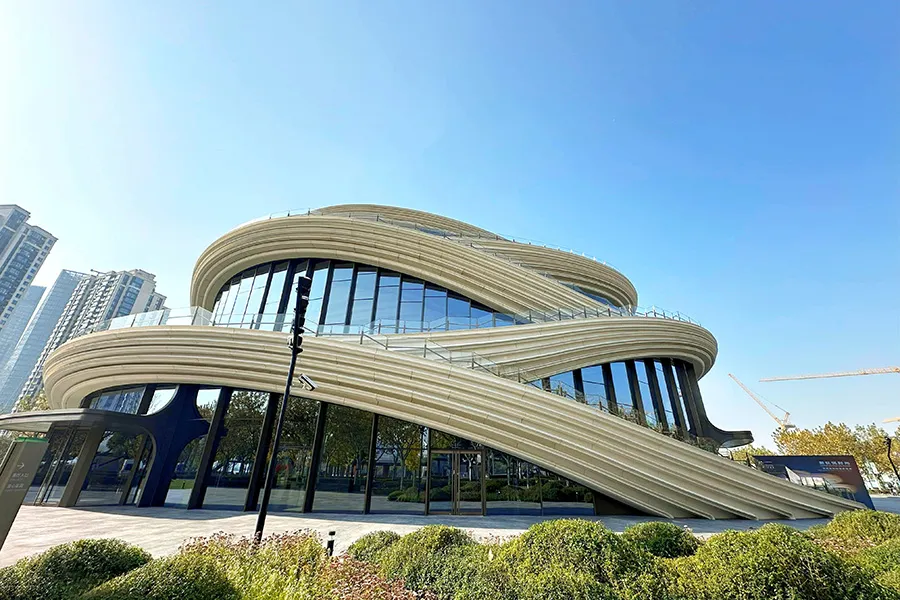
The Orbit, Shanghai
At Xuhui Riverside, the public art building ‘The Orbit’ is Thomas Heatherwick’s fourth design project in Shanghai. With a GRC façade resembling dancing ribbons, the building invites visitors to explore its open, arched staircases, bridges and terraces freely. It also offers a glimpse of urban waterfront art and recreation. The Shanghai waterfront area, better known as ‘Shanghai West Bund’ and located along the Huangpu River, is home to numerous renowned art galleries and leading financial institutions. It also serves as a hub for large-scale art and cultural events. Here, architecture and lifestyle intersect in a constantly flowing celebration that reflects the city’s ethos as a ‘new generation of waterfront regeneration’. As an observatory and landmark on the river, West Bund Orbit will serve as the starting point for the entire West Bund Financial City.
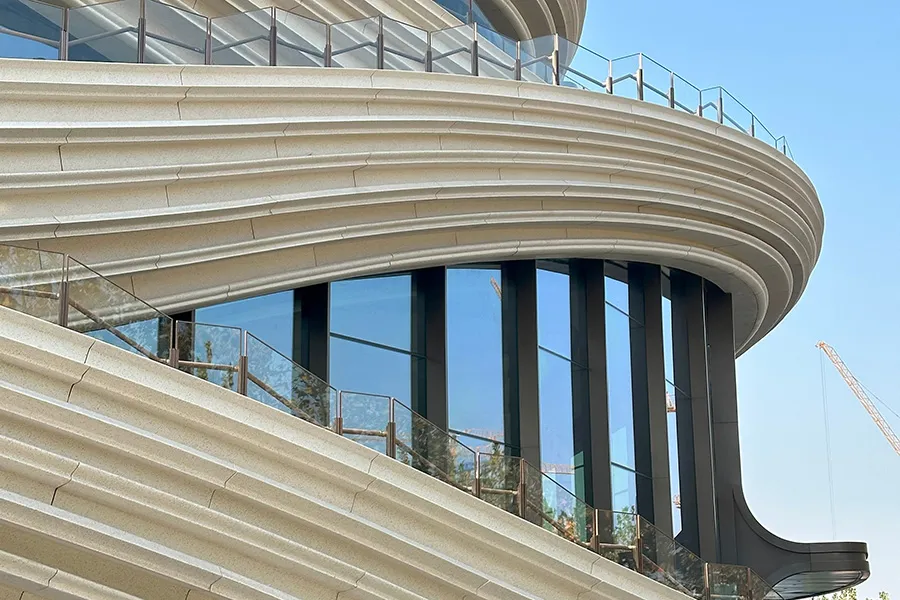
As a landmark in Xuhui Financial District, West Bund Orbit was meticulously designed by world-renowned architect Thomas Heatherwick. Its distinctive feature is the combination of dynamic and static design elements with a green, ecological concept. The interior design is led by architect Yu Ting of Wutopia Lab, making The Orbit an open work of art closely connected to the urban setting and the area’s way of life.
Geometric precision, flowing beauty
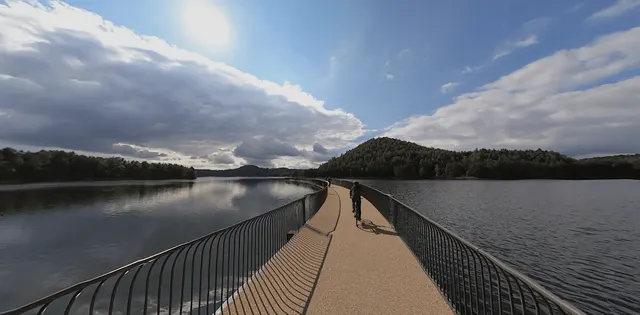
‘The Orbit’ refers to the natural forms represented in the design, including water waves, whirlpools, ribbons and stars. People walk around The Orbit like stars along the building’s perimeter. The roof garden also provides space for a range of public activities. The design inspiration for the outer ‘orbit’ comes from the ‘moon bridge’, often found in traditional Chinese gardens, combining geometric precision with flowing beauty. The architect uses the flowing orbit, which also connects the pedestrian routes, to wrap the building in a dynamic, undulating ribbon.
The West Bund Orbit’s building envelope consists of a zigzag glass curtain wall and GRC ribbon elements. The large curtain wall is supported by steel brackets, eliminating the need for beams and increasing transparency. The project has a diameter of 19.10 metres and a total above-ground floor area of 4,500 square metres. Its distinguishing features include the arrangement of stair flights, GRC ribbons, balustrades and landscape planters along the stairs, allowing visitors to enjoy both the greenery and the riverside vista.
Reflective mother-of-pearl shells
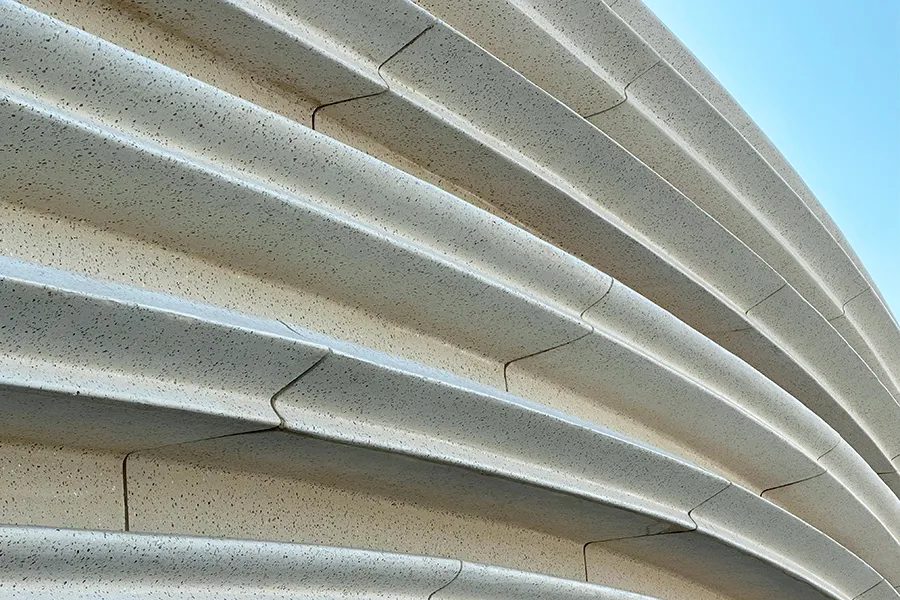
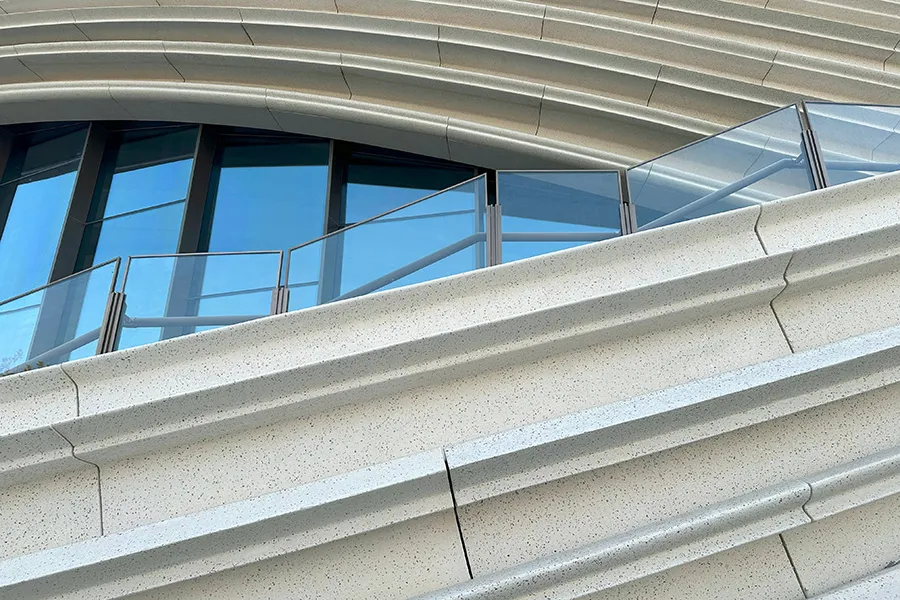
During the selection of the ribbon material, various materials, including metal, ceramics and GRC, were extensively tested. Based on these tests, GRC ribbon elements made with Aalborg White cement, produced by Zhuhai Shantai Precaster, were selected. GRC lends itself to smooth, curved forms. The addition of reflective mother-of-pearl shells also creates the desired terrazzo surface texture.
A visible foundation
The ribbon is light beige and takes on a golden hue in sunlight. The high stability of white cement ensures that the building’s overall colour tone remains uniform. The high purity of Aalborg white cement allows it to react fully with all additives, resulting in a smooth, delicate texture. This enhances the overall quality of the building. After polishing, the dense concrete surface improves the GRC façade’s resistance to dirt. In this way, the flexible and versatile material transforms the architect’s design concept into a visible foundation, giving the building greater functionality and potential.
During the design phase, the advisory team optimised the design by engineering a ribbon structure with three layers of box-section primary beams arranged from the inside out. Combined with decreasing cross-sections, this creates a light and transparent architectural effect for the ribbon staircase and the exhibition hall façade. The ribbon on the staircase was designed parametrically, with each ribbon comprising seven layers that form flowing curves through variations in panel size and overlap. BIM modelling and parametric design were used to optimise the number of GRC panel shapes. Installation and positioning were also determined to avoid clashes. Within the permissible tolerance, component variations were streamlined to the smallest possible number of types. This increased mould utilisation by more than 600% and reduced the mould area from approximately 2,000 square metres to approximately 300 square metres.
During construction, the ribbons were installed from the centre towards the ends of each coil to improve construction efficiency and ensure high quality. The Orbit will redefine people’s perception of the function of public buildings, says Neil Hubbard, Group Leader at Heatherwick Studio. “This exhibition hall is designed to be explored and experienced. Rather than simply enclosing a gallery within a decorative façade, The Orbit will come to life through the people who visit it. Its location at the bend in the river enables the building to become a true landmark for the area and attract people, not only for the events it hosts, but for the whole of Shanghai West Bund.”
Een zakelijke vraag aan Aalborg Portland Belgium? Neem contact op
Wie eraan werkte
The Orbit in Shanghai
- Aalborg White cement
 Aalborg
- architectHeatherwick Studio
- interieurontwerpWutopia Lab
- GRC-lintelementenZhuhai Shantai Precaster
Blijf dit volgen
Bij een nieuw verhaal krijg je een e-mail. Geen account nodig.
- ProjectThe Orbit
- ThemaMinder CO2 in beton en staal
- OnderwerpConcrete
- BedrijfAalborg Portland Belgium
- BedrijfHeatherwick Studio
- BedrijfWutopia Lab
- BedrijfZhuhai Shantai Precaster