‘Top of Mind’ in 3D moulds
Tekst en beeld Construx Weckenmann
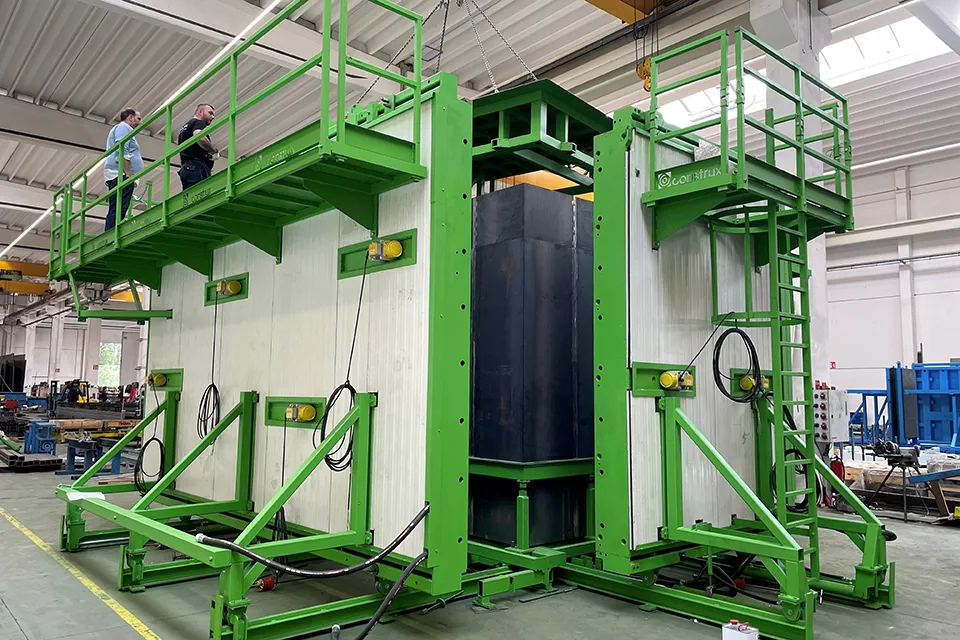
As one of the world’s most renowned manufacturers of concrete moulds and formwork systems, Construx Weckenmann has developed an extensive portfolio of moulds over the years to meet the needs of precast manufacturers. Working closely with the client, Construx Weckenmann aims to find the most suitable mould that meets all the technical specifications, fits within the client’s budget and is suitable for the dimensions and quantities of precast concrete elements the client wishes to cast.
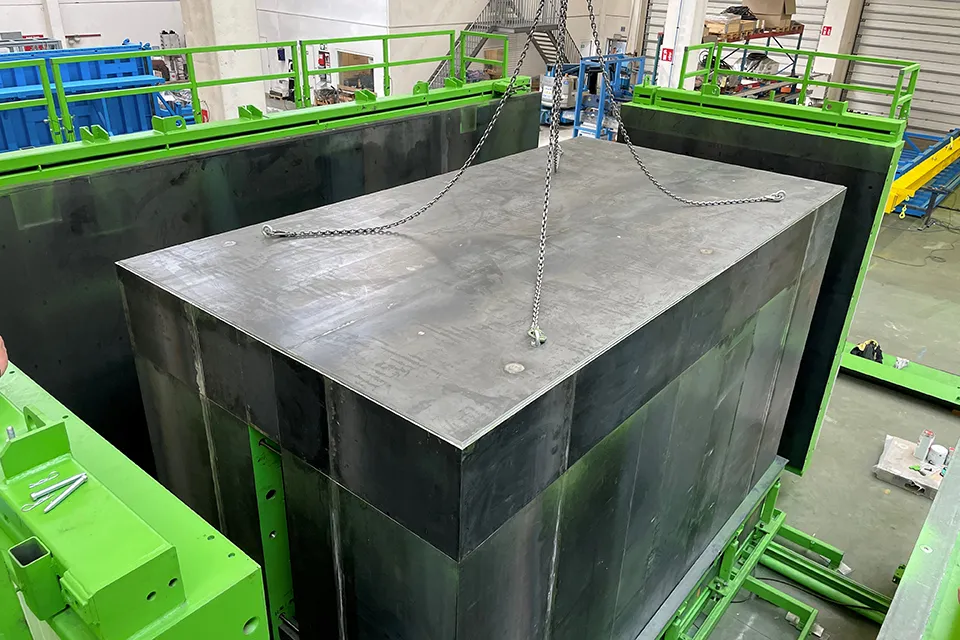
For companies supplying precast culverts and cabins such as electrical substations and prison cells, Construx Weckenmann has developed a complete range of state-of-the-art moulds over the years. Whether fixed-geometry, adjustable or fully automated, 3D moulds are the most complex, owing to the special design and technical specifications of these elements. As ‘Top of Mind’ in 3D moulds, Construx Weckenmann has become the leading supplier to most of Europe’s major precast substation manufacturers. Here are some examples of different moulds recently supplied by Construx Weckenmann to precast manufacturers around the world.
Australia: fully automated formwork for culverts
The precast concrete culvert elements, manufactured in two hydraulically operated formwork units, are cast on their sides and rotated 90° after striking using a turning mechanism. As the elements were to be installed at the base of a bored tunnel, the formwork dimensions had to meet very strict technical specifications. The tolerance for the joint dimensions, machined shear joints and upper recess forms with a tongue-and-groove profile, was +/- 0.75 mm. The width, height, diagonal and radius had to remain within a tolerance of +/- 1.5 mm.
Geometric requirements for the precast culverts:
- Length: 2.380 mm + 170 mm shear joint.
- External width: 4.440 mm.
- Total external height: 2.995 mm.
- Wall thickness: 300 mm.
- Roof thickness: 300 mm.
- Base thickness: 380 mm.
Given the large number of units the client had to produce and the high labour costs in Australia, Construx Weckenmann added a number of features to reduce production costs per unit as much as possible, making the formwork easy to use and limiting labour wherever possible. It also installed electronic valves and sensors with PLC controls to ensure the correct sequence of operations and safe working practices in accordance with Australian standards. Special hydraulic and electronic features of the formwork make it easy to use and limit labour as much as possible:
- Hydraulic opening and closing of the outer panels.
- Hydraulic contraction of the inner core.
- Hydraulic locking of the outer panels to each other.
- Hydraulic locking of the outer panels to the inner core.
- Hydraulic locking of the collapsible inner core.
- Hydraulic unit, including pipes, valves, connections and controls.
- Electronic valves and sensors with PLC controls.
- Remote control for all hydraulic movements.
Northern Ireland: formwork for communications cabins
These so-called precast ‘Comms Chambers’, or communications cabins, are mainly used in infrastructure projects such as airports, railway projects, roads and housing developments. The formwork is suitable for manufacturing Comms Chambers with internal dimensions ranging from 1.500 mm x 1.500 mm to 3.000 mm x 3.000 mm, in 500 mm increments in both directions. The internal height can range from 400 mm to 2.400 mm, in 100 mm increments. The wall and base slab thicknesses of the elements can be 200 mm, 250 mm or 300 mm. The formwork is suitable for making standard units (with a base slab) and risers (without a base slab). The elements are cast upside down and rotated 180° after striking using a turning mechanism, also supplied by Construx Weckenmann. Given the large number of units the client had to produce and the high labour costs, Construx Weckenmann’s proposal included a number of features to reduce production costs per unit as much as possible, making the formwork easy to use and limiting labour wherever possible.
Technical specifications of the standard units:
- Internal dimensions of the units, 10 different sizes:
- 1.500 mm x 1.500 mm, 2.000 mm, 2.500 mm and 3.000 mm.
- 2.000 mm x 2.000 mm, 2.500 mm and 3.000 mm.
- 2.500 mm x 2.500 mm and 3.000 mm.
- 3.000 mm x 3000 mm.
- Units can be cast in 100 mm increments, from 400 mm up to a maximum internal height of 2.400 mm for a single unit.
- Wall thickness, 3 options: 200 mm, 250 mm and 300 mm.
- Base slab thickness, 3 options: 200 mm, 250 mm and 300 mm.
- Tongue-and-groove joint for adding risers to the base unit/riser.
- Rebated joint for adding covers to the base unit/riser.
- Tapered edges on both short sides, maximum 500 mm x 200 mm.
Technical specifications of the risers (without base slab):
- Similar dimensions and features to the standard units.
- Available in heights of 500 mm, 750 mm and 1.000 mm.
- With a key joint (tongue-and-groove joint) at the top and bottom.
The formwork supplied by Construx Weckenmann is state of the art, hydraulically operated and equipped with all the required safety features. It is an adjustable and flexible solution for various communications chambers and enables monolithic casting: the walls and base slab are cast at the same time. The hydraulically movable outer panels consist of 4 main sections plus infill panels to accommodate the different required dimensions. The hydraulically collapsible inner core consists of 4 collapsible corner sections plus infill panels. Interchangeable top plates for the 10 different sizes of standard Comms elements are included. These top plates have machined chamfered edges and rest on the support structure of the inner core. A height adjustment system allows internal heights from 400 mm to 2.400 mm, in 100 mm increments. Bottom and top recess formers create highly precise tongue-and-groove joints.
Poland: fully adjustable substation mould
These substations are cast upside down and rotated 180° after striking. This fully hydraulically and electrically operated substation mould is designed to produce 4 different lengths and 2 different widths, with the following possible dimensions:
- Adjustable internal length: 3.150 mm, 3.800 mm, 4.200 mm and 4.700 mm.
- Adjustable internal width: 2.600 mm and 3.000 mm.
- Continuously adjustable internal height from 2.400 mm to 3.000 mm.
- Adjustable wall thickness: 90 mm and 120 mm.
Construx also supplied 2 different top sections for the inner mould, to produce elements with sharp edges between the floor and walls or with large chamfers at both ends, a typical feature for accommodating underground utility connections. The outer mould has hydraulically movable panels. The elements are vibrated using high-frequency vibrators. The inner mould has one fixed section and several movable sections, in line with the modularity described above. The intermediate sections can be positioned individually or together. During striking, the inner corners are first pulled down hydraulically, followed in the same way by the wall panels, creating an 8 mm gap on all sides.
Shaping the Future of Concrete
Construx Weckenmann aims to find the best solution for every client to produce their precast culverts and pods. This approach consistently results in satisfied clients. Construx Weckenmann is a technically focused manufacturing company that builds on the commitment, creativity and experience of its employees. Its aim is to partner with clients rather than act solely as a supplier, offering complete solutions for precast and formwork requirements, both in the factory and on site.
Een zakelijke vraag aan CONSTRUX? Neem contact op
Bedrijven in dit verhaal
Blijf dit volgen
Bij een nieuw verhaal krijg je een e-mail. Geen account nodig.
- OnderwerpConcrete
- BedrijfCONSTRUX