Waiting for the next incident is not an option
Tekst Tjerk van Duinen, Adviesbureau BejanBeeld Adviesbureau Bejan
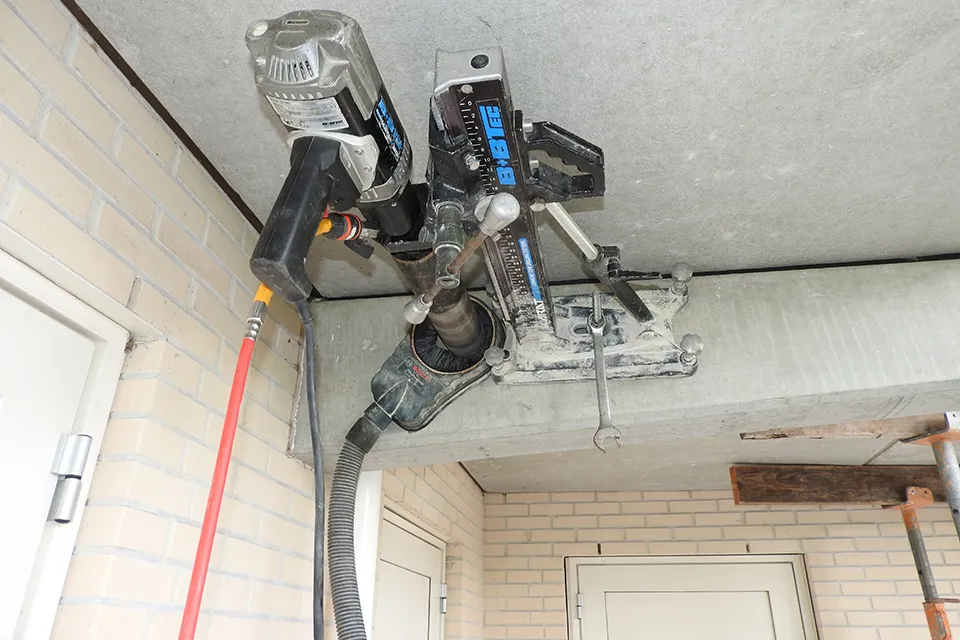
Access decks and balconies on older residential buildings are often supported by concrete corbels. Inadequate or deferred maintenance, combined with chloride ingress caused by the use of de-icing salts, leaves the corbels vulnerable to reinforcement corrosion. Routine maintenance, inspections and investigations can prevent costly repairs in the future, or worse, structural failure. “We really need to take action.”
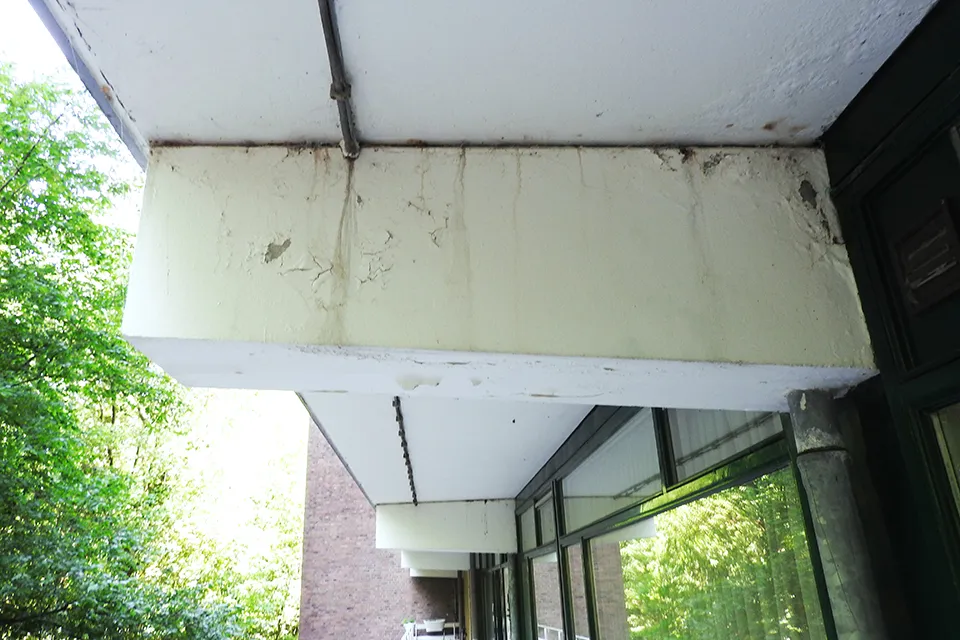
The Netherlands has a very large number of residential buildings constructed in the 1960s and 1970s. A typical feature of most of these blocks of flats is the concrete corbels supporting the access decks and/or balcony slabs. Sealant joints or flashings are generally used to keep the joints and movement joints between the access deck and balcony slabs watertight. These seals have a relatively short remaining service life and need to be replaced or repaired periodically. If the waterproofing is inadequate, rainwater can enter the joints and reach the top of the corbels.
Frost
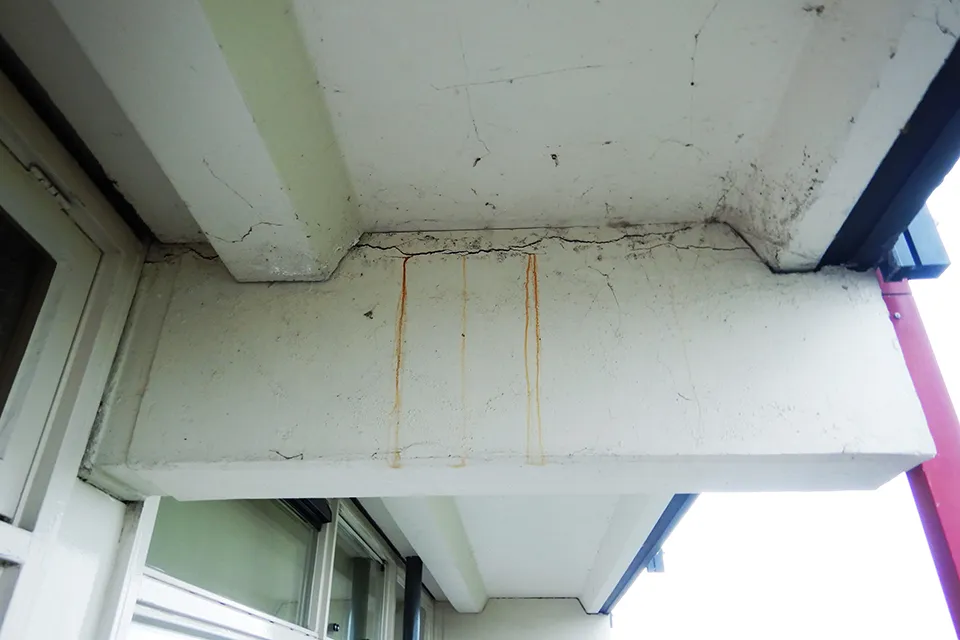
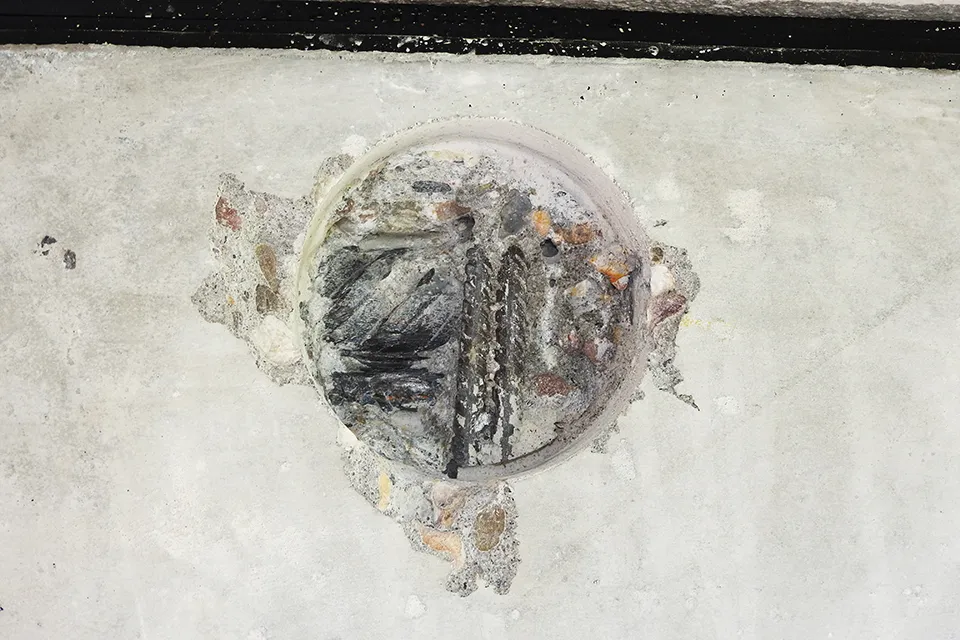
“The combination of moisture and chlorides in the reinforced concrete structure can lead to chloride-induced reinforcement corrosion,” says Robin Hartmann, managing director and owner of Adviesburo Bejan Bouw & BetonTechniek. “Corrosion reduces the diameter of the reinforcement and therefore its load-bearing capacity. Pitting corrosion can cause a local reduction in bar diameter, sometimes by as much as 30% of the cross-section. Most problems are caused by residents using de-icing salts to tackle slippery balconies and access decks during frosty weather. However, chloride salts were also mixed into the concrete in the 1960s and 1970s to accelerate setting. All these buildings are ageing, and we are now going to see a peak in the number of problems.”
Peak bending moment
Most concrete corbels are monolithic cantilever beams connected to internal walls or the building’s internal structure. Hartmann explains: “The main reinforcement in corbels is located at the top, and the peak bending moment occurs approximately one-third of the cantilever length out from the external wall. This is precisely where moisture and chlorides penetrate most, because water moves towards the façade. Much of the damage is due to deferred or inadequate maintenance and is therefore, in effect, avoidable. A housing association or owners’ association that cuts back on this can end up facing enormous repair costs in the future. Prevention is better than cure here too. Routine maintenance and timely replacement of defective movement joints and finishing layers can easily prevent rainwater and de-icing salts from penetrating.”
Core drilling
Investigations are needed to establish the condition of a building’s corbels. “Adviesburo Bejan carries out inspections and investigations, among other things, assesses the problems, advises on repairs and, if requested, also supervises the work,” Hartmann continues. “Inspecting corbels is not straightforward, as you cannot access them from above. We therefore take samples by drilling holes in various zones, combined with reinforcement scans, in such a way that we do not hit the reinforcement. Our material testing then reveals the severity of the problem. Chlorides may be present without any safety risk; in that case, it may be advisable, for example, to protect the concrete structure with cathodic protection. If the load-bearing capacity has been compromised, we work with a structural engineer to determine the next steps. These could include drilling in additional reinforcement or using another strengthening method.”
Don’t wait
Hartmann says it is important for building owners and managers to become more aware of the risks posed by concrete corbels. “Money plays a major role. Housing associations are better placed to tackle problems and establish maintenance programmes. Owners’ associations sometimes have less financial capacity. That should not be a reason to wait until the national press reports that another balcony has collapsed.”
Een zakelijke vraag aan Adviesburo Bejan Bouw & BetonTechniek? Neem contact op
Bedrijven in dit verhaal

Blijf dit volgen
Bij een nieuw verhaal krijg je een e-mail. Geen account nodig.
- OnderwerpConcrete
- BedrijfAdviesburo Bejan Bouw & BetonTechniek