Platform on concrete and steel in construction
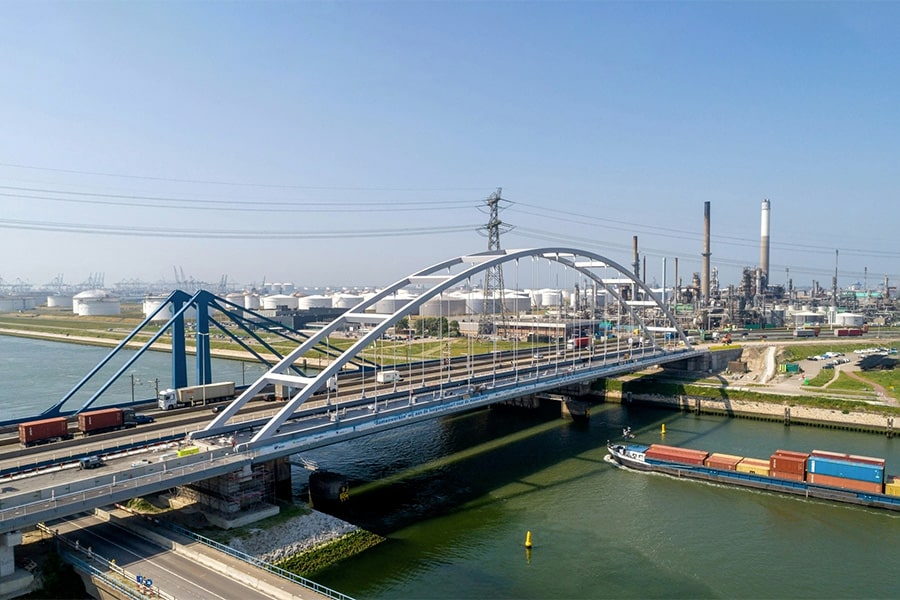
The Suurhoff Bridge in Rotterdam, part of the A15 between the Maasvlakte and the hinterland, was renovated in 2021 using an innovative reinforcement method: a steel reinforcement plate attached with epoxy glue and prestressing injection bolts. This technique, a first in the Netherlands, offered a lighter and faster solution than traditional methods such as reinforcement with high-strength concrete. The result is a sustainable and cost-effective renovation that reduces maintenance needs and extends the life of the bridge at least until its integral replacement starting in 2031.
The Suurhoff Bridge, built in 1972, is a steel road bridge with an orthotropic driving deck over the Hartelkanaal canal, consisting of troughs and sleepers as reinforcement. With the growth of freight and passenger traffic, fatigue damage occurred over time, including in the orthotropic driving deck of the bascule bridge. Starting in 2015, the Department of Public Works conducted extensive inspections, which revealed that reinforcement was necessary to maintain structural safety. In 2017, the decision was made to construct a temporary bridge, which would reduce traffic and loads on the existing bridge, renovate the existing bridge and strengthen the bascule bridge. Rijkswaterstaat led the project in cooperation with the Managing Contractor, a joint venture between Arup and Haskoning. Implementation was in the hands of contractor combination STIPT (Dura Vermeer, Besix, Mobilis and Hollandia Infra), with Hollandia Services and Takke Breukelen responsible for reinforcing the bridge deck of the bascule bridge.
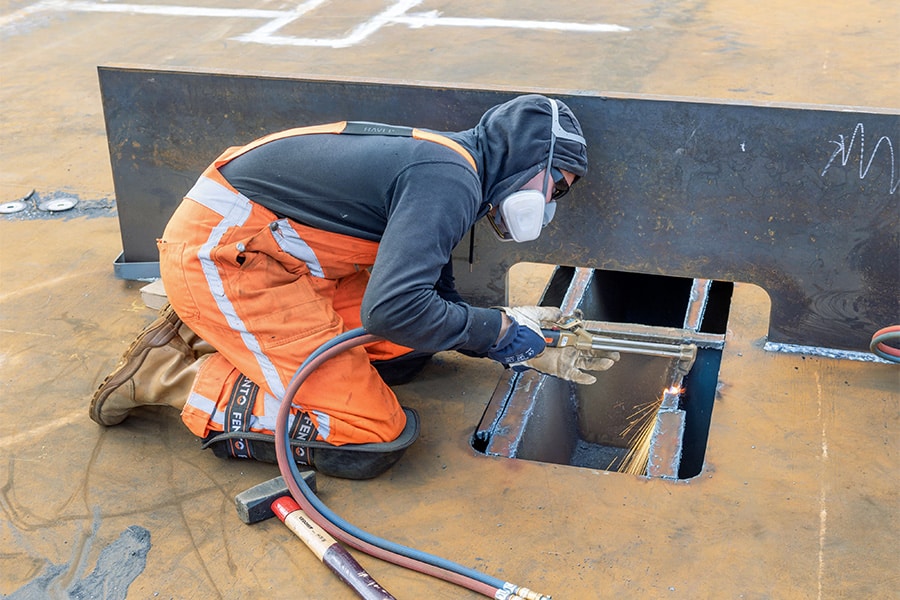
The chosen method, consisting of steel reinforcement plates glued and secured with prestressing injection bolts, proved ideal for the situation. “This reinforcement solution stems from a proposal we once made for the reinforcement of the western Van Brienenoord arch,” says Paul van Horn of Arup. “The traditional solution of replacing the asphalt overlay with a layer of high-strength concrete (HSB) would mean too long a period of disruption for the Van Brienenoord Bridge. Daan Tjepkema, design manager of the Van Brienenoord Bridge at Arup, then developed a proposal for reinforcement with a steel bolted plate on the existing roadway floor. This concept was worked out and tested in the laboratory at the time, but ultimately not chosen for the Van Brienenoord Bridge. The potential was mainly in the much faster execution time and the possible design optimizations that reduced the weight even further. However, the design was too new and thus too risky to apply directly to the largest arch bridge in the Netherlands.”
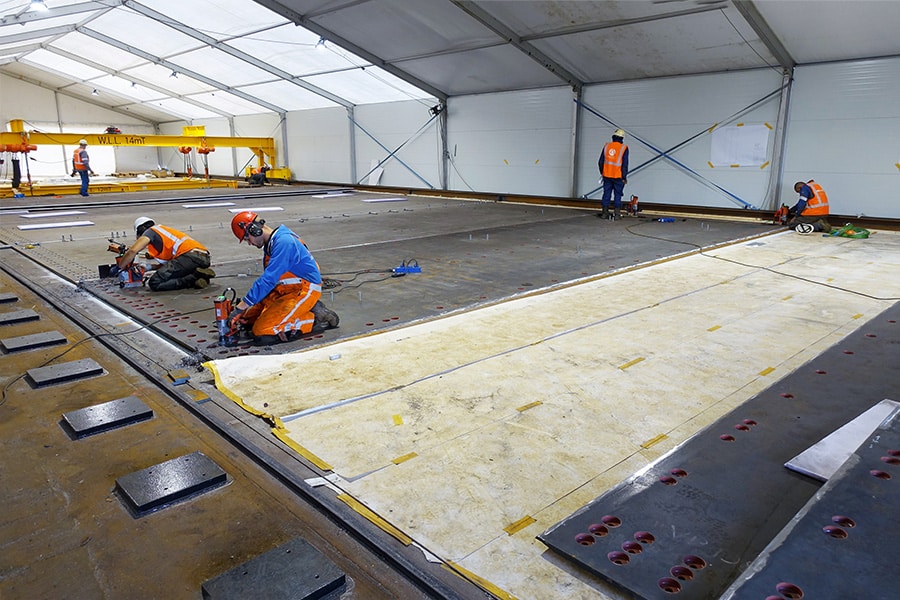
Things were different for the reinforcement of the Suurhoff Bridge, Tjepkema knows. “The HSB bearing simply could not be done and the required residual life was limited. Something else had to be done and the earlier solution at the Van Brienenoord Bridge came up. As a management measure to reduce unfamiliarity with the behavior of this reinforcement solution, we went through an extensive testing program. We did tests at scale (plate on plate with epoxy in between) and then removed the plates to see the epoxy. All in cooperation with Hollandia and the Department of Public Works.” As a result of the successful tests, the green light was given to apply this method to the moving part of the Suurhoff Bridge. The plates, 30 mm thick and approximately 4 by 10 meters, were welded together and connected to the existing deck plate with epoxy and pre-tensioning bolts. This composite action significantly reduces stress in the original deck, increasing fatigue resistance and reducing maintenance. The solution is possible in this particular case only because opening and closing of the bascule bridge no longer occurs. The solution is primarily suitable for fixed bridges, because a movable bridge is a system of equilibrium. Adding mass disrupts that.
Several structural innovations came together in the design and construction. The prefabricated plates served as a drilling template for accurately piercing the existing deck plate. Smart detailing, such as partial bolt assembly and rejointing of welds, limited distortion from welding heat. The epoxy was carefully selected based on viscosity, curing time and fatigue strength. Implementation was complex, but the close cooperation between designers and contractors from day one proved crucial. The joint preparation and pre-testing of the design at the factory allowed implementation on the bridge to take place within just four weeks, while the bridge remained largely open to traffic.
A major concern of the Department of Public Works when applying the innovative reinforcement method, according to Van Horn, was the temperature load: the difference between the deck and the underside of the bridge with the resulting stresses and the effect on the reinforcement solution. “This is why a monitoring program was set up in consultation with the Department of Public Works. The monitoring program will end in 2027. The preliminary results show that the temperature load is lower than expected, so a favorable result. The measurements on the other components also show no deviations from the calculation model. This solution can extend the service life of steel roadway floors up to thirty years. The solution can be made specific for the most heavily traveled parts and is applicable to all fixed bridges with a steel roadway floor. It looks like it is going to be a validated alternative for reinforcement of steel decks.”
Thanks to this innovative approach, the movable section of the Suurhoff Bridge is future-proof again. The method thus also offers prospects for other steel bridges with a steel roadbed: the reinforcement can be carried out faster, lighter and with less traffic disruption. The Suurhoff Bridge, awarded the National and European Steel Prize in the 1970s, will thus retain its essential function as a link between the Maasvlakte and the hinterland for the time being until the arrival of a new riverbank connection.