Platform on concrete and steel in construction
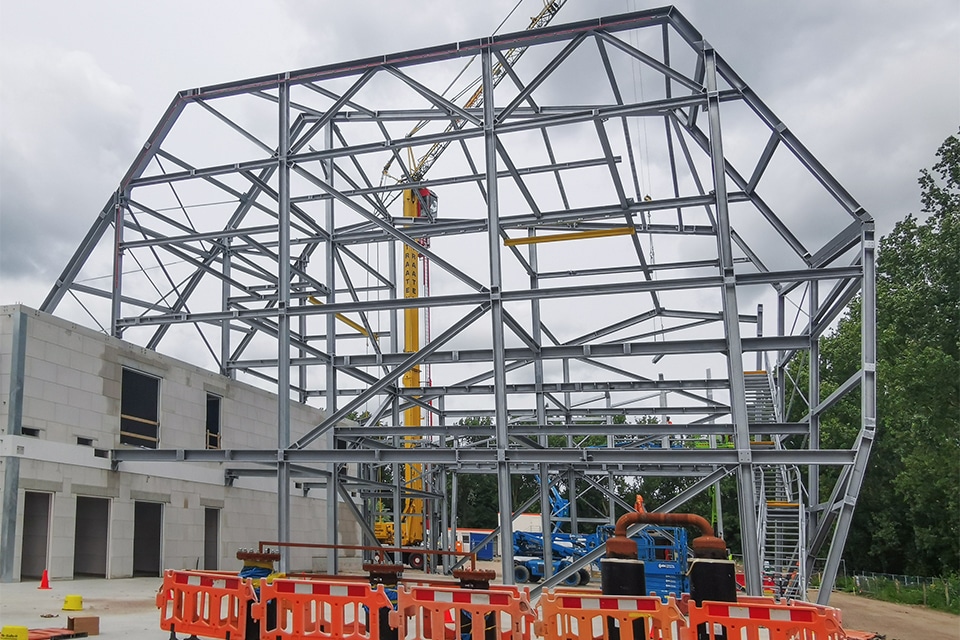
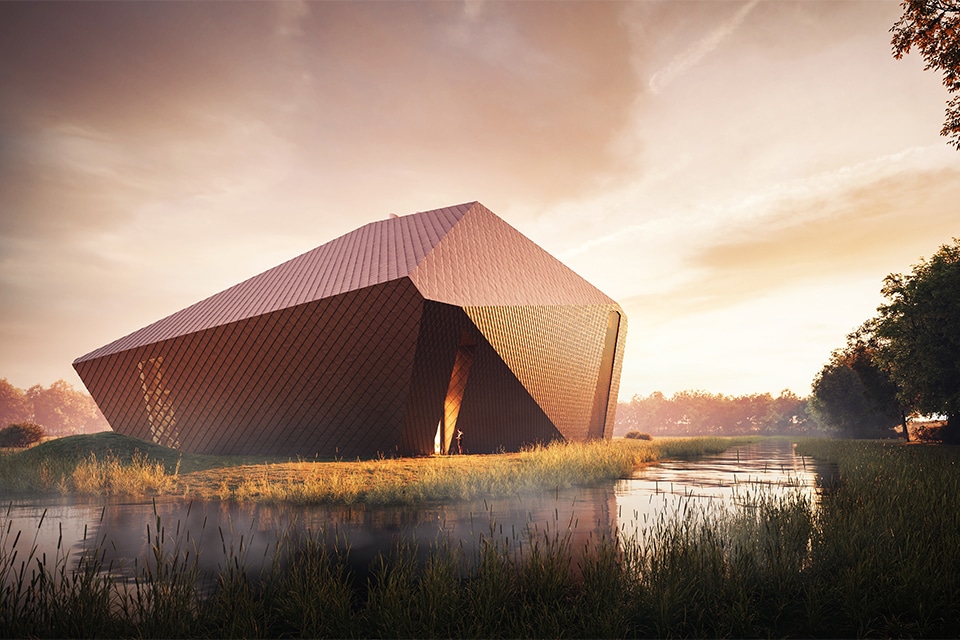
At the Het Groene Veld auxiliary heating plant (HWC) in Amsterdam-Noord, the steelwork is not merely about structural properties, but above all about coordination. Behind the building’s monolithic appearance—conceived by the architect as a meteorite in the landscape—lies a steel structure in which the main framework, facade and roof steel, utility supports, staircases, and landings had to constantly interact with one another. For Buiting Staalbouw, it was precisely this complexity that formed the core of the project.
The project, carried out for Westpoort Warmte with Equans as the contractor, involves approximately 300 metric tons of steel. Buiting Staalbouw further developed the design and handled the complete engineering, delivery, and installation of the steel structure, including cladding, staircases, and balustrades. “It’s a complex building with sloped surfaces, angled connections, and a dense array of systems,” begins project manager Johan Burger of Buiting Staalbouw. “That presents its share of challenges. During the preparation and execution phases, one of the key areas of focus was the interaction between the facade and the main load-bearing structure. These may seem like separate tasks, but in practice, everything is interconnected.”
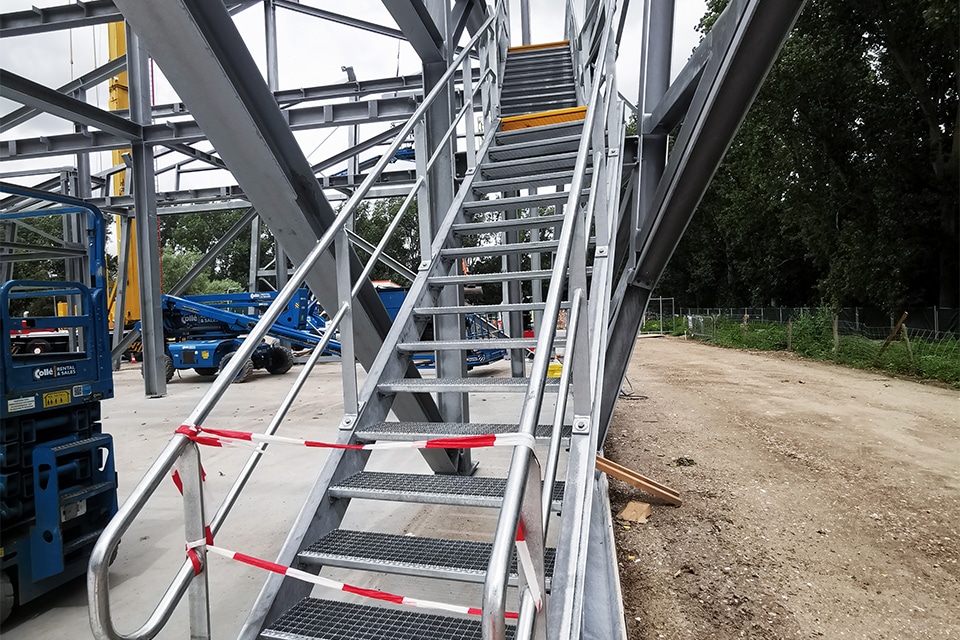
It was precisely this interdependence that accounted for the technical complexity. “That required intensive coordination among the structural engineers involved in the project regarding loads, force transfers, and detailed calculations, because changes in one model had an immediate impact on the other,” Burger continues. Added to this was the fact that the building services engineering was still very much under development while the structural engineering was already underway. The chimneys are illustrative in this context. “They are supported at the bottom but require bracing higher up in the steel structure using a sliding connection, so that thermal expansion remains possible. Such provisions may seem like specialized details, but they have direct consequences for the design of joints, the positioning of secondary steel, and the assembly sequence.”
The complex geometry made the task particularly challenging. Burger: “The sloping facade surfaces and the all-sided shape naturally resulted in difficult connections and irregular junctions. Or take the staircases, for example—in some places at the bottom, they cut through the facade because of the inward-sloping surfaces. We solved that by rotating the landing, but that makes even a simple staircase quite complicated. Architectural expression thus manifests itself in all sorts of details.”
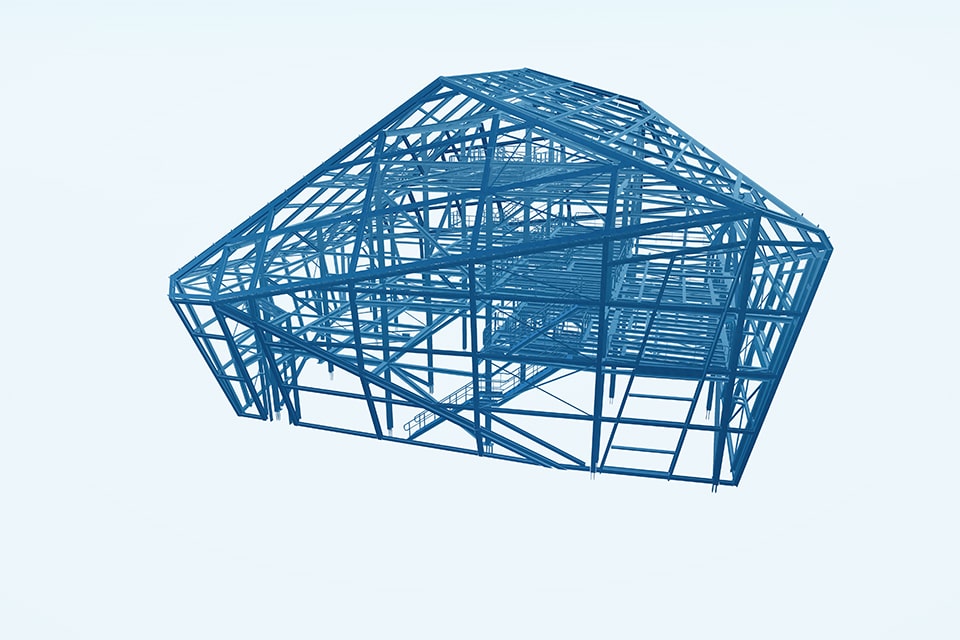
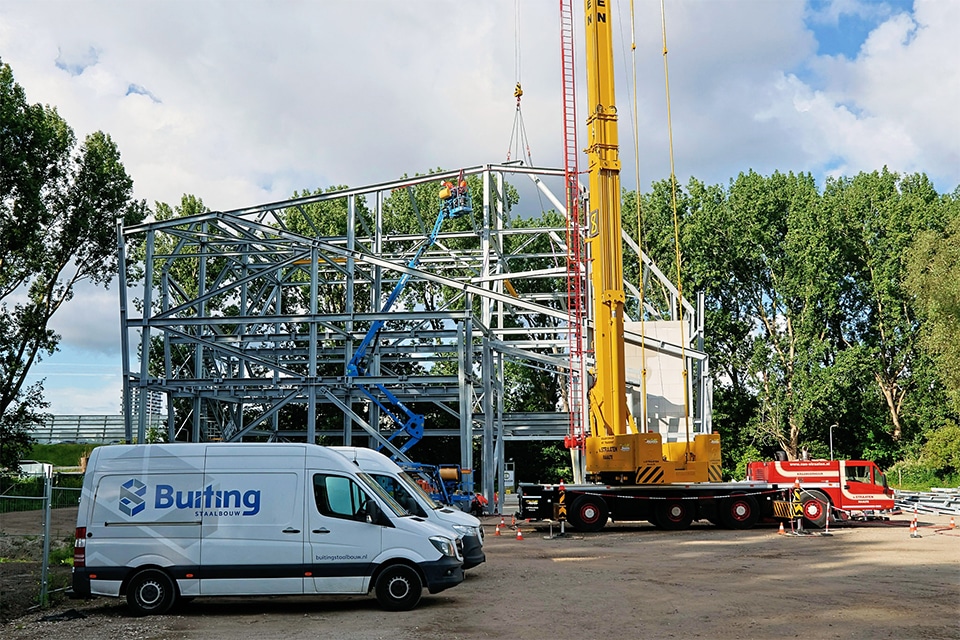
The assembly process also required a strategy that had already been planned out in the model. First, the main structure was erected, using only a limited amount of steel in the transverse directions, so that the roof structure could still be accessed from the inside using aerial work platforms. This was followed by the construction of the floors using a mini-crane from inside the building. At the top, it was still possible to work through the roof with a crane; lower down in the structure, however, the available space quickly diminished due to the accumulation of steel, staircases, landings, and utilities. Burger explicitly cites this accessibility as a challenge. “It says a lot about this project: it wasn’t the dimensions of individual elements that made it special, but the density of functions within an irregular envelope.”
The plant is used only occasionally when the district heating network needs extra capacity, but the steel structure had to be permanently ready for any scenario. It was precisely in that tension between appearance, installation, and execution that Buiting Staalbouw delivered its added value. Or, as Burger puts it: “It’s also incredibly fun to build something this unique. In engineering, it’s also a challenge that so many things change, and that you can support the client through that and take the pressure off them.”