[00:02] Digitization in the Prefab Industry
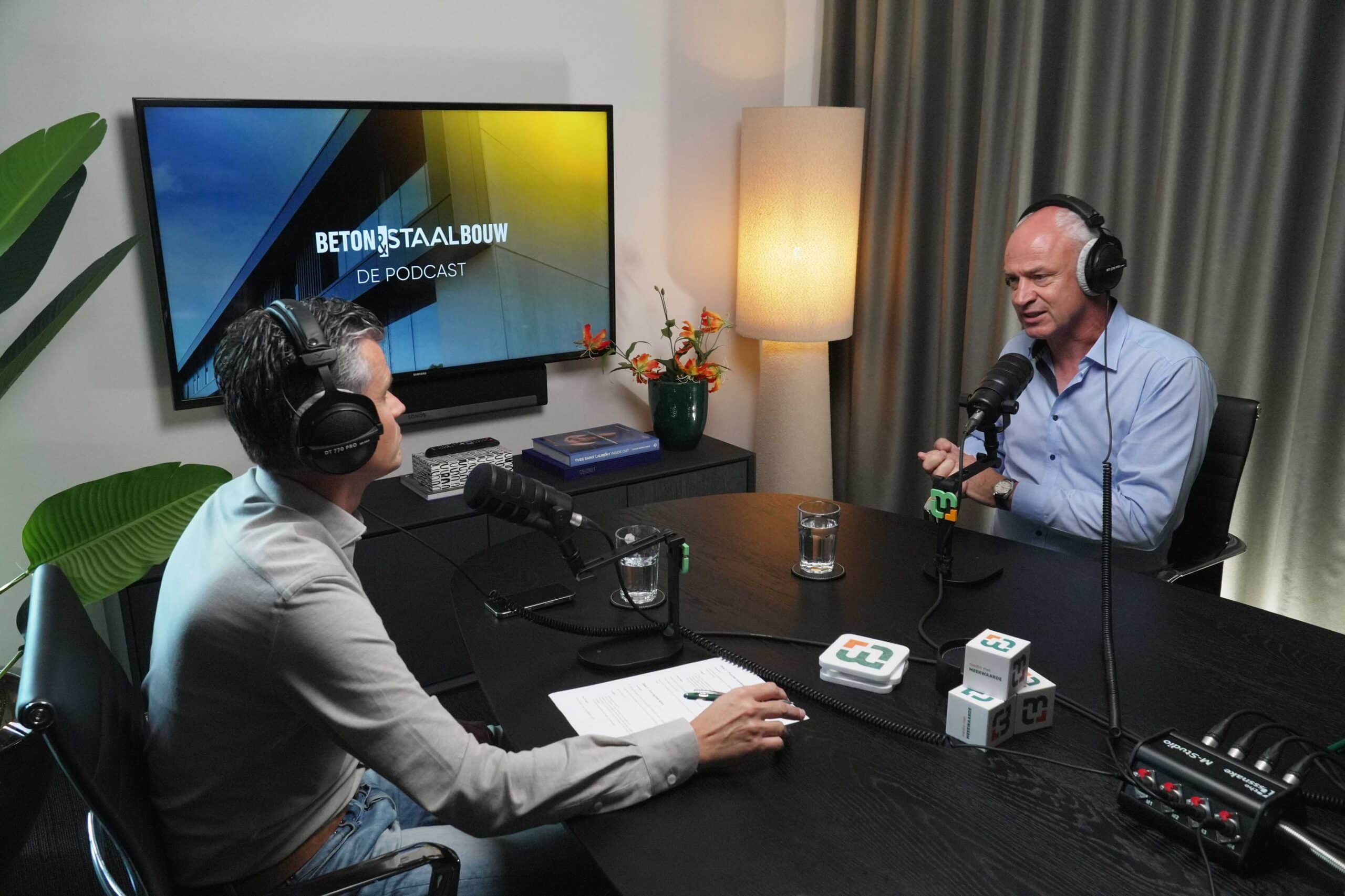
Roel van Gils: Welcome to another new episode of “Concrete and Steel Construction,” the podcast. Digitalization has become an integral part of the construction and prefab industries. Yet many companies still rely on disparate software packages, Excel files, and information stored in various locations. This takes time, leads to errors, and makes it difficult to maintain control over production, scheduling, and logistics. My guest today has been observing this for years and develops solutions that address this problem. He is Rony Verlee from i-Theses. Rony, welcome.
Rony Verlee: Thank you.
[00:35] Meet Rony Verlee and i-Theses Group
Rony Verlee: Yes, I’m Rony Verlee. I’m the managing director of i-Theses Group. We currently have three locations in Belgium. In Lokeren, where our commercial and administrative operations are primarily based. We have a branch in Limburg, Belgium, where development work mainly takes place. And for the past two years, we’ve also been in Buggenhout, where we have Kresoft—the company we acquired two years ago. Originally, we focused on flooring—primarily flooring. In recent years, it has become increasingly active in other prefabricated components as well—such as walls, beams, and columns. Steel was sort of a missing link. We would have liked to develop that in-house and did start down that path. But when we took a closer look, we realized it really is a specialized field. And we actually found a good fit with Kresoft—we share a similar management style. We now offer a complete range of products and services. So when it comes to concrete or steel, we can offer a complete solution. We actually have two ERP systems running: one from i-Theses and one from Kresoft. Kresoft is mainly for steel, while ours is mainly for concrete. I’ve been active in this field for over 30 years myself. I’m closer to 35 than to 30 now. Anyway, it’s just evolved that way. I never planned on pursuing this career. I trained as an industrial designer. I’m also a product developer. So I have nothing to do with IT. I have nothing to do with development. Don’t ask me to write code either. I don’t do that. But I kind of fell into it—starting in sales. And then in 1998, we became independent. We did a management buyout. And that’s how the ball started rolling. We started out with four or five people. We used to be part of Technosoft in the Netherlands. We actually stopped working with them. We’re now fully focused on our own development. We’ve developed all the modules we offer ourselves. We manage them entirely in-house.
Roel van Gils: In Belgium, too?
Rony Verlee: Yes, that's right. And we've really gone all in on prefabrication. So yes, there's not much to be gained from those standard designs. Developing our own solutions is much better. It's also much more rewarding.
[03:05] From Custom Solutions to Software for Prefabrication
Roel van Gils: Yes, as you mentioned, we’ve indeed gone down the path of prefabrication. Why? How did that come about?
Rony Verlee: Actually, we’ve been doing this since 1998. It all started with custom work—a few clients who specifically asked for certain solutions. We then began developing custom solutions, but the business just kept growing and growing. And at some point, we thought: Wow, there must be something to be gained from this. We turned it into a standard package. We grew within that framework. And the hollow-core slabs, actually. It all started with hollow-core slabs. People ask where we do business. We do business from Denmark to South Africa and from Costa Rica to South Korea. So yes, indeed, it’s quite…
Roel van Gils: You could say he's very well-known around the world.
Rony Verlee: Yes. And I’d even go so far as to say—I don’t mean to brag, but I’ll say it anyway—that we have the best solutions when it comes to flooring. You can pit us against anyone you want. It doesn’t matter.
Roel van Gils: What do you think is the reason for that?
Rony Verlee: Well, I’d say focus and knowledge. It’s not just about writing code and creating programs. That’s a lot of fun. But the knowledge and know-how—yes, we got our start with flooring. But now, of course, we offer a much broader range of products, as I just mentioned. We’re also focusing more and more on walls, so we actually have a complete product line when it comes to prefabricated solutions. A comprehensive ERP system. And again, Kresoft helped us fill in that missing piece. But today, we can truly handle everything from the first customer contact through delivery and invoicing—whether it’s floors, a beam, or a column. It really doesn’t matter. We can handle the entire process.
[04:39] Why Prefab Continues to Grow
Roel van Gils: And what makes the prefab industry so different from other businesses?
Rony Verlee: It’s related to construction. So you see constant growth in that market. The prefab market is actually still growing. We want to build faster.
Roel van Gils: Yeah, sure.
Rony Verlee: We want to get CO2 under control. We want to build faster. Controlled environments. Quality control. You can really only achieve that by prefabricating in a factory, in a controlled environment. And you’re right—as you just pointed out—our most promising prospects are the ones who work with Excel and still have an Access database somewhere. And they prefer it if that was developed in-house. They’re absolutely crazy about that. But the guy who originally built it has since retired. And that’s where we run into a problem. So yes, we come in, discuss the situation, and integrate the system. But actually, the core—the engine—is always standard. Yet every client has their own quirks, as we often say. We implement “à la tête du client.” We really listen to the client, see what we can do, and then we tailor the solution entirely to their needs. So every client with us has their own setup. Delivering software—that’s all automated, of course.
Roel van Gils: But then every customer has their own configuration set up on it.
[06:06] Automation as the Key to Efficient Production
Rony Verlee: The most profitable prefab companies are the ones that invest heavily in automation. Just last week, I was at one of our clients’ sites, visiting with clients from Poland. A company tour. Yes, that’s always impressive, of course, when you can take a look at the engineering department and then see the production floor as well. And that client was simply proud that he still had just four people working in his production department. And yet, per shift of course, he’s churning out 2,000 square meters a day from that factory.
Roel van Gils: With just four people?
Rony Verlee: They run it with four people per shift. Three shifts, of course. But then you take a look at those companies. And that’s a relatively old factory. But actually, it’s still operating very efficiently. And they’re constantly investing in automation. And any aspect they can refine, they’ll focus on it. And I never have any trouble convincing the plant manager there to try something new again.
Roel van Gils: So, automation and digitization.
Rony Verlee: Yes, full digitization and, indeed, automation. And yes, I think we need to look at that today as well. CO2, prefabrication, and cement are all under pressure. Those are all the factors at play. Yes, we want to keep failure costs as low as possible. So we want to get the most out of it. And you can only do that with prefabrication and automation. And yes, failure costs are very important. If you look at [unclear], a few years ago—I don’t know what the situation is now—but there they had a waste, a loss of 9% in production. That’s enormous. That’s unacceptable. So you have to turn to automation. It’s no longer feasible to say: “Look, I have a team of Indians and Pakistanis coming here to work. They cost me a few euros or a few dollars an hour. Why should I invest in automation?” No, that doesn’t work anymore. They’re going to look into it too. And they’ll eventually have to take steps to bring those costs down, to reduce that loss.
[08:11] Not a typical ERP vendor
Roel van Gils: Yes, because you often say that you aren’t a standard ERP provider.
Rony Verlee: No.
Roel van Gils: What exactly do you mean by that?
Rony Verlee: We always tailor our solutions to the client. Now, I don’t believe in a one-size-fits-all ERP system either. Of course, there are certain components you need. You need a CRM system; you need engineering and design in some form. And then you handle the administrative side of things. Yes, those are the components of an ERP system. But we customize so much for the customer.
[08:46] Integrations with Other ERP Systems
Roel van Gils: But is there another ERP system running alongside it? Or some other system, or an accounting system?
Rony Verlee: Yes, the larger the company, the more likely it is that they’ll have an administrative ERP system running alongside it. Name them all: JD Edwards, SAP, Microsoft Dynamics. And then we use APIs to exchange data. And that’s always coordinated with the customer, without fail. We have a production ERP. We don’t have an administrative ERP system. And that’s not our goal, either. We don’t do accounting. We don’t handle purchasing. We really focus on production and fully automate that process. And our motto is: we enter the data once, or it’s pushed from a system like Microsoft Dynamics, for example. We have certain clients who work that way. At a certain point, a quote becomes an order, and then it’s pushed. We can also create quotes within the system, but it’s not as comprehensive as what you could do in Microsoft Dynamics, for example, or SAP or JD Edwards. So when the data is pushed, we receive it and enrich it. And well, at the end of the process, we have an agreed-upon estimated delivery date. A target date is, let’s say, the end of September. That end-of-September date is the initial priority. But once you start production and begin scheduling shipments, you start refining the schedule. And those dates are always very critical. You’re essentially enriching your database based on the project’s progress. That allows me to work backward. I can say: if I have to deliver by the end of September, that actually means I need to have my drawing ready now. That I need to get approval within two weeks. Then I can go into production, and so on. So we focus very strongly on that—the scheduling.
[10:31] From customer contact to billing
Roel van Gils: But where do you start? Where does the process begin?
Rony Verlee: For smaller clients, they’ll also be creating their quotes with us. We’re currently developing the Office module, PlanDesk Office. We’ve actually had it for a long time, but its functionality has been very limited. And we’re expanding it so that we’ll also have a more comprehensive CRM system to handle that follow-up. And then the quote process actually starts with us—from the first customer contact all the way through to invoicing. We don’t handle purchasing, and we don’t do accounting either. But you can actually start the entire process with us. However, there are some clients—especially the really big players. In the UK, for example, we have a few clients, and we act as an intermediary there. So we’re essentially the link between Salesforce and JD Edwards for that client. They use JD Edwards to process purchases and to issue invoices. Yes, as a client, you’re the one who decides. If you say, “Yes, I want to use my JD Edwards for invoicing,” then I’ll use JD Edwards for invoicing.
Roel van Gils: All of this can be linked together.
Rony Verlee: Do you still want to bill us? Fine. There are some very large companies that do that with us, too.
Roel van Gils: The focus is on production, but it’s actually much broader than that.
Rony Verlee: Actually, we can offer a broader range of services. So we also handle logistics. We’re perfectly capable of managing inventory. So yes, we have a lot of options there. But the customer decides what they want from us and what they need to do with, for example, an external ERP system.
[11:54] Modules for Quality Control and Logistics
Roel van Gils: So those are all different modules within your package, right?
Rony Verlee: Yes, we’ve now decided to simplify things a bit. Because at one point we had so many modules—what we call “outside of production,” that is. That’s how we describe it. And that involves quality control. In the past, we only did quality control after production—on the assembly line, so to speak, or on the workbench. And it was either okay or not okay. But, well, a lot can still go wrong along the way. So we’ve moved that online, so that we can perform quality control on tablets at any given moment. Even if it’s outside. If it breaks—whatever happens. You need to be able to take a quick photo at any time, record what went wrong, and determine if it needs to go back into production. So you simply have instant information. And recently, we’ve been focusing heavily on that. Just like order picking. So you can handle the entire process digitally these days. And if something goes wrong, you record it. Those modules actually all overlap. That’s why we decided: look, we’re going to create a few more large groups of modules and basically bring them all together. Without quality control, it’s pointless. So yes, you have to have the ability to log something at any time. We said: come on, let’s put it all together now. And we’re trying to do that in a way that remains financially feasible for the customer. So we’re working entirely with subscription plans.
[13:28] Automation Step by Step
Roel van Gils: Different levels, then?
Rony Verlee: Yes, we’re actually going to put together packages. What you see now is that we often start with design, production planning, and load planning. Beyond that, the rest is kind of optional. Anything that’s not essential can be addressed in a second phase. Because you’ll also notice that if you automate too much… It all looks fantastic. We often have customers who say, “Yeah, but we want all of that.” Yeah, that’s great. But if we cram too much into one package, nobody’s going to use it. Because you’re overwhelming them. So start slowly. Begin on a limited scale and expand from there.
Roel van Gils: So that means there are some limitations when it comes to production planning?
Rony Verlee: Or at least production planning and freight scheduling. That’s often the case. Yes, sometimes production planning for the month is included as well. But then it stops for a while. And that mainly applies to everything that happens indoors—let’s just say, in Belgian terms, under a roof.
Roel van Gils: Yeah, yeah.
Rony Verlee: That’s a first step. Actually, that’s often more than enough, you know.
[14:28] Implementation and support for clients
Roel van Gils: Do you also involve people in the process of learning the software? How does that work?
Rony Verlee: Well, we have application engineers. And I want to speak with everyone as much as possible first. We do a lot on Teams. We often do introductory demos and presentations digitally as well. Just recently with a client—who is now a client in Lithuania. Yes, you start with the introductory meeting. If that goes well and there’s interest and you get the sense… I also believe that the price should never come as a surprise. So we’ll give them a rough estimate right away. We say: if you’re going to go through with this, you’ll have to take that into account. And if they back out at that point, we’re better off not even bothering. Because that’s just a waste of time. I’m not saying that client might not be a viable prospect in two or three years. By then, they’ll have an idea of what it’ll cost, and they’ll come back. But that initial meeting often happens digitally. But I want to have met the clients in person. I want to take a look inside their company. I want to see it for myself. They often criticize me for that: “What are you going to do there? You’ve already seen so many factories.” Yet every factory is different. And then you can also talk to the people on the shop floor. And then you know what’s going on. I actually enjoy that, too. Just going out to sell a standard drawing application, so to speak—that’s not… No, that doesn’t really appeal to me anymore. I’d rather see that factory in operation, where something…
[15:51] The transition to web-based software
Roel van Gils: And then, of course, you can also provide them with customized solutions. One clear trend at your company is that more and more software is becoming web-based. Why are you making that shift?
Rony Verlee: Well, just one thing: back in the day, you’d sometimes run into a limitation like, “Yeah, I have an Apple—can I run it on that?” “Yeah,” “No,” “It’s a Windows PC.” None of that matters anymore. You can use a tablet, a cell phone, a laptop, an app, or regular Windows—it doesn’t matter. So you’ll be running it in a browser; that’s one thing. Second: those applications are often much faster, too. And especially when you eventually… The door is now open to working in the cloud. I know, the prefab industry is rather conservative—let’s put it that way. These days, you get those people… I can’t get anyone motivated to start working in the cloud.
Roel van Gils: Still not on board?
Rony Verlee: No, no, no. That takes effort. In the cloud and all that. But the big advantage is simply that you can work on those tablets and you can also work with a tablet out in the field. Yes, for those new modules. And that’s actually the main reason we took that step. And yes, it’s more user-friendly and easier to maintain. Updates are basically pushed out. Something we used to run into: there are certain clients—say, ten users—who have three different versions running within the company. Then it becomes difficult to keep that maintainable. So maintainability is also easier. And we’ve also noticed that the speed is definitely… We’re currently working on moving Stargon entirely to the web—the Kresoft package we purchased. In terms of speed…
Roel van Gils: Yes, there's a difference.
Rony Verlee: Yes, there’s a difference. Yes, definitely. But you don’t just see it with us. You see it in a lot of applications as well. More user-friendly, accessible to everyone.
[17:44] Guiding Existing Customers Toward New Applications
Roel van Gils: Because I assume there are also existing customers there who still just…
Rony Verlee: Yeah, no, we’re going to push them. They need to switch to those new solutions. We’re going to phase out those desktop applications… There aren’t many left, you know. We only have two or three of them left. Production planning—I think the logistics module—and that’s pretty much it. And then there’s PlanDesk Office, which is coming soon and which we’re going to expand significantly, allowing us to do cost estimates right within our own environment. From the acquisition of Kresoft. It wasn’t our intention to do much with it, but they had a package that actually worked quite well and has a lot of technology. So we’re going to try to integrate that into our planning system. I think a lot of customers are going to be happy with that. It’ll be free of charge, because those who have Admin can actually get it for free. So yes, you can definitely see some evolution there.
[18:36] Artificial Intelligence in Software Development
Roel van Gils: One topic that no one can ignore these days is artificial intelligence, or AI. What are your thoughts on this?
Rony Verlee: Honestly, we use a lot of AI for our own development because it’s just so much faster. That doesn’t mean it’s going to be cheaper, though. That’s sometimes a bit of a misconception. You can churn out a lot of code, but you still have to process and evaluate it. And what you’re seeing now is that, instead of having someone who writes code, we now have people on staff who are tasked with reviewing it. And those are different types of roles. They’re analysts with a lot of experience who handle that. We’re investing to bring those people on board. So we’re analyzing things in much greater detail. Whereas back in the day… A client needed something, we’d listen on the phone, write five sentences, send an email: “Is that what you mean?” “Yes, that’s it.” Now those analyses are much more extensive. And we actually have analysts dedicated to that now—a role we didn’t really have as a specific position with us before, because the developers or the team project leaders used to handle it themselves. And the knowledge and expertise—the know-how—in AI, especially in our industry, is very challenging, because we operate in such a small niche market. I can imagine you’d want certain tables and statistics, and that you can do that perfectly. And that applies to our databases as well. As far as I’m concerned, the customer can use our data to generate certain statistics. Let them go ahead. But when it comes to developing within our applications, that’s still a bit… to ensure everything runs smoothly. Is it a tool? Absolutely. We’ve already experimented with it. We’ve also integrated certain features into our software. Production optimization, for example. We’ve done some testing for job scheduling. It looks fantastic in a demo. But in practice, you’re still missing that one parameter that’s just not there to make it run fully automatically. Is it something you should look into? Definitely. We’ve already done some testing, so something is definitely on the way. But it’ll likely involve querying the database itself.
Roel van Gils: Yes, actually when using the software, rather than when developing it.
Rony Verlee: Yes. And then you just say: “Look, let me see what our revenue has been over the last three months and put together some statistics for me.” Yes, those are the traditional AI applications that deliver immediate returns.
[21:09] Pilot Projects Involving AI
Roel van Gils: But can you give an example of a pilot project? Or is it still too early for that?
Rony Verlee: I'm not going to go into detail right now. We'll do that another time, at our next meeting.
Roel van Gils: Yes, that's fine.
[21:19] Web Applications and Integrated Processes
Roel van Gils: You’re constantly evolving—you mentioned that earlier. What are you most proud of from the past period?
Rony Verlee: That’s a difficult question, because then I’d end up favoring one team over another, and we’re not going to do that. The fact that we can adapt so quickly now with those web-based applications—our customers really do appreciate those applications. There’s less resistance than there used to be to starting to use them. You notice that we’ve recently brought in a few very large clients, including some in Northern Ireland, and we’ve gotten comments like, “It has revolutionized our business.” Yeah, those are nice things to hear. That happened very quickly. In just one year, they’ve actually made a complete shift away from a very outdated way of working with fragmented automation. They’d automate parts of the process in a very fragmented way, but really… And the moment you have to enter data a second time, you run the risk of errors.
Roel van Gils: Yeah, yeah.
Rony Verlee: No, that’s what I’m most proud of. Yes, those web applications that actually work well and are often quite spectacular to look at. Yes, a fully integrated process. Yes, that’s nice.
[22:41] The Acquisition of Kresoft and Stargon
Roel van Gils: And you just mentioned the acquisition of Kresoft. What does that specifically mean for your customers—for your existing customers?
Rony Verlee: That’s the Stargon module. By the way, there are also quite a few customers in the Netherlands who work with it—Stargon, no less. The idea is actually that we’ll soon be able to include a sort of mini-Stargon in PlanDesk, because quite a few customers—especially in the wall, beam, and column business—well, they simply need steel for that. It’s a bit less of an issue with floors, although… But yeah, it’s something we were missing. And we actually want to make Stargon fully web-based.
[23:23] Partnership and Growth Within the i-Theses Group
Rony Verlee: Something that Gert Janssens, who is in charge of Kresoft and is also a partner… By the way, I enjoy working with partners. I try to keep people in key positions, so to speak, tied to the company as much as possible. I had a lot of sleepless nights when our people were salaried employees. Because in 2020, my former partner left the company. So there were two of us as owners. He stepped down. And we then actually gave four people—who were in key positions and crucial to the company—the opportunity to come on board. They all took that opportunity. And they’re very satisfied. Because if we look back, things have more than doubled—maybe even tripled—in six years.
Roel van Gils: That was a good move.
Rony Verlee: Yes, that really paid off back then. Gert had actually been trying to get rid of Kresoft for quite some time. The system was getting slower. There were very heavy databases behind it. It was hard to get people on board, and they didn’t have the expertise either. In that sense, we were a perfect match right away, because we’ve been working on this webification for six, seven, eight years now. And that expertise was definitely welcome to them. And we’re now building a Stargon 360. So that will likely be rolled out to a number of pilot customers sometime after the summer break. Yes, people are very enthusiastic—about the speed and the interface, too. Yes, it’s coming along well. And for us, it was an enriching experience. We didn’t have to develop it ourselves.
Roel van Gils: A win-win in that sense.
Rony Verlee: Yes, that we can get them on board. And that it has indeed followed the same trajectory as i-Theses over the past six or seven years.
[25:13] International Growth Through Machine Manufacturers
Roel van Gils: You just mentioned customers from Northern Ireland and Lithuania. How did they all end up coming to you?
Rony Verlee: With the machine builders—the men who will be building the factories. That way, you get the information firsthand.
Roel van Gils: Oh, I see.
Rony Verlee: It’s also true that in recent years we’ve seen a trend toward automating machines and production processes. Think of a plotter, for marking out elements, cutouts, and lengths. Automatic sawing machines. For one particular customer, we even have a robot that we control, which actually cuts openings automatically. Yes, that connection with production has been very important over the last three or four years. And not every manufacturer has its own R&D department. So we forward information from production planning to production. And something that’s becoming more and more common is that we’re also getting more and more feedback from production. So if something goes wrong along the way, we have that information available immediately. Because, well, the cost of something going wrong isn’t so much the fact that the component itself fails. The real cost lies in the fact that you can’t deliver on time. And you end up with a whole lot of administrative hassle just to get everything back in order. The sooner you know something is going wrong in production, the sooner you can take action. And to ensure that your delivery isn’t compromised. Because, well, we’re facing more and more penalty clauses if something goes wrong. That’s pretty much the trend. I’m definitely not going to prospect in the United States or in Lithuania. And of course, we do attend a few trade shows, like bauma, for example. That’s also a great way to connect with international customers, of course. That’s often where the initial contacts are made. And especially with manufacturers. They’ll say, “Hey, Rony, do we have a solution?” Because they’re running that plotter in their factory—they have a plotter but don’t have the data. “Yes, that’s no problem; we can solve that.” That’s actually how we’re expanding globally. I’m currently working on some projects in South Africa.
Roel van Gils: You were there ‘for a little while,’ too—that’s great.
Rony Verlee: Yeah, yeah. So yeah, okay. That way, through those connections, we get in touch with a lot of new customers.
[27:32] Software for small and large prefab manufacturers
Roel van Gils: And starting at what company size does your software become relevant?
Rony Verlee: Let’s just say, we have very small players, very small players. And we’re also trying to consolidate things a bit, so that it’s feasible for them as well. We have a manufacturer in Northern Ireland. Actually, when I first went there, I thought, “Man, what are we getting ourselves into here?” But he’s really grown since then. He used to be producing outdoors with just two production lines. So when it rained hard, he’d stop production. But today he has four production lines and an option for four more. So yeah, he’s actually become a really big player. He’s also just recently purchased the rest of the modules. He started out with just a drawing program and some calculations.
Roel van Gils: Yes, the full package now. Everything.
Rony Verlee: Yes, those are great, of course. The ones who leave us for one reason or another… I think new ones are always joining us. And feel free to call the people on the reference list, get in touch with them, and ask how we’re doing. I think they’re all very satisfied.
[28:34] What Customers Value About i-Theses
Roel van Gils: What kind of feedback do you often get?
Rony Verlee: Well, yes, of course. The more you integrate, the harder it is to leave. If you start automating production and then want to leave, that’s going to be a really risky… That’s going to be tough. Everything’s working fine today. But what do you often hear? Speed, ease of use. Sometimes you hear stories—those are the fun ones. It’s not because of i-Theses that we’ve grown so much. i-Theses didn’t grow because of us, and we didn’t grow because of i-Theses—we did it together. That’s the truth. It’s wonderful to do that. We’re growing. We have customers who’ve been with us for nearly 30 years—people we’ve known for nearly 30 years.
Roel van Gils: That's great. Positive.
[29:17] Further Automation of the Prefab Industry
Roel van Gils: But when you look at the market, what trends do you think will shape the prefab industry in the coming years?
Rony Verlee: I think we need to take automation further. But also in production. Not just drawing and calculating. No, no. Actually automating production as well. I think that’s where the key lies. And what do you see then? That the newcomers who’ve started up in the last ten to fifteen years don’t have that social liability either. They probably have the highest depreciation expenses on their factories—yet they’re the most profitable companies. I think that’s where the key lies. Yes, the numbers speak for themselves, of course.
[30:04] The Future of i-Theses
Roel van Gils: Okay. And if we’re sitting here at this table again in five years, what will i-Theses—the company—look like?
Rony Verlee: I'm retired.
Roel van Gils: Well, that's a nice prospect.
Rony Verlee: No, no, no. Yeah, look, it’s my baby. I’ve put my heart and soul into it. Gosh, I don’t know. I already mentioned it briefly earlier, just between us. Germany… My final achievement might just be that we’re launching a division in the U.S. Other than that, we’ll stay very local. We’ve also always chosen to handle all development in-house. We had one experience through Kresoft where we had a project developed in India. That wasn’t a success. And the day you’re tied to production and something goes wrong, you have to be able to anticipate it. And immediately. So you can’t depend on other parties. But twenty people working in the U.S. in five years? I don’t know.
Roel van Gils: Hey, that's a good one. We'll hold you to that. We've made a note of it.
Rony Verlee: Yeah, go ahead.
[31:11] Advice for Prefab Companies on Digitalization
Roel van Gils: And finally, if you could give one piece of advice to prefab companies that are still hesitant about digitization, what would it be?
Rony Verlee: Yes, there’s only one way to go. You have to automate; you have to digitize. Unless, of course, you want to fill your mold with a shovel. In that case, you might as well keep walking that path, but I don’t think that’s going to work. No, you simply have to automate as much as possible. That’s the only way forward. Now, there’s another path to take—pay attention.
Roel van Gils: Yeah, aren't we there yet?
Rony Verlee: No. I think, look, why are we so successful with flooring? Because we have a lean process there, where we also have all the data from the drafting software all the way through to production. Everything is simply integrated and available. What about walls, beams, and columns? Are we really going to start from a BIM model? And then there’s IFC, which everyone was so enthusiastic about. But today you realize that a lot of information is still missing—especially when it comes to production. It’s a great format when we’re talking about models and want to exchange them. But we still have a long way to go; we’re still missing a lot of data. And just last week—I’m actually giving a presentation on this tomorrow—I told that prospect: Look, we can automate a lot, but you need to educate the engineering firms and drafting offices you work with. They have to submit their work in a specific way. And if you can’t get that done, none of the rest matters. You have to have the data—you absolutely must have it. And that really needs to be addressed. People are still spending too much time on modeling, and once the modeling is done, that’s it. No, no—that’s when we go into production. And then it’s possibly even more important to get that data properly structured. If we had an IFC for precast right now that worked fantastically… I get the feeling that it’s something of a stillborn project that people in Germany are very keen to keep to themselves. But we need a format. UniTechnik is pretty good, but it’s very specifically geared toward walls. And then, with automation and digitization, we can do a lot—especially when it comes to digital data processing. And yes, there’s still a lot of potential, you know.
[33:35] There is still plenty of room for growth
Roel van Gils: So I guess you're still working on development for a little while longer.
Rony Verlee: Well, look, I started out—as I just said—at Technosoft in 1992. And I planned to stay there for a few years because I wanted to gain experience in sales. Because, well, my dream had always been to start my own business. And I planned to stay there for a few years, figuring that by then everything would have been sold. By then, we’d all be using AutoCAD. Everyone was going to have AutoCAD, and then we wouldn’t have to… 35 years later, we’re still going strong. Yeah, it’s not over yet. There are still more ideas than we can bring to life. So there are still some things we’re going to focus on—and actually are focusing on.
[34:15] Toward a Single Integrated Digital Supply Chain
Roel van Gils: So we still have more ideas than we can possibly implement. Consolidating processes within prefab companies into a single integrated digital chain. That’s actually, I think…
Rony Verlee: That’s right. And yes, everyone knows us for our flooring, but we also specialize in walls and other prefabricated elements—in other words, custom work, custom prefabricated solutions. And we’re really working hard and developing our capabilities to provide solutions in that area as well.
Roel van Gils: Well, look at that. Rony, thanks.
Rony Verlee: You're welcome, thank you.
[34:47] Closing
Roel van Gils: Concrete and Steel Construction, the podcast, is produced by Louwers Mediagroep in Weert.