Platform on concrete and steel in construction
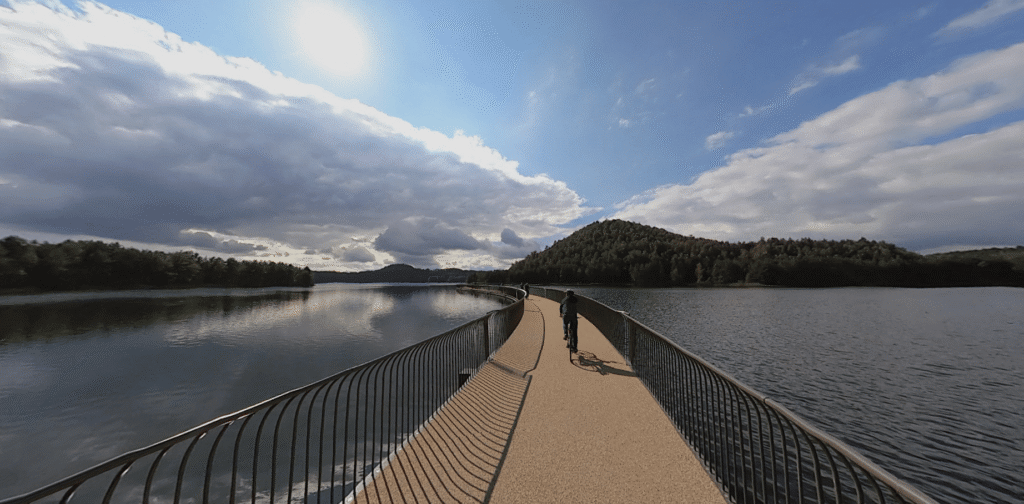
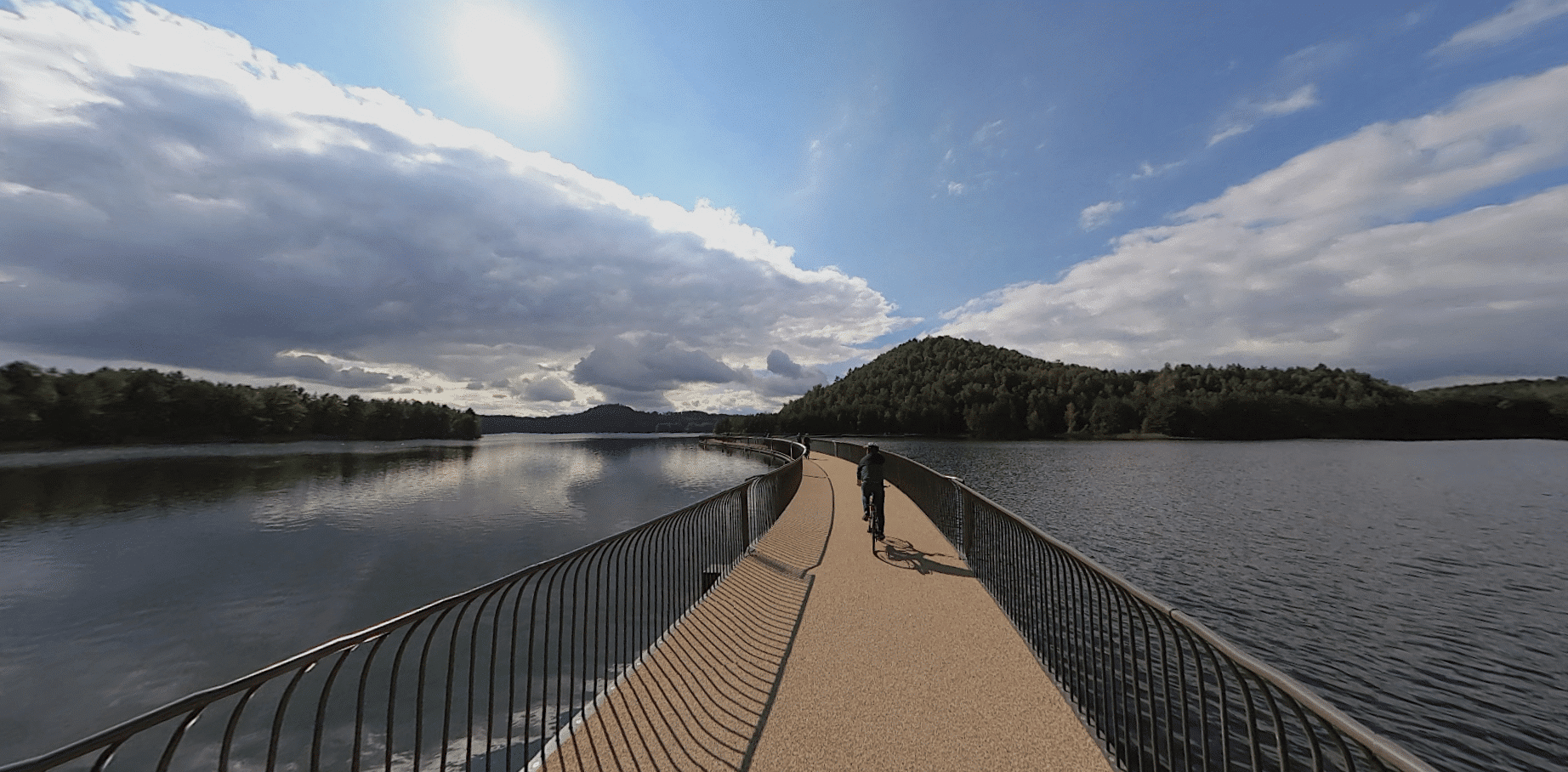
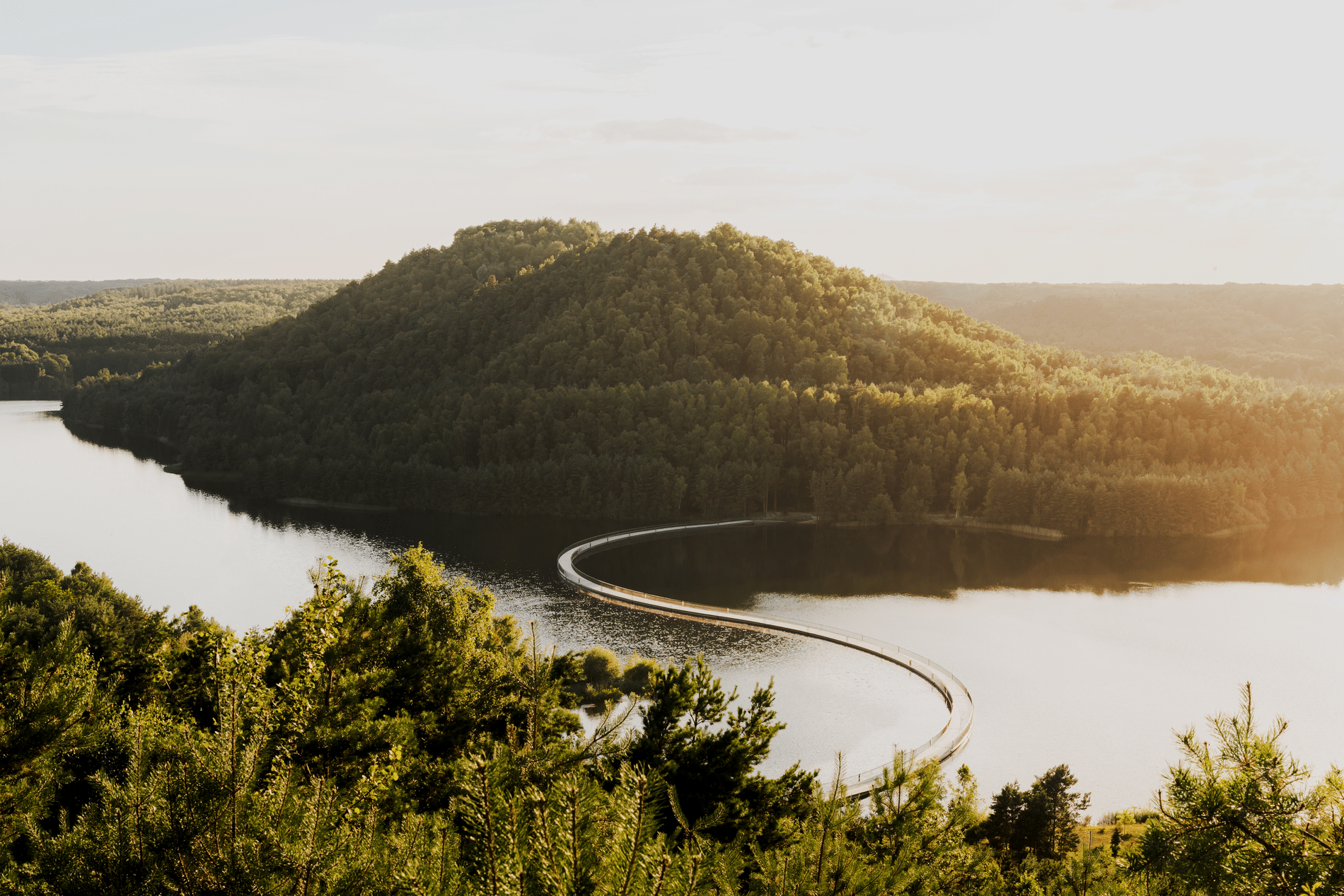
In Terhills, the former mining site in Eisden, the Limburg bicycle route network gained a unique new link. The 380-meter-long floating pontoon bridge between the Panorama Slope and the Twin Slopes is not only a tourist attraction but also a remarkable example of precast concrete, precision engineering, and sustainable area development. The S-shaped structure winds its way just above the water’s surface to the opposite side, allowing both cyclists and hikers to experience the repurposed mining landscape from a new perspective.
Today, Terhills is a nature and recreation area spanning approximately 365 hectares on the edge of the Hoge Kempen National Park. Where coal was once mined, there is now a landscape of water features, spoil tips, fauna, flora, and recreational pathways. The construction of the new pontoon bridge fit perfectly within this broader redevelopment: it adds a new dimension to the area without disrupting its existing landscape qualities. Instead of a heavy-handed infrastructure intervention, the design team opted for a lightweight, reversible, and landscape-integrated solution.
The bridge was commissioned by LRM and co-financed by the Province of Limburg. Burolandschap developed the design and the landscape integration, while Tractebel handled the technical implementation. The decision to build an S-shaped bridge was essential to this project. A straight connection would have created a harsh visual axis cutting through the area. The curved shape, on the other hand, follows a more natural rhythm and better aligns with the scale and the experience of the landscape. Transparent balustrades ensure that the view of the water, banks, and spoil heaps is preserved as much as possible.
Central to this unique project is the ingenious use of precast concrete. The bridge consists of 28 curved concrete pontoon elements, each 13.5 meters long, 3.30 meters wide, and weighing 40 metric tons. They are linked together like chain links via cast-in metal hinges. Underwater, they are guided and anchored by fifteen steel tubular piles, which have been driven 24 to 26 meters deep into the lake bed. This creates a stable yet flexible structure that can move with the fluctuating water level.
It is this interplay between robustness and adaptability that makes the bridge unique. The pontoons are equipped with an EPS core that provides additional buoyancy. According to Archimedes’ principle, they remain afloat due to the balance between their own weight, the volume of water displaced, and buoyancy. This is crucial, as the water level can fluctuate significantly due to seasonal changes, wind, and waves. The structure is designed to accommodate height differences of up to 2.5 meters and waves of up to 75 centimeters, while remaining comfortable for cyclists and pedestrians to use.
Betca was responsible for manufacturing the precast elements, based on the construction plan developed by contractor HYE. Fifteen elements with left-hand curvature and thirteen with right-hand curvature were manufactured using self-compacting C50/60 concrete. Precast concrete offered clear advantages here: high dimensional stability, controlled production conditions, limited on-site construction time, and optimal control of quality and tolerances. Furthermore, the precast approach made it possible to accurately design and test the complex geometry in advance.
That precision was essential. Steel UPN sections, lifting devices, connection details, and pour-in-place sections were integrated into the pontoons. Some tolerances were as small as 2 millimeters. The position of the guide structures and connections to the tubular piles also had to be exactly correct to ensure that the entire S-shaped chain connected properly to the abutments. 3D-CAD therefore played a key role in the engineering, work planning, and coordination between concrete, steel, and construction.
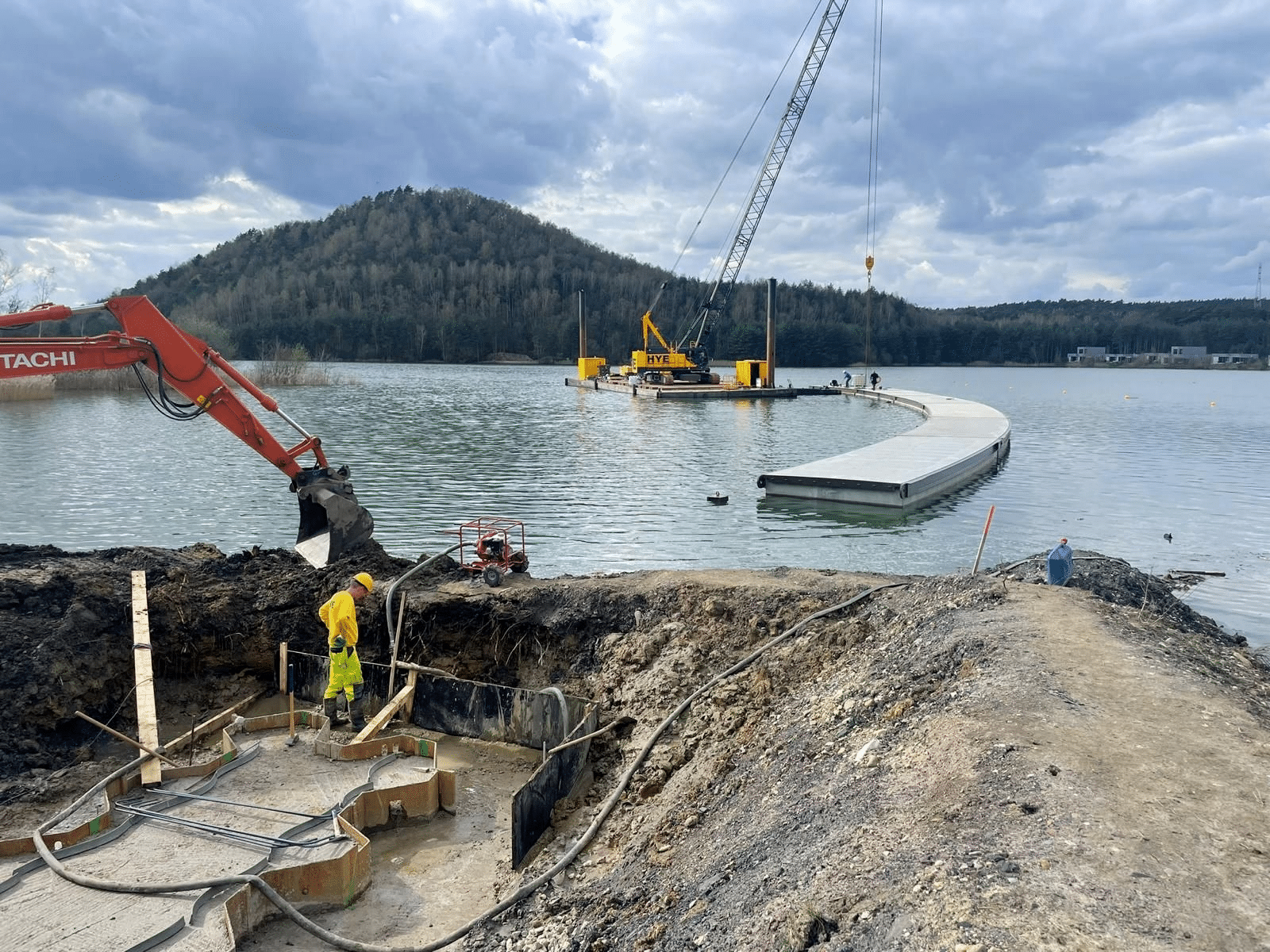
The construction site organization also required a well-thought-out approach. Because the body of water is completely surrounded by land, the precast elements had to be transported by road. HYE built a temporary quay to unload the pontoons and launch them into the water. A tandem pontoon served as a work platform for the cable crane used to install the elements. Despite the technical complexity, high water levels, and often difficult weather conditions, the bridge was assembled in just six months.
This pontoon bridge demonstrates how precast concrete can contribute to smart infrastructure in sensitive or valuable environments. The structure is sustainable, modular, and, in principle, reversible: if necessary, it can be removed without causing any lasting significant impact on the landscape. The Corten steel artwork at the end, made from reused segments of the anchor piles, also underscores this circular approach.
Since its opening in September 2024, the bridge has already welcomed tens of thousands of cyclists and hikers. Yet the project goes beyond its recreational function. It is an example of how a former industrial site can be given new meaning through targeted infrastructure. In this context, precast concrete is not merely a structural solution, but the vehicle for a broader ambition: to build a landscape that is accessible, forward-looking, and respectful of its past.