Platform on concrete and steel in construction
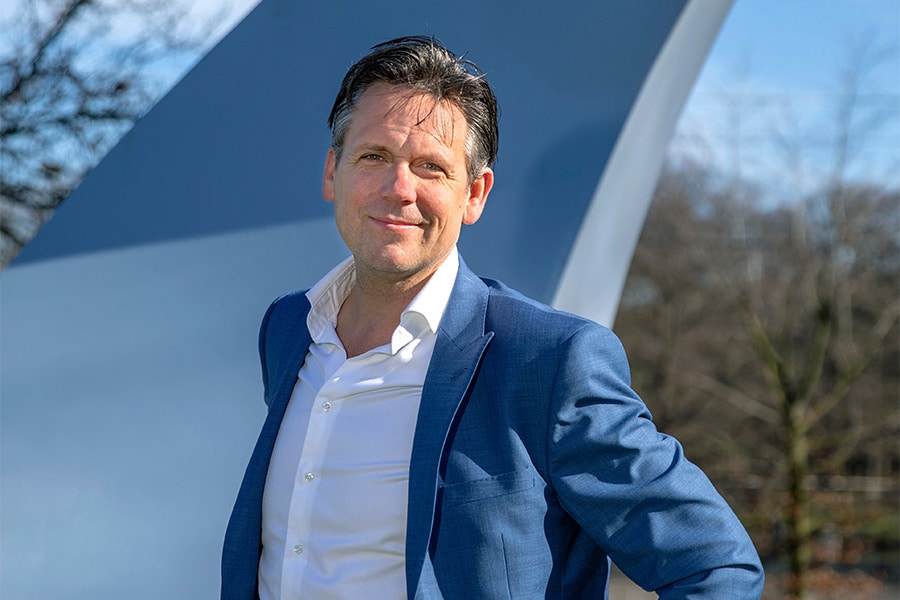
Concrete & Steel Construction spoke with Jan van Beuningen, director of Construction and Energy at the Ministry of Housing and Spatial Planning about the role of the construction industry in the sustainable and circular transition, the biggest policy challenges and the innovative power of construction toward 2030.
1. From the ministry, how do you view the role of the construction sector in the national sustainability and circular economy agenda?
“The construction sector is crucial for solving the housing shortage, making the existing stock more sustainable and the replacement task in energy infra and GWW. What we build now will determine the quality in decades to come. That is why we are committed to future-proof, circular and detachable buildings. The sector is showing more and more responsibility in this with innovations and new collaborations.”
2. What do you see as the biggest policy challenges to making the built environment more sustainable faster?
“Much has been achieved: CO2 emissions from the built environment have been roughly halved since 2010 and insulation measures have been widely embraced. At the same time, collective solutions such as heat grids and large-scale insulation approaches continue to lag behind. Grid congestion and nitrogen pose additional bottlenecks. Acceleration requires stable, predictable policies, clear standards and long-term financing so that parties dare to invest.”
3. Circular building is a broad concept: what concrete goals or priorities does the ministry set in this regard?
“Circular construction for us means structurally less emissions, waste and use of primary raw materials. We focus on three things: reuse of materials, more biobased construction and making traditional materials such as concrete and steel more sustainable. Programs like IOP, the upcoming Building Materials Agreement, the National Approach to Biobased Building and Circular Demolition should accelerate this movement, always in close cooperation with practitioners.”
4. What role do you see for material passports and reuse of concrete and steel in the coming years?
“Materials passports can greatly promote reuse in new construction, maintenance and renovation, provided data are current, exchangeable and easily accessible. DigiGo is therefore working on standardization and digital marketplaces. For concrete, direct reuse is particularly promising for detachable structures; otherwise, high-quality recycling is the obvious choice. Steel is often recycled, but reuse of complete structures is gaining attention.”
5. The energy transition requires substantial modifications in existing buildings. How can sustainability and circularity go hand in hand in this regard?
“Making buildings more sustainable is the moment to combine energy and material transition. We must not only manage energy consumption, but also material use, detachability and reusability. Through Verbouwstromen we bundle renovation requests into continuous renovation flows, enabling industrialization and circular solutions. Within the NPCE, we work on low installation, circular solutions, using the equivalence principle as a guiding principle: the end is the focus, not the means.”
6. What does this specifically mean for the role of clients and municipalities in new construction and renovation projects?
“The shift to industrial construction is essential: from single projects to continuous construction and remodeling streams. Clients such as housing corporations and developers can explicitly ask for circular materials and climate systems with lower environmental impact in tenders. Municipalities have an exemplary role with their own real estate - think schools, sports halls and community centers - where they can make circular choices visible to residents.”
7. What forms of collaboration between government, knowledge institutions and market participants do you consider most effective in accelerating circular innovations in construction?
“Acceleration requires true co-creation. This takes place in the Building Council, in TKIs such as Construction and Engineering and Urban Energy, and in Growth Fund and MMIP programs. The Circular Construction Economy Transition Team connects policy, knowledge and practice and helps to focus initiatives on shared goals and scalable solutions.”
8. Are there specific examples of projects or initiatives that you think could serve as inspiration for the industry?
“The Circular Facade Economy Agreement shows how chain parties are taking concrete steps together. Housing corporations are sharing examples that are circular, social and feasible through the Green Housing Association. The upcoming Building Materials Agreement is another inspiring example: it combines the energy and ambition of concrete, steel and wood chains to make real work of circular construction.”
9. How do you see the balance between incentives (grants, pilots) and obligations (regulations, standards) in promoting circular construction?
“We need both encouragement and standardization. Forerunners require space and support through programs, pilots and exemplary projects with, among others, the National Property Administration. At the same time, clear frameworks, such as environmental performance requirements (MPG), are needed to get the broad market moving. The introduction of Whole Life Carbon requirements reinforces this mix of incentives and obligations.”
10. What developments can we expect in the coming years around laws and regulations for sustainable and circular construction?
“An important development is the implementation of the European EPBD IV Directive. This contains both requirements for the existing stock and the obligation to introduce a WLC requirement for new construction. This requirement must be clear in 2027 and will apply in 2030. With this, we are integrally steering CO2 emissions over the entire life cycle of buildings.”
11. What technological innovations in concrete and steel construction do you think have the greatest potential for a circular economy?
“We need all materials - concrete, steel, wood, biobased and recycled - so we need to make them all sustainable. In concrete, we see developments around CO2 storage and low-emission cement substitutes, often using residual streams as raw materials. In steel, we are working with green energy and hydrogen, and there is a growing focus on reusing structures in addition to recycling. These innovations together are indispensable for the transition.”
12. Looking ahead to 2030, what would the construction industry ideally look like in terms of sustainability and circularity?
“In 2030, sustainability and circularity are natural parts of the sector. Market demands, fiscal incentives and regulations reinforce each other. Parties cooperate structurally in building and renovation streams, so that scaling up is normal. The material transition has clear frameworks and circular materials are widely used in new construction and renovation. Thus, step by step we are building a future-proof, competitive building sector.”