Towering expectations met without a hitch
Tekst Philip DoutreligneBeeld CIT Blaton
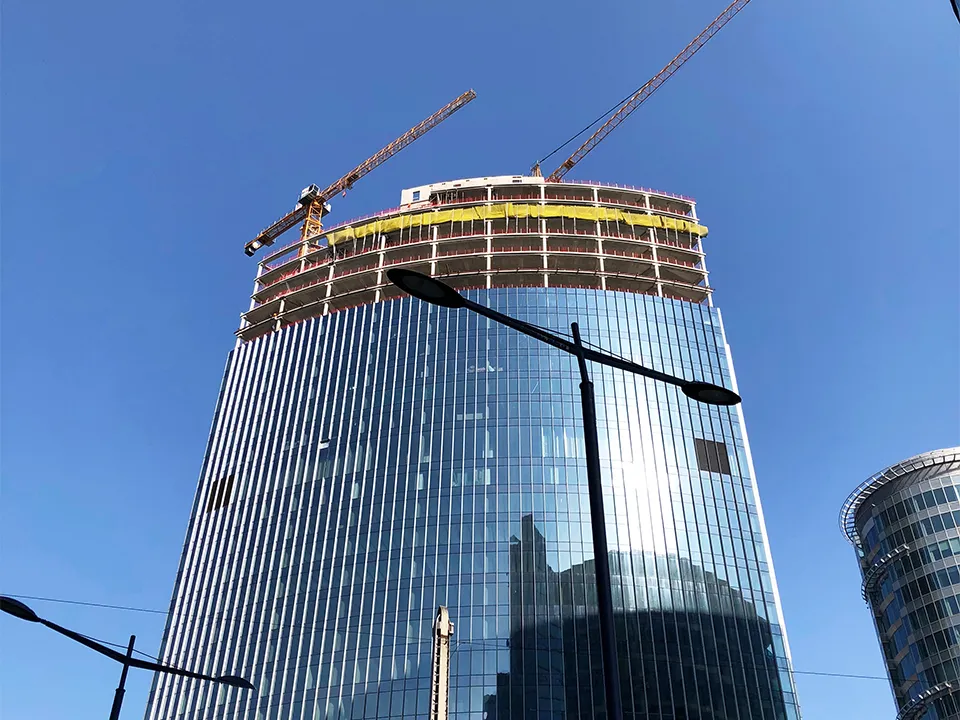
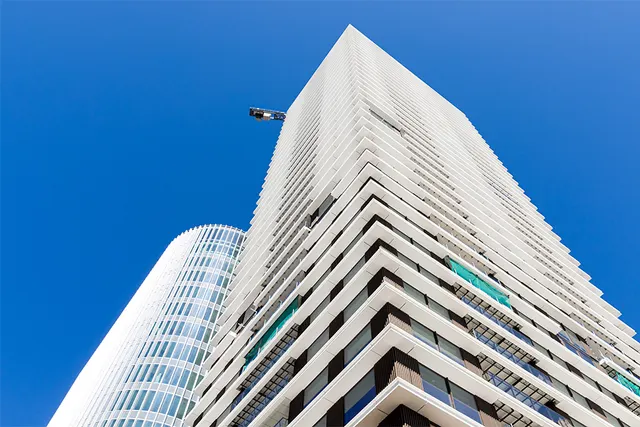
Brussels’ skyline recently gained a striking new landmark: the Silver Tower. CIT Blaton has recently completed the tower’s structural frame, giving it a futuristic appearance.
This was not the contractor’s first project in this Brussels district. It had previously built the Dexia Tower, the Zenith Tower and the North Galaxy Tower in the immediate vicinity, as well as the MG Tower in Ghent. Standing 137 metres tall, including its structural façade, the impressive office tower falls into the ‘High-Rise Buildings’ category. After the Zuidertoren, the Financiëntoren and the UP-site, the Silver Tower is the fourth-tallest building in the country.
A bumpy road to construction
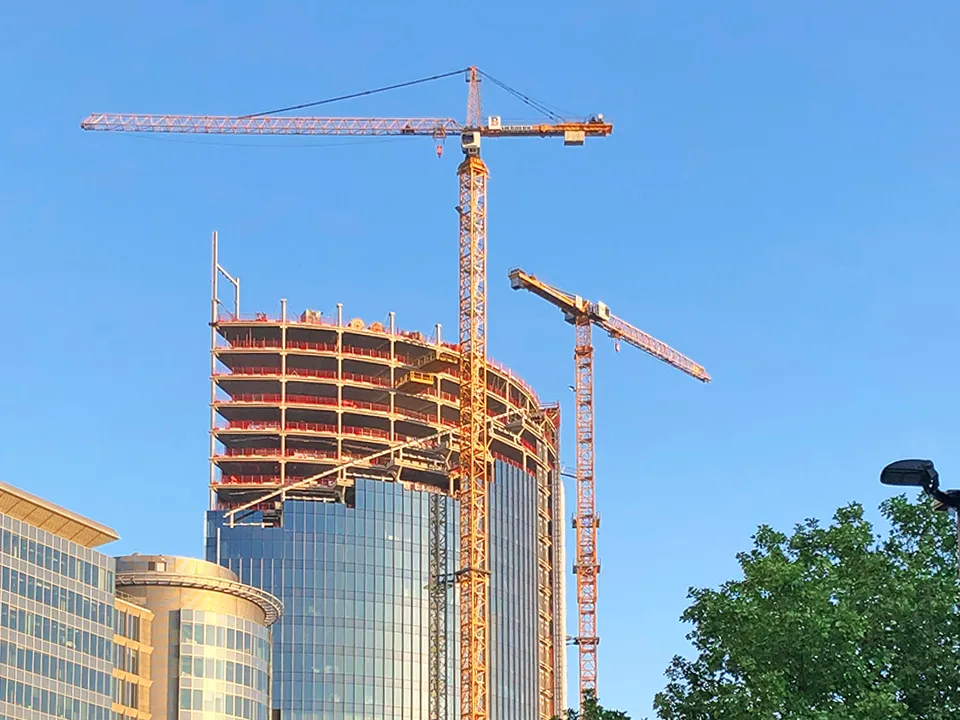
Construction of the tower did not go smoothly. The original building permit was issued to developer AG Real Estate as early as 2010. Uncertainty about the building’s occupancy, asbestos contamination on the site and doubts about the tendering procedure all put the project on hold. It remained at a standstill for several years, until AG decided to sell to Ghelamco. The latter quickly found a tenant, the Brussels-Capital Region, and got the project back on track. CIT Blaton was therefore able to start construction at the end of 2018. The structural frame was expected to take 18 months to complete, but the project ultimately ran 5 weeks behind schedule because of COVID-19.
Impressive figures
The Silver Tower, designed in the shape of an elliptical lens, was built on a relatively narrow site in Saint-Josse-ten-Noode, near Brussels-North station. It is hemmed in between a major traffic artery and the railway infrastructure of the North-South connection. The tower has a footprint measuring 28 m wide by 69 m long. It has 7 basement levels, a ground floor, 33 above-ground floors and 2 mezzanines. A total of no less than 16,000 m³ of concrete was largely cast in situ, and 2,000 tonnes of reinforcing steel were incorporated into the building, alongside precast columns, beams and hollow-core slabs. The total floor area is 45,000 m². Once complete, the building will accommodate more than 2,000 civil servants from the Brussels-Capital Region.
A time-saving construction method
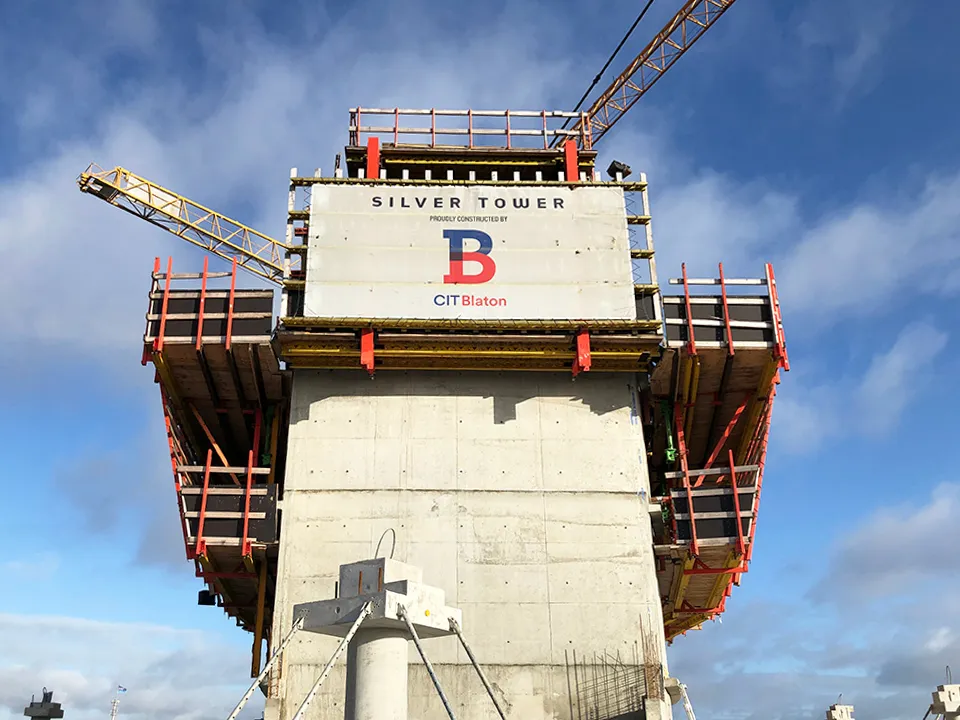
Marjan D’Hose, project manager at CIT Blaton: “To save time, we used the up-and-down construction method (stross), a process we often use on projects of this scale. This technique allows work to proceed above and below ground at the same time, avoiding the need for a disruptive construction pit to remain open for an extended period. First, the underground diaphragm walls were installed to create an ‘enclosed construction pit’, followed by the floor slabs, one by one. Construction above ground could begin as soon as the first floor slab (N-1) was in place. At the same time, work continued on the basement levels: these were excavated one level at a time, with each floor slab cast in situ. The excavated soil was removed through a small opening, without disrupting construction of the superstructure. Logistics were a major challenge on this small site.”
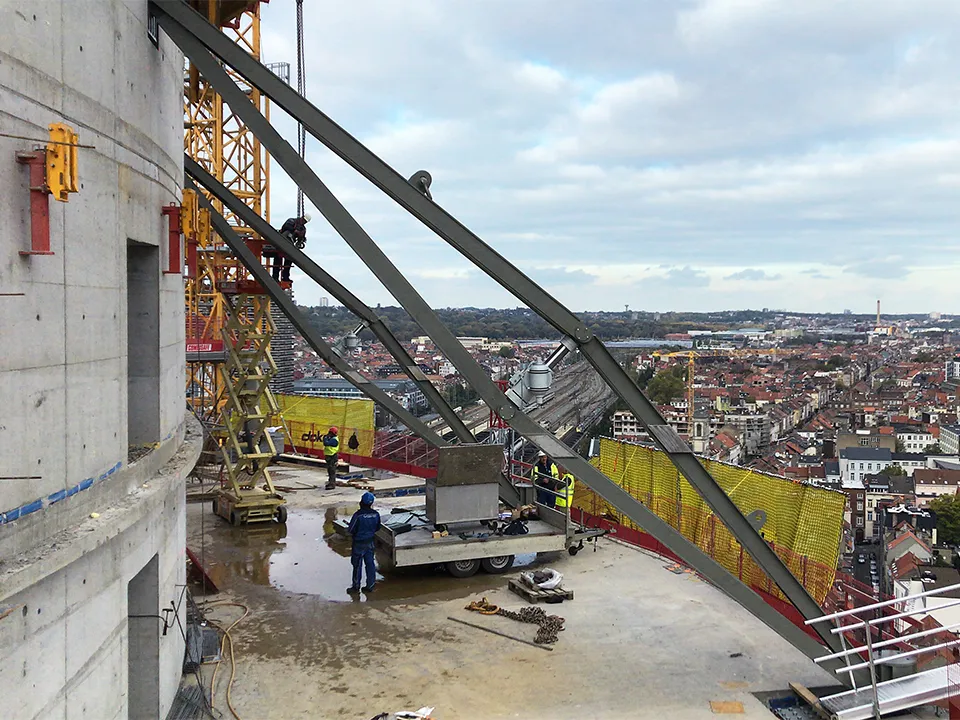
The tower’s superstructure consists of a central core built using self-climbing formwork. “Around it, column, beam and hollow-core slab structures were built to form the floors. A total of 8 steel ‘ties’, attached to the central core, were installed from floor +16 to +18. They act as rigid triangles, allowing a building this slender and tall to be constructed. The ties are fitted with hydraulic dampers to accommodate differential settlement between the core and façade (slow deformations), while preventing deformation caused by sudden, large forces such as wind. This technical tour de force was devised by engineering consultancy Greisch. The use of hydraulic dampers in the ties makes it a ‘smart, elastic’ alternative to a rigid triangle.”
CIT Blaton is a family-owned company with independent shareholding that has grown over 155 years to become one of the country’s leading construction companies. It combines traditional techniques with advanced technologies, with a strong focus on sustainability. With the completion of the Silver Tower, it also met the towering expectations of all stakeholders without a hitch.
Vraag over dit verhaal? Stel je vraag
Wie eraan werkte
Silver Tower in Echt-Susteren
- ruwbouwCIT Blaton
- studiebureauGreisch
- bouwpromotorAG Real Estate
Blijf dit volgen
Bij een nieuw verhaal krijg je een e-mail. Geen account nodig.
- ProjectSilver Tower
- OnderwerpProjects
- BedrijfCIT Blaton
- BedrijfGreisch
- BedrijfAG Real Estate