Platform on concrete and steel in construction
One of the most complex railway projects in the Netherlands will soon commence in Vught: Vught Verdiept. This project involves lowering the railway line below ground level. To enable this to be carried out without disruption, the existing railway line must be rerouted via a temporary bypass. At some point, this bypass will cross the N65. It is precisely at this point that sister companies Rijnstaal Nieuwegein and Civiele technieken deboer are playing a crucial role. They have literally built a bridge on a bridge. Twice, in fact.
Since 2024, BAM has been working on rerouting the railway line through Vught, with a new railway line, a temporary station, and a footbridge over the railway. Only when this is completed, according to schedule at the end of 2025, can the existing railway line be freed up for the construction of the sunken section: a tunnel through which trains will run under Vught. Everything related to steel within this project was handled by sister companies Rijnstaal Nieuwegein and Civiele technieken deBoer. Their assignment included the engineering, production, and assembly of the footbridge, railway bridge, and bicycle bridge. All of these are temporary in nature. The latter two structures run parallel to each other and cross the N65.
“We started by designing and manufacturing the bicycle bridge, which is largely constructed from circular materials,” says Bjarne Snel, work planner at Rijnstaal Nieuwegein. “The girders are composed of 1.40-meter-high steel profiles that were used as support structures in previous projects. They were lying on our site waiting for their next job. This circular approach earned BAM important points in the tender.” The bicycle bridge consists of four girders that are connected in pairs. The girders on either side are connected to each other with a concrete deck poured on site. “That is also the only connection, and that combination of concrete and steel made it structurally challenging.”
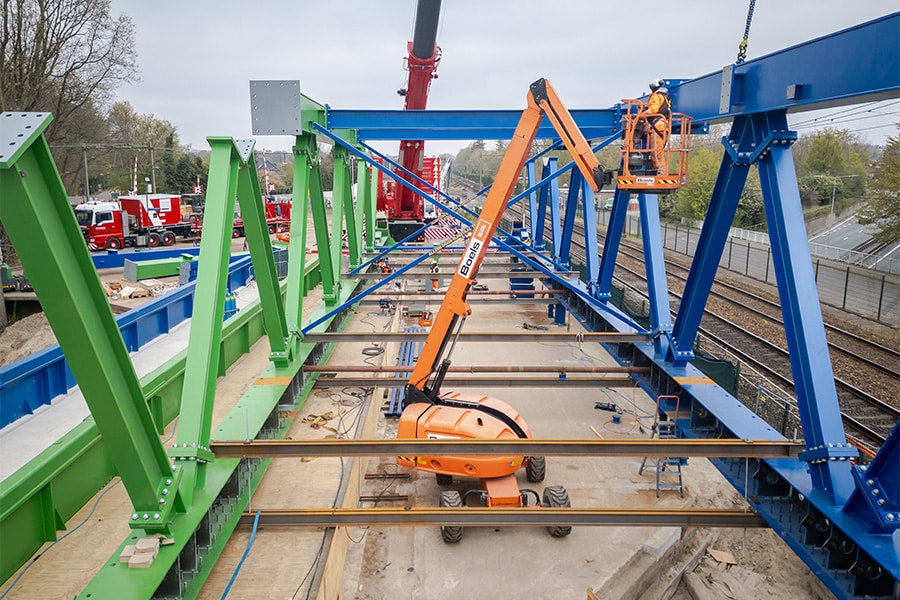
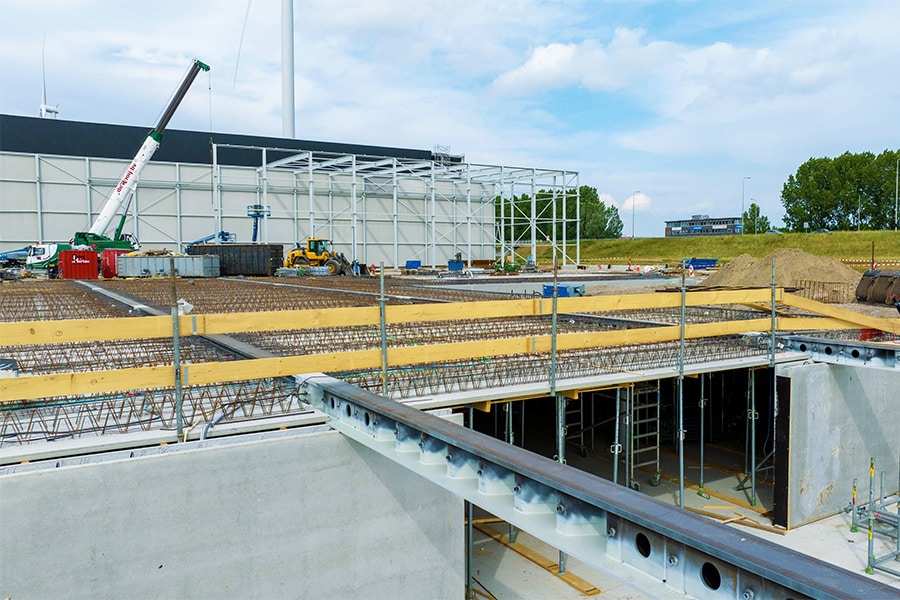
The bicycle bridge was prefabricated on the bridge deck of the underpass on the N65. So, literally, a bridge was built on top of a bridge. “Prior to construction, we installed sliding tracks on the bridge deck and jacks on the wall of the underpass,” explains Anton Gorter, project manager at Civiele technieken deBoer. “After the concrete of the bicycle bridge had hardened, the structure was lowered onto the sliding track using jacks. The bicycle bridge was then moved one length and a crash deck was attached to it as an assembly deck for the later phase. The bicycle bridge was then moved to its final position. It now hangs above the N65. Thanks to the crash deck, we did not have to close the N65 and the entire deck of the underpass was free to build the temporary railway bridge.”
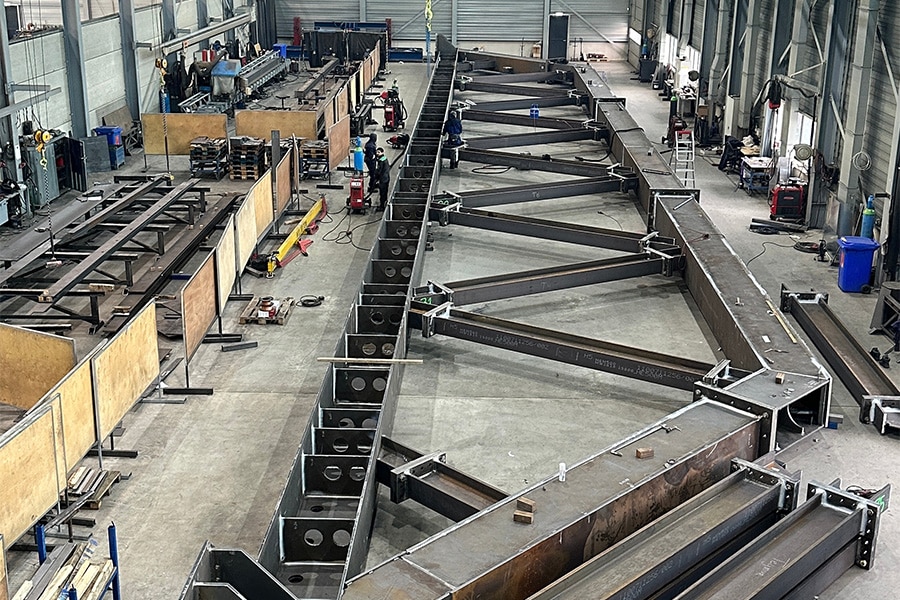
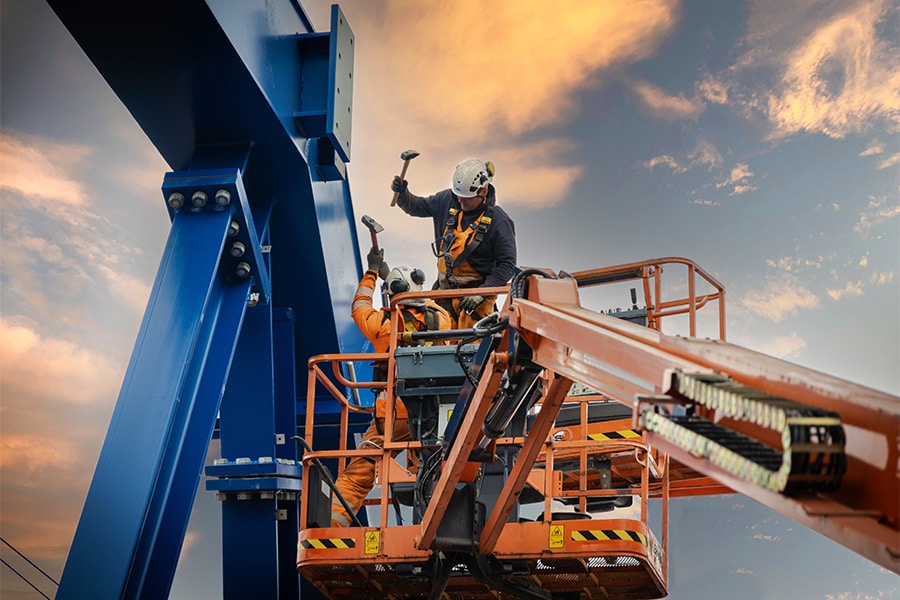
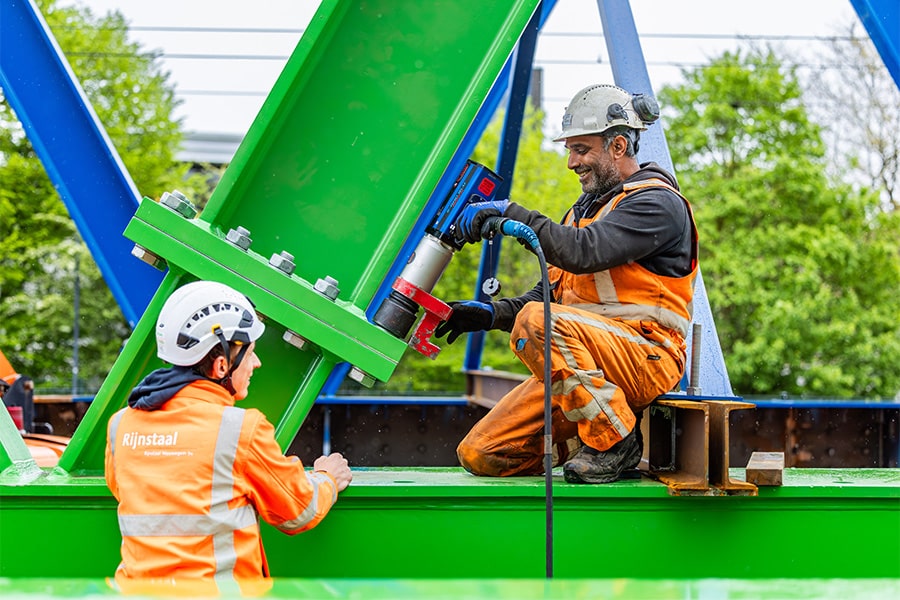
Yes, the railway bridge was also built on the underpass and will remain there. “After building our auxiliary structures, C-beams weighing 16 tons each were brought to the deck of the underpass. These were fully welded into two structures, each 51 meters long, by the specialists at Rijnstaal Nieuwegein,” explains Gorter. “We then positioned the jacks and two heavy cranes hoisted the structure into place, after which the truss sections and arch structures were added. The connections were made with M36 and M42 prestressing bolts, which were retightened with electronic torque wrenches. In addition, each weld was non-destructively tested to ensure absolute safety. It was truly Champions League steel construction, with all the temporary bracing for stability.”
Once assembled, the railway bridge was jacked up 120 centimeters by Civiele technieken deBoer. “This allowed BAM to construct the formwork for pouring the concrete deck,” explains Gorter. “New abutments were constructed in front of and behind the underpass, on which the entire structure was ultimately jacked up 180 centimeters, and the final bearings were also installed.” Although the structures are temporary in nature, according to Gorter, they meet all the requirements for new construction. “Thanks to the bolted connections, large parts can be reused in the future. All in all, this is a special reference for us as sister companies. The complex phasing with releases and shifting of technically complicated structures allowed the synergy between our companies to come into its own.”