Platform on concrete and steel in construction
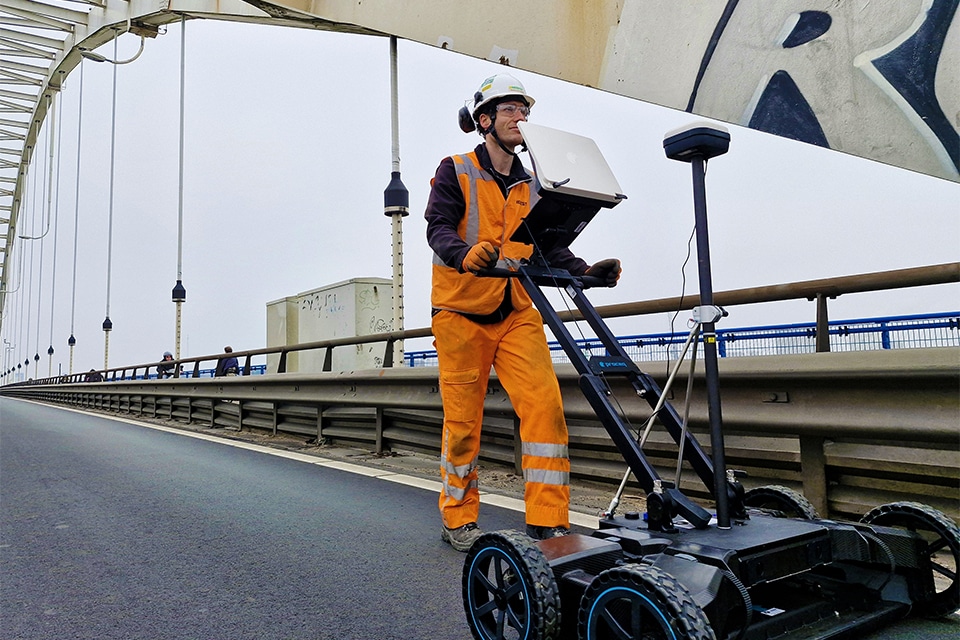
There are numerous non-destructive testing techniques for concrete structures, but radar—also known as concrete radar or Ground Penetrating Radar (GPR)—has become an indispensable part of concrete testing. Radar is primarily used to detect reinforcing bars and pipes within structures. What is the purpose of this measurement? It is often necessary to determine the exact position of these objects to ensure that no rebar or pipes are damaged during drilling or sawing operations, or when not all rebar data is available for a structural analysis, in which case radar is a highly suitable technique for obtaining additional information.
But radar can do more. In recent years, increasingly advanced research has been conducted in the Netherlands using radar. This article discusses two case studies in which (concrete) radar was used in ways other than simply as a ‘detection device’ for reinforcing bars and pipes in a concrete structure. You can learn more about this in the Concrete Association’s course on the Reuse of Existing Structures.
When repurposing real estate, it is essential to gather all relevant information about the structure. This almost always begins with archival research. Unfortunately, such records are not always available or complete. For the repurposing of a former concrete plant, it was necessary to determine the structure of a reinforced concrete slab measuring over 10,700 m². Little was known, except that the concrete slab had been expanded repeatedly between the 1950s and 1970s and that it was likely a concrete slab on piles.
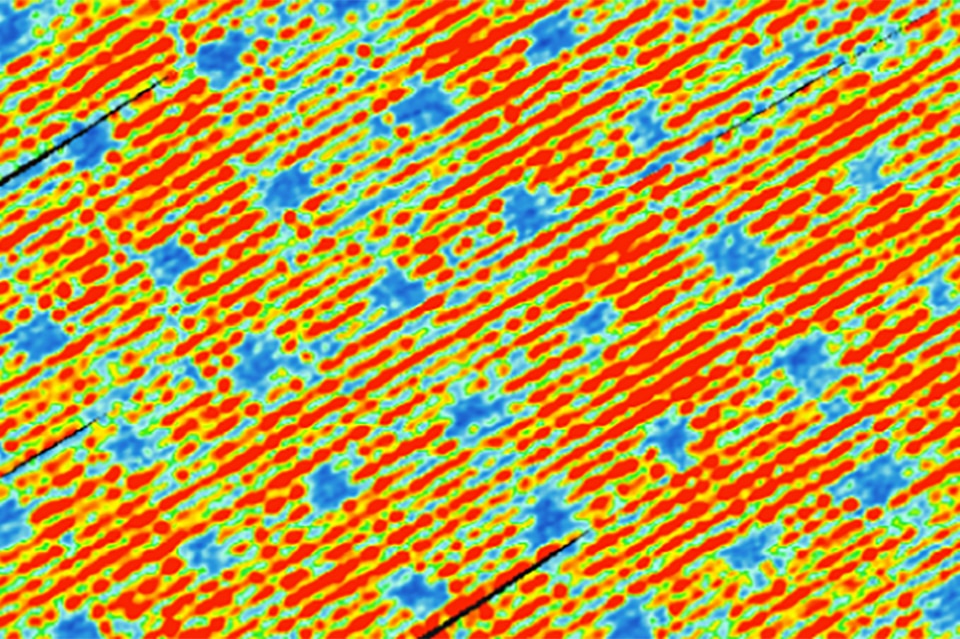
An essential part of the structural analysis was determining the as-built locations of the foundation piles. In less than two workdays, the entire surface was scanned using a multi-channel radar. A multi-channel radar scans in swaths rather than lines, allowing larger areas to be surveyed in a short amount of time. Figure 1 shows a section of the radar scan. The blue dots in the scan indicate the locations of the foundation piles. Because the scans are directly linked to a GPS location, the pile locations were plotted in a CAD drawing with an accuracy of 2 cm (Figure 2). Using radar, more than 4,000 foundation piles were mapped in less than two days.
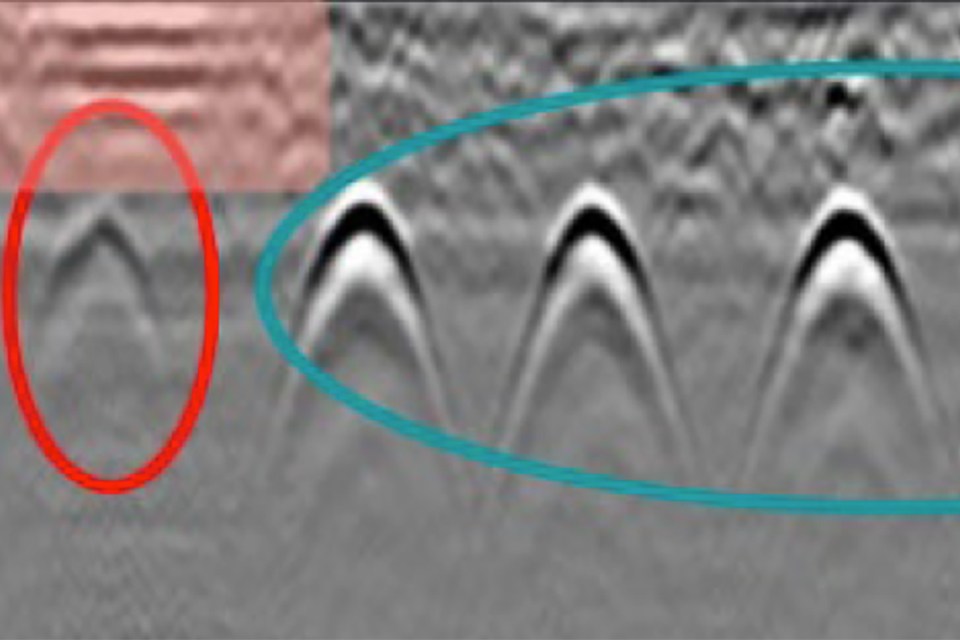
Another interesting application of radar is determining the risk of corrosion in the first layer of reinforcement beneath a covering, such as asphalt. This is an ideal application for bridges or parking garages. Using radar, a large area can be scanned in a short period of time—up to 10,000 m² per day. Based on amplitude analysis, the risk of corrosion in the first layer of reinforcement beneath the asphalt pavement can be assessed. Figure 3 shows an example of a small section of a radar measurement. The parabolic curves represent reinforcing bars. The likelihood of corrosion can be determined from the strength of the reflection from the parabola, with a weak reflection (circled in red) indicating an increased likelihood of corrosion.
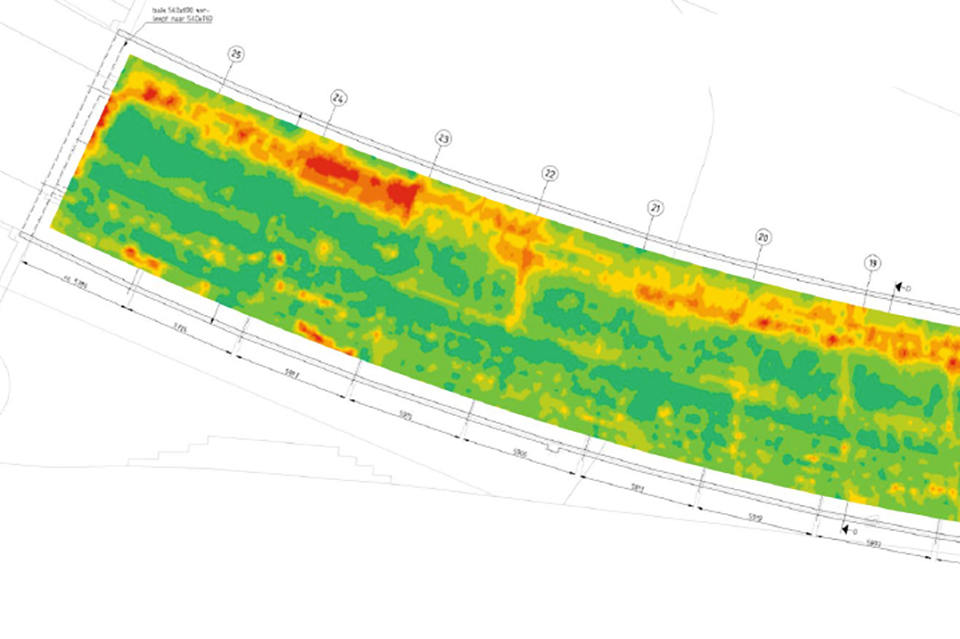
Manually selecting thousands of reinforcing bars in a radar scan is now a thing of the past. Fortunately, modern software is equipped with smart AI algorithms that can select these parabolic patterns in a fraction of the time. After this selection, the individual values are plotted on a clear heat map, providing a quick overview of which areas of the deck are suspected of having rebar corrosion (Figure 4).
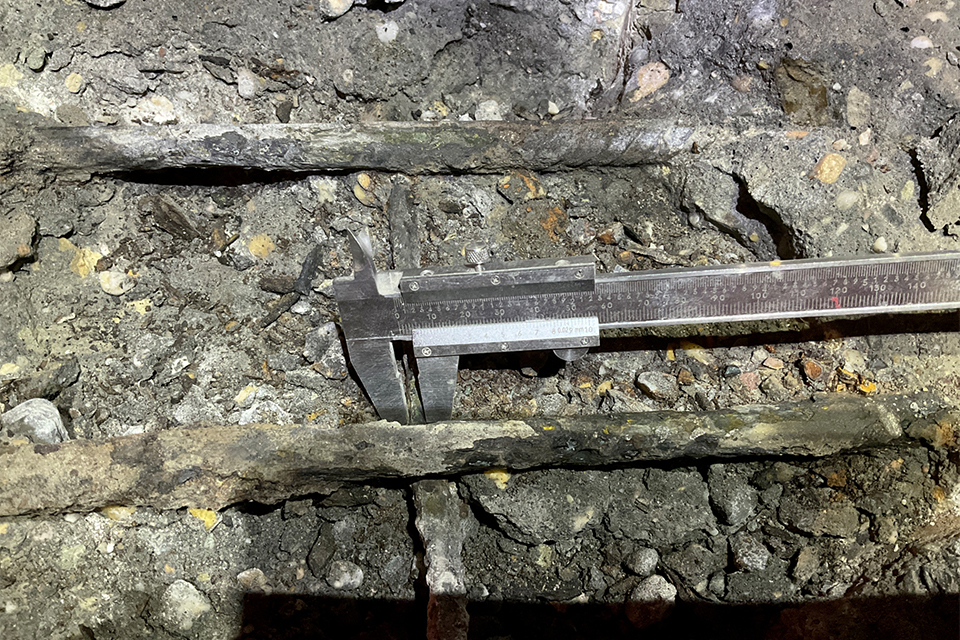
Although non-destructive testing alone can be very valuable, combining it with targeted destructive testing is still the best approach. Based on the results of the radar survey, locations were selected where the asphalt was removed and the reinforcement was exposed. The result is a strong correlation between the radar survey results and the detection of (pitting) corrosion, which provides a great deal of valuable information for maintenance planning (Figure 5).
While radar has long been recognized as a practical tool for locating reinforcing bars and pipes, its advanced use can lead to new insights that contribute to strategic decisions regarding the management and maintenance of concrete structures. To learn more about these types of decisions, the Concrete Association has been offering the course “Reuse of Existing Structures,” with a focus on buildings, since 2025. Over the course of six days, structural engineers and concrete maintenance specialists work together on relevant issues. The course takes a highly practical approach, with ample opportunity for case studies and discussion. During the hands-on day, all participants are introduced to the possibilities—and limitations—of various non-destructive concrete testing methods, such as radar techniques and rebar detection. Visit www.betonvereniging.nl For more information.
Neem dan rechtstreeks contact op met Concrete Association.
 Contact opnemen
The Concrete Association, founded jointly by government and industry in 1927, is the platform for individuals and organizations, who wish to share knowledge about the material concrete. It forms, through the composition of its members, a knowledge infrastructure for the acquisition of knowledge, the joint recognition of knowledge questions and the promotion of the development of new [...].
Bekijk Bedrijfsprofiel