Platform on concrete and steel in construction
The new Narrow Water Bridge not only serves as a physical link between Ireland and Northern Ireland, but is also a striking example of how digital surveying data is helping to shape international steel construction projects today.
At the narrowest point of Carlingford Lough, a complex 195-meter structure is taking shape, where design, production, transportation, and assembly must all align seamlessly. In such a context, there is no room for interpretation or doubt. Every millimeter counts, and any deviation can ripple through the entire execution chain.
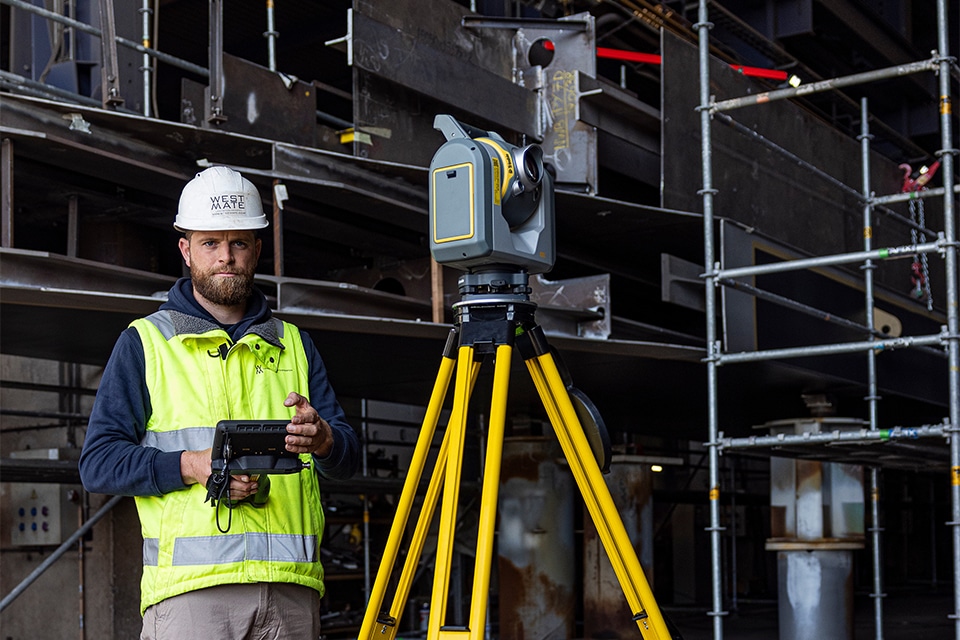
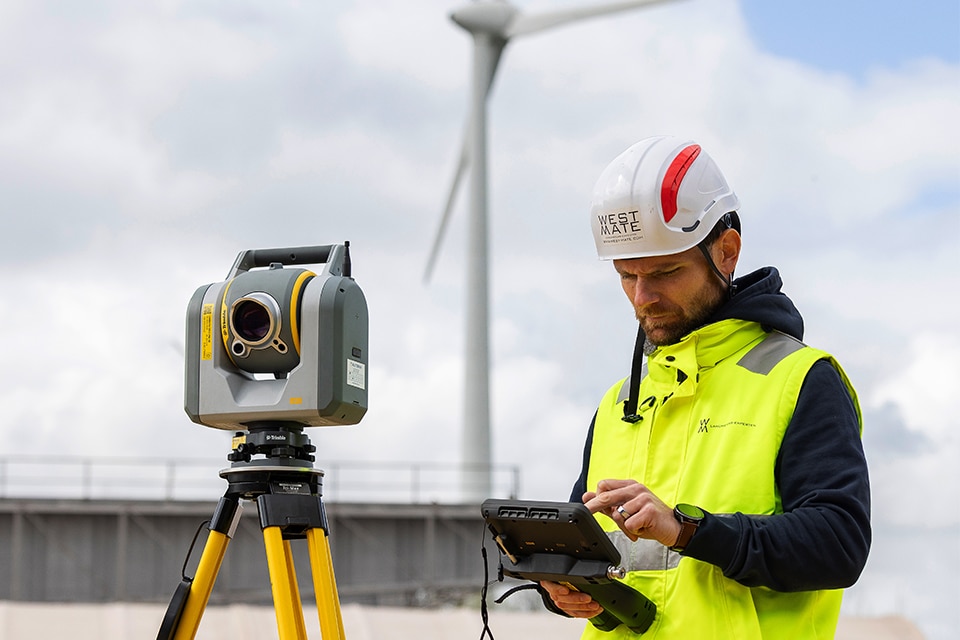
The measurements taken by the Belgian surveying team Westmate play a unifying role throughout this international project. The assignment began on-site in Ireland and Northern Ireland, where the team mapped the entire site in a single day using advanced 3D surveying technology. This approach, carried out under time pressure, requires not only surveying expertise but also absolute reliability of the equipment used. To achieve this, Westmate relies on Trimble’s connected hardware and software.
Anyone building steel structures today can see how the complexity of projects continues to increase. The technical demands are rising, components are getting larger, tolerances are tighter, and deadlines are shorter. At the same time, more and more parties are collaborating across national borders. This makes one thing clear: the days of working with loose plans, drawings, and guesswork are over. This is particularly evident in the case of the Narrow Water Bridge. The bridge consists of a fixed southern cable-stayed bridge and a northern cable-stayed bridge with a rolling bascule mechanism. The steel structures are being fabricated by the Belgian steel contractor Aelterman. BAM is responsible for the concrete work, and Sarens is handling the transport and assembly of the bridge sections.
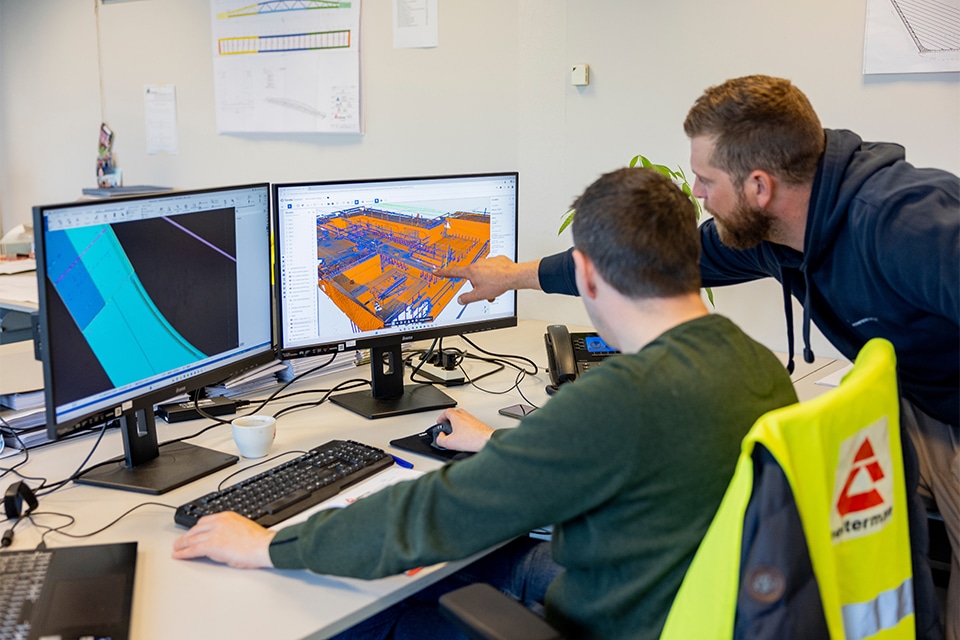
In such a chain, any error can cause a domino effect. A deviation of a few millimeters in steel construction in Belgium can cause days of downtime on the other side of the water. That's why Westmate and Aelterman deliberately chose a connected workflow, in which Trimble Tekla Structures, Trimble Connect and Trimble measurement equipment work together seamlessly. The result is a single source of truth for all partners, regardless of location, discipline or phase.
The Narrow Water Bridge is a prime example of how a modern, connected workflow brings an international project together. That workflow begins with the initial digital measurements that Westmate records on-site. The 3D survey forms the foundation upon which designers, steel fabricators, and installation crews build, acting as a data stream that remains consistent from the very beginning. “The site survey is directly integrated into the design model in Tekla Structures,” explains Laurens De Temmerman of Westmate. “As a result, designers no longer work with assumptions but with constructible data: accurate, usable information derived from reality. This makes it possible to test complex connections, tolerances, and moving parts—such as the bascule mechanism—against actual conditions as early as the design phase.”
Once the design is complete, it is not sent as a static drawing but published as an up-to-date 3D model in Trimble Connect. That platform serves as the digital backbone of the project. Revisions are automatically tracked, changes are transparent, and everyone works with the same information. In real time. This allows them to avoid the classic pitfalls of slow email communication, scattered files, and differences in interpretation. “On-site, production and construction teams no longer have to doubt the accuracy of their data,” explains Grégory Vanderstraeten of Westmate. “The field crews open the model directly on their Trimble fieldbook, where every component is displayed exactly as it was designed. No cross-sections, no flat drawings, no interpretation. The bridge segment in the factory is the same bridge segment that appears on the screen.”
Important here is the operation of the Trimble SX12. The total station combines point measurement with 3D scanning, allowing Westmate to capture both critical points and complete geometries. The scans are linked to the design model in Trimble Connect, where deviations become visually visible. Thus, problems are not discovered only during assembly, but already during production: a significant gain in a chain where every downtime weighs heavily.
For example, if a discrepancy is detected during production in Belgium compared to measurements taken on the concrete structure in the UK, BAM can immediately adjust its formwork. What would otherwise lead to delays, additional costs, and downtime is thus resolved before the problem can escalate. This predictability is the true strength of the digital workflow. Design, production, transportation, and assembly are evolving from separate stages into a single integrated process in which information flows freely and accurately.
Within the steel construction sector, more and more companies are choosing to entrust surveying work to specialized partners such as Westmate. This choice is based not only on technology, but also on expertise and responsibility. Westmate possesses specialized knowledge in 3D scanning, staking out, and modeling. In addition, it uses high-tech measuring instruments that are calibrated on a regular basis to ensure maximum accuracy. “Material properties also play a role,” says De Temmerman. “After all, steel reacts to temperature, so expansion and contraction are routinely factored into the modeling. These are all parameters that come into play.”
Implementing digital surveying and collaboration systems requires more than just hardware. Support, training, and knowledge sharing are essential to getting the most out of the technology. AllTerra Belux plays a connecting role in this as a Trimble distributor. The specialist in topography and surveying supports users with implementation, training, and technical questions, and ensures that systems are properly integrated into existing workflows. “Our role goes beyond simply supplying equipment,” explains Stefan Clopterop of AllTerra Belux. “Our application engineers listen to the needs of users like Westmate, collaborate on efficient workflows, and provide the right support.” His colleague Francis De Meurechy continues: “If additional support is needed, we connect Westmate with Trimble and Construsoft—distributor of Tekla Structures, among other products—so that specific software questions can be addressed.”
What this evolution in steel construction ultimately makes clear is that digitization is all about collaboration, transparency, and trust, supported by technology. When measurement data is accurately recorded and shared, it creates peace of mind throughout the entire project chain. Designers, steel fabricators, transporters, and installation crews all work from the same shared reality and can anticipate potential deviations more quickly and effectively. For an industry where precision, timing, and safety are crucial, this is a significant step forward. In other words: to measure is to know. But it is only when data is shared and integrated that the real benefits emerge—without any downtime.