Platform on concrete and steel in construction

High-strength steel is a term that is interpreted differently within the construction industry. In utility construction, steel grade S355 is often already considered high-strength steel, while in infrastructure, S355 is the standard and people only speak of high strength at grades such as S420 or S690. According to Frank Maatje, director of Bouwen met Staal, the difference lies in the yield strength: the stress at which the steel starts to deform plastically. It is precisely this property that makes high-strength steel a special construction material.
When steel reaches its yield strength, it begins to flow/shape without any further increase in tension. “That may sound like a disadvantage, but is actually a strength,” Maatje says. “In a steel beam, the highest stress usually occurs at the edges of the cross section. As soon as the yield strength is reached there, the remaining part of the cross section - which is not yet flowing - can absorb additional forces. The flowing part moves with it, so to speak, causing forces to redistribute within the structure. This redistribution ensures that steel structures can be loaded efficiently and safely.”
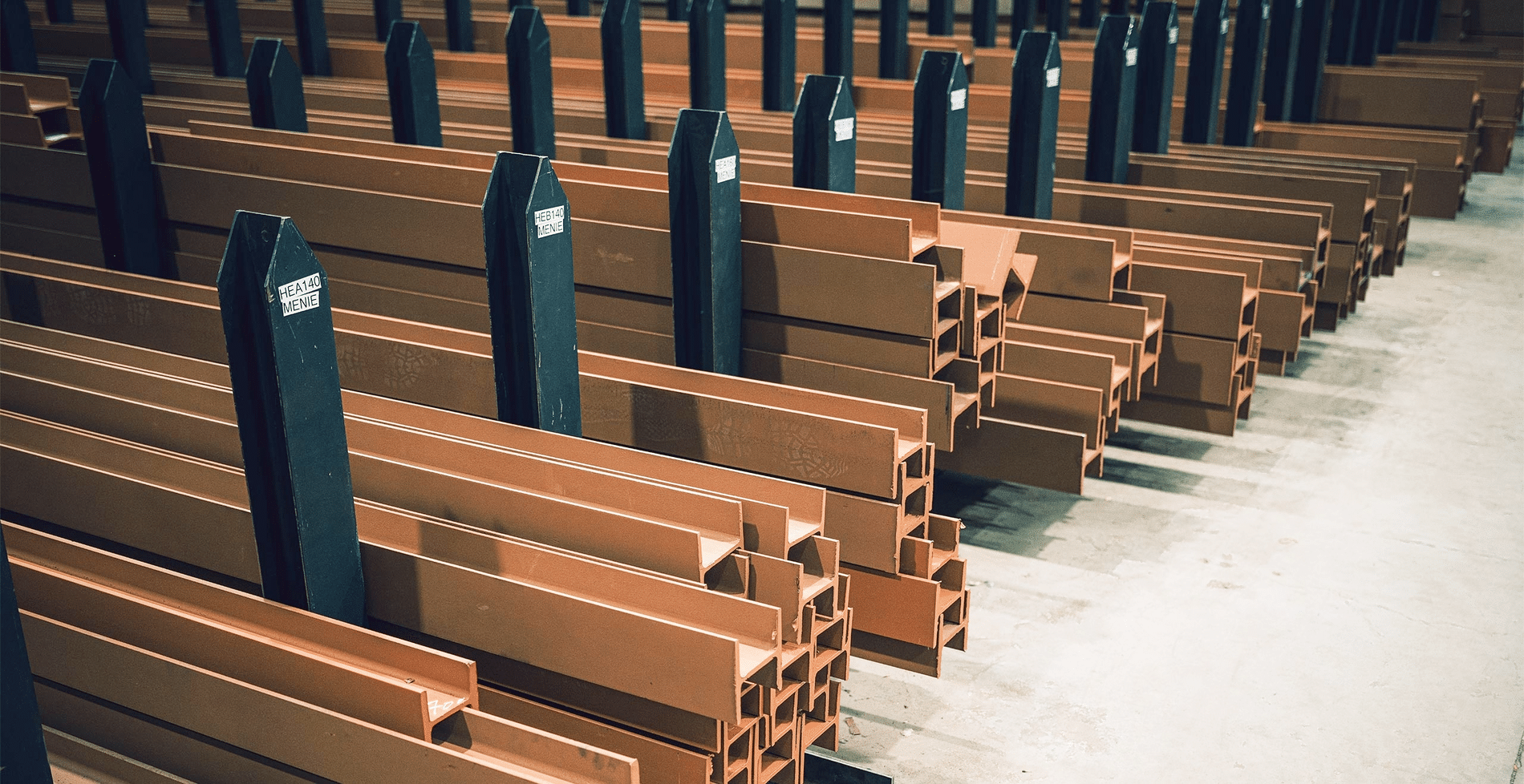
High-strength steel can be stretched further before the yield strength is reached. “Because a material can only absorb force when it deforms, more allowable deformation also means higher load capacity,” Maatje clarifies. “A steel like S355 can absorb more stress than S235 before plastic deformation occurs. That offers design freedom: more load can be carried with the same cross-section or, more interestingly, the same performance can be achieved with less material. So you can save on material.”
However, it requires careful engineering, Maatje adds. “Besides the fact that the stress must not become too high, there are also deflection requirements. The stiffness of steel is determined by the E-modulus, and this is the same for all common steel grades. Whether one applies S235 or S690: the modulus of elasticity does not change. This means that while a slimmer beam made of high-strength steel is stronger, it is not stiffer. Deflection must therefore be controlled through design, for example by using higher beams or truss structures. High-strength steel thus encourages smart, efficient forms of construction.”
And those more efficient shapes can save on material. “Switching from S235 to S355 can save about 10 percent steel in many cases,” Maatje gives as an example. “That means less weight, less transportation and a lower CO2 footprint. Especially in the context of sustainable construction, this is a relevant step. In Scandinavian countries, S355 has been the standard in construction for years, while in the Benelux countries and Germany S235 is still widely used. So there is potential here.”
Production-wise, high-strength steel is essentially the same material. “The difference arises during the rolling process. By rolling even more controlled, the microstructure of the steel changes at the atomic level, resulting in higher tensile strength,” Maatje explains. So high-strength steel is not an exotic material, but a refinement of an existing process.” However, the use of higher steels does increase the complexity of welding. “There are more stringent requirements for weld quality to prevent cracking. Also in fatigue, as in bridges, a higher steel grade does not offer an automatic advantage. Fatigue resistance does not increase proportionally with yield strength; it often requires thicker plates or appropriate detailing.”
Yet sectors such as heavy lifting and offshore have benefited from the strength of high-strength steel for decades. “Companies like Mammoet and Huisman build cranes and installations where weight saving is crucial. There, the use of high-strength steel is commonplace. So the technology is available and proven. The challenge in construction lies in designing differently and adapting the chain, from inventory management to execution. Those who are willing to look beyond the standard solution can use high-strength steel to build more efficiently, lighter and thus more sustainable. As an industry association, we do our best to get that across the stage.”