Platform on concrete and steel in construction
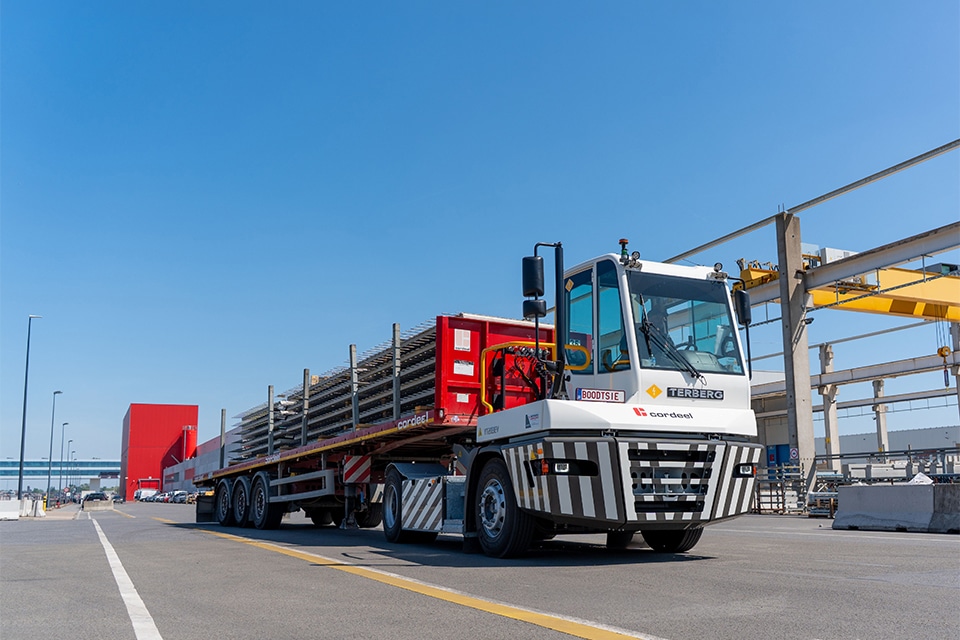
Ecocem, a pioneer in sustainable cement technology, developed ACT, a new generation of low-CO2 cement technology. C-concrete was the first precast manufacturer to test its application on an industrial scale. Together, the companies are demonstrating how collaboration within the supply chain can accelerate the transition to more sustainable concrete.
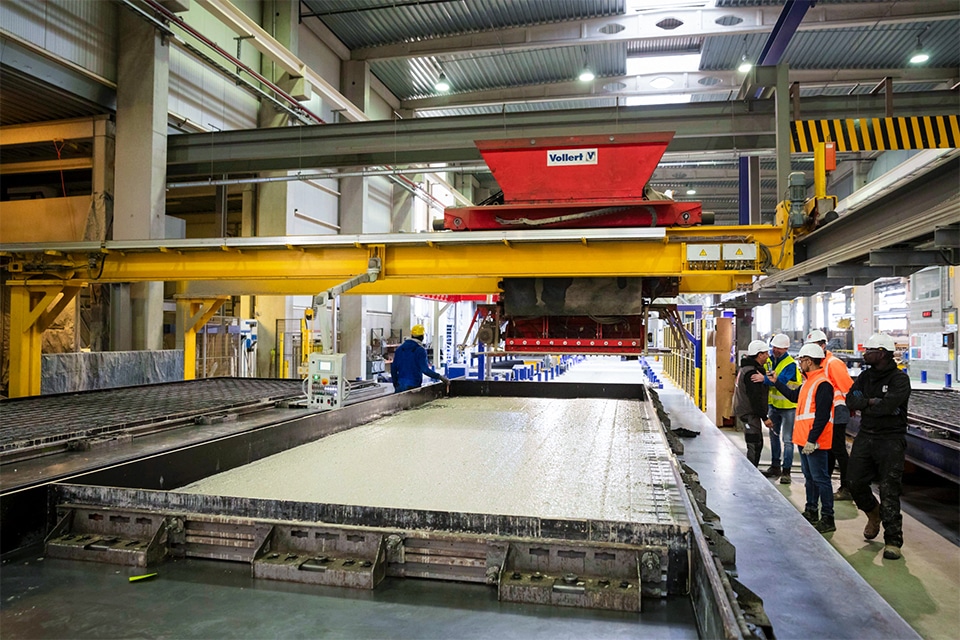
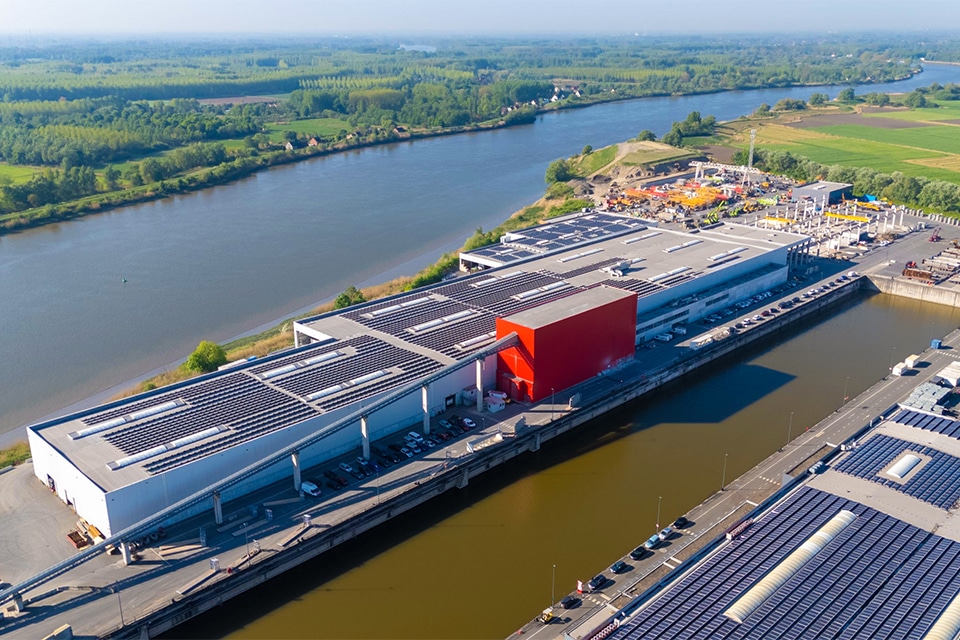
For C-concrete, part of the Belgian construction group Cordeel, the introduction to ACT came at just the right time. The company operates its own precast plant and concrete batching plant in Temse and has been working for years to make its concrete products more sustainable. “Early this year, we conducted the first laboratory tests with ACT,” says Simon Maillet, sustainability manager at Cordeel Group/C-concrete. “In mid-February, we conducted a large-scale trial in which we produced a solid wall and an insulated sandwich wall. These were fully-fledged precast elements produced on an industrial scale.”
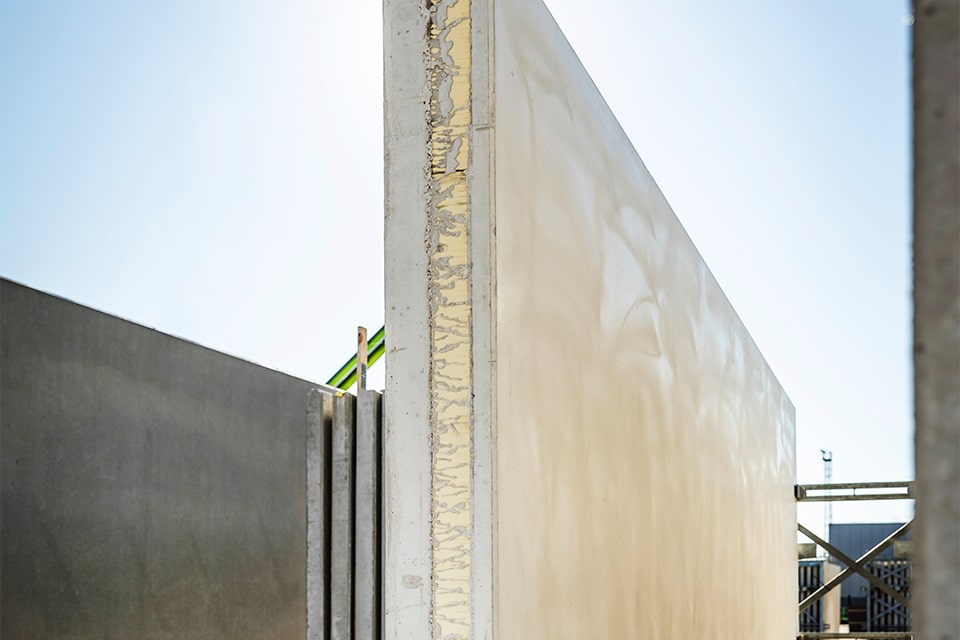
The trial was preceded by an extensive development process. “Together with Ecocem, we worked to find the right formulation for our products,” says Nikolas Schack, Concrete & Quality Supervisor at C-concrete. “After conducting various laboratory and production tests, we further refined the mixture so that it was fully ready for production.”
According to both men, the trial was a success. “For our employees on the production floor, ACT made virtually no difference in terms of processability,” says Maillet. “That was crucial. We want to be able to use innovative products without fundamentally changing our industrial processes.”
According to Schack, the successful trial does not change the fact that the use of low-clinker cements in precast concrete presents specific challenges. “This application differs fundamentally from that in ready-mix concrete for the construction site. With cast-in-place concrete, formwork can often remain in place longer. In a precast plant, however, the situation is different. There, elements must be able to be demolded daily to keep the production process running.” According to him, this makes the use of low-clinker cements particularly challenging. “These cements generally generate less heat during hardening and therefore reach the required early strength more slowly. This requires careful coordination of the mix design and curing conditions. The challenge is to maintain the same production speed while significantly reducing CO2 emissions.”
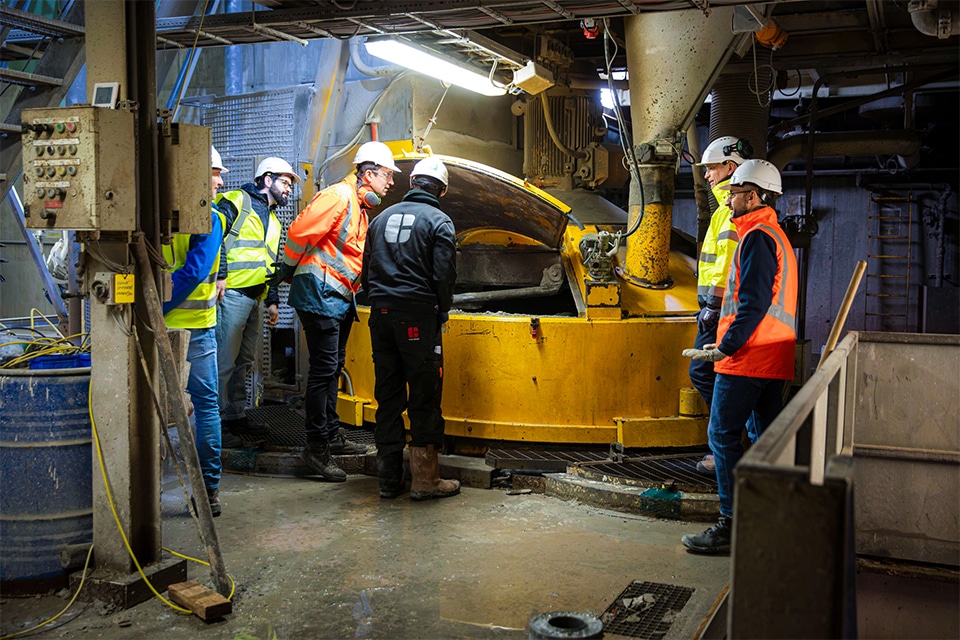
Sustainability is central to C-concrete’s strategy. The company is committed to circularity, alternative raw materials, reduced water consumption, and lower CO2 emissions. “For example, we use only rainwater in our concrete production,” says Maillet. “But the greatest gains can be made with the cement. That’s why we’ve been developing new formulations and testing alternative binders for years.”
According to Schack, the goal is always to strike a balance between sustainability and practical applicability. “A solution must not only yield environmental benefits but also fit within an efficient production process. Precast concrete may account for only a small portion of total concrete production, but we, too, must contribute to reducing CO2 emissions. The entire construction industry faces the same challenge.”
For Maillet, decarbonization is above all an investment in the future of concrete. “We believe in precast concrete as the answer to the growing demand for fast and efficient construction methods. But if we want to continue building with concrete, we must make the material future-proof.” That approach is paying off. “Our current concrete mixes are about 33 percent below the typical CO2 emissions on the Belgian market. With ACT, we’re going even further. Life-cycle analyses show that we can reduce CO2 emissions by more than two-thirds compared to typical levels.”
For C-concrete, this reduction is not only a response to stricter environmental requirements, but also to changing market demand. Maillet observes that clients are increasingly asking for solutions that align with the principles of Paris Proof construction and demonstrably contribute to reducing the overall climate impact of buildings. That is why the company continues to actively seek out new materials and technologies that go beyond current standards. According to him, the trial with ACT fits perfectly within that approach.
Interest in sustainable concrete is also growing in Belgium. “We have signed the Flemish Concrete Agreement,” says Maillet. “It sets a target to reduce CO2 emissions by 50 percent by 2030. In addition, there is a strong focus on circularity and recycled aggregates.” Yet he sees differences compared to the Netherlands. “The Dutch Concrete Agreement sets clear ceiling and benchmark values for the CO2 impact of concrete. That clarity is still partly lacking in Belgium.” According to Maillet, the sector in Belgium isn’t being held back, but it isn’t being strongly encouraged either. “Here, the focus is often even more on circularity than on decarbonization. For us, that’s actually an opportunity to take the lead, especially since we supply a lot to Dutch projects.”
Schack also notes differences in day-to-day practice. “In the Netherlands, people tend to adapt more quickly, and concrete is often viewed as a single material, regardless of whether it’s precast or cast-in-place. In Belgium, that distinction is still made more often.” Maillet also sees a cultural difference. “In the Netherlands, there’s a greater sense of urgency surrounding decarbonization. At the same time, Belgium is leading the way in some areas when it comes to the renovation and repurposing of existing buildings. Both countries can learn from each other.”
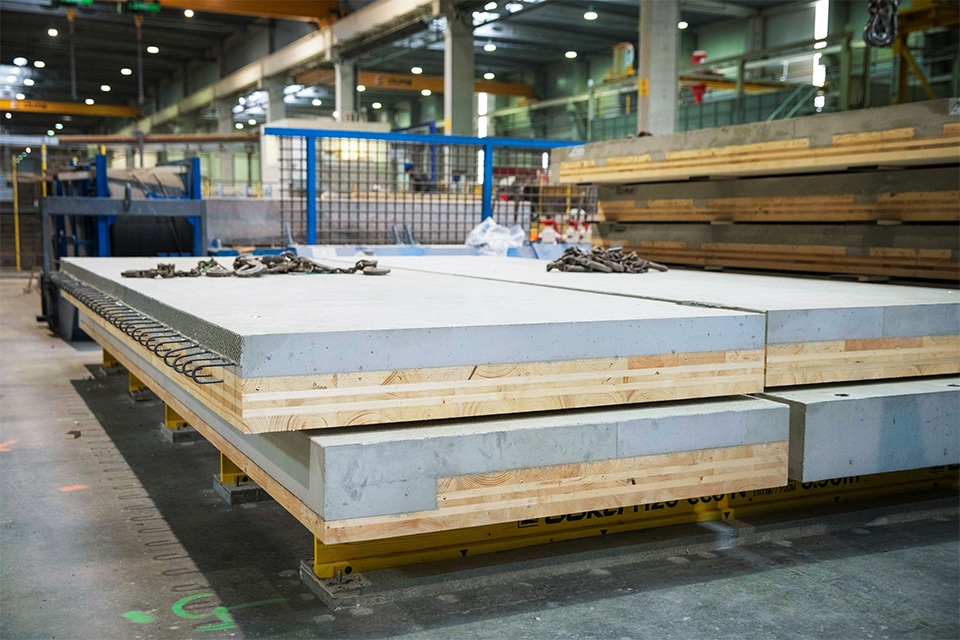
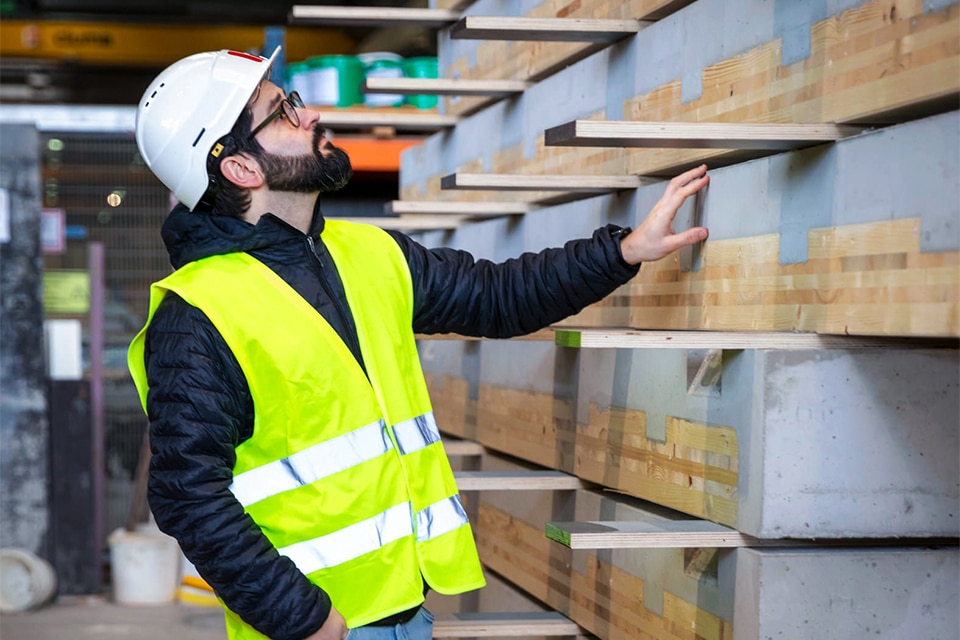
According to Maillet, sustainability doesn’t stop at reducing cement use alone. “For a project in Antwerp, we’re currently producing hybrid floor slabs using a combination of CLT wood and low-CO2 concrete. That, too, is a way to further reduce the environmental impact of buildings. The future lies in a combination of solutions.”
C-concrete’s sustainability goals are part of a broader strategy within the Cordeel Group. According to Maillet, this strategy is based on several pillars, including innovation, digitalization, climate, circularity, and nature. At C-concrete, this primarily translates into developing new concrete mixes and testing innovative binders that can reduce concrete’s environmental impact without compromising quality or productivity. “Because we have our own concrete plant and precast factory, we can test and scale up new solutions relatively quickly,” he says. According to Maillet, this combination of practical experience, production knowledge, and innovation makes it possible to approach sustainability not as a separate project, but as an integral part of daily business operations.
Neem dan rechtstreeks contact op met Ecocem.
 Contact opnemen
Ecocem Benelux B.V., founded in 2001 to develop and produce an environmentally friendly cementitious binder, is a subsidiary of the Irish company Ecocem Materials Limited. In Moerdijk we grind a by-product of the steel industry, granulated blast furnace slag into a high-quality cementitious binder (eco₂cem) for use in high-performance concrete. The concrete and mortar industry has immediate sustainable access [...]
Bekijk Bedrijfsprofiel