[00:05] Van Dijk Concrete and Heavy-Duty Precast Concrete
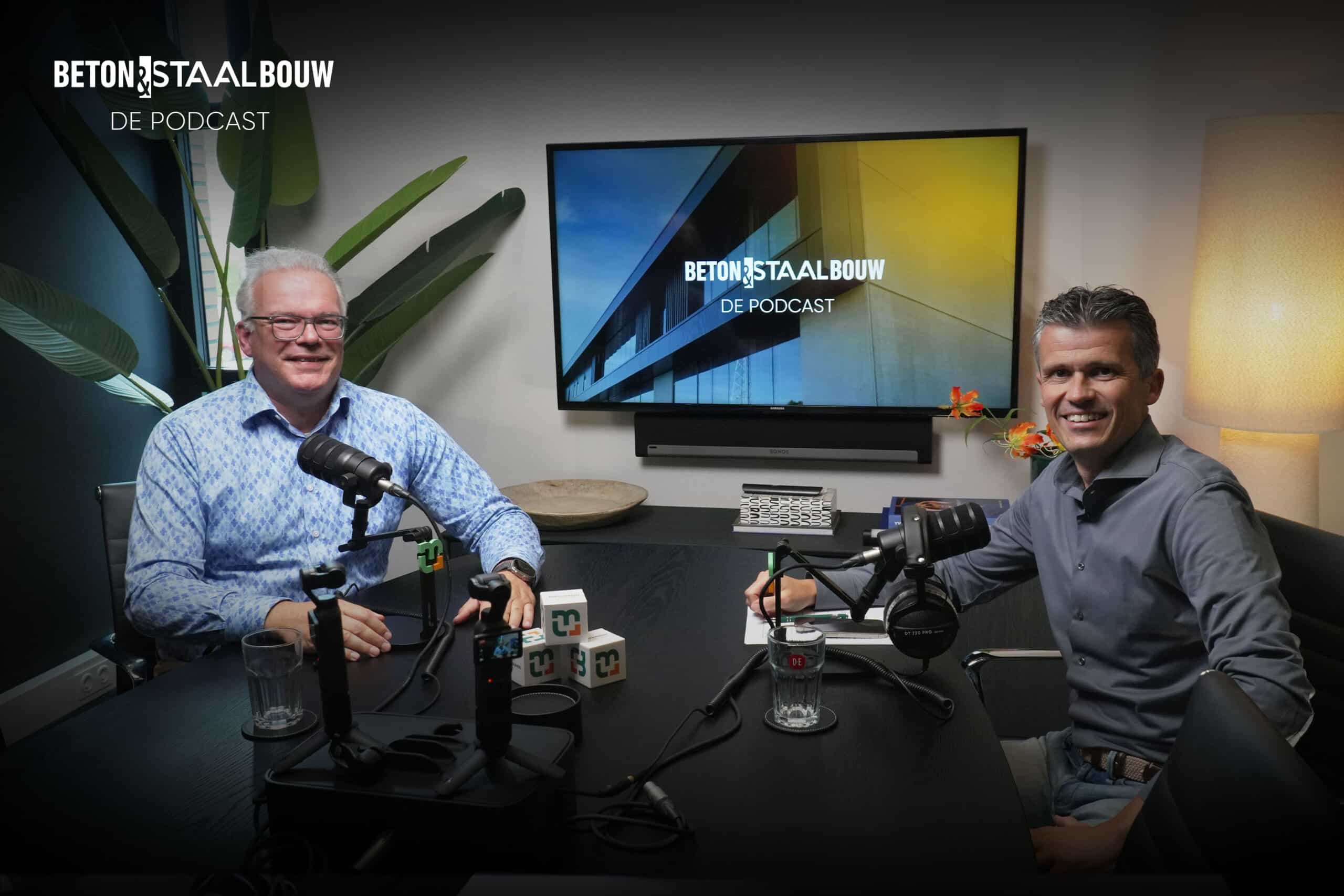
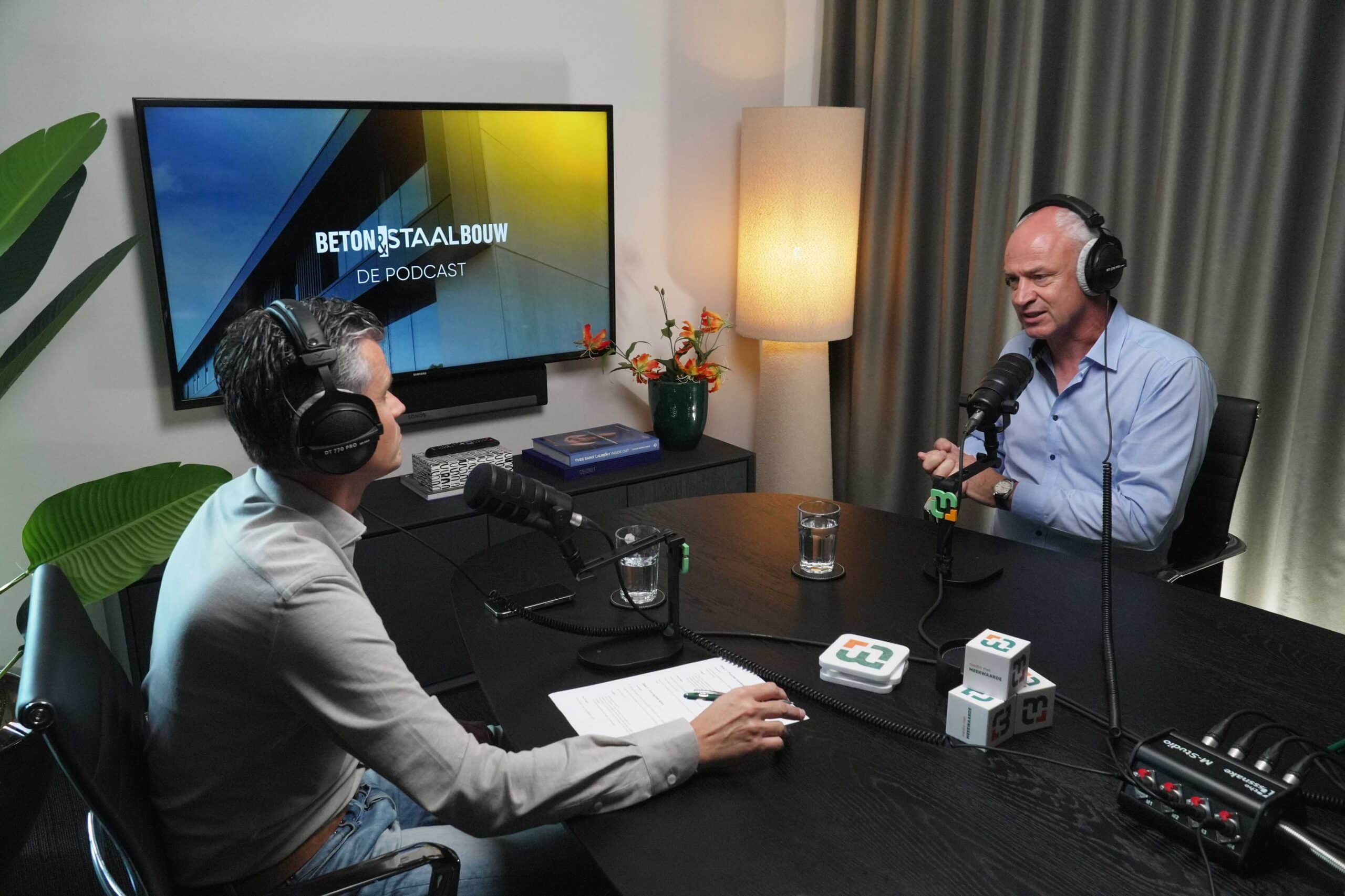
Roel van Gils: Welcome to another new episode of “Concrete and Steel Construction,” the podcast. Our guest today is Henk Schaap from Van Dijk Beton. A family-owned business now led by the third generation, it has grown into a specialist in heavy precast concrete. Welcome, Henk.
Henk Schaap: Thank you.
Roel van Gils: Maybe you could start by introducing yourself.
Henk Schaap: Yes, well, I’m Henk Schaap, now 58 years old. I started out in the waste industry, focusing on recovering raw materials from waste processing activities. From there, I moved into the cement industry. That industry requires a lot of fuel, and by using alternative fuels, you can reduce CO2 emissions. Yes, and from the cement industry, I eventually moved into the concrete industry, and since 2006 I’ve held executive positions at several concrete companies.
[00:56] With Van Dijk Beton since 2024
Roel van Gils: Yes, and how long have you been with Van Dijk now?
Henk Schaap: I’ve been with Van Dijk Beton for two years, having joined in June 2024. That was right when the third generation took over management. We needed support for commercial management. And on top of that, the third generation had limited management experience. So you kind of guide them a bit. Yes, I was asked to coach him. That’s Paul van Dam. And that was the main focus during the first year, indeed.
Roel van Gils: Yeah, okay, great. Welcome again.
Henk Schaap: Yes, thank you.
[01:27] Van Dijk Beton and De Lek Beton
Roel van Gils: Van Dijk Beton—a family-owned business, as you mentioned. Could you briefly summarize: who or what is Van Dijk Beton?
Henk Schaap: Yes, definitely. Van Dijk Beton is part of the Van Dam family. The Van Dam family owns two companies. One is called De Lek Beton. That name comes from the company’s location—namely, next to the Lek River. And next to the mortar plant is the precast concrete company Van Dijk Beton. You’ll see that from the mortar production, about 90% of the mortar produced goes out into the local area—to all kinds of contractors and construction projects. In addition, about 10% goes into our factory, where we turn it into precast elements, so that these prefabricated products can be assembled on the construction site.
Roel van Gils: Yes, so in that sense, you reinforce each other—or rather, the companies reinforce each other. You benefit from each other.
Henk Schaap: Yes, it's one part of the chain.
[02:21] Short lines of communication within a family business
Roel van Gils: Yeah, okay. So what makes a family business different from other businesses?
Henk Schaap: What’s really nice to notice in family businesses—I’ve worked at international companies before—is that in a family business, you see much shorter lines of communication and much faster decision-making processes. In the fall of 2024, I came across something that made me think: I really need to invest in this. And that was an investment of about a hundred thousand. So I thought: how do you pull that off? Because at my previous employers, you had to write entire reports and go through whole processes just for that. Yeah, and here you have a meeting in two weeks, do a few financial analyses, and three months later, the investment is made and you’re up and running. Yeah, so it all goes much faster. Entrepreneurship—where you can respond more quickly to opportunities as they arise.
[03:19] Standard Products and Underground Waste Collection
Roel van Gils: Yeah, sounds good. And if people aren't familiar with Van Dijk Beton, where can they find your products?
Henk Schaap: Yes, that’s nice. We have a wide range of products. On the one hand, we manufacture some standard items, and on the other, we do a lot of project work. Starting with the standard items, when consumers hear this: we make the concrete bins for underground waste collection.
Roel van Gils: Yet another piece of trash.
Henk Schaap: A piece of trash, indeed—yes, absolutely. But around the shopping centers where all those big bins are located, yes, the system is buried underground. And it’s housed in a concrete container. And we manufacture those. We produce between 1,200 and 1,500 of them each year.
Roel van Gils: And how big are those containers?
Henk Schaap: Those containers are about 180 by 180 in size. And they're 2.5 to 4.5 meters deep.
Roel van Gils: Okay, yeah, seriously.
Henk Schaap: There are a number of formats.
Roel van Gils: Yeah, okay. So those are the trash cans?
Henk Schaap: Those are trash cans. They’re also a familiar product to consumers. We make a lot of street furniture. These are those concrete benches, some of which are finished with wooden planks on top. Well, people recognize them from schoolyards and city squares. Those are mainly the standard products we make. We also make retaining walls that are widely used in the landscaping sector—to create a barrier along the water’s edge or as a soil retention wall. We make them in various sizes.
[04:49] VDC bearings for highways
Henk Schaap: The much larger projects. For example, we manufacture the foundation elements for the highway. On the highway, you see those huge gantries with all the variable-message signs and all the signs telling you which way to go, and so on.
Roel van Gils: Signage, yes.
Henk Schaap: But that has to be based on something. Well, at Rijkswaterstaat, they call them VDC piers—traffic support structures. And sometimes they have to support spans of up to 90 meters. So you can imagine that these have to be very heavy components with heavy-duty connections. We’re the ones who get to make them. Right now, traffic on the A2 and A27 is terrible.
Roel van Gils: But there's a reason for that.
Henk Schaap: And there’s a reason for that. And I sometimes say: I can’t complain. Because some of our products go there. Because they’re using them for reconstruction there. And so, indeed, a lot of those kinds of foundation elements are needed there as well.
Roel van Gils: Yes, will those be replaced? Because, of course, there are already portals there.
Henk Schaap: Some sections are being replaced. This is often because there is a somewhat lighter foundation element underneath. And there are also many new sections. A well-known stretch of road is Het Vonderen–Kerensheide in Limburg.
Roel van Gils: They're widening them right now.
Henk Schaap: They’re widening it right now. Well, a lot of new foundation piles are going in there. Yes, and the same goes for the A15 near Arnhem. A new section of highway is being built there, too. It took a very long time because of all sorts of permitting issues. But the decision has finally been made. Yes, a lot of these types of foundation elements will be used there in the coming years as well.
Roel van Gils: Okay, well, the VDC footings.
[06:22] Noise barriers and partition walls
Henk Schaap: In that same sector—the civil engineering sector—we also regularly supply noise barriers or plinths that support the noise barriers. We sometimes call them “piles,” but they’re actually small foundation elements that the noise barriers rest on. We manufacture the retaining walls that you often see around overpasses. Sometimes they feature a bird-pattern design.
Roel van Gils: All those patterns—are they all visual elements in that sense?
Henk Schaap: They're all visible elements. Well, we can create all kinds of patterns with them by preparing them that way at the factory.
Roel van Gils: Yes, so there are different templates.
Henk Schaap: Yes, you have a base mold, and a pattern is placed inside it. Then you pour the concrete over it. And that’s how you end up with a pattern embedded in the concrete.
Roel van Gils: Of course. Yes, because I believe there were also noise barriers with grooves.
Henk Schaap: Yeah, yeah. “Cannelures” is a really nice word, indeed. It was also the first time I’d heard it when I joined Van Dijk Beton. It’s a kind of lamellar structure—those stripes you see in it. Yeah, in our line of work, we call those “cannelures.” Well, we make those kinds of elements, too.
[07:32] Big on large prefab
Roel van Gils: Yes, because you guys have the slogan ‘Big on large-scale prefab.’ Yes. What exactly do you mean by that?
Henk Schaap: Well, what you see is that—and this is something that really sets us apart in the concrete industry—we’re very capable of manufacturing elements weighing up to 40 metric tons. Those girders, yes, they have what are called anchors on them, because steel has to be attached to them. All of that has to be incorporated into the concrete with great precision. So we need some specialized tools for that. And that’s what makes us good at doing it the right way. We’re talking about a deviation of 3 millimeters. Well, just imagine that in the concrete industry, where you’re working with gravel and sand into which you have to set such an anchor. You really do need the right tools to handle that properly.
Roel van Gils: So what's the secret behind it all?
Henk Schaap: “People” is definitely a key word for us in our organization. For example, we have one guy who’s from Ireland. It’s so funny. Martin. We don’t need his last name right now. But Martin works for us. He’s been with us for years. And he’s simply the expert when it comes to manufacturing these kinds of foundation elements.
Roel van Gils: Okay.
Henk Schaap: So the next step is this: now that we have a lot of projects again where they’re used, he’s training three people. They also know: what do you need to watch out for? Where should that cut-through go?
Roel van Gils: Yes, so it really is a craft in that sense?
Henk Schaap: It really is a craft, that’s for sure. Yeah, it’s not something you can just do in a flash: “I’ll just do it out back in my yard,” or “I’ll whip that up in a minute.”.
[09:09] Workers in the Concrete Industry
Roel van Gils: No. And what about the staff? Is everything going well there? Or are there still any open positions?
Henk Schaap: A huge, huge challenge. Right? In the concrete industry, it really is a massive challenge. As far as I’m concerned, we rely too much on temporary workers in our organization, but we can hardly avoid it. You also see that there are a lot of different nationalities. We actually have eight different nationalities working in the factory. So in terms of communication, that’s also very difficult. On the other hand, they’re often the skilled workers who still understand the trade and want to do the work. That’s an important factor. So we do value them. But I’d prefer to bring more people into the company itself, on permanent contracts. And that all comes down to this: ultimately, you want to build stronger bonds with your people. And with temporary workers, that’s not so easy.
Roel van Gils: So you're looking for even more Martins.
Henk Schaap: Actually, I'm certain.
[10:07] Precast Concrete in the Energy Transition
Roel van Gils: You just mentioned standard products and project-based work. I understand that you’ve also made quite a name for yourselves in the energy transition. Could you tell us a little more about that?
Henk Schaap: Yes, actually, that idea of ‘big in large-scale prefab’ comes up right away. We all know that TenneT faces a massive challenge in ensuring that enough energy can be transmitted throughout the Netherlands. There are a lot of towers at substations. You’re all familiar with that, too. And those towers, in turn, stand on foundation elements. We manufacture large foundation elements for those as well. TenneT is also imposing even stricter requirements regarding permissible deviations. They’re talking about a dimensional tolerance of just 1 millimeter.
Roel van Gils: O.
Henk Schaap: That’s another massive undertaking. We’re trying to develop all kinds of tools to make that possible. And those same power stations require even more prefabricated components. On the one hand, there are towers that need to be erected. But there’s also a lot of cabling involved. So we’re also manufacturing prefabricated cable ducts for that purpose. We’ve actually already delivered kilometers of cable ducts throughout the Netherlands.
[11:13] Retaining walls and substations
Henk Schaap: At those stations, you also have what are called transformer stations. The power comes in at 380 kV and has to be stepped down to 150 kV or 50 kV. So they actually build a kind of bunker wall around those transformers, which is called a “fragmentation wall” in technical terms.
Roel van Gils: Yes.
Henk Schaap: And we also manufacture those slatted walls. And the same applies there: large components.
Roel van Gils: What do they look like? How thick are they, for example?
Henk Schaap: We’re currently working on the project in Simonshaven. Yes, we’re making components that are 12 meters high, 2.5 meters wide, and 50 centimeters thick. Yes, that means they weigh 35 metric tons.
Roel van Gils: Yes, those are nice. And they're also being sent to the construction site, one by one.
Henk Schaap: Well, that’s what I was saying: big on large-scale prefabrication. Yes, we can handle up to 40 metric tons in our factory. And then on the loading area, you still need some equipment, like a tilting trailer. You have to be able to handle it with a crane. Your carrier also has to be able to transport it. And it has to be handled again at the construction site.
Roel van Gils: Yeah, I get it.
[12:22] Growth in the Energy Market
Roel van Gils: And how did that actually come about, in terms of the energy transition?
Henk Schaap: TenneT in the Netherlands—yes, they know us mainly for those large structural elements for the highways. Yes, they’ll ask: “Could you make something like that? Is that something you’d be able to handle?” Well, that’s how the first projects came about. Yes, it actually started with what are called “fragment walls.” One thing led to another, and now we really supply the whole package. Because what I haven’t mentioned yet is that buildings are often erected at those substations as well—MS buildings that house all kinds of installation work. Well, you need industrial walls for that, too. And now, we’re manufacturing those industrial walls as well. As I mentioned at the beginning of the story, we had to make an investment. That was one of the investments needed to participate in that project. Yes, and that’s why we’re now widely available in that market to supply basically everything needed for those projects.
[13:26] New Applications in the Energy Market
Roel van Gils: And I understand that more and more new applications are being added all the time. Because you mentioned foundation elements—is that right?
Henk Schaap: You see that in the energy market—in the smaller segments of the market—all kinds of battery stations are needed again. Yes, those also have to be mounted on foundation elements. Well, we also manufacture foundation elements for those. We’ve recently been in contact with a company that supplies complete energy systems to private homeowners, particularly in rural areas, so they can be completely off-grid. For example, they use a boiler there that runs on wood chips and wood pellets. And we’re now going to build a really nice foundation element for them that can house a silo to store those wood pellets, which then feed into the boiler. That’s how things come together. Because they see that we’re active in that market, they know where to find us for that kind of work, and we’re more than capable of taking on such projects—and can even add some aesthetic value to them.
[14:17] Anthracite concrete
Henk Schaap: We’ve managed to produce a very high-quality anthracite-colored concrete. The color fades very quickly in the sun. We’ve since developed a technique that at least slows down that process somewhat. However, even we can’t guarantee that it will always remain anthracite-colored.
Roel van Gils: But only for a limited time.
Henk Schaap: It does last a long time. And we need to keep monitoring the project now to see how long it actually stays in great condition. But normally, after half a year, if it’s been sitting on your lawn, it’s already turned light gray.
Roel van Gils: Oh, that fast, yeah.
Henk Schaap: Well, we can see now that it really does stay a beautiful deep black. In collaboration with a supplier.
Roel van Gils: Okay, yeah, yeah, absolutely.
[15:08] Wastewater Treatment
Roel van Gils: And you also supply products for wastewater treatment and water extraction.
Henk Schaap: Well, we’re growing nicely in the concrete sector. Yes, that’s here to stay. That’s a great step. It’s also important to have enough markets to ensure sufficient diversification in your business. And one of the markets we identified is the wastewater treatment industry. In the coming years, about 200 new plants will need to be built or replaced. And we’ve taken the step, together with one of the contractors, to start building for those wastewater treatment plants as well. The great thing about that is that a lot of pits are needed there, too. These are all very heavy components, weighing up to 70 metric tons. So we’ll be manufacturing them in two sections. But even so, they simply can’t handle them otherwise. And that means you have to rely on specialized transport. But that does give us the opportunity to offer this technology as part of our large-scale prefabrication solutions. Once again, the watertightness of the concrete and the associated structure are important. But of course, the wastewater enters the system somewhere at some point and has to go through a number of stages. Well, you need all kinds of tanks for that, and you have to connect them all together. Yes, and in addition, there are all kinds of field sumps where the wastewater is collected. Well, we’re going to build those sumps, too.
[16:25] Water Production
Henk Schaap: Yes, so that’s the step we’re taking. And in addition to wastewater treatment, there are also water production companies. So that’s another fairly significant area. Yes, prefabricated with a number of pour-in-place features. Well, as far as I’m concerned, that’s something we at Van Dijk Beton are really good at.
Roel van Gils: Yes, and you tackle those kinds of things together with all those parties. Yes, because I understand that collaboration and partnership are truly a top priority for you.
[16:58] Collaboration and Partnership
Henk Schaap: Yes, yes. You’ve really hit the nail on the head there. We believe that through genuine collaboration—a true partnership—you can actually make real progress together. You can have a one-time success. But it’s much more important to be able to make progress together over the long term. That also helps you make progress in standardizing your products. And ultimately, you’ll see that working together always pays off. I have to say, I’ve been in this field for about 35 years now. For me, that’s really a key concept. Do it together, and you’ll really get further. We all know the saying.
Roel van Gils: You go faster on your own, but you go further together. So, in that sense, customers can really turn to you for all their specialized issues?
Henk Schaap: As long as it’s big. It can also be smaller. We’re just good at that. We’re good at specialized work. We definitely have the skilled professionals on staff. That also means that mold making is truly specialized work. We also have a very good relationship with one of our partners.
Roel van Gils: A supplier, really.
Henk Schaap: Yes, but they work at our company. So we’ve made space available so that the molds we need to make—for 80, 85%—are simply manufactured right here on our premises. Those people are officially employed by our partner, but we just consider them part of our staff. Because we’re constantly working together. We also swap roles.
Roel van Gils: Knowledge, ideas, and you name it.
Henk Schaap: You develop knowledge and ideas. So even from the production side, they work very closely with the people who make the molds. The molds are right next to production. If there are questions like, “How do you plan to implement this?” you can respond right away. And your batch isn’t sitting 100 kilometers away somewhere.
[18:41] Sustainability and Concrete
Roel van Gils: I think we should also talk a little bit about sustainability. Concrete and sustainability.
Henk Schaap: Yes, they go well together.
Roel van Gils: A long service life, yes—of course.
Henk Schaap: Of course, it’s all about striking that balance in how you view the issue of sustainability. There are many discussions about this in the market, including within the government. In any case, we’re trying to put our own spin on it. We’re doing this in a number of ways. Starting from the basics: concrete is simply a super-sustainable product in the sense that it has a very long lifespan. It’s extremely easy to recycle. All raw materials can also be reused in concrete products. But more needs to be done. Cement—that’s actually where the CO2 comes from: the clinker production process. As I mentioned at the beginning, alternative fuels can help achieve some CO2 savings. But the clinker used to make cement is where the CO2 emissions originate.
[19:30] Alternative Binders
Henk Schaap: Yes, well, you can do that by using as little Portland cement as possible. We’re already using at least 50% slag—blast furnace slag. Yes, and we’re also looking into whether we can increase that amount. We’re currently running some tests where we’re already using 70% slag. Yes, and we’re also exploring the alternatives that are available. Something you’re hearing about more and more these days is the use of calcined clay. We’re now incorporating that into one of our products as well. And you’ll see that you can replace a portion of it there, too. Yes, we also have sand and gravel substitutes. But I’ll get back to that in a moment. By using alternative binders, you simply achieve a lower MKI value—the environmental cost indicator—because you reduce CO2 emissions.
[20:32] Sand and Gravel Substitutes
Henk Schaap: Well, let’s get back to your other comment for a moment. That’s right, sand and gravel. We already have several projects where we’re using at least 20% gravel substitutes. We don’t have a sufficient supply of alternative raw materials to do that in all our products. Because, in principle, it would be possible to do so in all our mixtures. Yes, in principle, it’s certainly possible. And in addition, we’re conducting trials to work with alternative sand as well, in order to reduce the extraction of primary sand.
Roel van Gils: So what exactly is this “alternative sand”? What kind of thing are we talking about?
Henk Schaap: Yes, you could think of ash from all kinds of processes that are used. And then there are residues from slag processing as well. Yes, that’s how you end up with those very fine fractions.
Roel van Gils: Which you also need in your concrete mix. But let’s look at the complete composition—in that sense, when it comes to sustainability.
[21:24] Balance in Sustainability Efforts
Henk Schaap: You try—I always say—to set the system boundaries wide enough to cover where you can ultimately generate your profit. And if I focus solely on one very small aspect, I might be able to make a huge profit there. But if that affects the rest, then it won’t work. So you have to keep looking at the big picture. There are plenty of possibilities, but everything has its pros and cons. You have to constantly seek that balance. We are active in the geopolymer sector. We’re currently making some products from it. But what are we seeing there? That the mold degrades much faster. So you have to think about that: how am I going to handle that with my mold? You have to take precautions because you’re working with chemicals. So you have to be careful with that, too. That’s how you have to make sure you’re making the right choices in every area. And look for a balance. I always say: you see this a lot in politics. People often make very absolute statements. We don’t make absolute statements. Don’t say, for example, “You should only build with wood.” No, you simply have to recognize that you need multiple things at the same time. That you have to find solutions that work side by side.
Roel van Gils: Yes, the right material for every project or product—and the right material.
Henk Schaap: Exactly.
[22:29] MKI and the GREEN CONCRETE TOOL
Roel van Gils: And you offer an MKI calculation tool on your website, is that correct?
Henk Schaap: Yes, the Betonhuis developed the so-called MKI tool, the GROENBETON TOOL. This allows you to calculate the CO2 footprint of your products and translate that into the so-called MKI, the associated environmental cost indicator. We actively offer this service. We have a client who wants it included with every quote we provide. That way, the calculation is included with every quote right away. He can then process that into his own system, whatever that may entail.
[23:05] Basalt reinforcement along the A28
Roel van Gils: Yes. Does innovation also lie in alternative reinforcement?
Henk Schaap: Henk Schaap: Yes, definitely. Last year, we completed a really great project along the A28 near Harderwijk. A noise barrier was to be installed there. That’s possible, but ultimately, if you use standard reinforcing steel, you’ll eventually need a certain level of coverage to prevent the reinforcement from rusting over time. So, together with the supplier, we looked into alternatives on the market. That’s basalt reinforcement. We used it in those barriers. And we delivered 900 elements there. Those elements were only 8 centimeters thick.
Roel van Gils: Okay.
Henk Schaap: And normally it goes up to 12 centimeters. Yes, if you compare that to 10 centimeters, you’re simply saving 20% of concrete. Yes, well, that basalt reinforcement is also much lighter than standard reinforcing steel. And we estimate that we’ve saved between 60 and 70% of reinforcing steel—or saved on reinforcement. Yes, so you’re saving on two fronts. Well, that’s an element that doesn’t have to do anything structurally, but it does have to remain intact. So it definitely needs to have tensile strength.
Roel van Gils: Yes.
Henk Schaap: Basalt reinforcement is very effective for that.
Roel van Gils: Yes.
Henk Schaap: And with that, we've put it into practice nicely.
Roel van Gils: Well, those are impressive savings in that sense.
Henk Schaap: Yeah, it turned out really great.
[24:36] Fiberglass Reinforcement at Schiphol
Henk Schaap: And we did something similar with glass fiber reinforcement.
Roel van Gils: Okay, one more thing.
Henk Schaap: Yes, we have that one too. Fire walls had to be installed at Schiphol. They serve as partitions at the stations where the buses—the electric buses—are charged. Well, to prevent the spread of fire. They had included a detail in the design that ended up being only 3.5 centimeters wide at the end of the element. That’s not possible with standard reinforcement.
Roel van Gils: No.
Henk Schaap: But that is possible with glass fiber reinforcement.
Roel van Gils: Yes.
Henk Schaap: Well, so we constructed it using fiberglass reinforcement. And the nice thing about it was that it was also a single element with grooves.
Roel van Gils: Oh, look at that.
Henk Schaap: A number of things came together. And in that anthracite color.
Roel van Gils: Oh, that too.
Henk Schaap: That was really wonderful—four things all coming together.
Roel van Gils: That's great. And has that already been implemented?
Henk Schaap: They're already there, as it were. Yes, definitely.
[25:22] Standardization in the Energy Sector
Roel van Gils: You just mentioned standardization, didn't you?
Henk Schaap: It’s certainly very difficult in the energy sector. We do try to compare it to what’s happening at Rijkswaterstaat. And I’m not saying that everything at Rijkswaterstaat is standardized. We’ve already discussed those foundation elements—the VDC footings—earlier in this conversation. Rijkswaterstaat has said: I want to take the next step in standardization, to develop a new standard. Rijkswaterstaat is succeeding in that, too. And they’re involving us in the process.
Roel van Gils: So basically, the supply chain that you… Yeah, just include that supply chain.
Henk Schaap: Yes, yes. But let’s look at the energy sector, and at TenneT as well. They’re very keen to standardize, but that’s still proving quite difficult. Because while we do have a number of standardized products, the range is still very limited. What we’re seeing is that there are so many players involved that different choices end up being made every time. Second, the circumstances at each project are also different.
Roel van Gils: You mean the location?
Henk Schaap: Yes, the location. The location where the station will be built, yes. But then you end up with discussions about cable trays. Like: What should the cable trench look like? I just came from a meeting with one of our partners, and we were discussing whether you should design the cable trench to accommodate the exact amount of cables that need to run through it, or whether you should say: no, it needs to be able to accommodate at least this much cable?
[26:53] Various cable trays
Henk Schaap: Yes, because we actually have two projects in the works right now. Those cable troughs look exactly the same, yes, except that one is 2 centimeters wider.
Roel van Gils: Why is that?
Henk Schaap: Because there’s just a little more cable in it. But then again, if you were to standardize and say, “Well, I have a few different sizes,” then you could take that step. Well, that turns out to be quite difficult.
Roel van Gils: Then you also have the lid on top and the lid inside.
Henk Schaap: Well, exactly. Then we have the debate about whether the covers should be on top or inside the element, with the pros and cons that go along with that. Well, some people swear by it: no, the cover has to be inside the element. Well, that does mean the edge that sticks up has to be strong enough not to break off when someone drives or walks over it. Others say: no, I want it to sit on top. Well, in that case, I think a retaining band is placed around it. You decide which is better. And then we sometimes tell our client: if you put the cover inside, the concrete section will be slightly thicker. Because ultimately, that edge does indeed have to be made strong enough. But then again, does that really outweigh all the labor involved, all the steps that need to be taken? Because putting the lid on means installing the retaining band around it. So that also means a little more concrete.
Roel van Gils: Yes.
Henk Schaap: Does that outweigh having a little more concrete in that element with the cover inside? Or not? Well, go ahead and do the math, go ahead and figure it out. Well, then you have to try to make a good decision together. Well, we just try to put that on the table every time we talk. And ultimately, the contractor has to do the work. He has to do it on behalf of TenneT.
Roel van Gils: Yes.
Henk Schaap: And so we’re trying to establish that dialogue. But in this case, that’s a somewhat longer process than it would be with Rijkswaterstaat. And it’s possible that Rijkswaterstaat has already gone through that process in recent years.
Roel van Gils: Yes, for a very long time.
Henk Schaap: Yes, exactly.
[28:44] Prefabricated Structures for Airports
Roel van Gils: Yeah, okay. Yeah, definitely. I think you’ve covered the breadth of your product line. Are there any other items that are currently featured in your line?
Henk Schaap: Maybe that's actually one of the nice things about our company. We're doing things at airports again, too.
Roel van Gils: Okay.
Henk Schaap: Everyone is familiar with an arresting system on an aircraft carrier. But we also manufacture large-scale components. We refer to those as aircraft arresting systems. We also manufacture concrete components for them.
Roel van Gils: Seriously?
Henk Schaap: Oh, right. Eindhoven is getting a makeover next year. We’ll need to make those kinds of components for that project as well. So we’ll be making them again. We’ve stored the molds safely. We’ve already equipped several military airfields with those components.
Roel van Gils: Yes.
Henk Schaap: And that's where we're going to build it in Eindhoven. And there we'll also be making all those little concrete holes that hold the lights—the ones everyone is familiar with.
Roel van Gils: Yes.
Henk Schaap: So we'll have to make 500 or 600 of those holes there later.
Roel van Gils: Are those really standard?
Henk Schaap: Those are pretty standard. Six varieties, yes. But you have to produce those six varieties in certain quantities. Yeah, yeah, so that's nice to see.
[29:49] The Strength of Van Dijk Beton
Roel van Gils: Yeah, okay. Finally, if you could describe Van Dijk Beton in a single sentence or a few lines, what would you say is your strength?
Henk Schaap: What is Van Dijk Beton, really? It’s just—well, basically—a wonderful family business with a wonderful group of people, made up of true professionals who can be an incredibly good partner for the industry we’re in. And we hope to continue doing that for a very long time—to continue bringing so much value to this market.
Roel van Gils: And, of course, for the somewhat more complex social challenges as well.
Henk Schaap: Absolutely, we'd be happy to participate.
Roel van Gils: Well, look at that. Thank you, Henk.
Henk Schaap: You're welcome. Thank you.