Platform on concrete and steel in construction
At MBS Group, geopolymer concrete is no longer just a promise from the lab—it’s now standard practice in the construction industry. Innovation and Product Manager Erik de Vries sees one major advancement in particular: structural precast concrete without cement, which can be used without disrupting the construction process.
Anyone in the construction industry who starts talking about sustainability quickly finds themselves dealing with system choices, modified details, and new risks. That is exactly what MBS Group wants to avoid with geopolymer concrete. “It simply doesn’t contain any cement anymore. That’s the message,” says De Vries. “Everything else needs to stay the same as much as possible: the same engineering, the same design, the same assembly sequence, and the same tolerances. We shouldn’t change the construction process—we should change the material.”
Technically speaking, geopolymer concrete is cement-free concrete. Sand, gravel, water, and additives remain recognizable, but the binder is different. At MBS, cement is replaced by ground blast furnace slag, activated with an alkaline liquid. Geopolymerization results in a hard, stone-like material. According to MBS, the strength, dimensional stability, workability, and performance in terms of fire resistance, sound insulation, and durability are comparable to those of cement concrete. The major difference lies in the environmental impact: because cement is not used, environmental costs can be more than halved and CO2 emissions can be significantly reduced.
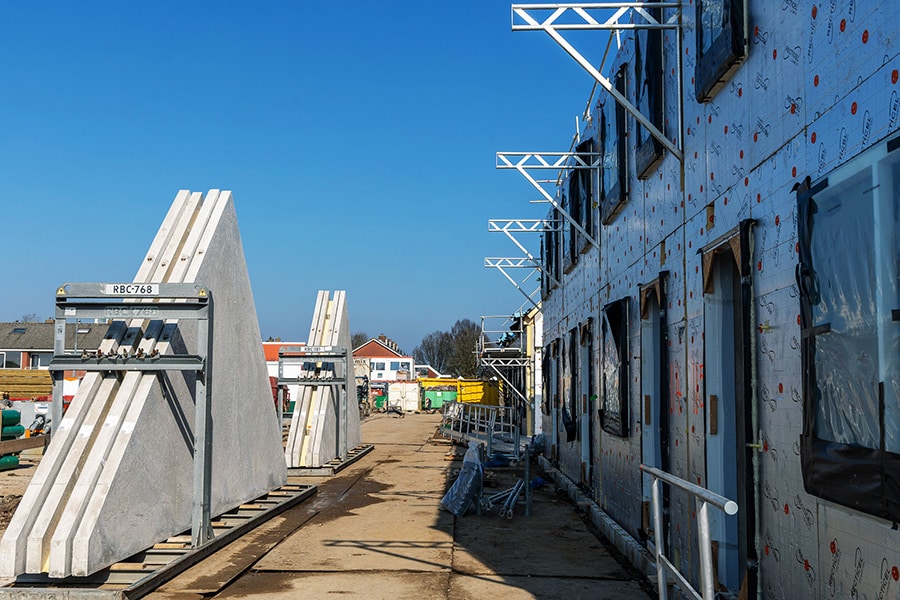
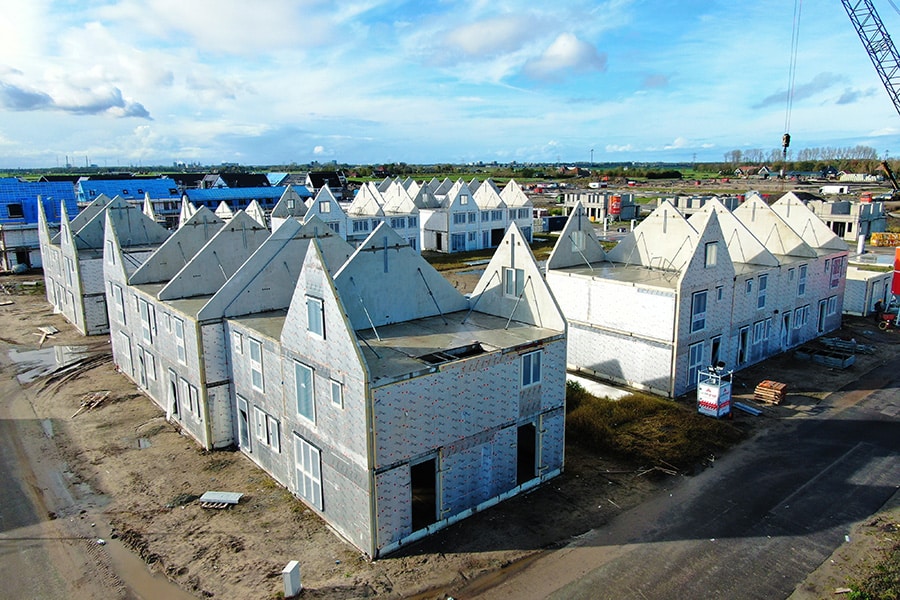
For De Vries, this isn’t just innovative thinking for the sake of it. MBS has been experimenting with cement-free variants for some time, but with current technology, the company has been seriously working on their application in structural prefab elements since early 2023. In late February 2024, the first installation of structural facade and wall elements made of geopolymer concrete took place at a Heijmans housing project in ’s-Gravenzande. Two homes in a row of four were the first to feature this technology.
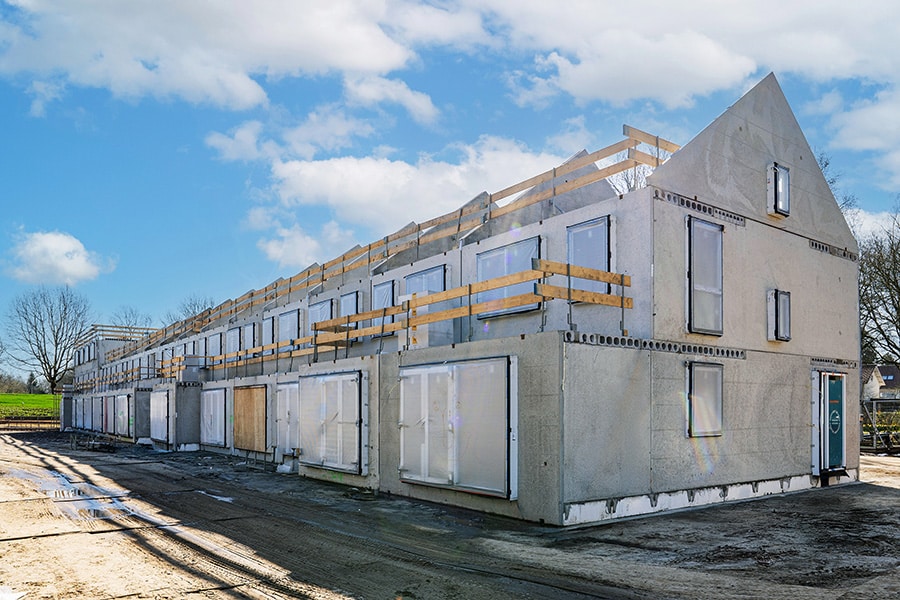
For now, the scope of application has been deliberately limited to ground-level housing—that is, row houses, semi-detached homes, and single-family homes. Not because the material can only handle light-duty applications, De Vries emphasizes, but because the design codes for cement-free concrete have not yet been established. “Certification isn’t quite the right word,” he says. Equivalence is demonstrated through the Concrete Innovation Desk, specifically for concrete walls and facades in ground-level residential construction. That desk, part of the Concrete Agreement, was intended to accelerate innovations. In this case, says De Vries, it has done exactly that: it produced the necessary documentation that a contractor can use to apply to the municipality.
The practice is now starting to gain traction. Earlier this year, MBS supplied Nijhuis Bouw with prefabricated geopolymer concrete elements for approximately twenty homes in Assen. That’s where the crux of the matter became clear: the design and execution remained the same. Upcoming projects are mentioned in Meppel and Hardenberg, among other places. Still, De Vries says the momentum is still too slow. The interest is there, but the extra cost is a sticking point. Not out of fear of the unknown, but rather because of the cold, hard reality of housing construction: contractors calculate every project down to the last detail. That’s where the classic innovation paradox lies. To eliminate the additional cost, MBS needs to scale up, but scaling up requires projects—which are harder to secure as long as there’s an additional cost. During a recent client event, MBS laid this vicious cycle out on the table for its clients. Not by asking them to switch everything over all at once, but by requesting that each client undertake a few projects using geopolymer concrete. According to De Vries, this has now led to concrete progress.
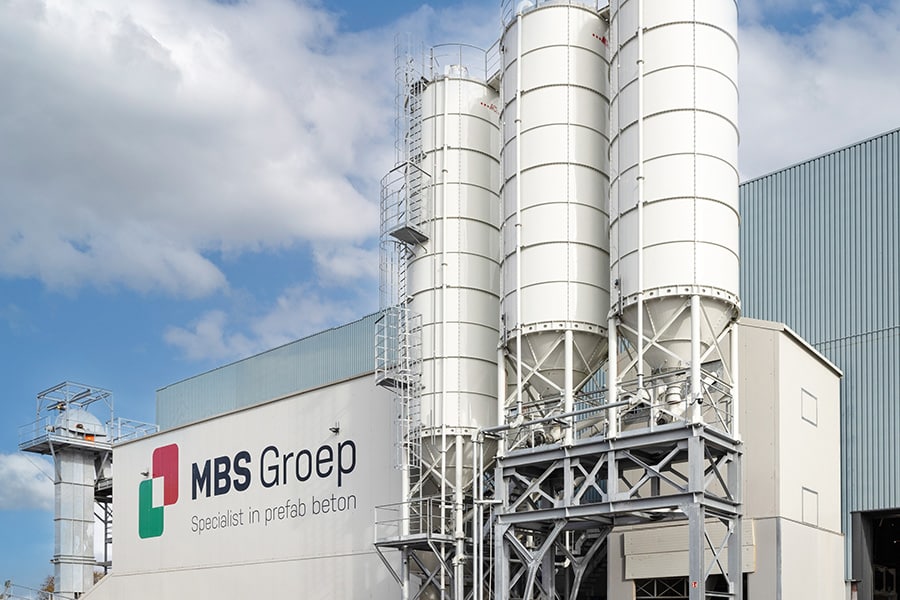
According to De Vries, the comparison with wood construction is also interesting. “In that sector, a higher price is often more readily accepted, precisely because of the sustainability claim. Geopolymer concrete calls for the same appreciation, but maintains the familiar logic of concrete. For clients and municipalities, that can be a key selling point: CO2 reduction without a different building shell or new construction methods.” De Vries therefore does not expect a revolution, but rather a series of projects that will make the exception the norm. Stricter sustainability requirements from governments would help in this regard. After all, the technology is there, the one-stop shop has done its job, and the first building shells are in place. Now the market needs to start using the material on a large scale. Or, in construction terms: stop talking about cement-free concrete and just start using it.
Neem dan rechtstreeks contact op met MBS Group.
 Contact opnemen
The MBS Group is a leading player in precast concrete construction. We supply a wide range of precast concrete elements for residential construction, high-rise buildings, utility buildings and custom-made specials. With our expertise and experience, we help you realize your construction project more quickly, efficiently and sustainably.
Bekijk Bedrijfsprofiel