Platform on concrete and steel in construction
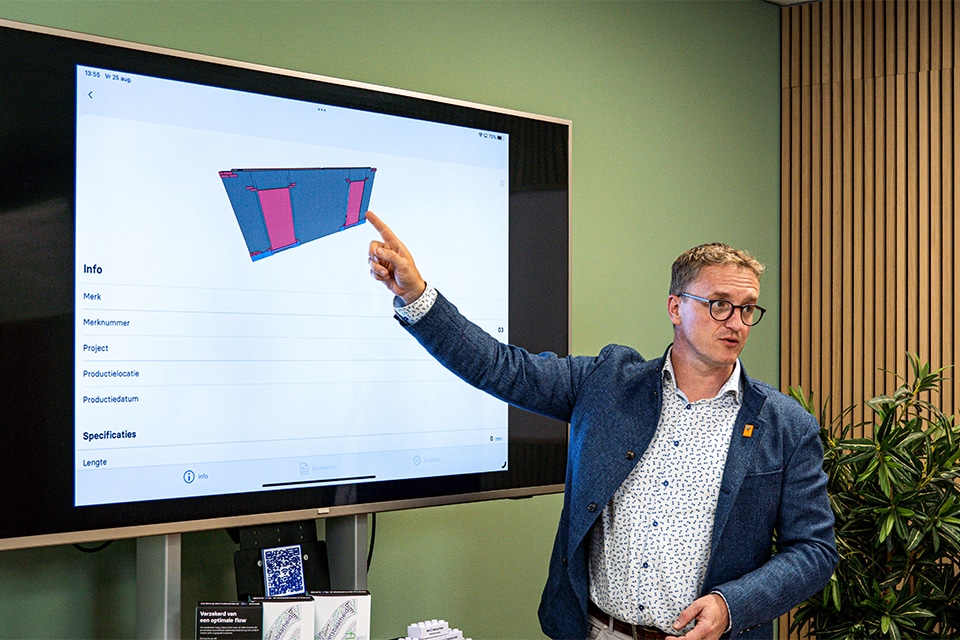
Industrial construction is rapidly professionalizing. Production lines are becoming more complex, economies of scale continue and margins remain under pressure. At the same time, social pressure is growing to build faster, better and demonstrably. The Wkb increases this pressure even further: quality must not only be delivered, but also proven. Speaking is Maarten van der Boon of BIM4Production®. “Digitization plays a key role, but for many companies the software landscape is a confusing mix of systems, terms and promises. Anyone who wants to keep seeing the forest for the trees must above all understand that three systems have their own, non-interchangeable roles: ERP, MES and APS.”
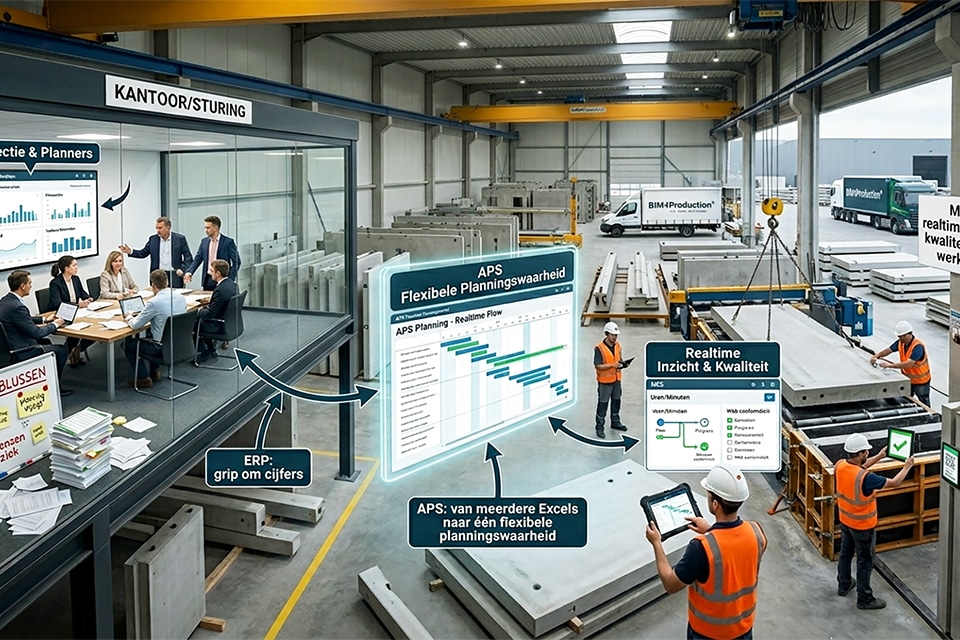
A construction plant functions as a single entity: people, machines, materials and information must be continuously coordinated. Disruption in one place directly affects the rest of the chain. It is precisely in this necessary coherence that three persistent misunderstandings arise in practice, according to Van der Boon. “First of all, the frequently heard remark: ‘Our ERP can do this too.’ Theoretically perhaps, but in practice it leads to customization, detours and frustration. The comment is often followed by a second: ‘We have one system for this.’ A successful digital transition is not a ‘big bang’ and does not fit into a ‘one system fits all’ solution; it starts with the biggest bottleneck and grows step by step. The comment: ‘Digitalization is an IT project’ is the last, frequently heard comment in the top three. The opposite is true: processes, people and culture determine success, not software alone.”
Those who recognize these misunderstandings in time create space for a systems landscape that reinforces rather than counteracts each other, says Van der Boon. “This is why a modern factory requires three systems that together form a digital backbone: ERP for enterprise process, MES for execution and APS for planning.” He continues his story in a brief explanation of the various systems.
“An ERP system is usually the administrative and financial project brain in an organization. ERP gives structure to orders, purchasing, finance and reporting. Indispensable at the enterprise level. But ERP works coarsely: it looks in weeks and transactions, while production works in hours and minutes. ERP is therefore less suitable for controlling production workstations or daily production flow in detail.”
“MES brings the production reality of the plant into focus. It provides employees with the right drawings, instructions and quality checks at the right time in the production process. And it records real-time progress and deviations. The result: fewer errors, less paper, more predictability and demonstrable quality assurance per element - which is useful within precast and the Wkb context.”
“As long as schedules float on Excel, orders and a dose of experience, they remain vulnerable. APS creates one realistic plan truth based on actual capacity in people and resources. And if reality changes due to disruption or changing priorities, APS integrally adjusts the schedule. This increases delivery reliability and reduces the risk of unnecessary production downtime.”
“The SaaS platform BIM4Production fits seamlessly into this triad. It combines ERP information (independent of ERP vendor), an MES layer for execution and quality assurance, and a planning module that acts as an APS engine. Everything is integrated into one production ecosystem, specifically designed for industrial construction plants. This creates one continuous data flow - from order to element and from planning to production - fully Wkb-compliant and without the pitfalls of separate systems.”
Van der Boon concludes with a clear vision: “The question is not whether ERP, MES and APS are needed, but how they are balanced. Companies that manage that cohesion are not only building a future-proof IT landscape, but above all a factory that produces reliably. Every day.”
Neem dan rechtstreeks contact op met BIM4Production®.
 Contact opnemen
With smart production software, you bring flow to your planning, production and logistics of precast building elements. And that from your 3D BIM model. Assured of optimal flow BIM4Production® has closed the gap between 3D BIM engineering and automated precast production. Our ambition dream is therefore: a fully automated and large-scale production process in every factory in the world. Including yours. [...]
Bekijk Bedrijfsprofiel