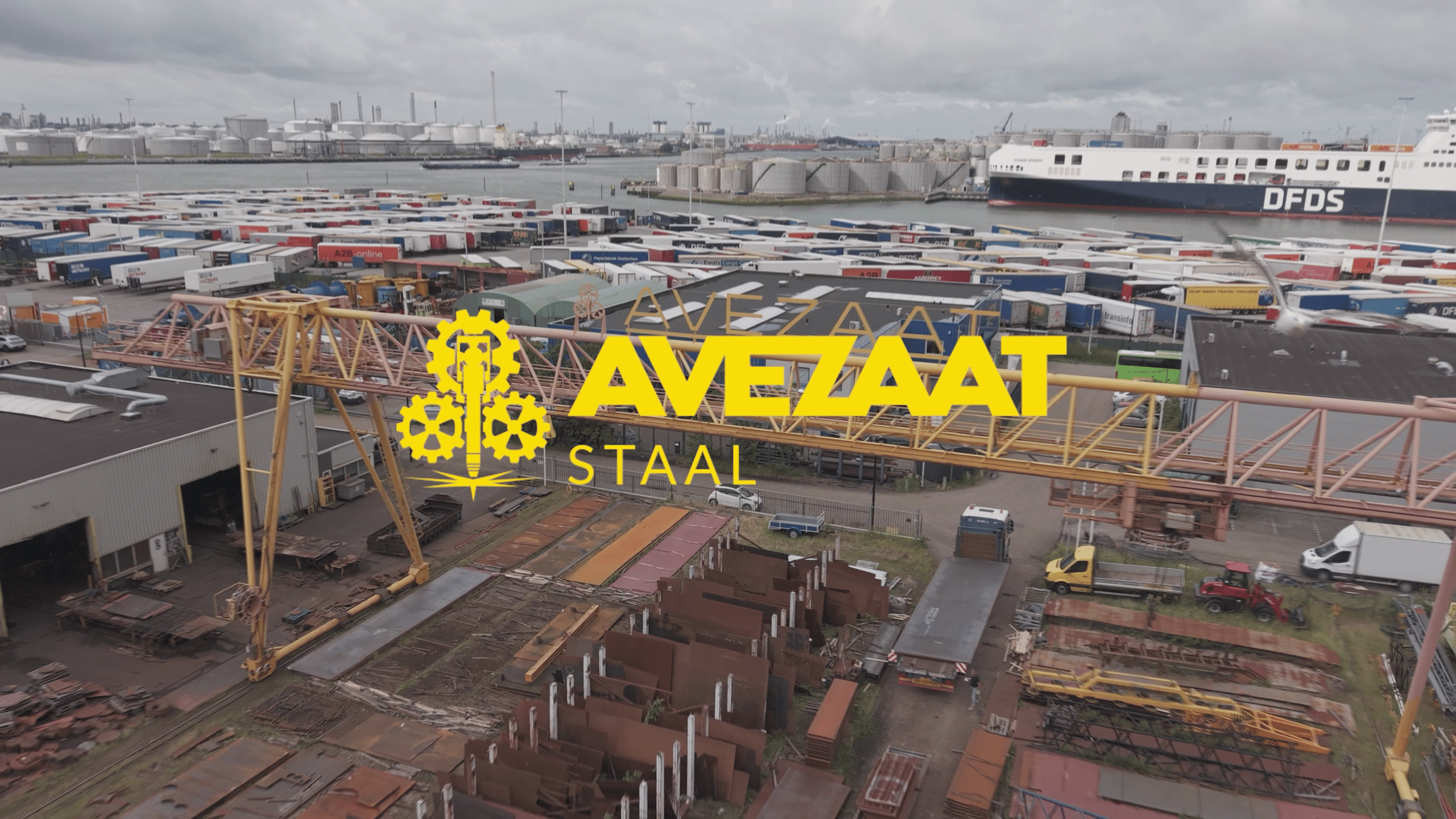
Today we’re visiting Avezaat Staal in Vlaardingen. And I’m speaking with the owner and CEO, Barend Avezaat. Could you tell us a little bit about who and what exactly Avezaat Staal is?
Avezaat is a holding company comprising several businesses, including crane repair, aerial work platform repair, and a steel cutting shop. For the past 40 years, we have been supplying products for offshore ship repair, mechanical engineering, and similar sectors. We also manufacture semi-finished products for these industries and companies to help them carry out their work.
Of course, we’re not here just for the sake of it today—we’re here for a special reason. You’ve found a new location here in Vlaardingen that’s four times as big as where we are now. Why don’t we go check out that new location sometime to see what it’s like?
Yes, once again with immense pride—but also with a tear in my eye, I must say. We’re leaving a piece of history behind, but the best part is that we can make our dreams come true and continue to expand the adventure.
Well, Barend, here we are at your new location. What do you hope to achieve with this location?
As for what we want to achieve—we’ve actually already reached our limit; for at least seven years now, we’ve been running into the problem of hitting a wall—in terms of space, keeping customers satisfied, and growth. We’ve taken a different path than our potential competitors and peers. This applies to our cutting methods and product variety, as well as the speed and quality of delivery. We also want to reduce our use of fossil fuels as much as possible—to the extent that it’s feasible and technically sound. And to do that, we needed two things: more space to optimize our logistics efficiency, We also needed the cooperation of municipalities and agencies committed to supporting the business community. And yes, this is actually something we’ve been preparing for over the past few years—and now we can make it a reality.
What are you most worried about regarding the move?
Well… what I’m most apprehensive about—and have always been—is mainly: How does it actually work? How does it play out in practice? How much expertise is actually available in our industry regarding the equipment and machinery we use? And whether it remains economically viable to invest.
Suppose I come back in five years and we're standing here again. What do you hope to have accomplished by then?
The energy we can then generate from our own resources—that we can actually use more than 50% of it as part of our total energy consumption. And on top of that, we can go even further with technology that continues to evolve at the cutting edge.
I would like to thank you very much for giving me a glimpse into your current business and your future business.
Yes, thank you.
I wish you the very best of luck with all the changes.
Yes, and I hope you’ll stick with us through those five years, too. Because then maybe we can say we’re ready to move forward again—whether that means advancing further in technology or expanding even more. After all, fortunately, we have the capacity to do so.
I'd be happy to accept that invitation, Barend.
Let's agree on that. Thank you.