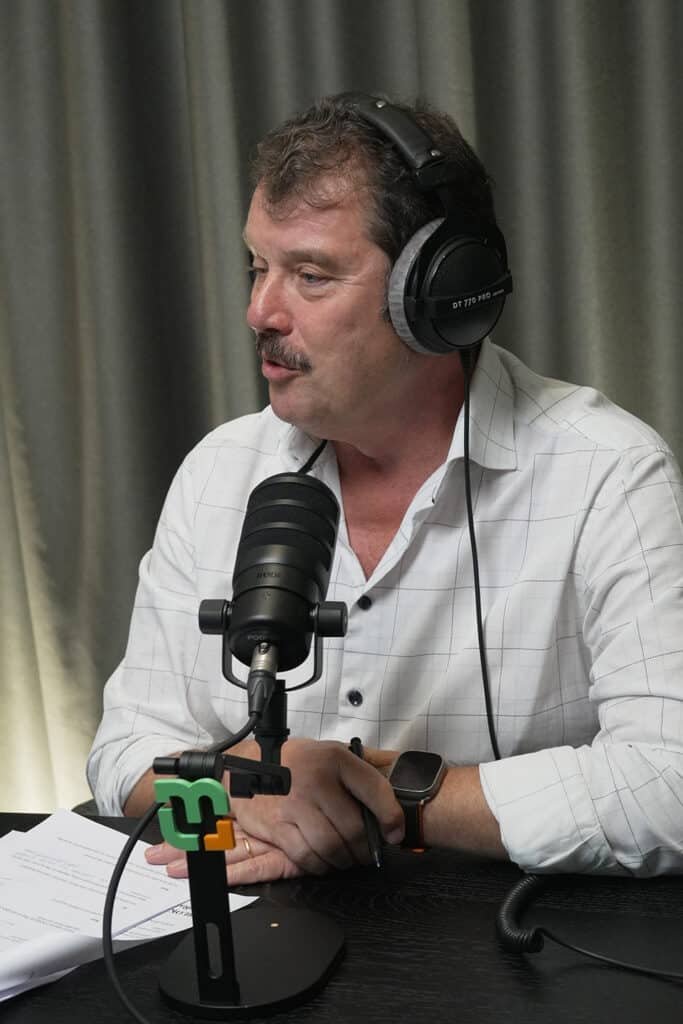
[00:00] Maintenance Based on Actual Condition
Roel van Gils: Welcome to another new episode of “Concrete and Steel Construction,” the podcast. The Netherlands has thousands of bridges, viaducts, and other engineering structures that are used intensively every day. Many of them date back to the 1960s and 1970s. They are slowly reaching an age where maintenance is becoming increasingly important. At the same time, infrastructure managers face an enormous challenge. There is more infrastructure than ever before, maintenance is becoming more expensive, closures are rare, and the societal impact of disruptions is only increasing. When can we move away from maintenance based on a fixed schedule and transition to maintenance carried out based on the actual condition of a structure? Today, we’ll be discussing this with Jo van Montfort of Bjond Innovation and Jos Kronemeijer of ProRail. Welcome to both of you.
Jo van Montfort: Thank you.
Roel van Gils: Maybe you could start by briefly introducing yourself, so we know who's at the table.
[00:55] Jo van Montfort and Bjond Innovation
Jo van Montfort: Jo van Montfort. I am the owner and founder of Bjond Innovation, and we are a consulting firm specializing in steel and concrete. We primarily focus on complex issues—such as extending the service life of these materials, material degradation, and arbitration cases. And that, in a nutshell, is what we focus on every day.
Roel van Gils: Well, I'm sure we'll come back to that later. Great examples. Thank you. Jos?
[01:28] Jos Kronemeijer and Asset Management at ProRail
Jos Kronemeijer: I work at ProRail, in the Asset Management division, as a systems specialist. So I help draft design regulations, specifications, and guidelines for the materials we use in engineering structures, bridges, viaducts, and tunnels. Maintenance and management issues are part of my job. I’m a materials technologist. I studied Materials Engineering, and I work in the field of cementitious composites—that is, cement, grouts, mortars, concrete, coatings, and so on.
Roel van Gils: I think so.
Jos Kronemeijer: Yes.
Roel van Gils: Look. Welcome again. I’d actually like to start with ProRail. Of course, many people see the trains running, but they don’t realize how many structures they’re passing under or over. Can you give us a general idea of just how big this maintenance task is?
[02:24] The size of the rail network
Jos Kronemeijer: There are about 7,000 kilometers of railroad tracks in the Netherlands. And every few kilometers, there’s a culvert.
Roel van Gils: That’s huge, yes. And in steel, in concrete, and in all kinds of materials, of course.
Jos Kronemeijer: Yes.
Roel van Gils: And what makes a railroad bridge different from, say, a state bridge?
Jos Kronemeijer: The fact that trains run over them—in the Netherlands at a very high frequency, meaning they are subjected to extremely heavy use. An important difference in the load they bear is that, for example, salt is not spread on railway viaducts and bridges. The structures we build are different, and fatigue—specifically, long-term behavior in terms of fatigue—is particularly important to us. And there’s also a direct link to the maintenance systems we use, as well as the products we apply to them, such as coatings, which we’ll discuss later. These have a direct correlation with fatigue, among other factors.
[03:32] Preventive Maintenance and RAMSHEEP
Roel van Gils: Yes. And when we look at how maintenance is traditionally carried out these days, how does that work?
Jos Kronemeijer: As with all major public asset managers, we use, among other things, the RAMSHEEP method—a type of risk and performance analysis tool. The acronym RAMS stands for: Reliability—that is, the reliability of the system. Availability—the systems must be available. Maintainability—the ability to maintain them. And that’s the central theme we’re focusing on right now. Safety—safety for the environment and for the users. And, of course, the interaction with the environment surrounds all of that.
Roel van Gils: Yes, but do you mostly work according to a set schedule?
Jos Kronemeijer: Yes, we have to. We can't, let's say, make that dependent on whether there's a disruption. Then we'll be too late. If we didn't do that, it would be total chaos.
Roel van Gils: But perhaps as a preventive measure?
Jos Kronemeijer: Yes, on a large scale.
Roel van Gils: Yes, that does happen. So it’s not just according to a set schedule?
Jos Kronemeijer: Combinations.
Roel van Gils: Combinations, yes. Okay. Because just looking isn't enough anymore, of course. Jo, your approach fits in perfectly with that.
Jo van Montfort: Absolutely.
[04:57] Why Visual Inspection Is Not Enough
Roel van Gils: Why isn't just watching enough anymore?
Jo van Montfort: Well, as Jos said, when we look at coatings: if a coating fails, you can obviously see it. Anyone can see that. But then you reach a certain level of degradation where you end up having to perform what’s called corrective maintenance. For most clients—such as, and especially, ProRail—this is a massive problem, because the periods when trains aren’t running are very short. That means repairs can often only take place at night. Or an entire rail line must be closed, with all the consequences that entails, meaning that all traffic on that line must be rerouted, along with all the complications that come with it. So that’s not desirable. We need to find solutions that extend the lifespan of the existing preservation or protection of the structure for as long as possible. And that’s why you want to know: when will that failure occur? So you want to analyze that coating using data—not just observe it.
Roel van Gils: So just looking at it isn't enough, because a coating can look perfectly fine on the outside even though the deterioration process has already begun?
Jo van Montfort: Absolutely. A person can look perfectly healthy, but that very same afternoon be admitted to the emergency room with a heart attack. Or take tooth decay, for example. It can go unnoticed for a long time, and the cavity is already there. But at some point, the cavity breaks through and the decay reaches your nerve. And then you feel it—but by then it’s too late. That’s why you go to the dentist preventively. If the dentist notices, “Hey, that enamel is starting to wear down and erode a bit.” It’s no different with coatings. He can measure that to some extent as well. But in that regard, we’re a bit further along in the world of coatings. So we’ve developed techniques to further measure the degradation—the degree of degradation, so to speak, the health of the coating—and to do so non-destructively.
[07:07] Electrochemical Impedance Spectroscopy
Roel van Gils: What's that technique called?
Jo van Montfort: That's Electrochemical Impedance Spectroscopy—a fancy term.
Roel van Gils: It’s a term that’s widely used around the world. It sounds pretty complicated. But what does it actually involve? Please explain.
Jo van Montfort: Well, it’s a non-destructive method. As I said before, you basically place two electrodes on the surface of the steel. You pass an alternating current through them, varying its frequency. Well, to keep it from getting too technical: you’re essentially measuring the resistive properties—the barrier properties. That’s ultimately what you get: the barrier properties. Imagine this: a coating like that—which many people don’t realize—is about 300 micrometers thick. Not even half a millimeter. And it’s even specified at 350 micrometers. Those are the requirements. That means it’s about the thickness of a hair on your head. And that’s often three or four layers. And that’s supposed to protect the steel for 20 or 30 years. That’s what we’re measuring. We’re actually measuring that thin layer. That’s how you should picture it. And the result is essentially a percentage decrease in condition. Is it green, orange, or red? That’s basically what the result shows.
[08:29] Natural Aging of Materials
Jos Kronemeijer: Maybe this is a good point to add to what you said. Everything we build ages over time. Natural degradation, exposure to UV rays, weather, wind—you name it. And what specialists like Jo look at, among other things—and we, of course, as asset managers—are external chemical influences. Those cause the materials to literally age. Yes, the sooner you address it… That’s part of preventive maintenance. So periodic inspections—that’s the preventive side of things. And if something happens between those preventive inspection intervals, you’ll perform what’s called corrective maintenance. That’s when you get to work on it.
Roel van Gils: And how do you determine the locations where you take measurements?
[09:12] Making EIS Accessible to Inspectors
Jo van Montfort: That also involves knowledge of the material you’re examining. So, of course, that’s a factor. We’re currently working on further standardizing and formalizing that process, because right now it’s still the work of true experts—of specialists. We actually want to bring it to a level similar to how we now measure coating thickness. Back in the 1980s, we measured coating thickness by making a scratch in the paint and using a magnifying glass to see how thick the layer was. Then someone came along with a magnet, and that man was declared a madman, but in the end, he was proven right. And now we perform all measurements on paint systems non-destructively using a coil and a magnet. And that’s accurate down to the micrometer. We’re actually at that same stage right now with the EIS process. So we want to standardize a technique that already exists, such that in 80 to 90 percent of cases, anyone who has completed standard coating inspection training can perform that measurement and even interpret the results. Of course, that leaves 10 to 15 percent that’s really difficult. But then again, that’s why Bjond still has a reason to exist.
Roel van Gils: Yes, but was that EIS method developed by you guys—by Bjond?
[10:31] Partnership with C-Cube International
Jo van Montfort: That wasn’t developed by Bjond. It’s a method that was developed back in the ’70s and ’80s in laboratories—primarily by Americans—and was adopted by European laboratories, where it was further refined. A company like C-Cube, for example, in Delft—it’s a university spin-off. They’ve turned it into a workable system, and we collaborate very closely with them. Yes, that coating… Sorry, the measurement system they’ve developed is very robust, very user-friendly, and also very reliable. And of course we’ve tested it ourselves, because we want to know what we’re working with. Yes, in the outdoor environment—in the field.
Roel van Gils: But then you project that onto the artwork?
Jo van Montfort: Yes. So how does it work? First, you place a few sponges under a small magnet on your artwork—that is, on the coating—to let the coating acclimate to the environment. So you need a conductive medium. So you need to moisten it a little. Then you let it sit for a week. After a week, you come back. Then you place your measuring electrodes on it and, within two minutes, you take a measurement at the spot where you want to determine the properties. Each measurement takes about one to two minutes per point. So within a few hours, you’ll know exactly what condition that coating is in: bottom, top, sides, inside—anywhere.
[11:59] A comparison with an ECG
Jos Kronemeijer: Yes. That might be a good analogy to the example Jo just gave. When you have an ECG, you also attach electrodes to your chest, and they need to make good contact. Yes, these sensors need to make good contact as well.
Jo van Montfort: Analogies, yes. That's right.
Roel van Gils: You're already on the right track. But how often do you take those measurements?
[12:29] A baseline measurement for new coatings
Jo van Montfort: That measurement frequency… So you start at zero. That’s your choice. It’s best to do that when the building is new.
Roel van Gils: So, on the newly applied coating?
Jo van Montfort: Yes. The system is so powerful that you can also determine the quality of a newly applied coating. As I often say: a coating like that is very thin, but it’s also very difficult to apply. Painting a steel structure involves quite a bit. The conditions have to be right. The temperature has to be right. The humidity has to be right. The surface has to be clean. There are a lot of requirements.
Roel van Gils: What you're saying is: something could go wrong there, too?
Jo van Montfort: A lot goes wrong there, very often in practice. And especially when you also have a train-free period during ProRail projects.
Roel van Gils: It has to be done quickly, of course.
Jo van Montfort: It has to be done quickly. So you have to apply special products under difficult conditions, and they still have to cure properly. You’re dealing here with a curing process and materials that react with each other. If the temperature isn’t right—which we almost never have in the Netherlands… Last week it was way too hot, and before that it was way too cold—or it’s way too wet. It’s never right, so it’s never ideal. Those products aren’t ideal either, so it’s always a compromise between a number of factors. But what you really want to know is how good the end result actually is.
[13:41] Establishing the Initial Condition
Jos Kronemeijer: Yes, maintenance literally begins just as it does with a car that comes off the assembly line. The moment it rolls off the line, that’s when it starts. You assess its condition so that you can then, so to speak, track its deterioration over time.
Jo van Montfort: Yes, exactly. And you can also use it to determine your zero-defect standard—if you can establish it properly. Then you can make clear agreements with your contractors, saying: Look, here’s the deal: yes, it looks pretty good. The color will be right. The thickness is sufficient, and it also adheres well. And when it comes to that adhesion, I’m being destructive, because I’m damaging the coating—which is actually what you don’t want. So then I have to repair it again. With this technique, you’re working non-destructively. Then, based on the initial condition, you can say: is it 80%, or did you actually achieve the 90% that you’re required to achieve?”
Roel van Gils: I actually think that's pretty low. You'd expect to get 100%. But so it's never 100%?
Jo van Montfort: That’s exactly what I just said. The application process is so complex that, theoretically, we could achieve that 100% in the lab. That’s where a paint system like that is tested, too. So laboratory tests are being conducted. Well, I always say—rather irreverently—that those tests are done on flat panels. But an object… Just look at the corners, the seams, the welds.
Roel van Gils: Where coverage is actually limited.
Jo van Montfort: Yes. And corners and seams that are hard to reach and where conditions are unfavorable for the coating to ultimately perform as intended. It’s all about the performance of such a coating. And you want to know that right at the beginning of the entire cycle: what’s my starting point?
[15:15] Non-destructive testing and scarce expertise
Jos Kronemeijer: Perhaps another nice addition. To assess it in a way that isn’t—as has been almost exclusively the case in the past—destructive. When you assess the condition, you sometimes cause a little damage. And then you have to repair it. That creates more work. And when you have monitoring systems that you literally just have to stick on and then remove again, without causing any damage—in other words, non-destructive—that’s a huge advantage. You also need, let’s say, the expertise required to implement all of this in the field. Intelligence in that sense is built into the monitoring systems, and the demand for it is growing. The number of qualified technicians with the specialized knowledge to fill that need is declining dramatically. We need to address that as well.
Roel van Gils: There are a number of factors at play here, and they all come together in these kinds of new technologies.
[16:10] From Measurement Data to Predictive Models
Jo van Montfort: Yes. So you get a huge amount of data from that object. And that data tells you something, but you also have to be able to interpret it. There’s an expert involved who, so to speak, fills in the prognostic, predictive model. And as I just mentioned, we’re working on standardizing that as much as possible. It also turns out that it’s possible to standardize this. A great many coating systems that you see on the structures around you—bridges, lock gates, flood barriers, you name it—as well as chemical plants, tanks, and so on—have similar systems. And that’s because the paint suppliers are happily peeking over each other’s fences and readily sharing best practices on how things are done. So the base binders are often the same, meaning the basic behavior is also often the same—or at least comparable. This will make it easier—in a manner of speaking—to create a good predictive model.
[17:22] Measurement Intervals and Requirements for a Paint System
Roel van Gils: Jo, you say that in an ideal world, you should actually start with a baseline measurement. So what about the intervals between those measurements? Are they a bit longer at the beginning or during the initial period, and then a bit shorter afterward?
Jo van Montfort: Yes, that depends a bit. It depends on a number of factors. It depends on what the customer’s ultimate requirements are for the coating system. OGOS is an organization of major clients in the Netherlands that is also involved with this technology. It might also be worth mentioning them briefly. And within OGOS, there are a number of members. These include Tata Steel, the Province of South Holland, ProRail, the Ministry of Defense, the Flemish Government, the City of Rotterdam, Gasunie, and, of course, Rijkswaterstaat.
Roel van Gils: So what do they do?
Jo van Montfort: They consult with one another, sharing this knowledge and initiating projects to test the reliability and reproducibility of these kinds of techniques in practice. This is because they also recognize that this offers enormous advantages over simply examining paint.
[18:43] From Practical Application to Standardization
Roel van Gils: So is that only happening in pilot projects now?
Jo van Montfort: No, it’s happening. But to really make it standard—to standardize it properly—so that the 80-20 rule or the 90-10 rule becomes a reality. And of course, we fully support that happening.
Jos Kronemeijer: Perhaps another partial answer to your question. The pooling of knowledge that takes place there means that experience with the various coating systems is gained across a very broad spectrum of applications. And that helps with calibrating your system up front. Whether it’s an application at ProRail, Rijkswaterstaat, or anywhere else. From the product system’s perspective, we can already estimate what the inspection intervals should be. And you adjust it by calibrating the systems upfront—at T0 when the system is commissioned. And then it’s, let’s say, the expert system and the experience that determine: okay, we’ll choose those intervals. We know that if we schedule them at that point, we’ll be on time.”.
Jo van Montfort: As is often the case these days, it's too late.
Roel van Gils: That's right.
Jo van Montfort: Yes. But on the other hand, it's also too soon.
[20:04] Maintenance performed too early is also a waste
Roel van Gils: Does that happen, too? Isn't that better, though?
Jo van Montfort: Yes, but of course that's a huge waste of materials. It drives up costs.
Roel van Gils: What do you mean? Measuring too early, or too early…
Jo van Montfort: Maintenance performed too early. Based on a little rust, people decide, “Well, the coating isn’t good,” simply because they don’t know any better. Yes, if you don’t measure it, you don’t know. So it may well be—as we clearly demonstrate with that EIS measurement—that on certain parts of a structure, such as the underside of a bridge, the coating degrades faster than on the top. You wouldn’t expect it, but that’s often the case, because it stays damp longer there, and more dirt accumulates. For the ProRail bridges, this is somewhat less of an issue, but especially for regular bridges, which are exposed to salt damage—that’s where you see it. These are also findings that emerge from this research regarding paint systems. So we have clear examples where we see that a different system should actually have been chosen for the underside than for the top.
Roel van Gils: And now everything is the same?
Jo van Montfort: Or perhaps even the other way around, because the wrong assumptions are being made.
[21:12] The Best Time for Maintenance
Roel van Gils: Yes. Then you're back to that issue of knowledge, as you already mentioned.
Jos Kronemeijer: Yes. And you can compare it to other fields as well. If you need to service your car, it needs new oil. You’ll be on time with that, and that’s good for the vehicle, but it also means taking it out of service and thus reduced availability. And if you’re too late, you’ll end up with damage. So finding that optimal moment also depends on usage and operating conditions. A car will, let’s say, consume more oil in the desert than, say, in a cold climate—you name it.
Roel van Gils: So do you look at each work of art differently, or individually?
Jo van Montfort: Absolutely. As I just mentioned, the artwork’s requirements in terms of lifespan and use are extremely important. The environment in which it’s located—is it by the coast or in a chemical environment, a chemically contaminated environment? That’s a major factor. So is the complexity of the structure. How is it constructed? Do you have a sleek, minimalist structure, or are there still a lot of timber-frame structures with riveted joints? You’ll need to preserve those. They often still have very old layers of preservation on them.
[22:24] Preserve old conservation layers
Jo van Montfort: Well, actually, Jos knows… People often say that: “Yeah, those should be removed.” But if we use that as a standard, it’s not always the best decision.
Roel van Gils: Does it have to come off?
Jo van Montfort: So, together with ProRail, we’ve also looked at a number of projects where the conclusion was: okay, if you upgrade it, it might still last another 50 years. Whereas with old protective coatings, the initial reaction is: just strip them off… But the new protective coatings applied afterward fail within 15 years. And the others just stay on for 50 or 60 years. That poses a problem from an occupational safety and health perspective. So when the time comes to remove them, you’ll naturally encounter substances like lead and chromium-6.
Roel van Gils: Oh, then you'll have a whole new set of problems and challenges.
Jo van Montfort: But as long as you leave it in place and it doesn’t leach into the environment, it isn’t a problem in and of itself for people or the environment. But it does offer extra protection for your existing structure. And you can monitor that very effectively using this technique. Well, of course, it’s up to the client whether they want that or not. There are clients who say: I don’t want it; I just want it removed, and I want to start from scratch.
[23:43] Blasting, primers, and new cleaning techniques
Jo van Montfort: And that brings us to the moment when you’re starting over clean—if I may continue on that point for a moment.
Roel van Gils: Yes, just keep going.
Jo van Montfort: So you say: well, we’re going to sandblast it. We’re going to sandblast it all off—with a lot of dust and a lot of hassle. And we’re going to apply a primer, and then we’ll rebuild the paint layer from scratch. Yes, there are also movements now where they say: “Well, we’re not going to blast it off with abrasive.” Because when you use an abrasive, that’s an active method where you’re essentially projecting particles onto the steel. You’re throwing something at it, and that causes something to come off. Yes, you can imagine that dust and particles remain in that surface. That primer is supposed to ensure that the paint system actually adheres properly afterward. If I were now able to get it perfectly clean, then that wouldn’t actually be necessary. Then you could skip the primer altogether. It saves material and also improves adhesion. There are now new laser-based cleaning techniques for this. They’re in full development. Until recently, they were considered too limited because they were too slow, or so it was said. You have to supply the blasting media. You have to blast it onto the surface. You have to remove the blasting media—which contains the contaminants—again. And there’s the load on your scaffolding, which can weigh hundreds of thousands of kilograms.
Roel van Gils: Of course, you have to pack everything.
Jo van Montfort: Packing everything up, dust exposure. If you factor all that in… A laser cleaner—you just shine a light on it.
Roel van Gils: Literally.
Jo van Montfort: Literally. That coating evaporates. Just that thin layer—that super-thick coating—evaporates. I’d vacuum it up with a small vacuum cleaner so it doesn’t end up in the environment or in my lungs. Then, of course, you can work much more cleanly.
[25:31] Laser cleaning as an alternative to blasting
Roel van Gils: But how far along is that technology?
Jo van Montfort: We’re still a long way from that right now. It’s being used extensively in the United States—partly because many projects there are prohibited from generating dust. In Europe, unfortunately—and certainly here in the West—we’re lagging quite a bit behind. And I really do advocate taking a close look at this. It’s truly a technology with a very promising future. Especially where sandblasting isn’t an option at all. But you could easily apply this on a large scale, even to important structures. Especially when it comes to preventive maintenance, where you end up with a perfect surface. And if you have a perfect surface, you can imagine: then I also have a perfect preservation system.
Roel van Gils: Ultimately, a preservation system.
Jo van Montfort: And I can easily monitor that with EIS to see if it’s actually true. So you can very easily monitor whether what I’m saying now turns out to be true using a system like that.
[26:26] Remaining Service Life and Replacement Schedule
Roel van Gils: Yeah, okay. So how does ProRail view these kinds of solutions?
Jos Kronemeijer: To put it very simply: in the same way. Maybe that’s a good starting point, because I hear Jo saying a lot of things that ring true. When you build new structures—bridges, viaducts, tunnels, you name it—you incorporate a design-life perspective right from the start. To put it simply: design life. And in practice, that service life is sometimes shorter. But we live in a time when large-scale replacement… There’s often no budget left for that. When you have to postpone that replacement, monitoring the condition becomes even more important, of course. Monitoring allows you to determine how that degradation is progressing, so that based on experience you can say: okay, a dangerous turning point will arise in two or three years. When you conduct such monitoring—and if you do so continuously—you gain a clearer picture. Then it’s no longer just snapshots, but rather a continuous video, making it easier to extrapolate into the future: “Okay, the decline has begun.” The better we can predict where that point lies, the better we can determine the remaining service life. And knowing the remaining service life, of course, lets you know when you’ll need to carry out major repairs or, if necessary, replacements. And once you know that, you can budget for it, turning it into a manageable issue. Essentially, this is the need and desire among asset managers to use monitoring systems to build more intelligence into the system and thereby achieve cost control: not too early and not unnecessarily, but certainly not too late. Because the need for replacements simply cannot be budgeted for on a large scale in the coming years.
[28:05] Technology Readiness Levels
Roel van Gils: But are you looking at more than just the preservation system—including monitoring?
Jos Kronemeijer: Yes, definitely. You also just asked: Is this technology new? Well, that might be a good starting point. New technologies entering the market—innovative technologies—have the disadvantage that there’s often no historical track record of their reliability yet. That means the creators of these new technologies will have to prove that they can actually make them work in the field. After all, they’re the ones who developed the technology. Well, there is a system they’ve developed for this purpose. It’s called Technology Readiness Levels. And for a new technology or innovation, you can classify the Technology Readiness Levels from very low, level one: an idea in your head and tested at the kitchen table. Technology Level two: tested in the garage, on your own workbench. Up to and including number eight—let’s say it’s known within the field. And number nine: available on every street corner—regulation. So you actually have to navigate through those levels as well. And the technologies you’re talking about fall within the range of eight to nine.
Roel van Gils: Oh, have they gone that far already?
Jos Kronemeijer: Yes. And that naturally makes them interesting to administrators, because it makes a large part of the teething problems—as well as the limitations and strengths—of those systems much clearer. And new technology is always useful and important—you should always consider that. If only because it allows you to better solve future or existing problems. If you want to implement it, then it’s important for asset managers to know what stage that new technology is at.
[29:36] Continuous Monitoring with EIS
Jo van Montfort: We were just talking about measuring the condition using a handheld method, which I just explained. Yes, and that’s actually what this story is about. We might also add that, within that entire field, we’ve developed a methodology to continuously monitor the condition of the coating. A pilot project at the Philips Stadium. So, one of the pylons standing there is 40 to 45 meters high. It’s encased in an aluminum shell. So there’s a steel pylon. The entire roof is suspended from it. There are eight of those pylons. And we chose one that was relatively easy to access. So you have to go up 14 meters in an aerial work platform to install the sensors. And those are then connected via a small box and a wireless connection. So with this, you can monitor a structure that you can’t actually reach, that can’t be inspected… There are countless examples of this. Think of high-rise buildings, think of bridges that are hard to access, think of lock gates, think of whatever. Offshore, there are quite a few projects being carried out as well. Like offshore wind. To create a kind of alert system. It’s not as if it’s going to cover the entire structure. Just like in your car: if the oil level threatens to get too low, a light comes on. You can actually see that, too. So if the condition level threatens to fall below a certain percentage, we get an alert. Then you know: okay, something’s going on. In addition, you can also monitor the microclimate inside that pylon very effectively—all at the same time.
Roel van Gils: So you're actually taking it a step further?
Jo van Montfort: Yes. You get that extra data. What we don’t know right now is that there’s dirt buildup there, and there are temperature changes. All of that affects the lifespan of that coating. We’ll get all that data and actually feed it into the model—which we might discuss later—so that you can make those predictions with increasing accuracy and ease.
[31:45] Monitoring Without Taking the System Offline
Jos Kronemeijer: Perhaps a quick addendum to that. When you want to conduct a condition assessment for ProRail, it’s done either physically, within arm’s reach, or through monitoring and sensors located on-site. Taking equipment out of service is very difficult. It’s not safe for the people who have to do it. So, a service suspension… The impact of a service suspension is greater than with road traffic. You can’t just put up a temporary barrier. You can’t just close off a lane so that everything can keep moving smoothly, or have drivers take a detour of a few kilometers. That’s not an option with railways. Freight and passenger transport—all run on the rail network. That means that when you plan a service suspension, the economic—but also the social—impact of that suspension is significant. The costs involved are enormous. So anything you can do in terms of continuous monitoring—and do in greater detail regarding degradation, rate, and nature—is a net gain.
Roel van Gils: Yes. But what needs to happen in order to implement that on a large scale at ProRail?
[32:46] From pilot projects to broader implementation
Jos Kronemeijer: That concept has been under consideration for some time. It’s already being used, too. It’s just that this technology isn’t yet being applied on a large scale because it’s still relatively unfamiliar. That said, there have been demonstration projects using it, and there is interest in it. Every structure has its own unique challenges. Take an offshore wind turbine, for example—accessibility is obviously an issue there, as distance makes it very difficult. We might be able to do some things with drones. But physically measuring the coating systems themselves is where you actually get the most reliable overall information. Because you have the overall condition and the unique local condition. What many people notice is that a small patch of paint is starting to peel in a corner where water has been collecting for a long time. That can also be addressed in other ways. But the overall aging of the entire coating system is what’s particularly valuable here.
Roel van Gils: Yes. And it even goes a step further—at least according to what Jo says at the Philips Stadium—in that you also measure the condition of the structure.
Jo van Montfort: Yes, that’s right. Standard inspections aren’t going away. So let’s make that clear. It’s not that you no longer need to do them or are no longer required to. You definitely still need to do them, but you’re getting an extra tool—and an early warning system. If you use the permanent system, you also have the ability to measure things remotely, of course. So that adds an extra dimension to managing your assets.
[34:18] Digital twins and just-in-time maintenance
Roel van Gils: Yes. And you actually already made the connection to a digital model yourself.
Jo van Montfort: Exactly.
Roel van Gils: What does that mean for a bridge, for example?
Jo van Montfort: You're literally creating a digital twin.
Roel van Gils: You took the words right out of my mouth.
Jo van Montfort: Yes. The pylon is physically located in Eindhoven. And it also exists digitally on my computer. I can literally climb in and around it. And I can see, for each sensor, what kind of signal it’s sending and how it actually feels. And I think that, looking ahead, you’ll be able to do this for a wide variety of assets. Look at that data. But the future, of course, involves an automated system handling this. Think of artificial intelligence—systems you can apply to it that recognize patterns very quickly: is something wrong here or not? And they’ll likely send an alert right away. And after that, of course, you’ll still need that expert for a while—or at least the person who ultimately performs the validation. And we’ll certainly advocate for continuing to do that. But by creating these digital twins, you can easily monitor those assets and switch to just-in-time maintenance.
[35:41] Real-time measurement and action thresholds
Jos Kronemeijer: Yes, that might be a nice addition again. Those sensors, combined with those systems, allow you to take real-time measurements. You can determine the condition at any given moment and use that information to make decisions later. If operating conditions are harsh, you shorten those intervals and increase the frequency. But it’s real-time and remote access. If a certain threshold value is exceeded—meaning action is required, i.e., an action threshold—the administrator might see a flashing red light on a dashboard. Or someone in the management organization receives a text message: at such-and-such a location, we’ve determined that the action threshold has been exceeded for that asset.
Jo van Montfort: And then you respond to that—reactively, but in a timely manner.
[36:25] Six Stages of Coating Degradation
Jo van Montfort: It actually consists of six stages. So you have a stable stage. That alone lasts 15 to 20 years. Everything is still fine. You don’t notice any difference either. But the coating is still in good condition at that point. In the second stage, it really starts to degrade. Then it starts to deteriorate a bit. You can’t see that, because the coating looks perfect. There are no cracks in it. It still feels fine, but there’s already damage in that coating. So moisture can get in. And I could measure that immediately with EIS, but I can’t see it. Then I move on to phase three. That’s when the actual propagation—as you call it—begins. That’s when it really starts to break down slowly. You’ll also start to see a very slight delamination and, by the way, a bit of rust. But then comes phase four. That’s actually when most inspectors say, “Now it’s not good; now I see something.” But by then, we’re already in step four.
Roel van Gils: Then the tipping point has already passed.
Jo van Montfort: By then, it’s already too late. It’s already over. The coating starts to peel off at an incredible rate, and the quality deteriorates. It practically peels away from the steel on its own. You see that a lot, too—a coating that curls up at the corners. And they call that “under-rust.” But the coating itself really wants to come off, because it’s literally shrinking away from the surface. And of course, it ends up lying there. We never see stage six. Sometimes we do, but by then it’s completely peeled off. That can be prevented by handling it the right way.
[38:08] Concrete as Protection for Steel
Roel van Gils: Yes. When you think of coatings, you often think of steel—at least, I think most people do. But Bjond does a lot more than that. Can you tell us a little about that?
Jo van Montfort: Yes. So yes, we sometimes say: of course, you protect steel with a coating. But in the world of concrete, we protect steel with concrete. Yes, I sometimes jokingly say that concrete is actually a pretty good coating. I don’t mean that in a bad way. It’s because I look at the world through the eyes of a materials scientist. And if you look at it from a materials science perspective, concrete is really nothing more than… A coating is really nothing more than micro-concrete. That’s what I call it. Why is that? Well, concrete consists mainly of sand, gravel, cement, and water. This creates a stone-like material. It’s ultimately called cement stone. And that forms a thin layer of concrete. It envelops the steel. The steel is a crucial element in the concrete structure. And it ensures that the steel enters a passive state because the pH is very high. As a result, the steel no longer rusts. So that cement skin actually acts as a protective layer.
[39:31] The relationship between the coating and the concrete
Jo van Montfort: Just like that coating. That coating also consists of three main components. An A component and a B component that you mix together. And it contains some fillers that add color, as well as other fillers. And if you look at it on a microscopic scale through a microscope, they look very similar. So if you were to show a photo taken under a microscope of a coating and of concrete—I’d make them black and white—you’d have a hard time telling the difference: is this concrete, or is it a coating you’re looking at?
Roel van Gils: Oh, that's funny.
Jo van Montfort: So that’s why. Anyway, if you look at the material properties, they’re obviously very different. And the coating—well, we don’t really like that. But actually, that’s true. It’s actually very hard and stiff. And brittle epoxy becomes stiffer over time. With concrete, that happens a bit less quickly. With concrete, we have a slightly different corrosion mechanism. You have chloride penetration and carbonation. But ultimately, the properties of that outer layer of the concrete determine whether the steel inside will corrode. So that’s the same. Physically and in terms of materials science, it’s the same.
Roel van Gils: So, could you also use EIS to assess the condition of the steel and the concrete cover?
Jo van Montfort: Yes, and that’s true. You can measure that, too. A great deal of research has been done on this. And as we speak, serious projects are being set up to measure this in the field, just as we do for coatings. Yes, it’s still at a lower Technology Readiness Level than for coatings, but beyond level three, I think—four, maybe even five.
[41:10] The Zeeland Bridge as a real-world example
Roel van Gils: But at the Zeeland Bridge, you told me, did you guys have something similar there, or did something similar happen there as well?
Jo van Montfort: As for the Zeeland Bridge—yes, I’ve been involved with the issues surrounding the Zeeland Bridge for more than 25 years. The Zeeland Bridge was built in the 1960s, in the early 1960s. And the problem there is that chloride penetration occurred fairly quickly, causing the chloride content in the bridge’s skin—the outer layer, or “covering” as they call it—to be too high. If you were to compare that to current standards and requirements, you’d say: well, just tear that bridge down, because there’s way too much chloride in it. It’s literally rusting away from under you, to put it in construction terms. Of course, that’s not the case right now, because in the late 1980s, my former colleague at Intron and I came up with a clever solution to stop that corrosion. The reality is: there’s a lot of chloride in it. So basically, if you compare it to a patient, he has terminal cancer. But we’re going to stabilize the cancer, encapsulate it. That’s essentially what we’re going to do. And that’s exactly what we did.
[42:24] A coating system that has been in use for decades
Jo van Montfort: That was an experiment back then—a large-scale experiment. It’s been 35 years now, and it’s still working really well. Yes. So we were able to limit the access of moisture and oxygen there, in such a way that the corrosion process proceeds slowly. Yes. And well, that’s covered in current regulations—specifically CUR Recommendation 118 and similar documents… Look, that wouldn’t be possible there. But this is a great example showing that solutions already exist to use a coating system on a concrete bridge of that size… You’re talking about a five-kilometer bridge with a few hundred thousand square meters of concrete surface, just to maintain it. What’s crucial here is that the coating continues to perform as intended. That’s the main task I’m focused on. I’m not so much concerned with the concrete itself—that was the initial focus. We looked at the concrete. And now the question is: will that “coat” covering the bridge—let’s put it that simply for now—continue to function? So we want to know whether the coating system will continue to perform as intended. And we’re still using traditional methods to do that at the moment. That is to say: we’re going to take samples and examine them in the lab, looking at all kinds of properties—chloride profiles, things like that—but also conducting more complex tests to assess the properties of the polymers in the coating, that sort of thing. Yes, you could also do that using an EIS method. We’ve conducted tests for that purpose. So some exploratory tests have been carried out. They were relatively successful. But the project has currently been put on hold due to various circumstances, including budgetary issues.
[44:06] Smart Infrastructure at ProRail
Roel van Gils: And yes, do you see opportunities to apply these kinds of principles at ProRail as well?
Jos Kronemeijer: Yes. I’d like to briefly revisit a few keywords I’ve heard Jo mention. Because there’s quite a string of them. So, when you can monitor the condition of a structure with fewer personnel and, let’s say, gain a clearer picture of degradation rates than with occasional inspections… You’re actually creating smart structures. They tell you themselves when they need maintenance. Just like a modern engine management system in your car tells you when tire pressure is low and that you need to do something about it—you name it. That demand is going to skyrocket in the coming years. When it comes to smart sensors, there are so many possibilities. There are sensors we can embed in road surfaces during normal traffic that can detect, for example, that the left-rear dual-wheel set had slightly low tire pressure. So, spectacular things are happening in the field of sensors. They’re getting cheaper all the time.
[45:20] New materials call for new monitoring methods
Jos Kronemeijer: And the properties you measure… The properties you measure in coatings and the relevant properties for concrete are sometimes just a little different. And yes, there are a lot of similarities in the composition and behavior of coatings and concrete. Concrete as a structural material is simply many times cheaper than building with steel. And untreated steel requires protection against the elements, otherwise it will corrode. Concrete acts as a preservative for steel. The only differences are in price and service life. Of course, the maintenance requirements for steel are on a different level than those for concrete. There are known examples of concrete structures—admittedly exotic ones—that are sometimes 2,000 years old. It was the Romans who built the first cast-in-place concrete structures. However, some concrete structures were constructed somewhat haphazardly during the production phase, with minor flaws creeping in that prevent the concrete from adequately protecting the steel. While the thickness of that covering layer does play a role—as it does with coating systems—porosity is the primary factor. And that porosity can vary greatly from one spot to another. And when you take measurements there, this technology also appears to demonstrate a high degree of suitability for this purpose.
[46:47] Low-carbon cements and steel grades
Jos Kronemeijer: That brings us to the new types of concrete that are on the horizon. Not only will we be able to monitor existing structures, but a wave of new materials is coming to the concrete and steel industries. Steel grades are going to change. They’ll also require different coating systems. From now on, we’ll be producing steel with a much lower environmental impact than before. Spectacular things are happening there. It’s just that the progress is a bit slower. In the world of binder systems—that is, the cements used in concrete, which is one of my areas of expertise—the new binder systems with much lower carbon emissions—that is, low-carbon cements and low-carbon concrete types—will behave differently. We just don’t know exactly how they’ll behave. We do know, however, that we don’t have the time to keep working with the old, conventional materials. Because conventional cement production is incredibly harmful to the environment. The same goes for steel. And if you want to keep track of those two factors—along with declining expertise in the field and shrinking maintenance budgets—you’ll need to set up a smart monitoring system. Yes. And once you start using different materials—and the aging process changes as a result—you’ll need to monitor those coatings even more closely. And sometimes you might not want to use a coating at all, but rather apply the same system directly to the concrete surface—to reveal what’s happening beneath it. So that need is only increasing. If for no other reason than that the world is changing. Because access to certain raw materials in Europe is changing. We’re going to be working with different materials more often, but everything also has to be completed in a shorter amount of time anyway. And at the same time, we want to extend the service life. And, and, and.
[48:20] Geopolymers and Unknown Long-Term Behavior
Roel van Gils: Well, great. Do you have anything to add?
Jo van Montfort: No. Well, in that sense: what Jos says is true, isn’t it? So these new types of concrete—the geopolymers—are becoming increasingly popular. And it’s true, their long-term behavior is unknown. And we don’t have the time to wait it out. So what you do have is this technology that lets you monitor it. And that allows you to intervene at the right moment. Collecting data in the field so that you can ultimately make those predictions. Ultimately, improving and further developing the products. Also think about reusing old materials and old structural components. That’s another theme that’s becoming increasingly important. You’re seeing it come up more and more in academic literature and trade journals as well. But that’s also where the challenge lies: yes, but how effective is it, really? And how safe is it all? And how are we going to determine that? Are we going to overload it, or what are we going to do? And that’s where these kinds of advanced techniques—I’ll just call them EIS for now—especially their non-destructive nature, play a key role. It can be a key factor in gaining a better understanding of these issues. So these are also the issues that are certainly receiving attention throughout the entire construction industry and the civil engineering sector.
[49:49] What will maintenance look like in ten years?
Roel van Gils: After this master class on materials science: if we’re sitting down together again in ten years, what do you think maintenance will look like then? If you could summarize it in a few lines.
Jo van Montfort: I see that a great deal is being monitored using remote sensing. So smart sensors are being installed on most structures, and—as Jos just mentioned—more and more advanced and new materials are being used. Application techniques are also changing, as I just mentioned. Blasting—we really won’t be doing that anymore in ten years. I actually think we shouldn’t be doing it anymore even now, but anyway, that’s just my opinion. So there are now more advanced techniques available, which have been continually refined and improved, combined with smart monitoring. And that’s linked to smart systems and artificial intelligence. I think that’s the future. We’re still going to have to apply coatings. Unfortunately, we can’t prevent corrosion. But we can manage it much better than we do now. That’s my position.
Roel van Gils: Look, that's a nice way to wrap things up. Jos?
[51:03] Use longer, reuse, and recycle
Jos Kronemeijer: Yes, I’m picking up on the same point. Essentially, we need to make the existing infrastructure last longer and ensure it functions reliably. We’ll be removing entire structural components more often and reusing them in a circular manner, which makes their condition even more important. The expectation is that these components will be able to function trouble-free for—let me throw out some numbers—25, 50, or 75 years in the new situation. And that’s only possible if you know the condition of the elements you’re removing. We’ll be recycling more often—breaking materials down to the raw material level and reusing them. And those materials may well find their way into coating systems as well. So, if we can intelligently strip coatings from structures and reuse them, that also reduces the demand for raw materials. So it has to be done with less material, fewer people, at lower costs, and it has to last longer.
Roel van Gils: Look at that.
[52:03] Technology remains dependent on expertise
Jo van Montfort: Yes, so it might also be a good idea to make it clear to the listener: this isn’t really about EIS and EIS sensors. Ultimately, it’s about the people who work with them. And it’s about those people knowing where the initial risks arise. That’s what you want to know. If you have a good handle on that, then the future will be clean.
Roel van Gils: Thank you all for these wonderful insights. Thank you for listening. “Beton en Staalbouw,” the podcast, is produced by Louwers Mediagroep in Weert.