[00:00] Introduction of Kobout and Joost Kunst
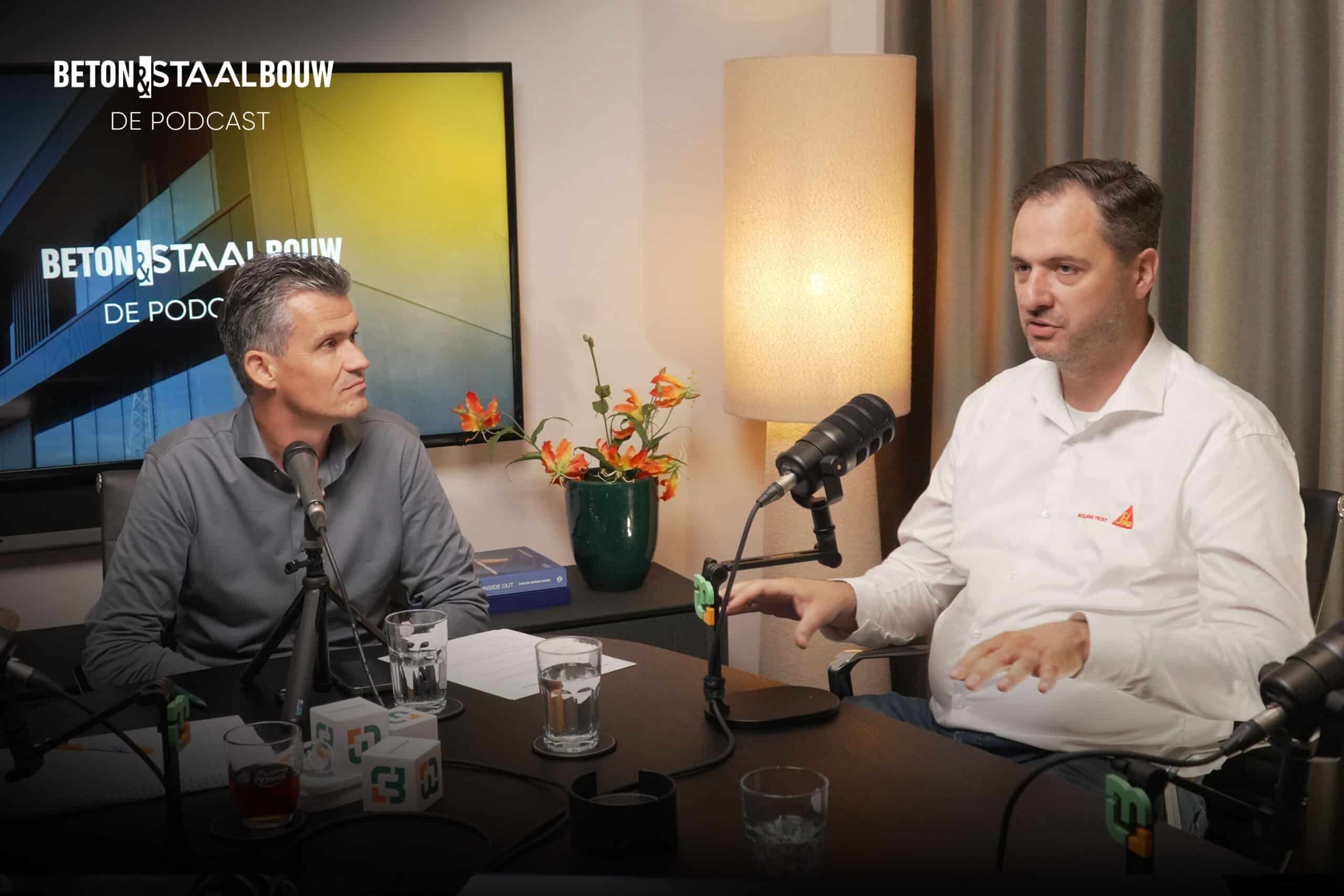
Roel van Gils: Welcome to another new episode of Concrete & Steel Construction, the podcast. Today we're going to talk about bolts, nuts, threaded rods, as well as inventory management and supply chains. With us at the table is Joost Kunst from Kobout. Joost, please introduce yourself.
Joost Kunst: Thank you very much. Nice to be on the podcast with you. I'm Joost Kunst, director of Kobout in Hendrik-Ido-Ambacht, wholesaler of nuts and bolts.
[00:34] More than just nuts and bolts
Roel van Gils: From special packaging to smart RFID systems, you go way beyond nuts and bolts. True.
Joost Kunst: Our slogan is: It's more than fasteners. And we try to carry that through into everything we do as a company.
Roel van Gils: We'll come back to that later. Let's start with the basics. What do you stand for as a company?
Joost Kunst: It's more than fasteners, we keep coming back to that. Initially, we always say that more is, above all, people. We work with 160 colleagues in fasteners, in nuts and bolts, but it's all about those people. About people who do their best to help the company further, to help the customer further, to be there for our customers, to maintain a good relationship with our suppliers and all stakeholders. That human touch is what Kobout stands for.
Roel van Gils: So more than just price and delivery time?
Joost Kunst: Definitely, absolutely. Although of course price and delivery time are important. Those should always be there. Certainly delivery time is very important and increasingly important.
[01:45] Why customers choose Kobout
Roel van Gils: Why do customers keep coming to you?
Joost Kunst: Of course because they are well served. So price and delivery time have to be right. Ordered today, delivered tomorrow, for a good price. But that extra help, if something goes wrong, someone has forgotten to order, going the extra mile to help your customer, that's something someone doesn't just forget.
Roel van Gils: So customers choose you because you think with them. You also don't sell no, you said earlier.
Joost Kunst: True. If someone asks for something we don't just have on the shelf, we will always go out of our way to make sure the customer does.
[02:24] An exceptionally wide range
Roel van Gils: It seems that you also have a lot of products on the shelf.
Joost Kunst: We currently carry 25,000 different products that are available from stock.
Roel van Gils: That's quite a number.
Joost Kunst: Quite a number. We are far from there, because in our system we now have 130,000 different types of bolts and nuts. We are not going to stock all of those, we don't need to, but we are expanding quite a bit every month.
Roel van Gils: Are those all equally profitable or is that a conscious decision that you have so many from stock?
Joost Kunst: Exactly. Of course we have our A-range, the runners-up. We have pallets full of those inside, they are like water from the tap, they are always there. But besides that, we have an ever-increasing longtail. Products that are sold maybe once a year or once every two years. Those are almost gathering dust in our systems, but if a customer needs them and orders them today, they will have them in tomorrow. We then don't have to say that delivery is not possible for another week.
[03:31] Consciously holding stock despite software advice
Roel van Gils: So that's a pretty deliberate strategy.
Joost Kunst: Definitely. We recently started working with software to optimize inventory. Such software then advises: don't buy those products anymore, that's a slow runner, that's capital drain. No, we hack that software. We do stock this.
Roel van Gils: Why?
Joost Kunst: To help our customers. There is not purely the idea of putting as little money as possible into stock and keeping only the profitable products. Our strategy is deliberate: we are specialists in nuts and bolts. If you are a specialist, then you also have stock.
[04:12] Expansion of warehouse capacity
Roel van Gils: Of course, that also means that you guys are bursting at the seams with that ever-expanding stock.
Joost Kunst: That's right. Our warehouse is pretty full. We're even renting extra space at the moment. But hopefully we'll solve that soon. We are working on a piece of new construction where we are going to put up a big extra hall. Then we'll be able to expand those products again.
Roel van Gils: From when is that going to play out?
Joost Kunst: We are now working hard on the permits. I expect to start building hopefully by the end of this year.
Roel van Gils: That's pretty soon already. How much bigger is it going to be?
Joost Kunst: We're going to add a 900-square-meter piece, and that's also going to be quite tall.
Roel van Gils: At the current property?
Joost Kunst: At the current property, correct.
[05:01] Stock as protection against supply chain disruptions
Roel van Gils: That stock is of course also a piece of security for you. Also for your customers, because availability remains guaranteed. Of course we have seen problems when the Suez Canal was blocked, for example.
Joost Kunst: True. A lot of our products come from Asia and that supply chain has actually been disrupted since corona.
Roel van Gils: Never improved again?
Joost Kunst: Some improvement, but never as stable as it was. And now, especially with the war in Iran, everything is going to go up again. That's why we have to continuously make sure we have a lot of stock, extra stock, so that you can absorb those ripples in world transportation.
Roel van Gils: But that's not about weeks?
Joost Kunst: Not anyway. When we order products from the factory, it takes about six or seven months before we have them in.
Roel van Gils: Seriously? That long?
Joost Kunst: So long, yes. So we always have to plan well ahead.
[06:05] Thinking ahead in economically changing times
Roel van Gils: So you are ordering almost counter-cyclically.
Joost Kunst: True. If the economy is going very well, then we have to think about whether it might get worse at some point. Then you have to stop ordering, otherwise you will overflow. And vice versa: especially in times of crisis or when the economy slows down, you have to think carefully about when it will pick up again. Then you have to make sure that stocks are back to normal.
[06:35] Who are Kobout's customers?
Roel van Gils: If we zoom in a bit more on your target groups: who are your customers anyway?
Joost Kunst: Very broad. Half of our customers are also traders. They sell the products on to end users or other dealers. Many of them are in the Benelux, but also some abroad. Our export department delivers from Reykjavik to Athens throughout Europe, mainly to large trading companies. We also supply a lot of industry in the Benelux. Producers in shipbuilding, greenhouse construction, trailer construction, agricultural machinery, mechanical engineering in the broadest sense of the word. And in the construction industry itself, especially dredging, civil engineering, utility construction and larger projects.
Roel van Gils: That is very broad indeed.
Joost Kunst: We always say that the stock on hand ranges from the screw for your watch to a bolt you use to put an oil rig on the seabed.
[07:32] Increasingly customized and private label solutions
Roel van Gils: And you also target customers who want just a little extra?
Joost Kunst: A lot. We don't always have to. Someone who orders a box of bolts from us is very welcome. But you see that more and more people want to be included in their process. We have adapted our processes to that. For example, if a trader says: I want to buy your bolts, but in my own box, private label. About 10 to 15 percent of our trade goes out the door in private label throughout Europe.
Roel van Gils: Also in specific numbers, right? You guys make special packaging.
Joost Kunst: True. We are counting down more and more. Since a few years we have been doing that for a small club of regular customers. Not too many, first testing how to do that well and arrange it as easily as possible. Meanwhile we are scaling that up. We have a piece of automated warehouse.
[08:22] Automated filling of exact quantities
Joost Kunst: If a customer orders 17 bolts, for example, we have to make sure that there is, of course, a box of bolts in that warehouse from which those 17 come. But it is also set up so that the right sticker is printed immediately. The moment the order is picked, those 17 bolts are taken, the right sticker goes on the box and it can be shipped.
Roel van Gils: All those steps are fully automated?
Joost Kunst: Exactly. Meanwhile, we are scaling that up and releasing it for more clients. That's going so fast now that we're even working through the breaks. If one colleague goes on break, another one picks it up quickly, otherwise we can't manage to get all the work done in one day.
Roel van Gils: But 17 pieces from a large pack does sound very specific.
Joost Kunst: That's true. But on the other hand, we have more and more customers who want that. If we have one spent box that ten customers draw from, that is also easy to arrange. For the customer, it's a big advantage, because you don't have too much inventory in the lean world. Overprocessing and too much stock you don't want. You have to store, keep and control that again. There is a lot of work involved in maintaining inventory and we avoid that for our customers.
[09:44] Complete kits based on parts lists
Roel van Gils: As a result, you are taking over an important process from the customer.
Joost Kunst: Yes, and then it goes even further. Because of everything digital nowadays. A machine has a parts list and every bolt is described in it. Then you can very easily say: I need these thousand different products for this machine, divided over twenty drawings. Can you then deliver a box per drawing, like at IKEA, with bags containing exactly the right products and their item number? That process is now automated in our system. That's not a problem. We read your list and deliver a pallet with exactly the right products, with the right stickers, so someone can get started right away.
Roel van Gils: You then get that parts list delivered and based on that everything is specialized internally.
Joost Kunst: Repackaged.
[10:43] From metalworking to specialized operations
Roel van Gils: In addition, of course, you also have many specials and operations that you can do in-house.
Joost Kunst: Yes. About fifteen years ago we started doing metalworking. That keeps growing and we keep going crazier. We started with cutting threaded rods, later bending, drilling and tapping were added. We now have a customer, for example, who has a bolt that needs to be notched for securing. Then we have a clamping machine that presses the bolt just a little bit so that a lock is created, exactly at the right place in the thread. Things like that. We like to think along, come up with a solution. Then we purchase the machinery and can use it again for other customers.
Roel van Gils: Those standard bolts are purchased then?
Joost Kunst: Right. Then we do the edits.
[11:40] Cutting threaded rods to size
Roel van Gils: That's mainly about threaded rods?
Joost Kunst: Threaded rods a lot. Those are cut to the right length. The standard trade length is one, two or three meters. That is in stock in the Netherlands. But actually nobody uses those standard lengths. It is always made to measure. A customer used to buy it and go to work himself with a grinding wheel. Or he brought it to a metal worker who cut it off. Now we have exactly that stock of threaded rods next to our sawmills. All sizes, dimensions, types, types and qualities are standard stock. On the website there is a calculation tool. Then I can say: I want diameter M16, quality 8.8, hot-dip galvanized, but I want them at 330 millimeters in length. And one head has to be hot-dip galvanized so you don't get rust on the cut-off side.
Roel van Gils: That was indeed my next question.
Joost Kunst: Then we take that threaded rod, cut it to size and deliver it directly.
[12:53] From steel construction to the whole of Europe
Roel van Gils: What sectors do you do that for?
Joost Kunst: We started doing that for civil engineering and steel construction. That's where the demand initially came from. But now that we offer it, you see that trading companies all over Europe are also coming to us for this service.
Roel van Gils: Really?
Joost Kunst: Definitely.
Roel van Gils: So you do all that yourselves? Your own sawmill and your own processing line?
Joost Kunst: True. Besides our logistics, we have a separate department where we do the metalworking and also often the preparation for private labels. So unpacking, repackaging and all the additional work.
[13:40] Combining wholesale and metalworking
Roel van Gils: Often in Europe you see a separation between wholesale and metalworking. But you guys really combine that.
Joost Kunst: True. As a result, you have a lot of time savings.
Roel van Gils: Does that make you unique?
Joost Kunst: By now not entirely unique. There are some other companies doing this. But in Europe there are not many providers doing this on this scale yet.
Roel van Gils: If you order today, when will it be delivered?
Joost Kunst: That depends on how much, of course. But certainly for contractors: if there's an emergency in between, we're very flexible. Then it just happens the same day. Then it goes in between. In consultation, that's possible.
[14:31] Standards and certifications
Roel van Gils: What about certifications of bolts and nuts? Can you just do machining on those?
Joost Kunst: Good question. With threaded rods, yes. But you have special standards, for example, for steel construction. There it comes very precisely. Sometimes we are not even allowed to open the box.
Roel van Gils: Then you're not allowed to repackage either?
Joost Kunst: No. The factory stamps and guarantees go with that. With certificates for the pre-material and all the data that goes with it. There are big differences in that.
[15:07] Collaborate with brands and build knowledge
Roel van Gils: I understood that you are also increasingly collaborating with well-known brands.
Joost Kunst: Right. That's one of our strategies. We are specialists in fasteners. And a specialist has knowledge in addition to stock. A good example is that we recently started working very closely with Lindapter.
Roel van Gils: A nice brand of?
Joost Kunst: A clamping system that is used a lot in steel construction. Then we don't say: we'll put it on the website and see what comes of it. No, we're going to train all our people first so they can talk to customers properly. What are we talking about? What options are there? What exactly is the customer asking for? What does he need? That way they can give the initial advice.
[15:54] Combining stock and knowledge
Joost Kunst: In addition, of course, we stock everything we think we need. We invest heavily in that. That combination, meaning stock and knowledge, also gives such a brand the confidence that we are doing something with it. Recently we also started doing it with Wylie rings. A very nice eccentric ring for steel construction, to tension wind bracing. Those are very nice products. Because of the extra attention it gets at our sales, you can just help the customer with that as well.
[16:35] Helping customers with open-ended questions
Roel van Gils: Do customers also often come to you with open questions? For example: we need an anchoring and we need a solution for that.
Joost Kunst: More and more often. Because of that knowledge as well. If someone knows that we know about it, they are going to ask those questions. Where possible, we then definitely help.
Roel van Gils: Then you can also talk to the manufacturer.
Joost Kunst: Absolutely. We don't do the actual calculations of such a steel structure ourselves. We submit those to the manufacturer and they come back.
[17:15] Specials and product development
Roel van Gils: Can you cite some examples?
Joost Kunst: Very broad. Often it's about construction projects. A bridge, or a problem that has arisen in a work. Then it's good to be able to think along and have that expertise.
Roel van Gils: And specials, really specific things, you guys do as well I assume?
Joost Kunst: Most products are to a DIN or ISO standard. But besides that, you see a lot, especially for industry. They come up with a product. For example with electrification in automotive: then they need a fastener, but it has to be as light as possible. Every gram less to carry is an energy saving. More and more people are thinking about that. Then we start looking along: how far can we go? When do you still keep your power? When do you no longer? Together with the customer and the factory, we try to figure out a product that fits perfectly and is eventually made in large production quantities.
Roel van Gils: Then you take on a completely different role than just being a supplier. Then you work together with product development.
Joost Kunst: We get that question more and more often. Sometimes the customer has already done the product development: we need this, but it doesn't exist anywhere yet. Then it's up to us to find a manufacturer who can make it. Of course, we have that network in Europe and Asia. Sourcing is something we really like to do.
[18:50] Kangaroo and Vendor Managed Inventory
Roel van Gils: Then we also have to talk about Kangaroo. How do you explain that? That's kind of a special story.
Joost Kunst: Maybe so. Customers in the industry are increasingly asking us for a VMI solution: Vendor Managed Inventory. That you can automatically order and monitor inventory. The customer no longer has to order; we know when we have to deliver something. That development has been going on for 25 years. Maybe we started that even longer ago, with kanban systems. When a tray is empty, it comes back to us. Then we fill it and deliver it back to the customer. That system in itself works nicely. In recent years we have invested heavily in digitizing and automating that process. That went so well that customers asked: can you also supply other products? Electronics, pneumatics, hydraulics, gloves. It doesn't stop what people want to order automatically.
[20:07] From Kobout to an independent company
Roel van Gils: You started with bolts and nuts and eventually customers thought: we should have this for safety equipment as well.
Joost Kunst: We thought: it's more than fasteners, why not? But our organization is a club of people who are crazy about nuts and bolts. We don't know other products well enough. What is the quality of pneumatics? Where should we buy that? Do we know about that? Why don't we use the strength of our customer's suppliers? You probably already buy this somewhere. Shall we take over the contract for you? We set a transparent fee, take work off your hands and keep inventory for you. That went so quickly and so well that it became a separate business. Kangaroo does do those systems for Kobout, but it's a separate company that stands on its own and does logistics services for customers. Meanwhile, also for crates, beer, cup-a-soup and ping-pong balls. You name it.
[21:22] A complete supply chain management system
Roel van Gils: There is some dimension to it I suppose.
Joost Kunst: We also have customers who have pallet canbans. If it fits in a pallet, it can be done.
Roel van Gils: It actually evolved from Kobout.
Joost Kunst: It grew out of Kobout and is now on its own. A kind of start-up. It is growing fast and they are doing very nice things.
Roel van Gils: What percentage of Kobout goes through that system?
Joost Kunst: That's more than half.
Roel van Gils: And that has been implemented with all of your customers?
Joost Kunst: No, especially with serious industry customers. Of course you need a certain production process, a kind of line production, because you want continuously repeating orders. If you do serial production, you need a lot of one product at one time and you only have two trays on hand, that doesn't work. You have to pay close attention to which process this fits and where it doesn't.
Roel van Gils: It's a complete supply chain management system.
Joost Kunst: Actually, we do. With hardware, software and services. A complete platform.
[22:45] Ordering via webshop, mail, EDI, phone and WhatsApp
Roel van Gils: When it comes to ordering: through Kangaroo, it goes completely digital. It doesn't involve anyone anymore, I think. The bins that are empty are filled and put away again. But suppose you don't work with that system, how do you order?
Joost Kunst: Different ways. Our web shop is very important. People can apply for an account. We do a check first: for example, aren't you already buying from a customer of ours through trade channels? We always try to protect those. If it's already fine through a trader, we don't want to get in their way. In addition, many private individuals try to become customers. We are not waiting for that. B2B, we stick to that.
Roel van Gils: But as of zzp?
Joost Kunst: Zzp is possible, but often we see that from a larger company it becomes more interesting. Five men, ten men or bigger. That webshop is a big part of our turnover. Customers see stock and prices right away and can order directly. If you order on time, we send it the same day. We also have a big stream of emails, PDFs and EDI messages. But you can still just call.
Roel van Gils: Does that still happen, too?
Joost Kunst: Definitely. We find that very important as well. A customer who wants to call, we just stand by. No matter how big or small that customer is. You do get a fixed contact person, so you always speak to the same people and they know who you are and what you mean. That kind of small thing is important to us: keeping the human touch. We even have people who still fax. There aren't many of them in the Netherlands anymore, but in Europe they still do. That fax comes to us as a pdf. We will no longer answer by fax.
[24:45] Reach out through all channels and build long relationships
Roel van Gils: Through all channels can you be reached?
Joost Kunst: We can be reached through all channels. Nowadays you also see more and more people whatsapping.
Roel van Gils: To whom? To the company?
Joost Kunst: To their regular vendor. We facilitate all of that.
Roel van Gils: And then also in all languages, I assume? You also have international customers.
Joost Kunst: The focus is on the Benelux, but internationally we are doing more and more. A lot in German or English.
Roel van Gils: What I like about your story is that it's not about nuts and bolts, but really about the buzzword of unburdening the customer.
Joost Kunst: A terrible word, mind you. We'll have to think of something else for that. But it comes down to this. If customers notice that you think along with them, are flexible and prevent problems, then of course you also work on long relationships. Building long-term relationships, both with customers and suppliers. That you know what you have in common. Then that works best for everyone.
Roel van Gils: Thanks for your story and good luck.
Joost Kunst: You're welcome.