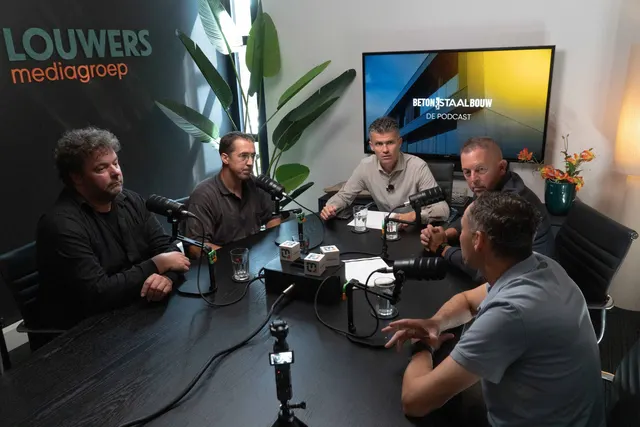
#1: In conversation with Yves Terneu (Aalborg White) and Bernard de Troch (Conix RDBM)
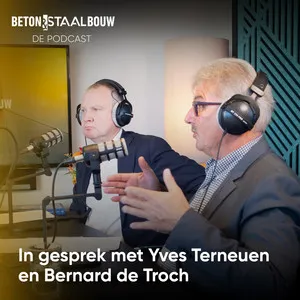
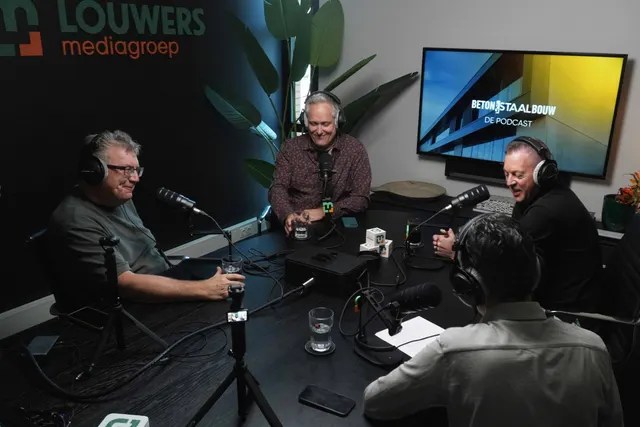
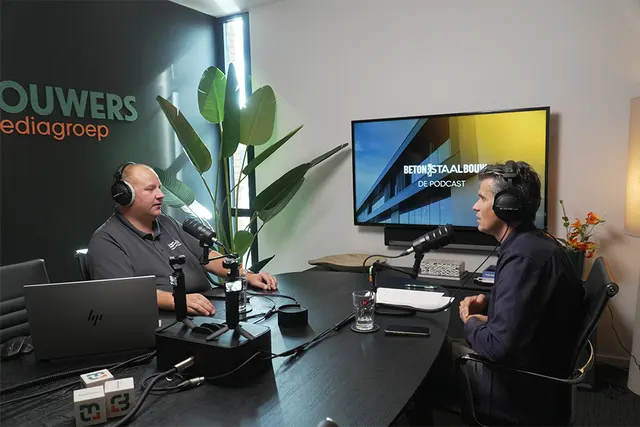
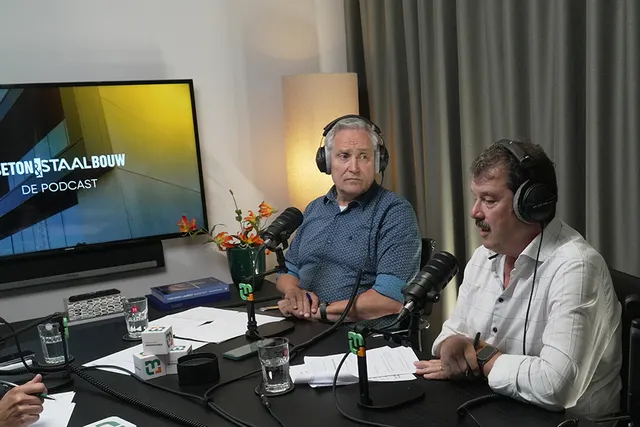
In this edition of Beton & Staalbouw, the podcast, two guests join us: Yves Terneu from Aalborg White and Bernard de Troch from the renowned architecture firm Conix RDBM. The topic for discussion: can white cement compete in a market focused on drastically reducing CO2 emissions?
The construction sector plays a major role in global CO2 emissions, making it crucial for architects and designers to opt for low-carbon strategies. How does white-cement concrete fit into this, and what is the main difference from conventional grey concrete? The guests offer some surprising insights, discuss unique applications and also highlight the less familiar aspects. In short, an interesting conversation for anyone working with white-cement concrete who also needs to meet all sustainability and CO2 reduction targets precisely.
Een zakelijke vraag aan Aalborg Portland Belgium? Neem contact op
Volledig transcript
00:04 Welcome to Beton & Staalbouw, the podcast. My name is Roel van Gils, and I’m your moderator today. Joining me at the table are Yves Terneu from Aalborg White and Bernard de Troch from CONIX RDBM.
00:18 Gentlemen, please introduce yourselves.
00:21 Thank you for the introduction, Roel. My name is Yves Terneu, and I work for Aalborg Portland. Aalborg Portland is a white cement manufacturer with production facilities in around 70 countries,
00:35 where we operate and, as I said, produce white cement.
00:39 Okay, thank you. Bernard?
00:41 Thank you, Roel. I’m Bernard De Troch, and I work for CONIX RDBM Architect. We’re a large, medium-sized architecture firm, active in both the Netherlands and Belgium, with 65 to 70 employees working on our designs, projects and deliveries.
01:04 Thank you. Gentlemen, or Bernard, I should say, here’s what I’m wondering: what are the main reasons for choosing white-cement concrete?
01:13 Let me start with concrete in general. Concrete is a very versatile material. It’s almost indispensable in construction. The fact that it can also be white gives our buildings a very luxurious, aesthetic appearance. That has many advantages.
01:27 In terms of heat, a black building heats up very quickly, while a white building reflects much of the heat. So that’s a major benefit for the interior and indoor comfort.
01:39 And, of course, there’s the luxurious appearance. I often compare it to the past, when town houses in both the Netherlands and Belgium had white plasterwork. It gave them a majestic appearance, and that’s something we still try to achieve today.
Lees het volledige transcriptTranscript inklappen
01:53 Concrete is a very straightforward material to use for that.
01:58 It’s also a very versatile option. People often tell us that a white concrete building has a distinctive appearance. But it also offers a degree of safety.
02:11 In many cases, it’s also lighter than other buildings.
02:16 We’ve heard about a number of advantages. Are there any disadvantages too? I’ll turn to Bertrand for that one.
02:22 There’s no problem, really. Disadvantages? Yes, it may be a little more expensive, because it lasts a very long time. Concrete lasts well for 30 or 40 years, so it is a bit more expensive.
02:34 As for maintenance, I’ll go back to the advantages, because it’s such an obvious choice. One disadvantage is that it needs to be cleaned. On a white façade, you can see dirt or rain marks below window sills and so on.
02:49 That calls for some careful cleaning or maintenance. We can limit the risks through architectural design. But as far as disadvantages go, it’s a durable material. Compared with other materials, for example, natural stone has to be imported from far away.
03:03 It gets dirty too. Steel is more susceptible to dents and damage. Concrete is very difficult to damage, unless it’s subjected to a really heavy impact.
03:14 Bernard mentioned 30 or 40 years. I think that if you look at the Pantheon in Rome, which has stood for almost 2,000 years and was also built using concrete, you can see that concrete lasts a very long time. I’ll say a little more about white concrete, or coloured concrete, in a moment.
03:30 Like any other façade, white concrete will of course get dirty. In an urban environment, where there’s a lot of soot from cars, you’ll see it on the façade. In a wooded setting, it will certainly turn green.
03:45 But it’s very easy to clean, because the surface is excellent and you can clean it perfectly well with a domestic garden pressure washer, a Kärcher, as I’ll call it. If you do that every four or five years,
04:00 your building will look as good as new again. There are lots of good examples of buildings that have been standing for 40 years and then had an extension added. The clients say, “Yes, I want exactly the same colour.”
04:16 We’ve told them: “Yes, clean the original section, even if it’s 30 or 40 years old, then simply make the new section in white concrete and it’ll be a perfect match.”
04:23 You mean with ordinary household equipment?
04:26 Exactly, with an ordinary Kärcher. You certainly don’t need heavy industrial equipment, because that could give you a different surface finish. Just a simple domestic pressure washer, so to speak.
04:41 Okay, thank you. Yves, how is white concrete actually made?
04:45 White concrete is made using white cement. That gives you the best result. The same goes for white or coloured concrete, because we talk about white concrete quite a lot here, but also about coloured concrete.
04:58 We’re here in the Netherlands. Suppose you wanted to make some very attractive orange concrete: that’s perfectly possible. If you make it using white cement, you’ll get a very attractive, stable and uniform colour.
05:12 That’s down to the properties of white cement. Almost all the iron-bearing components are removed from white cement, which means you can use all kinds of colour pigments, or most kinds, to create a really
05:29 beautiful, uniform colour. Okay, thank you, that’s interesting. Bernard, does building with white concrete require any additional considerations?
05:40 Yes, every material has its own applications. I was thinking earlier that if you wanted to create organic façades with curved shapes, concrete would be more difficult to work with, and the formwork requirements would be more demanding.
05:55 So once you’ve chosen a material, you have to follow certain rules. The challenge for every architect is to find the best combination. As I’ve already said, concrete is a very versatile material and almost indispensable
06:11 in construction. As Yves also said, the Pantheon has stood for 2,000 years. You can hardly build a dome like that with anything other than concrete. That’s why concrete will continue to add tremendous value in the future, and will remain almost indispensable.
06:25 We want to create buildings that can be used for different purposes, not just housing or shops. Concrete is a very useful material because it can accommodate all kinds of uses and
06:39 allow for further uses in the future too. But yes, you need to know the rules, and then you can make the most of it. That’s what
06:47 architects are there for. Yes, you’ve already mentioned a few examples, of course. Do you have any recent projects of your own that we could admire, for example in Wilmerton? Certainly,
06:56 and that’s because I know Yves so well. Balconies are a very standard product that we always make in white, because they provide a visual accent. Now, in Nostende, our
07:08 façades are also striking on the coast, where white concrete façades are often used on high-rise buildings. Or there’s the architectural plinth, which is made of concrete and can then be combined with brickwork. It’s a standard product. I think we’ll need concrete for a long time yet, but we do need to try to reduce or offset its CO2 emissions.
07:26 And we need to try to reduce or offset the CO2 emissions associated with it.
07:32 Okay, perhaps that’s a good segue.
07:36 Yes, indeed. CO2 is a very important topic at the moment. Aalborg has been working for years to reduce CO2 emissions across all possible aspects of the material.
07:59 We’re also working to reduce emissions from the clinker used to make white cement. For example, we’ve recently introduced our D-carb, which produces 15% less CO2, and even 36% less than other products.
08:14 We also have requirements from governments and other bodies that we need to meet now, and especially by 2030 and 2050.
08:28 We’re also working to capture all our CO2. We’ll capture it in the chimney, liquefy it, and work with leerliquide, who will then be able to use the product for other purposes.
08:54 What are the main differences from traditional grey concrete, Yves?
08:59 Well, concrete made with grey cement has a different appearance and a different look. It’s grey,
09:18 and is used for all structural applications, for all the basic elements required in a concrete building. White or coloured concrete made with white cement is a little different. White concrete made with white cement will always remain white. To give you an
09:33 example, some architects do this in a building: pour a bucket or glass of water over concrete made with grey cement,
09:47 and you’ll see it turn very dark. The light grey concrete you know will turn a very dark grey. That’s the effect water has on the concrete. With white cement, as I said earlier, because all the iron-bearing components have been removed,
10:02 you don’t get that effect. It stays very white. So even on rainy days, you’ll still have that bright white building.
10:11 Okay, do you recognise that, Bernard?
10:13 Yes, absolutely. I don’t think we’d propose grey concrete façades to clients. It’s suitable for infrastructure projects, motorways and bridges. Even there, we see white concrete used when you want to create an eye-catching feature. As architects, our ambition is to create something beautiful that people enjoy looking at.
10:32 Grey concrete isn’t suitable for that. The very fact that white cement is added also sets higher requirements for the finish and for well-made formwork. Then the contractor or builder knows, “Oh, we want to create something beautiful here.” That’s not the aim with grey concrete, and it doesn’t work. It’s subtle.
10:55 It doesn’t work. Subtle, no. So it also requires more from a construction point of view, or higher standards during assembly and construction, so to speak. That’s why we’re so proud of it,
11:00 white cement. Everyone gets motivated, and everyone does their best when working with white concrete, because we know what the end result will be. There’s also an overlap: concrete has a load-bearing function and is therefore used from the early structural stages, but we don’t want it to be… It’s a visible element of the load-bearing structure,
11:17 and white cement helps ensure it receives the attention it deserves, so that it isn’t undervalued as something that’s there to last and look attractive. Yes, to stay beautiful
11:32 for years. And indeed, if you make beautiful white concrete, it’ll look right from the outset. If you take proper care of it and everyone takes responsibility,
11:48 then it will be no more difficult than making grey concrete, for example. No, it is all the same. But you do need to give it the right attention, because you want that beautiful material or panel to be right first time, for the next 30, 40, 50 years.
12:10 And much longer. And much longer. Yes, if I may add to that, because of that attention, it is indeed clean from the outset, and that brings us to prefabrication too. Concrete is
12:22 cast in controlled factory environments. If you want a carefully executed finish in brick or metal on a construction site, it has to be done on site. And there are more risks. You cannot control the weather conditions
12:37 and you do not always have your people... You also have to achieve it on site. Concrete has the advantage that it is made in a factory and then assembled on site in one go. So that gives you a guarantee of quality.
12:52 It can also be finished neatly and correctly in the same way every time. Once you have designed the drip detail, that balcony can be repeated, built and installed a hundred or two hundred times.
13:05 So you have a guarantee of quality and appearance, which gives you confidence as an architect that you will get an acceptable result in the end.
13:13 Is that also an argument for choosing white concrete or constructing modular elements? Absolutely.
13:18 A combination of the two. Modular certainly, because of that repeatability. If it needs to look good and be visible, you can make it in white concrete.
13:29 It is even becoming a necessity. Workers on construction sites are becoming very scarce. It is almost essential to try to work in factory conditions and limit the work on site to assembly.
13:44 The elements, the components, arrive from a controlled factory environment and only need to be assembled. That is an advantage. Yes, almost unavoidable.
13:56 In urban environments, it is also becoming increasingly difficult to find space to carry out the entire construction process on site. That is why it is often very easy to bring in a number of lorries with
14:09 the elements on them and simply assemble them. How do you embrace
14:17 carbon-free and low-carbon elements in contemporary design? A very important answer. In the past, actually it is
14:27 an obvious question, but in the past the question for architects was limited to: what will it cost? How do you determine the price? Today we absolutely have to move towards this, and we are working on it, so that we can tell the client not only what it will cost, but also what the CO2 emissions will be. And
14:40 there too, as an architect, you realise you do not have ready-made answers for the comparison. But you must be able to tell the client from the outset, approximately, what it will cost and what the CO2 emissions will be. We can no longer ignore that. So bills of quantities and unit prices have
14:58 become outdated if you cannot immediately include the CO2 emissions. As architects, we provide a comparative study by extracting quantities from BIM designs in good time. And the challenge is not really that great. Instead of asking what is the
15:13 price per cubic metre of concrete, what are the CO2 emissions per cubic metre? And then, let us be honest, as architects we are of course also a driving force, but we look to Yves, the challenge lies with him. Yves must ensure that the concrete and
15:27 the cement remain sustainable. It has already been mentioned that the government also imposes regulations, and I would say that for us as architects, the client is also asking for this, because
15:41 I have made the connection: developers get favourable credit terms if they can demonstrate that a building is sustainable or has a certain level of CO2 emissions. From that perspective, the challenge simply becomes obvious. Tell me, everyone,
15:56 what are the CO2 emissions? That applies mainly to Belgium, I think, or is it also
16:00 European? European, and certainly in the Netherlands. You are much further ahead on that point, if I may say so, compared with Belgium at the moment. MKI calculations have been used in your country for years,
16:14 whereas they are only now really coming to the fore in ours. So no, certainly in the Netherlands too.
16:21 We look across the border to see how those calculations are done in the Netherlands. There are already databases for them, and comparative studies. Because of course we need an objective parameter. For a cost estimate, there are prices from databases. But for the CO2 emissions of those products,
16:36 are they certified, can we rely on them, what does an architect base that on? The Netherlands is indeed further ahead there. The same goes for nitrogen emissions. You can shut down a construction site if nitrogen emissions are too high. We are not that far along in Flanders yet.
16:50 Fortunately, I am tempted to say.
16:53 For the progress of construction projects, indeed.
16:58 The Netherlands is paying the price of learning.
17:01 Can we return briefly to the production of white cement concrete? In terms of targets, what exactly are you doing to reduce CO2 emissions further?
17:16 As I mentioned earlier, we try to use as many materials as possible to reduce CO2, and therefore reduce the amount of clinker.
17:29 We do that by adding limestone, for example. In one of our applications, it accounts for approximately 16-17%, so you get that saving straight away.
17:41 That is one. Meanwhile, there are many other things we are researching. Secondly, as I also mentioned earlier, the carbon capture and
17:55 storage plant. You have to imagine a plant almost as large as a cement plant being built alongside it, which converts it all from gas to liquid. So that is going to happen. As a result, apart from transport of course,
18:19 we will have completely CO2-neutral cement within 2-3 years.
18:25 Yes, that was indeed my next question, within 2-3 years from now.
18:29 Within around three years. Construction of the plant began six months ago. Where is your plant actually located? Our main plant is in Aalborg,
18:41 Denmark. We are right by the water there, so we can ship everything on large seagoing vessels to all the different locations where we have it. So that is very convenient. I would like to
18:53 return briefly to your question about what else we are doing. We have a state-of-the-art plant there in Denmark. And the waste heat from our kilns and so on is used to heat households in the city of Aalborg, for example.
19:13 So we are very inventive there and have been doing this for years. A second example is the water from our limestone quarries. It stays at a cool 9 degrees all year round. And that water is used for air conditioning in various industries.
19:44 It is already being used in a hospital a couple of kilometres, 2-3 kilometres, from the plant. So that water at 9 degrees is used to supply the air conditioning there. Especially in summer, when tap water can be somewhere between 15 and
20:04 20 degrees, that makes a very big difference. If I turn back to, look briefly at
20:10 Bernhard. Bernhard, do you expect a greater preference for low-carbon products, finished cement products, in your future projects?
20:18 A good question, but let me be honest. As an architect, the end result is what matters. Whether there are a lot of CO2 emissions or not, the result still has to be there. And I think the greatest pressure will come from the financial side, with CO2 penalised through an additional cost. And I absolutely support helping Yves ensure that cement is produced with low CO2 emissions. But I am not the one at the controls.
20:52 I only hope that I can continue to use cement and concrete because they are so indispensable. They enable us as architects to make sustainable buildings. Look at it at building level. Buildings themselves must also be sustainable as a whole.
21:08 And cement accounts for 2% of all the building elements in that. So the question is not only for IEVE to make low-CO2 construction products, the whole thing must also be low-carbon. We are finding it difficult, for example, to sell aluminium or use it as a façade finish,
21:26 because it also has a very heavy sustainability footprint. The solution there is circulation and recycling. The challenge is everywhere and we are a partner in it. I cannot eliminate concrete,
21:39 and I do not want to eliminate it either, let me be very clear about that. And I hope it remains affordable. For me, the building must remain affordable, and that of course puts pressure on clients. Everything is getting more expensive, we have to push for greater sustainability. Let us, for example, give
21:53 buildings a longer life. That means a client saying: look, instead of a ceiling height of, say, 2.70 metres, let us set the ground floor as standard at 2 metres, 3 metres, so that we can also create shops there.
22:06 And so that it can still be used for housing later on. That means we need to think longer term, both as architects and in the concrete industry, to limit the CO2 impact, but also for clients.
22:19 We all have a responsibility to future generations. Will it become cheaper? No. Let us think together, and we are hard at work on it. Hence this conversation, to convince ourselves of that.
22:33 You mentioned a number of arguments. Efficiency, speed, quality, high quality, sustainability. We have not yet talked about fire resistance. Perhaps we could touch on that briefly.
22:43 I think Bernard is also well placed to explain that, but we all know that concrete has very high fire resistance.
22:54 Absolutely, absolutely. Take façades, for example. If you make them in concrete, both the outer and inner sides, you can enclose the insulation between the inner and outer leaves.
23:08 Today we use polyurethane for that, but we need to move to rock wool. By working with precast elements, you can prevent fire spreading through the cavity by sealing the elements against one another.
23:20 That takes some work. We also try, today we build a lot of sealed boxes. Buildings are super-insulated to prevent heat loss. Does that mean the buildings overheat in summer?
23:34 And I think, that is a very different discussion, but we need to find a balance so that there is not too much insulation. We are now getting rock wool layers of 30 centimetres, making the façade build-up almost impossible to achieve.
23:47 So understanding is also evolving on how to optimise that. Fire spread is again an essential consideration, whether it is addressed with concrete or other elements, there are always solutions.
23:59 But concrete is indeed non-combustible, so fire spread is one less concern.
24:04 Do you also see it being chosen for that very reason?
24:08 Absolutely. Around the world, many architects use it for that reason, to show the outer skin, the façade elements, balconies and so on, all in concrete.
24:26 So we do indeed see that worldwide too.
24:33 And finally, could you perhaps name a great reference project in white concrete?
24:39 Yes, I think OCIE in Ostend is a very good example, Bert. Yes, magnificent.
24:44 Ief, you're taking the words right out of my mouth. It's one of the larger projects. We've completed four phases so far, each covering 50,000 square metres. White concrete has been used in every building.
24:57 It has been an advantage that work there can progress quickly. The tourist season means the construction period is limited. And the building seasons on the coast are also very strictly regulated.
25:10 And yes, I agree. As architects, we try to be creative. We also fitted a smaller building with white facing brick. And yes, we have to admit that, as I mentioned earlier, the
25:25 quality of the paintwork is always harder to guarantee, and yes, I'm sorry to have to admit that installing those beautiful white facing bricks did not produce the result we wanted, and the owners had complaints. With concrete, as I said, in
25:42 precast construction, quality can be guaranteed more reliably. And of course, it is a selling point. We used a lot of white concrete in the first tower. The client then also asked
25:55 for it to be used in the next two, the third and the fourth phases, which we're carrying out now… I'm talking about a project that has been running for eight years. So, after eight years, we're at the final phase, with another 50,000 square metres of apartments.
26:09 So the developer's sales team asks for plenty of white façade elements, please, to create that look and enhance that fresh feel
26:21 and make the sales results absolutely clear. It's also a very beautiful building. When you arrive in Ostend, driving towards the sea, not towards the centre of Ostend but right towards the beach,
26:37 at some point you look to the left and see all those beautiful buildings lined up. It's really, well, what do you call it?
26:47 A landmark.
26:48 A landmark, indeed. Thank you, Bernard.
26:50 So, well worth a visit. Absolutely.
26:53 All the CONIX RDBM construction sites.
26:56 Let's do that.
26:57 Thank you.
26:58 Well, today we've been talking about white concrete. We've discussed its advantages and the arguments in its favour. So if tomorrow we can put up buildings in beautiful white, almost CO-neutral concrete, then everyone…
27:15 Everyone wins.
27:17 That's right. Thanks for sharing that with us. Berna, did you want to add anything?
27:21 Yes, not just us, but future generations too.
27:25 Well, thank you both for being here. And thank you, listeners, for listening. Until next time, and stay curious. Betonnen Staalbouw, the podcast, is a production by Lauer Media Groep.
Bedrijven in dit verhaal
Blijf dit volgen
Bij een nieuw verhaal krijg je een e-mail. Geen account nodig.
- ThemaMinder CO2 in beton en staal
- OnderwerpGeneral
- BedrijfAalborg Portland Belgium