#2: In conversation with TBI and Penetron Benelux about sustainability, extending service life and reducing concrete’s CO2 emissions

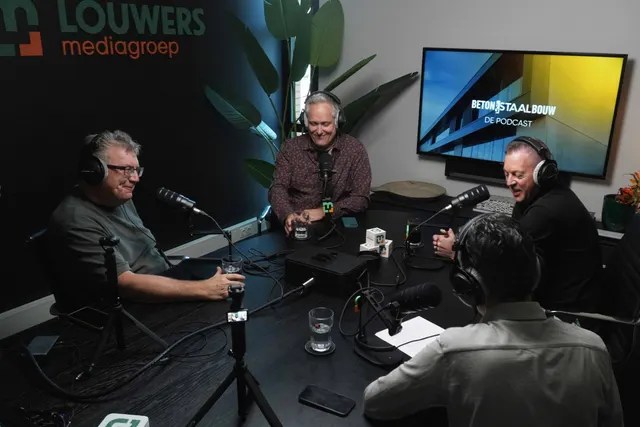
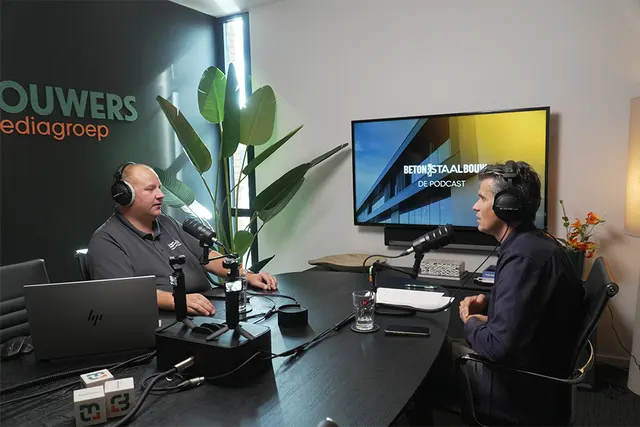
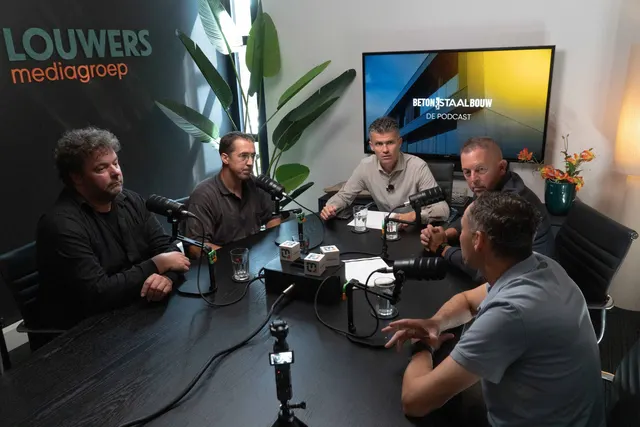
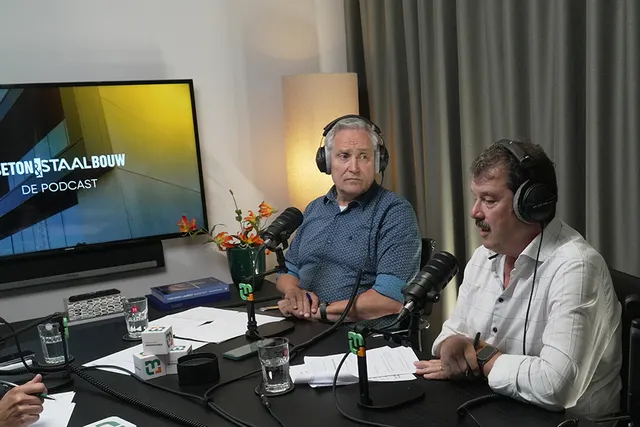
In this edition of Beton & Staalbouw the podcast, we welcome three guests: ‘concretefluencer’ Niki Loonen of TBI, and Olivier Suerickx and Bob Lambermont of Penetron Benelux. The topic of discussion: sustainability, extending service life and reducing concrete’s CO₂ emissions, themes that are bringing about profound change in the construction sector.
Together with our guests around the table, we have an objective discussion about the role of extending service life in reducing CO₂ emissions, with a focus on innovative technologies such as self-healing concrete. An informative and inspiring conversation about knowledge, awareness and collaboration in the construction sector. One thing is clear: sustainability is about more than just building…
Een zakelijke vraag aan Penetron Benelux? Neem contact op
Volledig transcript
Alle hoofdstukken (18)
- Introduction and guest introductions
- Statement: sustainability in construction is still too often a marketing term
- Statement: forget circular construction, extending service life comes first
- Extending service life and quality of execution
- Taking a whole-life approach and tackling maintenance backlogs
- The technology is already here, but we are not using it enough
- Self-healing concrete: how it works and examples of its use
- Revolution or evolution?
- Risks of self-healing concrete
- Self-healing throughout the concrete structure
- Why self-healing should be standard
- CO2 savings: new build versus existing structures
- The service life of concrete is mainly an organisational problem
- Self-healing concrete is no longer science fiction
- Sustainability means demonstrably extending service life
- Construction in ten years’ time
- The shared challenge
- Closing
Episode 2
Conversation with Niki Loonen (TBI), Olivier Suerickx (Penetron Benelux) and Bob Lambermont (Penetron Benelux)
Host: Roel van Gils
Introduction and guest introductions
Roel van Gils Welcome to this episode of Beton en Staalbouw, the podcast. We’re broadcasting live from the Louwers Mediagroep studio in Weert. We’re talking about sustainability, extending service life and reducing concrete’s CO2 emissions. These are themes that are bringing about profound change in the construction sector today. Joining me at the table are Olivier Suerickx of Penetron Benelux.
Olivier Suerickx Good afternoon.
Roel van Gils Good afternoon. Bob Lambermont, also from Penetron. And Niki Loonen of TBI. Welcome, everyone. Thank you. Please introduce yourselves.
Niki Loonen I’m Niki, and I work on making concrete more sustainable at TBI. I help construction companies use increasingly sustainable concrete in their projects.
Olivier Suerickx I’m Olivier Suerickx, managing partner at Penetron Benelux. My role in the organisation is mainly commercial and technical. We focus on sustainable solutions that extend the service life of concrete structures. Technologies such as healing and self-healing concrete make a lot possible in construction today.
Roel van Gils Thank you.
Bob Lambermont I’m Bob Lambermont. I work for P&O International as a specification manager. In that role, I travel all over the world, visiting many places to follow projects from the outset and advise on specifications. As a result, I often get to see what is happening around the world, in different countries, with new types of cement and new concrete mixes. What is actually being used in practice?
Roel van Gils Once again, welcome, everyone. We’ve already talked about carbon neutrality, the circular economy and energy-efficient construction, but the reality on the ground often proves challenging. How big a problem is it in construction, really?
Niki Loonen Well, if I can start. It’s quite a big problem. We have a pretty clear picture of the limits set by the Paris Agreement, of course. The Dutch Green Building Council has done some excellent research into the impact construction should be allowed to have. I think the average construction project is now well over that limit, by a factor of two or more. And that limit will halve again in the coming years, because we need to emit less and less. So we need to achieve reductions of 50 per cent from now just to be roughly on track to meet the 1.5 to 2-degree target. And then we’ll need to halve that again by 2030 to 2035.
Roel van Gils Okay, we’ve put together a number of statements. Perhaps we can start with statement one.
Niki Loonen Yes.
Roel van Gils Unless you have anything to add, Olivier.
Olivier Suerickx Yes, not specifically. I agree with Niki. I think the biggest problem we face is that cement production and concrete are responsible for around 8% of global CO2 emissions. Something really needs to be done. I think it’s important that this is put into practice. I think everyone involved in concrete, or construction in general, needs to play a part in making it happen.
Roel van Gils Yes, that’s perhaps a good segue.
Bob Lambermont I still see differences between countries and types of clients. In some countries, and among some types of clients, there’s absolutely no concern about CO2. They only care about price and getting the job built as quickly as possible. Awareness is growing, though. I’ve just returned from a trip to Latin America, and you can see that awareness is growing there. In some countries, it’s much further advanced than in others. There are opportunities there. Some clients are demanding greater sustainability, and that is becoming more important. Other clients are not concerned about it at all, but they are responsive to sustainability, even if they are not concerned about CO2 emissions as such.
Niki Loonen Yes, look, here in the Netherlands we’re seeing financiers and housing associations, for example, already set stricter requirements for primary resource use and CO2 emissions. Developers and contractors are being asked to build accordingly. So I see movement in the right direction, but we’ve got a long way to go.
Lees het volledige transcriptTranscript inklappennog 17 hoofdstukken
Statement: sustainability in construction is still too often a marketing term
Roel van Gils So, our first statement: sustainability in construction is still too often a marketing term. Is that still true?
Niki Loonen In some cases, that may be true, but I’m seeing more and more genuine commitment to moving in that direction. I also see that it’s difficult in many places to put that commitment into practice. And that, driven by good intentions, people try to make small things seem bigger so they can take pride in them. That’s good too, of course, because it inspires others. But the steps we need to take are still quite big.
Roel van Gils And what’s the reason for that?
Niki Loonen I always say that old habits die hard. What you’re used to doing is very difficult to change. Even when you know better, just look at yourself. In my case, I like sugar, so I’m a real sugar addict. And I know it’s bad for me. But it’s so difficult to change. Old habits die hard. I think everyone has something they know they shouldn’t do, but do every day anyway. Construction is no different. What you’re used to doing is very hard to give up and replace with something else. But we need to do it.
Roel van Gils And is that also down to a lack of knowledge, for example?
Niki Loonen Yes, I think that’s partly due to knowledge, of course, but there’s also very little knowledge about the way we build today. I think very few people who work with concrete understand how it’s put together. For someone working with concrete, it needs to be workable and meet a certain strength and exposure class. If the ready-mixed concrete supplier says it does, people have traditionally not asked, “Yes, but what exactly is in it?” And I have to be honest, at a certain point I lose track when it comes to cement chemistry too. I don’t know everything either. So yes, we obviously need to do a lot in terms of education and training. But I think it really starts with a genuine desire to take those steps.
Olivier Suerickx I think your comparison with sugar is a good one. I’d like to turn it around a bit and say we need to step outside our comfort zone. Step outside our comfort zone, be open to new things or work differently. That’s a shift we need to set in motion. Sometimes you can bring the client on board, but it’s not just the client. Several parties are involved in a construction process. Everyone needs to be pulling in the same direction. And I think that’s still a challenge.
Bob Lambermont Exactly, it often comes down to responsibility. Everyone says, “Okay, we’d really like to use new technologies, but perhaps someone else could try them first to see if they work.” And so everyone keeps looking to everyone else. What’s very positive, I think, is the growing awareness and the fact that everyone is putting CO2 on their front page as a target, a goal we need to take steps towards and reduce. That’s really getting the concrete industry moving and looking for solutions. In the past, such ideas would have been dismissed outright. Now there’s much more openness to them.
Statement: forget circular construction, extending service life comes first
Roel van Gils Yes, okay. That leads nicely to the next statement. We talk a lot about circular construction, but forget that extending service life is actually the first step. How can existing structures, for example, be made to last longer? Do we have an example?
Niki Loonen I always use the Pantheon as an example. Oh yes? A 2,000-year-old concrete structure built by the Romans. On the one hand, it’s a myth that Roman concrete was so much better than our concrete. We have better grinding techniques. We can calcine limestone instead of using the quicklime the Romans used. Our concrete really is superior. The only thing is that we put reinforcement in concrete, and that very often limits its service life. That’s where the main problem with concrete’s service life lies. Even if the Pantheon had been built with reinforced concrete, we would have had to rebuild it 20 times by now because of concrete cancer. So, on the one hand, we need to make concrete that lasts a very long time. The Romans did that pretty well, because they also used self-healing. And there’s still plenty we can do to improve on that.
Extending service life and quality of execution
Bob Lambermont It’s not just about adding self-healing technology. It’s also about placing the concrete correctly, which is often not done properly. Vibrating it properly and curing it properly. These are simple things that can also significantly extend its service life.
Niki Loonen Yes, absolutely. Quality of execution is extremely important if you want concrete to have a long service life. Curing is not something that is properly covered by standards. I’m not really in favour of standardisation, but when you see something like curing being done badly, you might think there should perhaps be a rule for it after all.
Olivier Suerickx No, but that’s true too. Curing sometimes gets added as an afterthought. It doesn’t get enough attention, but inadequate curing disrupts the hydration process. As a result, cracks can form, including early-age cracks that could have been avoided. Especially when steel is also involved, everyone is tearing their hair out just after the concrete has been poured. What now? Then there are additional costs and other issues that need to be dealt with. So curing is important.
Bob Lambermont Yes, indeed, concrete can look fantastic on paper. It can be very well specified, with the right mix, and beautifully produced at the batching plant. Then it arrives on site, and during the concreting work, everything can go wrong. So how much is that paperwork really worth? We need to look at what we have built and whether it meets the requirements. What really matters is the structure’s actual performance.
Taking a whole-life approach and tackling maintenance backlogs
Niki Loonen Yes, coming back to this point, if you look at service life, in the Netherlands we design concrete structures for service lives of 50 to 100 years. We can see, for example, that Rijkswaterstaat currently faces a huge challenge simply to keep the infrastructure in service. You both come from Belgium. You can see it in the infrastructure there too, so to speak: there is also a maintenance backlog. We are less affected by that in the Netherlands. But the challenge ahead is enormous.
It is actually very strange that the structures we built in the 1960s and 1970s are now more or less reaching the end of their service life, and that we are not building any more intelligently or effectively today than we did back then. In my view, we should think much more carefully about how to ensure that what we build now, exposed to the elements, can last indefinitely, as Roman structures have. We can learn from the past. And we have the means to do it.
You can take concrete technology measures and measures during construction. You can use innovative chemical and technical additives, such as a self-healing agent. You can use alternative reinforcement, such as basalt fibre, or prestressing protected by plastic liners. There are many ways to achieve an unlimited service life, or to build without reinforcement, as the Romans did.
The technology is already here, but we are not using it enough
Roel van Gils So the technology for more sustainable construction is already here, but we simply are not using it enough?
Niki Loonen No. That also means the technology needs to be scaled up. You cannot simply move from one day to the next and start doing something new. There are whole processes you need to go through. You need pilot projects. You need to scale up production. You need to bring standards and regulations into line with the new technology. That takes time.
Pilots also serve a very important purpose: they show what is possible. Once a number of pilots have been carried out, a guidelines organisation such as CROW may say: this is interesting, it is being used so often now, let us draw up a guideline for it. That is how you make progress. The technologies are there, and scaling them up is what we are working on.
Roel van Gils Olivier or Bob, perhaps you could tell us about a technology?
Bob Lambermont You made the comparison with solar panels. Thirty years ago, in our part of the world, they made no sense at all and were far too expensive. Now you see them everywhere, because they have been scaled up and there is enough volume and demand to make them viable. The technology has also advanced, so we are part of that evolution. It is a very exciting and interesting story.
Self-healing concrete: how it works and examples of its use
Roel van Gils Can you give an example of how self-healing concrete is used, or explain how it works?
Bob Lambermont Yes, self-healing concrete has been around for a long time. It is used quite often. It clearly has direct benefits for service life and permeability. For underground structures, for example, it can eliminate the need for other techniques such as membranes. You can also excavate less if you add this self-healing technology to the concrete. In effect, you give the concrete qualities for which we currently use additional solutions. The performance of, for example, waterproofing membranes is built into the concrete in an active way.
Niki Loonen Yes, another benefit is that we currently use quite a lot of reinforcement to control crack widths, for both service life and watertightness. Take a tunnel structure as an example: it used to have around 150 kilos of reinforcement per cubic metre. Now that figure is over 200, or 225 kilos per cubic metre. That is essentially because we are willing to accept less and less cracking.
If you know that self-healing can seal cracks, you can accept wider cracks and use considerably less reinforcement. So if you use self-healing, and in some situations I would also combine it with a shrinkage-reducing admixture, you reduce both the cause and the extent of cracking. Add a self-healing agent, and you get concrete that needs reinforcement almost exclusively to resist structural forces. Quite a few structures need only half or a third of the reinforcement currently used as standard to meet the ultimate limit state. We could reduce that with this technology.
Revolution or evolution?
Roel van Gils Would you say this is more of a revolutionary or an evolutionary step for the industry?
Niki Loonen I personally believe more in revolutionary change. People need to feel confident that a building will not collapse when they walk into it. Structural safety matters. Investors put 30, 40, 50 or 100 million into buildings. They need to be confident that a building will stand for 50 years without extreme maintenance costs.
So you introduce changes step by step. Tomorrow, for example, we might do a trial pour using self-healing concrete in a basement wall, without removing any reinforcement. First, we gain experience. Does the construction work go well? A year later, is the wall still in just as good a condition? Perhaps even better? Only then can you take bigger steps on a subsequent project.
That is why I call it evolution in the pilots, revolution in the end result.
Risks of self-healing concrete
Roel van Gils And what are the risks?
Niki Loonen The risk with self-healing is that it does not work. It is quite funny: when you go to a project, people say they want innovation, and then immediately ask what the risks are. What I like is that some products do indeed involve risks. But the hardest thing to deal with is the unknown unknown.
With geopolymer concrete or basalt reinforcement, I would not yet dare to say there are no unknown unknowns. But with self-healing, the main risk is that it might not work. In that case, you are left with what you had before. The likelihood of it working is high.
Olivier Suerickx I think we focus far too much on crack width. A self-healing agent does not just work in cracks: it works throughout the capillary structure. It helps extend service life by preventing harmful substances from penetrating.
Niki Loonen Yes, it densifies the pores. It slows chloride ingress and frost damage, among other things. It should really be standard in infrastructure.
Self-healing throughout the concrete structure
Olivier Suerickx I also think that, when it comes to self-healing, we still focus far too much on crack width or cracking in general. But it is not just about cracks or cracks that may occur in future. The technology is an active system that continues to respond whenever water enters. It also works at the surface and throughout the concrete mass, in the capillaries within the concrete structure.
Roel van Gils So you are saying it helps extend service life?
Olivier Suerickx Yes, it does not just protect cracks, it protects the structure as a whole. It prevents harmful influences from getting in.
Niki Loonen Yes, what it actually does is seal the pores in the concrete. This greatly slows the ingress of harmful substances. That results in a much longer service life, even without reinforcement. Frost damage and chloride ingress are both reduced.
Why self-healing should be standard
Niki Loonen It is actually very strange that self-healing is not simply standard in infrastructure. It is a case of, if it does no good, it does no harm. And the chances of it doing good are high. The renovation challenge is now so great that you would think we should avoid adding even more structures that will also need maintenance later, when we can limit that need.
Bob Lambermont In practice, we have seen demand for port infrastructure and quay walls rise sharply in recent years. The specified service life is often 50 years, but in practice, some structures do not even last 20 or 30 years. That is when people start looking for sustainable solutions that reduce maintenance and operating costs.
CO2 savings: new build versus existing structures
Roel van Gils The biggest CO2 savings do not come from new construction, but from preserving and repairing existing structures.
Bob Lambermont It applies on both sides. How can we extend the life of existing structures? Self-healing technology can also be used on existing structures. But they do need to be in good condition, or brought into good condition. Then the question is: does renovation make sense, or should the structure be demolished and rebuilt?
Niki Loonen There is great potential to reduce the impact of new construction. But demolishing something just to rebuild exactly the same thing is absurd, of course. Good maintenance and smart renovation deliver immediate sustainability benefits. But that alone will not provide the 100,000 homes a year we need. We need both: renovation and new construction. And construction is becoming more complex, not less.
The service life of concrete is mainly an organisational problem
Roel van Gils The service life of concrete is often an organisational problem, not a technical one.
Niki Loonen Absolutely. It starts with the client’s brief and our standards framework. Concrete is currently designed for a service life of 50 or 100 years. But we are building a world that should ideally last for centuries. Look at the Binnenhof: it was never designed to last 50 years, yet it is still standing.
If you build a concrete façade and it develops concrete cancer, while the building services are also worn out after 40 to 50 years, the whole building becomes unattractive. Then we say: just demolish it. That is a mistake in our thinking.
We should build things that, like the Pantheon, can in principle last forever, with alterations when needed but without fundamental deterioration of the structure.
Self-healing concrete is no longer science fiction
Roel van Gils So the conclusion is that self-healing concrete is no longer science fiction.
Bob Lambermont Absolutely. It is already being used in basements, underground structures, structures subject to water pressure and maritime infrastructure. You replace membranes with active technology, and speed up the construction process.
Roel van Gils Can you give us some specific examples?
Bob Lambermont Yes, for example, tunnels built with sprayed concrete that incorporates self-healing technology. You skip entire construction stages, such as installing PVC membranes. That saves weeks. We have also used it on tank projects: cracks that would take 6 weeks to close sealed themselves in 4 weeks. And even 45 additional cracks were found to have sealed completely. That proves it works.
Sustainability means demonstrably extending service life
Roel van Gils A structure is only sustainable if it demonstrably extends the service life of the construction.
Niki Loonen You build a tent or a palace. That is my philosophy. A tent consists of replaceable components. A palace has to last forever. Do you use secondary raw materials? Then you reduce the environmental impact, but you do not necessarily extend the service life. That is why we have methodologies such as LCA and the Environmental Cost Indicator (MKI). They are not perfect, but they are the best we have.
Roel van Gils And what role does self-healing concrete play in that?
Bob Lambermont It greatly extends the service life. The cost is minimal compared with the total investment. If a technology can extend the service life by decades, the answer is simple: use it.
Construction in ten years’ time
Roel van Gils What will construction look like in ten years?
Niki Loonen If it were up to me, we are in the middle of the transition’s chaos phase. Technology is advancing, old technology is dying out, standards are changing, supply chains are grinding to a halt and innovations are clashing. I love chaos. But clarity comes after the chaos. We will be much further along in ten years, but the journey there will be intense.
Olivier Suerickx All the technologies already exist. The only thing we need to do is apply them. Step outside our comfort zone.
Bob Lambermont We need to dare to set higher standards. Build beautiful structures that are sustainable too. There is already an openness to new techniques.
The shared challenge
Roel van Gils So the conclusion is clear: we simply need to start applying them. The technology is there. Where there’s a will, there’s a way.
Niki Loonen We could have started yesterday. But if we haven’t, let’s do it tomorrow.
Closing
Roel van Gils Thank you all for being here and for this inspiring conversation. Olivier, Nicky, Bob, and listeners, thank you for listening. Until next time.
Bedrijven in dit verhaal
Blijf dit volgen
Bij een nieuw verhaal krijg je een e-mail. Geen account nodig.
- ThemaMinder CO2 in beton en staal
- OnderwerpGeneral
- BedrijfPenetron Benelux
- BedrijfOlivier NV