

[00:01] Introduction – Less Cement and CO₂ Emissions
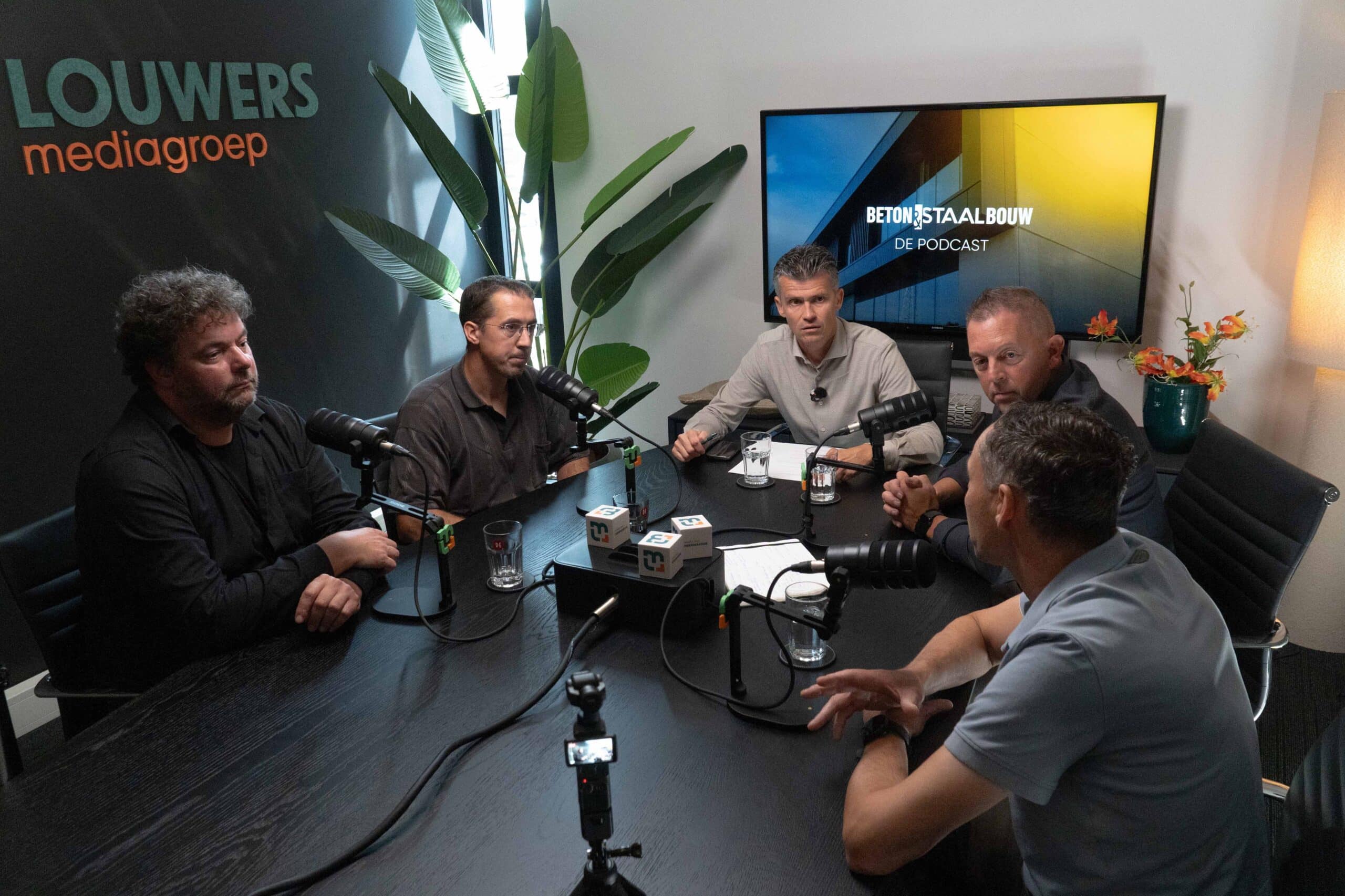
Roel van Gils: Welcome to a new episode of “Concrete & Steel Construction,” the podcast. Concrete is indispensable in the built environment, but at the same time, it accounts for a significant portion of CO₂ emissions. The biggest culprit? Cement? Or specifically, Portland clinker in cement? The question is therefore simple, but the solution is anything but, I think. How can you use less cement without compromising strength, durability, workability, and reliability? Today, we’ll be discussing this with four stakeholders from across the supply chain. By working together, we can truly make progress. So, joining me at the table are four guests: Sigrid Mulders, Pierre Hendrikx, Gerard Roelofsen, and Vincent van der Plas. Welcome, everyone.
Sigrid Mulders: Thank you.
[00:43] Introductions
Roel van Gils: Can we go around and briefly introduce ourselves? Would you like to start with the lady at the table?
Sigrid Mulders: My name is Sigrid Mulders. I actually graduated as a wood structural engineer, but surprisingly, I ended up in the concrete sector through structural damage assessment. At my employer, Dura Vermeer, I get to help make the concrete sector more sustainable. I do this partly through projects—by trying to implement the low-hanging fruit—and partly through pilot programs to realize tomorrow’s low-hanging fruit.
Roel van Gils: Look at that.
Pierre Hendrikx: My name is Pierre Hendrikx. I’ve been working at ABT for over a year. Before that, I worked at BAM for eight years. My philosophy, based on my higher professional education, is that you learn about construction best by being close to the actual work on-site. And I was actually fortunate that the concrete technologist was about to retire at that time and wanted to hand over his responsibilities. That was just before the sustainability movement really started to take off. So I was able to get a solid grasp of the basics first, and then sustainability suddenly came into the picture. It’s a very interesting field—the intersection between structural engineering and concrete technology. If you can bridge that gap, it also means I know the other people at the table well.
Vincent van der Plas: I work for Dyckerhoff Basal in the Southwest region. I’ve been doing this for a year and a half now. Before that, I was the quality manager at Martens Beton. Before that, I was a concrete technologist at Struyk Verwo. And before that, together with two other friends, I mainly poured and built a lot of concrete floors. Actually, I started out at sixteen with a trowel in my hand. So I really come from a hands-on background.
Gerard Roelofsen: Yes, Gerard Roelofsen. I work at Sika, known for its additives, and provide technological advice to clients. Sustainability is one of the issues that really resonates with me. I especially enjoy seeing how the rest of the world approaches it, particularly within the global Sika Group. Everyone approaches it in their own way. So it’s also really interesting to learn from other countries about their best practices and then see how we can apply them here in the Netherlands.
[03:00] Why the conversation starts with cement
Roel van Gils: Okay, great. Thank you. Welcome again, everyone. The sustainability storm has broken out. Why does that conversation always start with cement, anyway?
Pierre Hendrikx: Since the introduction of LCAs—life cycle assessments—we’ve gained insight into the environmental impact of the raw materials in a cubic meter of concrete. It became clear fairly quickly that the cement content—which varies slightly depending on the type of cement—ranges from 15 to 80 percent. And if you break that down to see what’s in the cement and where the greatest impact lies, you’ll find it’s the binder.
Roel van Gils: So what are the solutions? This might be a very broad question right off the bat, but where do you start?
Pierre Hendrikx: One of the factors that will undoubtedly come up today is the water-cement ratio. I think that’s the key term when we’re discussing the ratio of water to cement. And then the other quality aspects will also be addressed. A structural engineer who prepares a recommendation specifies a concrete compressive strength and an environmental class. That’s essentially a minimum requirement. That’s what the standard tells him—what’s safe and what ensures that his concrete will last 50 years.
Roel van Gils: And I think that standard has been around for a long time.
Pierre Hendrikx: Yes. The VB 74, if I recall correctly, is one of the first published works in the Netherlands on concrete mix design. If you don’t know how something affects your concrete mix, it becomes difficult to keep durability in mind, so to speak. So that aspect is still sometimes a little lacking. My advice, therefore, is: just take the time to learn more about what goes into a concrete mix.
Roel van Gils: And who exactly are you directing that call to?
Pierre Hendrikx: First and foremost, to the contractors. Keep in mind that what you specify is considered a minimum requirement. Copy the compressive strength class and the environmental class onto the order form, because that allows the contractor to verify the specifications. That he requests a specific mix, that he has a C20/25 XD3 listed on the order form with 50 percent Portland cement content for use in winter as a substitute. And that it might then have a compressive strength of 80 N per square millimeter at 28 days. You won’t hear them complain about that, because the order form did specify C20/25 XD3. So take a closer look at how your design choices and construction decisions impact your concrete mix.
[05:35] The Impact of Design Choices
Roel van Gils: Then a whole new world opens up for you. What do the other parties think about that?
Sigrid Mulders: I do agree. I always say: builders have a gold mine on their hands. They have the opportunity to share information, and people actually pay attention to it. In any case, I think structural engineers should be critical about which environmental class and which strength levels they specify. That’s also a great example—what I think you’ve done at Basal with KJ-Plein—of being very conscious of exactly where specific strength levels are needed. If, on the top floor, you’ve simply copied over what was once required in the basement—fortunately, that’s happening less and less—then the structural engineer actually has the authority to say: we no longer need this strength here. Or, for these walls, we need a different strength than for the floors. Then the floor can handle a different load. So be critical about your strength requirements and your environmental class, because that ultimately leads to specific requirements for the concrete plant. You also have the option to include this type of durability data on drawings, so you can specify: “This is a foundation strip; CEM III/B is sufficient.” Or, “This section takes much longer to reach full strength.” It doesn’t need to be loaded or stripped of formwork tomorrow.
Roel van Gils: Yeah, okay. So those are solutions that help with that.
Sigrid Mulders: Making concrete more sustainable involves, in part, reducing the clinker content. Sometimes you can use more cement and still end up with a more sustainable—or lower-carbon—mixture.
Roel van Gils: What caused that, then?
Sigrid Mulders: There are more than 35 types of cement.
Roel van Gils: Oh, I see. So you're using a different type of cement.
Sigrid Mulders: Yes. If, for example, you manage to produce CEM VI—you’re laughing, but yes, we’re also considering that for a project near Rotterdam—then you can work with a different type of cement, a different composition. Then you can look at clinker, slag, and limestone powder, or recycled concrete fines, as Everox does, for example. You might have used more cement, by the way, but less clinker. And ultimately, the environmental impact is lower than with a traditional CEM I.
Roel van Gils: Okay. Those are great developments, of course. So you have all these different parameters, different knobs you can adjust to arrive at the right composition.
Sigrid Mulders: But then you have to get those preconditions right. If you just change the binder but don’t heat it or use other additives, you still won’t get the result you want. It really comes down to the combination.
[08:19] Workability and Prerequisites
Roel van Gils: That might also raise another issue. I’m not sure if it’s really a problem, but it’s a matter of manageability. Of course, that needs to be taken into account as well.
Vincent van der Plas: Yes, of course workability is taken into account. Look, it’s just as Sigrid says: it’s important, especially at the start of the project, to work together to identify the requirements. So, when does the contractor need what strength? Does he have more time for that? Can you deliver for delayed curing? Is there a risk of thawing or not? If not, then III/B could work. If it’s in the winter, then a little Portland cement will have to be added. But if there’s a chance of heating, you could, for example, switch to 100% blast furnace cement right away. It’s important to agree at the outset on what the requirements are and what the ready-mix concrete supplier can actually do to meet them. Because if the supplier isn’t invited to that initial discussion, little will be done to ensure sustainability, since you’ll simply end up supplying the standard mix design. As a ready-mix concrete supplier, you can’t just say, “I’ll supply all the concrete using only blast furnace cement,” without consultation. That naturally has consequences for the construction process. It has to be agreed upon together.
[09:43] The concrete supplier asked at the table
Roel van Gils: And does that happen often—you guys sitting together, so to speak? In that kind of triangle? Or actually, far too rarely?
Vincent van der Plas: It happens quite often. I have several meetings every week with a whole bunch of contractors—especially with Sigrid, of course—and with other contractors as well. So, fortunately, we’re getting invited more often.
Pierre Hendrikx: I’d like to pick up on that for a moment. You often come to the table, but in my view, often much too late. I think the market also supports this. This has to do, among other things, with contract structures. A contractor is only allowed to come to the table after the contract has been awarded, or beforehand as a consultant. But most contractors don’t come to the table as consultants. You can seek advice in advance from a supplier or concrete provider, but that’s no guarantee that the contractor with the winning bid will actually work with that supplier. Because that, in turn, is tied to specific contracts.
Roel van Gils: Or maybe at the start of the project?
Pierre Hendrikx: Yes, it depends a bit on the size of the contractor and the scope of the project. And on the ambition. But I’ve often found that, two or three weeks before pouring, we still had to come to a conclusion: we needed to make some adjustments to the concrete mix.
Gerard Roelofsen: And that’s especially true for us as a supplier of auxiliary materials. We usually get a call a day or two in advance: “I’m having problems—could you please fix them quickly?” So just work a little magic, and you’ll get it sorted out.
[11:10] Technically, there's room for improvement
Roel van Gils: But technically speaking, much more is possible than is currently being done.
Sigrid Mulders: Absolutely.
Roel van Gils: So what's holding it back?
Sigrid Mulders: As I just said, we also need pilot projects so that people can see why certain steps are necessary or make sense. With some additives, it all makes a bit more sense and has sunk in a bit more, but I think other additives still need a bit more visibility.
Gerard Roelofsen: When it comes to sustainability, of course, you also have to look at how long something lasts, aside from CO₂ reduction. If you look at England, it’s very common there to use waterproofing agents. It’s standard practice there. In the Netherlands, you almost have to fight to get people to pay attention to it. That’s just a fact.
Roel van Gils: But do they also handle sustainability standards differently? Or is the Netherlands a leader in that regard?
Gerard Roelofsen: I definitely think—based on what I’ve observed internationally—that the Netherlands is truly a leader in sustainability. In terms of CO₂ emissions per cubic meter, we’re really way ahead of the curve. When you share that with my colleagues at Sika, you can see their eyes widen at those figures.
Pierre Hendrikx: Yes, the figures show that as well. Global cement production accounts for 8 percent of CO₂ emissions; here in the Netherlands, it’s 3 to 4 percent.
Roel van Gils: And is that because of those developments?
Pierre Hendrikx: No. The main reason is that we—and some people might not like to hear this—are fortunate to have Tata Steel and the byproduct they supply, called blast furnace slag. Not to be confused with LD slag. I get asked that question all the time now: Is LD slag also used in concrete? The blast furnace slag we use in concrete is the slag that’s produced fairly early in the process. LD slag, on the other hand, is the slag produced toward the end of the process.
Sigrid Mulders: The slag we routinely use in cement production contains virtually no contaminants. It is truly safe to use in concrete products and is in no way comparable to steel slag.
Pierre Hendrikx: As far as I recall—feel free to correct me or cut this out if I’m wrong—it has to do with the fact that coke and coal are used in the production of blast furnaces, and that fraction is purer in the residual product than the LD slag. LD slag is the stony material that remains after all the iron has been extracted. So it still contains a lot of heavy metals.
Roel van Gils: Yes.
[13:51] Standards and Deferred Paving
Roel van Gils: When we talk about rules and standards, do they still reflect what’s currently possible?
Vincent van der Plas: For example, I think that CUR Recommendation 122 mentions a factor kₜ in the context of delayed curing. And that’s where the Rüsch effect comes into play. You have to take that into account in your concrete mix design. For higher strengths, you have to apply that factor kₜ, which means I actually end up adding more cement to my concrete mix design to comply with CUR 122. I think there are parts of the standards that are a bit too conservative. After all, you can also demonstrate compliance using cube compressive strengths or take core samples to prove afterward that the concrete meets the strength specified by the structural engineer.
Roel van Gils: But isn't it dangerous, of course, to prove it after the fact?
Sigrid Mulders: Not at all, actually. Because you only find out later what was actually dumped there.
Roel van Gils: Yes.
Sigrid Mulders: So you have the product as it was manufactured, and you’re inspecting it. That gives you much greater certainty about what was used in its production. So I would actually view it as a means of verification. And you do that in a way that’s already specified in the standard. Because if you have a situation where you’re unsure whether the product has achieved the required strength, there are methods for that as well. You can use that same method here, too. So, with long-term strength—or whatever people want to call it—you can use a different mixture with a much lower impact, while still having the guarantee that it has achieved the same strength. Or at least the same strength.
Vincent van der Plas: We did test all those recipes in advance, and we have the results. But since you need to achieve a higher characteristic value—which involves a standard deviation…
Roel van Gils: Yes. And I'm curious to hear what you think of it.
Vincent van der Plas: Yeah, me too.
[15:53] Coherence Among Concrete Rules
Pierre Hendrikx: The challenge lies, in part, in the overall relationship between standards. Structural engineers approach concrete from the perspective of Eurocode 2. A concrete technologist approaches concrete from the perspective of NEN-EN 206 and NEN 8005. The construction team approaches concrete from the perspective of NEN-EN 13670 and NEN 8670. And since we’re throwing around standards anyway: there are quite a few of them.
Roel van Gils: Yes, exactly. There are only a few of them.
Pierre Hendrikx: When we use cement in the Netherlands, we assume that it is universally applicable. So that means: whether our structure is a large bridge pier in a seawall, a parking garage floor, or a residential floor, the cement is the same for all applications. There’s something else here that makes me think: as far as I’m concerned, the regulations could use a little shake-up. For example, what really surprises me is that Eurocode 2 includes a table that links a maximum water-cement ratio to a minimum cement content. However, the standard doesn’t specify which type of cement this applies to, since we use generic cements. Yet everyone knows that CEM III scores lower than Portland cement in terms of frost resistance, but performs much better when it comes to chloride migration, for example. So I think: what if we took a closer look at these kinds of frameworks and said, “I have a structure here that’s outdoors, where salt is spread on it, and that has to deal with freeze-thaw cycles and de-icing salt.” Take a parking garage floor, for example. It’s not uncommon for it to have almost no contact with actual frost—say, below ground level—but it does come into contact with de-icing salts carried in by the wheels. If we were to specify a blast furnace cement there, we’d reduce our environmental impact just a bit more. Plus: we’re tailoring the concrete’s performance to better match the actual loads it will bear. When it comes to chloride migration, we need to take a more structured approach: what are the actual benefits of such a cement, and what does that mean for my sustainability goals? That means I have to look at something else.
[18:03] Concrete as a Specific Product
Pierre Hendrikx: You just mentioned the triangle: the structural engineer, the concrete technologist, and the contractor. As far as I’m concerned, every structural engineer should keep their own design in mind and figure out what that means for construction—and thus for the concrete mix. And when they specify a sustainable concrete mix, they should consider the impact that has on construction. Because if they keep doing what they’ve been doing, they’ll keep getting the same results. That won’t get us anywhere.
Sigrid Mulders: I just wanted to chime in for a moment, because I think that idea—viewing concrete not as a generic product but as a specific one—really offers a tremendous opportunity to start working with admixtures. Because then you’re focusing much more on concrete based on its performance, and you can actually get the right concrete in the right place.
Gerard Roelofsen: Yes. And not every admixture works equally well with one type of cement as it does with another. As an admixture supplier, we have entire tables on this: which admixture works better or less well with one type of cement versus another. That allows you to achieve your goals much more effectively. Do you want a slightly longer open time? Or do you want a bit more strength instead?
Roel van Gils: Air Bubble Generator.
Gerard Roelofsen: Air bubble generator, yes.
[19:10] Admixtures, fillers, and water-cement ratio
Roel van Gils: So when you say that without additives, it will be difficult to reduce CO₂ emissions?
Gerard Roelofsen: If you want to lower the water-cement ratio, you’ll definitely need it. You can’t do it without it. That, in turn, creates other problems, depending on the concrete’s composition. Especially now with all the new fillers, aggregates, and sands. Each one is even more exotic than the next. And that brings its own specific problems or challenges.
Roel van Gils: But that's what they're there for—to be solved.
Gerard Roelofsen: Yes, those are definitely problems that can be solved. But I do think we can get a lot more out of them.
Roel van Gils: What do you think, Pierre?
Pierre Hendrikx: I completely agree. I’m glad you’re making the distinction between admixtures and fillers. You can reduce CO₂ emissions without using admixtures, but as you say: only if you maintain the water-cement ratio… The term says it all: water-cement ratio or water-binder ratio. You can’t count a lot of fillers as part of your binders. So you can add them, but ultimately you’ll still have to use a binder to demonstrably meet your strength requirements. Grain packing optimization, for example, is an area where there wasn’t much we could do about twenty years ago. But nowadays, with computers, the available capabilities, and especially the models we can run digitally, we could certainly take another step forward in that area.
Roel van Gils: Yes.
Gerard Roelofsen: And you also need quite a bit of filler. If you have a very dense mixture, it gets pretty tough. Then the workability isn't all that…
Pierre Hendrikx: No. There are companies that, in the past, have made concrete containing 100 kilograms of binding agents and managed to make it workable. But the days of pouring S2 floors are well behind us. I think F4 and F5 are more the standard than S2.
[21:17] Strong mixtures and precise dosing
Vincent van der Plas: Here’s a good example: for the RottaNovaC55/67 project, we used pure CEM III/B, in F5, with a wcf of 0.38. So I made extensive use of your admixtures.
Gerard Roelofsen: Yes, thank you.
Vincent van der Plas: Yes, we definitely needed that.
Gerard Roelofsen: And you have to admit that there’s a lot going on in the world of additives right now. A lot of new types of polymers are coming onto the market, all of which are even more effective.
Roel van Gils: Does that just make things more complicated?
Gerard Roelofsen: Yes. You can do more, but you have to know what you're doing.
Pierre Hendrikx: Adding a plasticizer is nice, but if you don’t have enough powder in there to ensure stability, you’ll quickly see that it breaks down and separates. And what kind of powder? Because there are some that hold together really well at first but fall apart completely after fifteen minutes.
Gerard Roelofsen: And one issue we still encounter frequently is that not everyone—especially when using stronger excipients—has their dosing properly under control. We simply still have some factories that are a bit less modern, so to speak. There really needs to be some modernization there. Otherwise, even with those potent additives, we won’t be able to solve the problem.
Roel van Gils: Shouldn't that happen anyway? Do power plants also need to make the transition?
Gerard Roelofsen: Yes. From the power plant to the raw materials supplier to the equipment manufacturer: we have to work together; otherwise, it won’t work. And we also need to be understanding of each other’s challenges.
Pierre Hendrikx: Absolutely. And don't be under the illusion that something new is, by definition, something better, or that it will always be easier, simpler, and cheaper.
Sigrid Mulders: I actually think it’s the other way around. When you consider how many opportunities there are to optimize your product, you need people. It’s a complex field, and we really need people who know what they’re doing.
Gerard Roelofsen: Yes, and that is a problem. When you compare the number of new recruits with what’s needed, we’re actually already facing a shortage.
Roel van Gils: And there's still so much to be built.
Gerard Roelofsen: Yes, and preferably sustainable.
[23:54] Sustainability Across Various Sectors
Roel van Gils: Ideally, it should be sustainable—by definition. But anyway, you’re all here, and together you can make that change happen, right?
Vincent van der Plas: A lot of things work out.
Roel van Gils: But that message needs to be spread more widely?
Vincent van der Plas: I think it varies quite a bit by sector. If you have a very large project, there are more sustainability requirements attached to it than there are for flooring contractors. They just want to deliver a nice floor and get home quickly. Their priorities are very different from those involved in a large residential tower. For smaller projects, sustainability isn’t really a major consideration. I think that if we all keep sitting down together at the table, there’s truly a lot we can achieve.
Gerard Roelofsen: Yes, the key is to keep the conversation going. You can already see that with flooring, for example. In addition to admixtures, we also supply a wide range of floor coatings. In a parking garage, the first thing my colleagues do is identify all the cracks and seal them off. That, too, is part of making structures more durable. It doesn’t stop with the additives; it’s also about combining concrete with a coating to reduce or block chloride penetration. Coverage enhancers, for example—there are plenty of such techniques. And you see sustainability efforts in the coatings industry itself as well. It’s all an ongoing process. You often see my colleagues sitting down with flooring companies, but then they mainly talk about coatings. On a very rare occasion, we worked together on a floor project in Hilversum. There, we had a more comprehensive discussion about how we could prevent that cracking. What can we do about it in the concrete itself? There are very good solutions for that. It does come with a cost in terms of the price of the concrete, but you recoup that by not having to inject those cracks. So there’s a major advantage there. There’s still a lot to be gained.
[26:22] Pilot Projects and Knowledge Sharing
Sigrid Mulders: You were just talking about that collaboration, and Vincent mentioned it too. In larger projects, you often have a bit more leeway to do things. So we also try to launch pilot projects. In larger projects, we specifically aim to conduct pilots so that trust, experience, and—above all—the development of knowledge can take place there. We then try to incorporate those insights and make them more mainstream, so that parties who don’t have the opportunity to undertake such large projects—or suppliers with fewer silos—can still take them into account in their development and production and implement changes. But it’s exactly as you say: you really have to do this together. That’s incredibly important. I don’t just mean that teams within companies talk to each other about, “We need to do this; this is an interesting pilot.” It’s especially important to reach beyond those teams as well. We’re sitting here at the table with these people now, but there’s also the municipality and so many other parties with whom you sometimes need to have discussions and share information.
Roel van Gils: So it can actually be done much faster if you know that sooner.
Sigrid Mulders: Yes. But what really matters to me is that you need each other to make this happen at all. Making things more sustainable is truly a team effort.
[27:39] Contract Types and Early Collaboration
Pierre Hendrikx: You might also wonder whether the most common type of contract in the Netherlands is suitable for team sports. A great many projects are still put out to bid under the UAV, the traditional specifications-based contracts. This creates a very clear divide between the pre-award and post-award phases. After the contract is awarded, the contractor enters into discussions with their supplier to take that step toward sustainability. But if nothing was put in writing before the award and the contractor doesn’t have that strong connection with the concrete plant, it’s not a given that the transition to sustainability will actually happen. In PPPs or a two-phase approach, you see contract structures in which contractors and suppliers sit down together much earlier in the process.
Roel van Gils: And that's when we're challenged.
Pierre Hendrikx: Then they’ll be challenged, too. Because in a kick-off session beforehand, we’ll simply say: this is our ambition. Everyone, you’re all on equal footing. There’s no hierarchy here. There are no barriers between us. You’re all responsible for the final result. Make it the best building it can possibly be.”.
[28:35] Field Tests and Self-Healing Concrete
Roel van Gils: Was that also the motivation behind the project you just mentioned?
Vincent van der Plas: Yes. At RottaNova, we used to sit down together and calculate what the emissions would be if we were to supply standard concrete—that is, concrete containing some Portland clinker. We looked at the difference if we were to supply pure III/B and what the implications would be for the construction process. We’ve already made quite a bit of progress. We’ve actually poured two types of concrete there ourselves. We also conducted a pilot project there. Soon, we might start pouring CEM VI at RottaNova. I think we’ve gathered quite a bit of data there.
Sigrid Mulders: That’s the beauty of it. We were just talking about certain additives that reduce water content or act as air-entraining agents. But even those self-healing additives can, over time, help us reduce the amount of rebar we need. We may not have made the concrete itself completely sustainable, but that still represents a huge reduction in CO₂ emissions. It’s about what you do and what the effect is. That’s why we need to work together, and that’s why we need these pilot projects to gain that experience.
Gerard Roelofsen: At Sika, we have a great deal of experience with self-healing technologies, especially in international markets. You notice that this concept often has a harder time gaining traction in the Netherlands.
Roel van Gils: And why?
Gerard Roelofsen: That’s a good question. I don’t have an answer. Some people find that difficult. They see it as an extra and say, “I don’t think it’s necessary.” Then they cut it out. Cost is also a factor to some extent, and that’s always an issue.
Roel van Gils: But if you look at the long-term implications, it’s a different story, of course.
Gerard Roelofsen: Yes. Of course, it also depends: are you taking on a building where you just have to pour the concrete, or are you also responsible for maintenance? If maintenance is also part of your responsibilities, you’ll start thinking very differently.
Vincent van der Plas: When it comes to self-healing additives, people often don't take into account that they also extend the service life.
Gerard Roelofsen: Absolutely.
Roel van Gils: Or does it depend on the specific property again?
Gerard Roelofsen: We have additives for that purpose for which we can also provide guarantees. Expected service lives of 50 or 75 years are possible with these. Of course, there are conditions attached, but it is possible. The question, of course, is: if you look beyond 50 years, most people think, “I’m fine with that.” You’ll definitely notice that.
Roel van Gils: Right?
Gerard Roelofsen: Unfortunately.
[31:25] The Contractor's Sustainability Goals
Roel van Gils: So what is actually the most important thing for contractors in this whole sustainability challenge?
Sigrid Mulders: We have a very strong sustainability goal with “Op naar Net Zero.” It’s very important to us that we take on our role and serve as both a role model and a driving force, helping others move forward. We simply can’t do this alone. We need each other to achieve our own goals. Our ultimate goal is to be completely carbon-neutral by 2050. Our goal is to achieve about 90 percent of this through reduction measures. At some point, there will always be some residual emissions. Those can then be addressed using CCUS: carbon capture, utilization, and storage. But to make that a reality at all, we really need each other. I think that’s our role above all else.
Roel van Gils: And launch those pilot projects.
Sigrid Mulders: Exactly.
Roel van Gils: Because how do you even go about something like that?
Sigrid Mulders: That depends a bit on the purpose of the pilot. We don’t run pilots just for show. We only do pilots where we think: this is something that could eventually become standard practice in production. If someone has a question and needs a larger project to investigate it, that’s when it gets really interesting to get started on it. Then we look at: What are the effects? Is there anything else that might need to be measured afterward? What’s an ideal project? Which municipality? You really assess what’s needed. Depending on what’s needed, our role also changes. Sometimes we help draft the recommendations for the municipality. That’s how the various pilots are carried out.
[33:31] Collaboration and Concrete as a Process
Roel van Gils: Okay, great. What do you think the real next step is?
Gerard Roelofsen: I really believe in collaboration. In thinking through the entire supply chain. As an excipient supplier, I’d definitely like to be involved earlier in the process more often: “This is possible,” or “We have a solution for that,” or “We have experience with that in another country.” That’s how they’ve approached it. So, it’s a bit like sharing knowledge across borders. I think there’s still a lot of ground to cover in that area.
Pierre Hendrikx: I would say: stop thinking of concrete as a product. That sounds very cryptic, but it’s actually how I start almost every presentation. Stop thinking of concrete as a product and think of it as a process. People think: if I just follow all the steps I’ve always taken, I’ll be able to define my concrete in such a way that it ends up being sustainable. But if you don’t think from the start about how you want to use your most sustainable concrete, you’ll eventually end up with a compromise where you’re incorporating all your previous steps into your concrete mix—simply because that’s how it’s always been done. Then you come to the conclusion: if I’d thought about it a bit more critically, I could have done something differently in that concrete mix. But now it’s already set in the design calculations, it’s been approved by the municipality, and we’ve made a promise to the client. We have no other choice. And then the contractor comes along and wants something too.
Roel van Gils: It's always those contractors, isn't it?
Pierre Hendrikx: No, definitely not. It’s not just the contractor, not just the client, and not just the consultant. Everyone has a responsibility in this regard within their part of the chain. For some, that responsibility extends from start to finish and gradually diminishes. For others, it gradually increases. Some are responsible for a single phase. But just clarifying that process once would help a great deal. That expansion of knowledge would help a great deal. What holds the chain together is actually the table on which the links rest, so to speak. That’s a very pessimistic approach. There are also plenty of examples where it does work.
[35:42] Supply Chain Knowledge and Understanding of Standards
Roel van Gils: Of course, every project is different. So we always have different teams, with different members. It’s hard to keep preaching the same message over and over again, so to speak.
Pierre Hendrikx: That brings me back to my first point. There are simply three standards, all of which deal with concrete, but which are otherwise unrelated to one another. And that’s what we call the chain. If that structural engineer doesn’t take the time to study NEN-EN 206 and NEN 8670, he’ll end up specifying something. It’s like ordering a car without knowing whether you’ll get a Fiat Punto or a Ferrari. Maybe they’ve decided in their head that it has to be a Ferrari, but they end up with a Fiat. Then they’re in for a nasty surprise. All they wrote down was: I want a car with four wheels, an engine, and doors.
Roel van Gils: Yes, exactly.
Pierre Hendrikx: So it’s also a matter of fully understanding what you’re prescribing. Setting limits—lower limits, but also upper limits. I think that still doesn’t happen often enough.
[36:43] New Generations of Additives
Roel van Gils: Okay. Gerard, what exactly are you guys working on?
Gerard Roelofsen: A whole lot of things. In this context: a whole new generation of additives is on the horizon, particularly additives that are more potent and effective. There are also new types of polymers and new chains that you can create within them.
Sigrid Mulders: Does this apply to other binders as well?
Gerard Roelofsen: Yes, especially for other binders. Sika actually started doing that a few years ago. The additives that came onto the market three or four years ago were already suitable for calcined clay cements, for example. They simply work with them. You do realize, though, that you still need to gain more knowledge in this area. Specifically: how do those types of fillers and cements behave? What exactly happens over time? That’s what you’re mainly focused on. We’re also seeing some new stabilizers emerge to help bind materials together more effectively, or even to replace limestone or cements. In that case, you’re essentially replacing them with a stabilizer. That’s also a viable option. Accelerators are a hot topic right now, across the board. You see all kinds of experiments with them, both good and bad. But above all, there’s still very little understanding of exactly what’s going on. I don’t feel like we know exactly why we’re doing this or how we should approach it. For example, we’ve noticed that sometimes it’s better to use a more potent water-reducing agent instead of an accelerator to achieve the same effect. With an accelerator, you tend to have to use a lot of it. The products themselves also have an EPD value. So the cure might end up being worse than the disease. Above all, we need to think about the right amount and not just throw something in blindly. Digitalization is part of that, too. As Sigrid already mentioned: we simply don’t have enough concrete technologists. We see that concrete is often viewed differently abroad. Especially in countries where the common belief is: the more cement, the stronger. Those places do exist. That sometimes leads to some very strange discussions. I’ve experienced that with colleagues as well. Fortunately, it ended well, but it does happen. So that digitization is important. It will also help with that to some extent. You’ll see that it helps determine mix proportions and assists plants in developing better mix designs: what should you dose, how should you dose it, and when should you dose it? What impact does that have? Should you perhaps mix for longer? Or should you mix for a shorter time?
[39:48] Dosage and Application Guidelines
Roel van Gils: Yes, because that knowledge is already there. Of course, it’s also valuable for you to build on that.
Vincent van der Plas: Absolutely. The timing of dosing is very important. What is the water reduction? And then there’s the type of admixtures. So you have lignosulfonates, superplasticizers—the third generation. You have to consider the specific application for everything. What’s desirable in each case? Sometimes you can also add a small amount to extend the open time instead of using a retarder. That way, you can adjust the admixtures slightly to achieve the right workability, but also perhaps a bit more open time or, conversely, a slightly faster setting time. There are winter admixtures and summer admixtures. We also always switch to Sika admixtures midway through the year. And the timing of dosing is important. Otherwise, you’ll lose all the admixture if you dose it at the same time as your water. Then the cement will absorb your admixture.
Roel van Gils: You’re a major player, but is everyone aware of that? In terms of power plants, so to speak. Do you provide guidance on that?
Gerard Roelofsen: You always give that instruction. But there are pioneers, and then there are people who say, “Hey, I’ve been doing this for twenty years and it’s going well.” And everything in between. Sometimes you’re preaching the gospel of sustainability to a brick wall. The next time, someone says: “This is exactly what I’ve been waiting for—let’s do something.” Everything in between. And going back to what Vincent just said: you also notice with additives—especially with the new fillers and clay products—that the additive is, as it were, absorbed and then can’t escape from there anymore and stops working. Then you can, for example, start working with sacrificial additives. There are methods for that. But then you really have to know what you’re doing. If you just say, “I’ll throw it in the silo and mix it in—it’ll work out…” No, it won’t work out. Then we sometimes find ourselves wondering: “I don’t understand any of this; I don’t get how it works.” In that case, you have to check everything yourself, step by step: what’s the mix like, and where have you been applying pressure?”
[42:03] The Mixing Engineer's Experience
Pierre Hendrikx: Then you’d almost have to stand next to the miller at the station, watch the screens, and see what’s happening inside the mill through the camera.
Gerard Roelofsen: Then you’ll see what happens. Of course, they can adjust the water and admixture levels a little here and there. But if you try to do that with an ultra-high-performance superplasticizer, it won’t work out well.
Pierre Hendrikx: If you’re used to always checking the ammeter—at a lot of power plants you visit, when you make a change to the fuel mix, the first thing the plant operator looks at is how the ammeter reacts. Then he knows: it’s a bit stiffer than usual. Then it comes out of the mill and, darn it, it’s even stiffer. Those people are so immersed in a power plant; they’re almost one with it. They immediately notice the slightest change and already know how it will turn out on the other end. That’s knowledge you can’t replace with AI. That’s the kind of real insight you need at a plant. And that also underscores what Gerard rightly says and what I’ve experienced myself: sometimes a process engineer has to see it for himself before he believes it. You can’t blame them for that, because those people are just so immersed in their daily production. They know their own products inside and out. They know exactly: if I do this with my product, and I do that, and I add that additive, then this concrete will be the result. So when someone from outside suddenly comes along and says, “I have something new that can improve sustainability,” it’s a bit like when a salesperson comes to the door trying to sell something. The first instinct is to come up with an excuse and shut the door again.
Gerard Roelofsen: Yes. For example: when you tie your shoelaces, try doing it a different way or from the other side. At first, it won’t work. You need practice for that. It’s the same with excipients. When you introduce a new additive, the first reaction is: “This one isn’t like the last one.” Yeah, we knew that. But now you have to gain some experience with it. Then a year goes by, and you say, “Great product.” The holy grail of: we throw in a little additive and it’s exactly what we’re looking for. And we use even less, too.
Roel van Gils: That would be nice, wouldn't it?
Gerard Roelofsen: That actually happened recently. But those are rare occurrences. Everyone’s kind of looking for that unicorn, and it doesn’t exist. So, above all, we have to be bold. And if it doesn’t work out the first time, don’t give up right away. Test it for longer, keep communicating with each other, and keep running a few sessions together. What can we tweak? Then you’ll also see why it might or might not work.
[44:34] Advice to the Market
Roel van Gils: Well, that’s another lesson learned for the future. Nice conclusion, I think. Anyway, what’s your advice to the market and the listeners?
Gerard Roelofsen: Don't be afraid. Above all, don't be afraid. Just give it a try.
Sigrid Mulders: And seek out opportunities for collaboration.
Gerard Roelofsen: Yes, because that's very important.
Sigrid Mulders: We’ve heard that a few times today. We’re not going to compete on sustainability. If you have a company nearby that’s also working on becoming more sustainable, start a conversation with them. Talk to your supplier; talk to your clients. Just see where you can get knowledge, where you can find partners, and work together to become more sustainable. We’re really turning this tanker around, and in a few years, we’ll have turned it a good way. Or to put it another way: we’ll have come a long way by then, especially in terms of mentality and mindset. Once we’ve made some progress, we’ll look further ahead. But first, we really need to work together to implement these changes.
Gerard Roelofsen: I also think that once we’ve made that shift and turned that tanker around, things will move faster and faster. Then it’ll become second nature to check in with each other and ask: Have we done everything? Have we checked all the boxes? Have we reviewed everything thoroughly? And only then move forward—instead of just going for fast, easy, and cheap. That’s the thing that always seems to get in the way a little. But “cheap” can, of course, apply to other aspects as well. It doesn’t have to be limited to the cost price.
Sigrid Mulders: Yes. If, under certain circumstances, you can create something so much better as a result, that should be valued more highly. That’s where sustainability and “duurzaamheid” also converge. The Dutch word makes that difficult. As you just said, Pierre, there are simply circumstances in which a more sustainable mix performs better. That brings us back to concrete’s performance. Just figure it out: what do you need where, and who do you need where? It’s a process we’re all in the middle of right now.
Roel van Gils: Anyway, the technology is there—at least, that's what I say.
[46:55] Responsibility in the Supply Chain
Pierre Hendrikx: More and more. Also be aware of where you stand in the process. Where do you stand as a party in the chain, what responsibilities do you have, and what options are still available to you? And when you make a choice, know that you’re thereby limiting the choices available to the party after you. You say: the tanker is turning. Sometimes I get the feeling that the tanker is turning more because of the current than because all of us on board are fulfilling our proper roles.
Gerard Roelofsen: Yes. Two captains at the same helm, each pulling left and right.
Pierre Hendrikx: So to speak. To turn a ship around, you need someone to limit the engine power, someone to set the course, someone to actually turn the wheel, and someone to handle some of the maintenance so the ship doesn’t break down halfway through the turn. If we take a good look at that process, just know that you have a role in it and that your choice has a significant impact on the outcome. It’s not as if the person after you will just fix it anyway.
Sigrid Mulders: That’s absolutely true. Because if you, as the client, don’t ask for it, not much will happen. But if you, as the supplier, don’t offer it… You really need each other, and you have to ask each other questions.
Gerard Roelofsen: You also need to inspire each other with new products or new perspectives. Sometimes this pays off, sometimes it doesn’t. But you have to keep moving forward. The moment you stand still, we’re not going anywhere.
Vincent van der Plas: Often, there are far more possibilities than you might think. Once the needs are clear, we all work together to explore: what alternatives are there, and what solutions can we offer? Based on that, it has actually become clear so far that there are far more possibilities than we thought.
Sigrid Mulders: Look, I really love that.
Gerard Roelofsen: We’re actually still surprised by it every week—all the possibilities and the new things that keep coming up.
Vincent van der Plas: There are so many new products on the market. And if there aren’t any pilot projects… With every pilot project, we collect a huge amount of data. We have that data analyzed by external laboratories. We check whether something actually works. Does it add any real value? Is it just a CO₂ reduction? That data helps us move forward.
Sigrid Mulders: And technically, there are so many possibilities.
Vincent van der Plas: Technically speaking, there are an incredible number of possibilities.
Sigrid Mulders: But above all, we need to just get started.
Vincent van der Plas: Yes, pay attention.
Pierre Hendrikx: Understand that a concrete wall is part of a building and that its quality is determined on the construction site. It requires contractors to build it. Once you understand that, really consider the entire process. It could just as easily be located in Eemshaven, so to speak, on the quay. Cement, raw materials, and admixtures will do the job. But really think of it as a wall in a building with an XC1 and a C30/37 or a C20/25. And act accordingly.
[49:52] Collaboration as a common thread
Roel van Gils: Okay. So, collaboration—that’s really the common thread running through this story. Thank you all very much for this conversation.
Sigrid Mulders: Thank you for the invitation.
Pierre Hendrikx: Yes, thank you all.
Gerard Roelofsen: Thank you.
Vincent van der Plas: Thank you.