Platform on concrete and steel in construction
Steel frame construction is a collective term for applications of thin-walled, cold-formed steel products. It has a wide range of applications, but is not universally standardized. Design frequently relies on assumptions and essential components such as stability, connections and local effects remain structurally underexposed. Cor van Zandwijk of CFP Engineering emphasizes the importance of testing: “Physical testing makes visible what models cannot always fully predict.”
There has been a clear development in recent years: the need for clear standards and calculation rules is growing, notes Van Zandwijk. “For example, an important step was taken in 2019 with the development of a standard for mezzanine floors. The aim of this was to make the market more mature by creating uniform principles for design and bidding. This also contributes to a fair playing field, in which providers can substantiate their products in a comparable and, above all, verifiable manner.”
Despite the enormous progress in software and calculation methods over the past 10 to 15 years, it turns out that we still often fall back on assumptions, Van Zandwijk knows. “In practice, many structures are designed and applied based on experience: ‘we've been building this way for years, so it must be good.’ But that says little in reality. For industrial mezzanine floors, the design often assumes a usage load of 500 kg/m2. However, that does not mean that the design is demonstrably safe under all circumstances. Safety depends on proper modeling, detailing, execution and validation of critical mechanisms. Especially with cold-formed steel products, behavior is often complex and difficult to model fully with FEM calculations. Correctly predicting failure mechanisms is complicated, and that is precisely where the risk lies. Testing in such cases is often the most direct way to validate models and gain certainty about the actual behavior of a structure.”
This is true not only for floors, but for all projects in which steel framing is a structural component. “Local collapse or instability can occur suddenly, especially with thin-walled sections and connections. The argument that something has never collapsed before does not hold up. Extreme loads, such as heavy snowfall or exceptional wind forces, do not occur every year, but when they do, the consequences can be severe. History shows that structural failures often only become apparent when things really go wrong. Consider well-known collapses where it was later found that essential components were missing or inadequately sized. When a structure fails, it rarely happens gradually: it often goes badly wrong all at once.”
It is therefore striking that in the field of fire safety a lot of testing is done, while structural testing remains relatively limited, says Van Zandwijk. “That is remarkable, given the wide variety of detailing and connections in steel frame construction that are difficult to model. In contrast, in other sectors, such as scaffold construction, testing is intensive. Companies there invest millions annually in load tests to validate their products. This is not without reason. That realization must also permeate steel frame construction. Not everything can or should be based on assumptions. Testing is an essential component for system behavior, connections and special detailing, not for every standard product. Only then can steel frame construction develop into a mature and reliable construction method.”
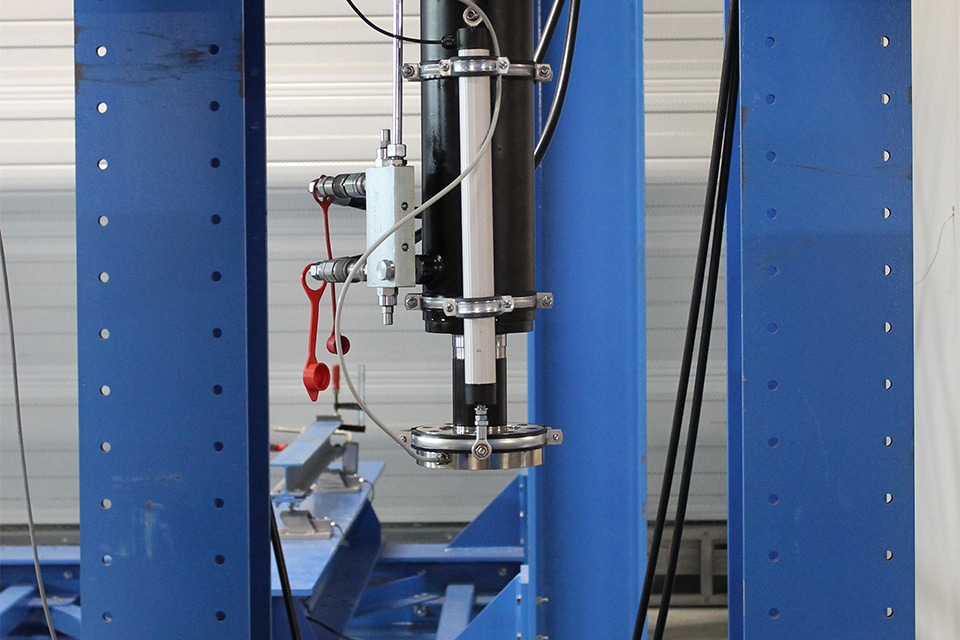
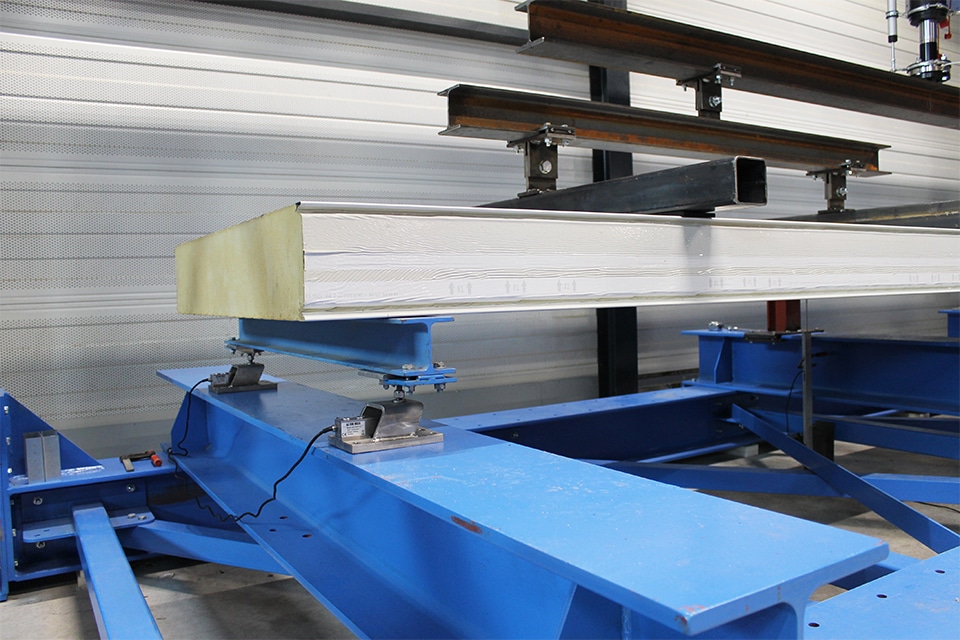
CFP Engineering deliberately deploys testing to validate mathematical models and detailing. “We have test benches on hand with a span of up to 7 meters and a width of 3 meters, with a capacity of 2 x 25 tons. With this flexible setup, we can perform a variety of tests in steel frame construction: from deflection of floors and loads on scaffolding to examinations of sandwich panels and facade panels. In addition, we also test on a small scale, with setups of up to 10 kN, for example for pull-out testing of screws.”