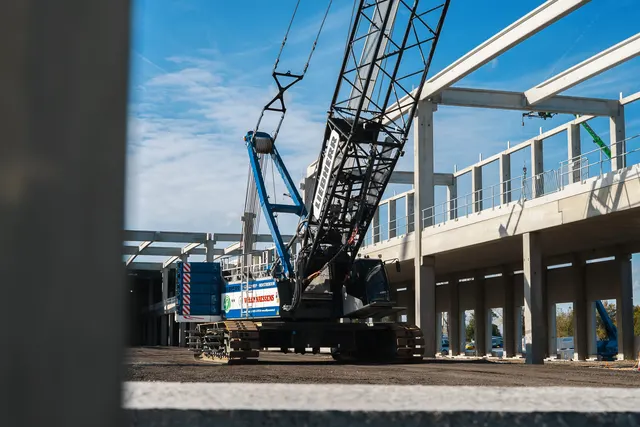
Quality assurance from design through to assembly
Tekst Liliane VerwooldeFotografie KOMO

Precast housing concepts with concrete frames
The Netherlands faces a major construction challenge. Whether it can be met depends on the approach taken. Can the construction sector switch to an industrialised building method with a high degree of standardisation? In light of the Quality Assurance (Building) Act (Wkb), this shift will have a very positive impact on the construction process. At the same time, the quality assurance process will become much more efficient.
Quality assurance on site becomes considerably simpler if the supplying industry has its processes independently assessed in advance. The larger and more complete the industrially manufactured units supplied, the more quality aspects can be assured at the factory. The Wkb performance ladder, previously reported on by KOMO, illustrates this.

KOMO certification
Quality assurance coordinators are already setting conditions to limit the effort required for assurance. One condition is that another body has already assessed the industrial process, at a level at least equivalent to their own. This objective aligns with that of KOMO certification. After all, anything certified in advance at the factory reduces the workload for quality assurance coordinators.
Quality assurance in advance
In the field of concrete construction, Kiwa Nederland B.V. is developing BRL 2840 for precast housing concepts with concrete frames. Part 1, the basis for certifying the design, is complete. Part 2, covering the assembly of the homes on site, will be published shortly. This means that a home designed and assembled under a KOMO certificate complies with building regulations by definition.

Shift in the burden of proof
With the introduction of the Wkb, the burden of proof under the Dutch Civil Code shifts to the builder. The builder is responsible for all activities during production and at handover. In the years that follow, the builder must also be able to prove that its housing concept complies with building regulations and the requirements for correct assembly. The actual quality achieved on site, or as-built quality, must be demonstrated for each construction project.
KiK templates
The KOMO quality assurance instrument (KiK) has been developed to support the builder and quality assurance coordinator in compiling their project files. The KiK tool software application, which forms the basis of KiK, is available free of charge. Templates can be created in the KiK tool for each housing concept. Once a project is complete, the templates can be adapted for the next housing concept. They are designed to collect evidence systematically, from the design phase through to assembly. This gives the quality assurance coordinator all the information needed to carry out their work.
Linking KiK templates and KOMO certificates
The KiK templates can be linked to the KOMO certificates. Quality assurance coordinators can then see at a glance which aspects have already been assessed under the KOMO certificate and which they still need to assess for quality. The KOMO certificate thus serves as a risk control measure, allowing the quality assurance coordinator to limit the intensity of their supervision, and the associated costs.
This naturally raises the question of whether this will leave quality assurance coordinators with too little work. But Keimpe Stroop, a quality assurance coordinator at gBOU., is not concerned. “There is plenty of work for quality assurance coordinators. Moreover, this keeps working under the Wkb affordable.”
Een zakelijke vraag aan Kiwa? Neem contact op
Bedrijven in dit verhaal
Blijf dit volgen
Bij een nieuw verhaal krijg je een e-mail. Geen account nodig.
- ThemaNormen, testen en aansprakelijkheid
- OnderwerpPrecast concrete
- BedrijfStichting KOMO
- BedrijfKiwa