What makes a production line for cast wall panels efficient?
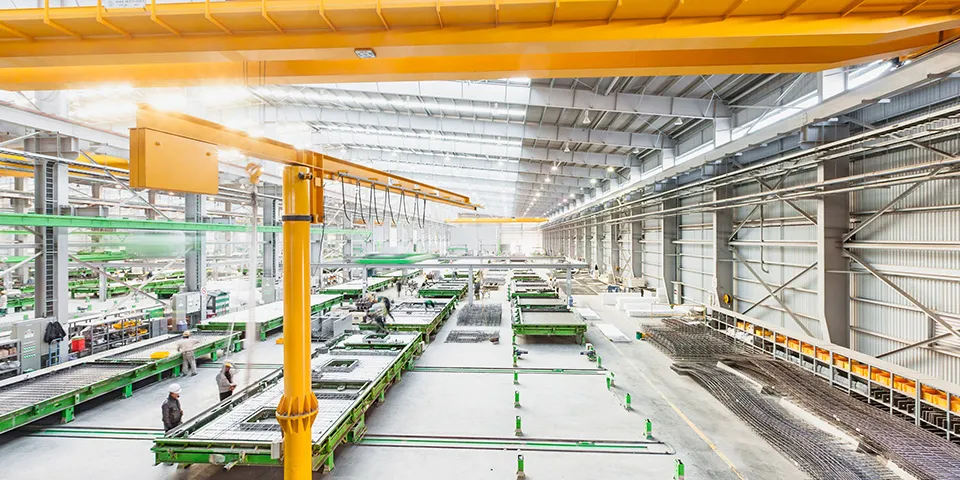
Elematic is well known worldwide for its hollow-core technology, but the company also has a strong product range for cast wall panels, with three ready-made layout concepts (SEMI, PRO and EDGE) to suit different levels of automation and production capacity.
However, as Toni Koitmaa, Elematic’s Product Manager for Wall Technology, explains: “There are many possible solutions. We have many other layout options for different capacities, and they work very well in many existing production facilities. Our strength lies in our tailor-made wall production solutions.”
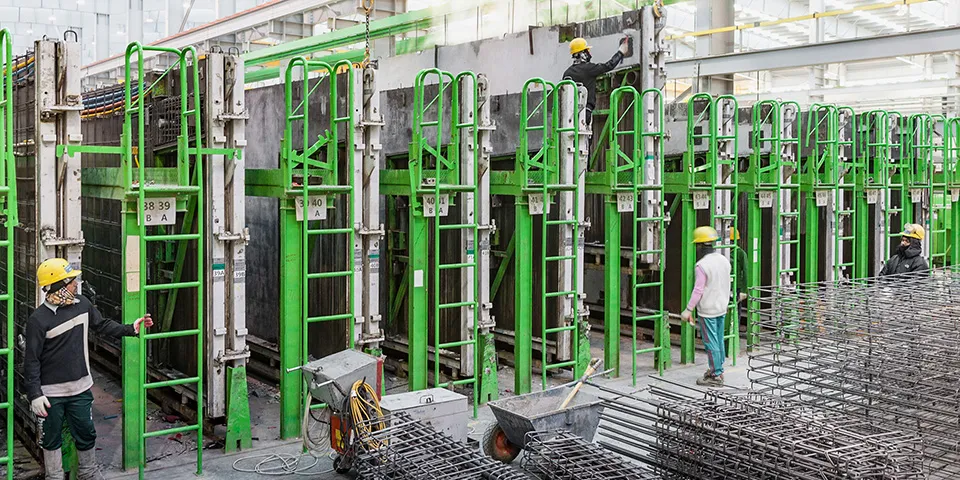
A full range of wall production equipment
One piece of equipment that seems to make wall production lines considerably more efficient is the central transfer car, particularly when the product pallet includes both simple, fast-moving elements and complex panels that require more production time. “The central car moves the elements that need more production time away from the main line, preventing bottlenecks in production. This allows the faster-produced elements to move ahead, making production highly flexible,” Koitmaa explains.
Predefined processes and good documentation throughout the production process are important for production consistency and quality management. “Table moulds, for example, are a long-term investment. You have to ensure that the moulds can meet the requirements specified for the wall element. Table moulds must be flat and straight, and must support the load placed on them without bending. It takes a great deal of experience to manufacture mould tables to tight tolerances,” says Koitmaa.
The casting machine is another essential piece of equipment. Elematic’s Comcaster is, in Koitmaa’s words, “highly unique, highly accurate and fast”, and enables a lower water-cement ratio. It can also produce stiffer concrete than conventional casting machines and reduces surface finishing time.
Other goals, such as reducing waste in the casting process and improving efficiency and safety, are also continually pursued. “With the right shuttering system, you can use half the amount of timber required for table moulds, battery moulds, and column and pillar production. The FaMe system consists of push-button magnets and aluminium side forms that replace timber and steel, resulting in substantial savings.” Koitmaa adds that the FaMe system was designed to improve workplace safety and reduce the risk of finger injuries.
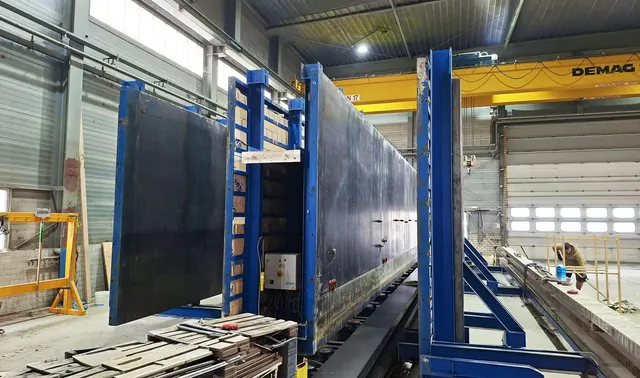
Battery moulds, used to cast solid load-bearing walls, can also have a major impact on efficiency. The cold mould system, supplied by very few machine manufacturers in the industry, has almost twice the capacity of a standard battery mould. The casting cycle is significantly shortened by transferring the cold mould panels to the battery mould after the previous cast elements have been removed. “The cold mould system significantly speeds up the production cycle because only casting and curing take place in the battery mould. This achieves considerably higher capacity,” Koitmaa explains.
Digitalisation also brings top performance within much closer reach. “Digital systems enable you to realise the maximum capacity of casting lines by optimising the process at different production stages, leading to shorter delivery times and resource savings,” Koitmaa promises. At this year’s BAUMA, Elematic introduced WallMES as part of its digital plant control system for casting facilities.
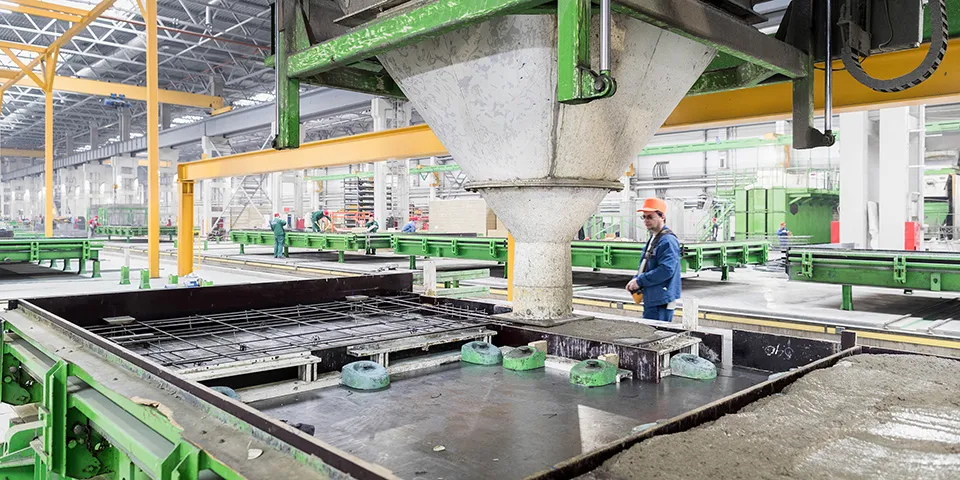
Proven and tested many times on the factory floor
Some examples of Elematic circulation lines in operation:
Elematic’s production line is helping to transform the cityscape in the Nizhny Novgorod region of Russia. Karkas Monolit’s line has an annual capacity of 280,000 m2, with 40 tables, 3 concrete transport shuttles, a transfer car, a stacking station, a tilting station and a transport trolley. Its factory is the largest in the region.
Block Berge Bygg AS in Norway, whose production accounts for 15 per cent of the country’s total precast concrete market, purchased an Elematic circulation line with a weekly capacity of 1500 m2.
Santalan Betoni in Finland has also invested in an Elematic circulation line for its new cast wall factory. The line includes 26 tables, a Comcaster E9 casting machine, tilting tables and two transfer cars.
Elematic wall production lines
SEMI, for cast wall production of between 70,000 and 150,000 m2 per year. SEMI Wall has a straightforward, easy-to-learn basic design.
Theoretical capacity: 280-600 m2/day (one casting)
Staff: 10
Production area: 2000 m2
Land area: 20,000 m2
Number of tables: 10-15
Average table size: 3.5 x 8.0 m
PRO, for casting production with an annual capacity of 170,000-300,000 m2. All key PRO functions are automated. The PRO Wall line consists of a circulation line and optional battery moulds and tilting tables.
Theoretical capacity: 680-1200 m2/day (one casting)
Staff: 12-20
Production area: 2800 m2
Land area: 45,000 m2
Number of tables: 20-30
Average table size: 3.8 x 9.0 m
EDGE, for very high capacity (400,000-750,000 m2 annually), with a wide product range and highly automated casting production. For high productivity, the tables move automatically between production stages. Logistics are handled efficiently by a central transfer car that ensures smooth traffic flow. Productivity is further improved by fully automated concrete transport and an automatic closing station.
Theoretical capacity: 1600-3024 m2/day (one casting)
Staff: 30-35
Production area: 9000 m2
Land area: 70,000 m2
Number of tables: 40-60
Average table size: 4.0 x 10 m
All figures are estimates
Vraag over dit verhaal? Stel je vraag
Blijf dit volgen
Bij een nieuw verhaal krijg je een e-mail. Geen account nodig.
- OnderwerpPrecast concrete