Connections & connection techniques
Symbolic railway bridge replaced by the world’s first network arch bridge
Tekst en beeld Mammoet
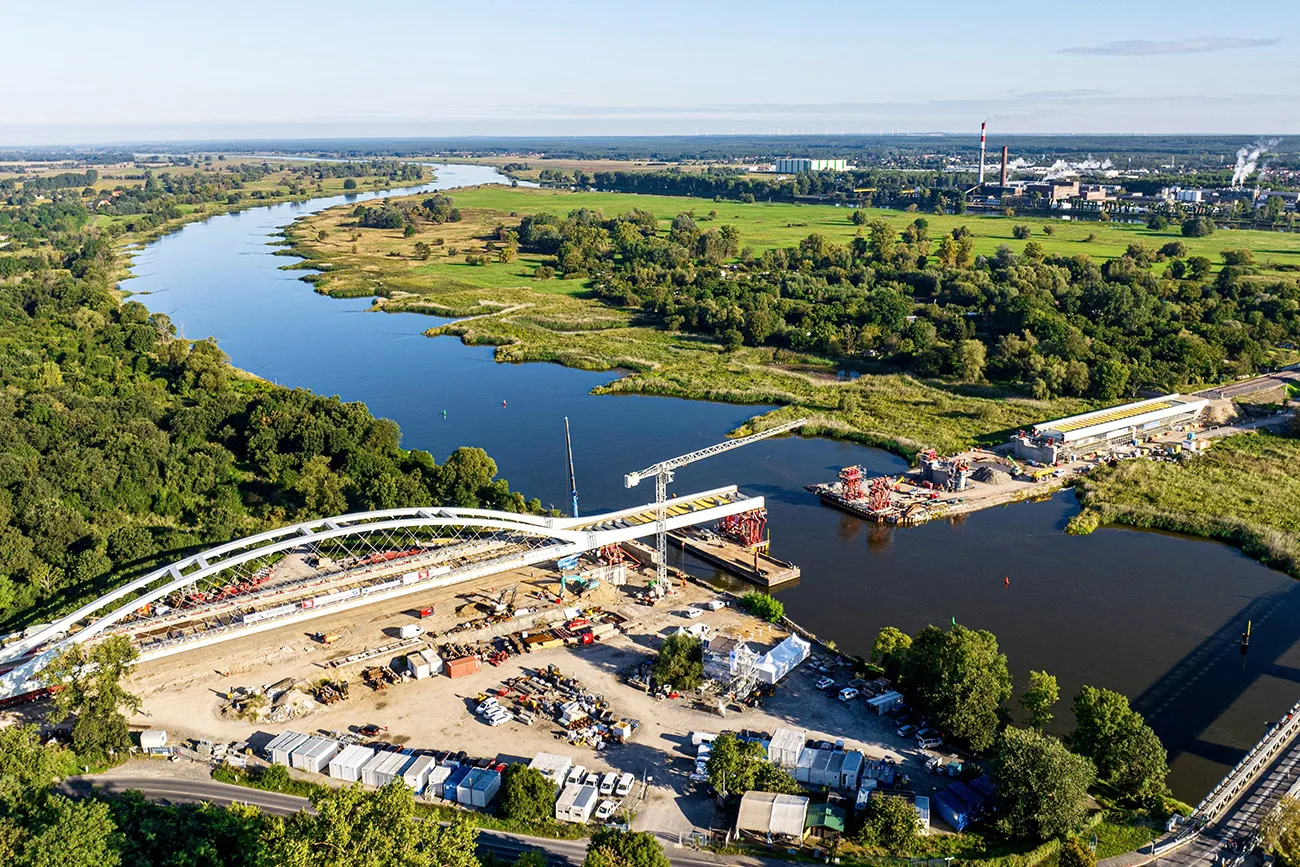
Smart solution for moving the complete structure saves time and minimises disruption
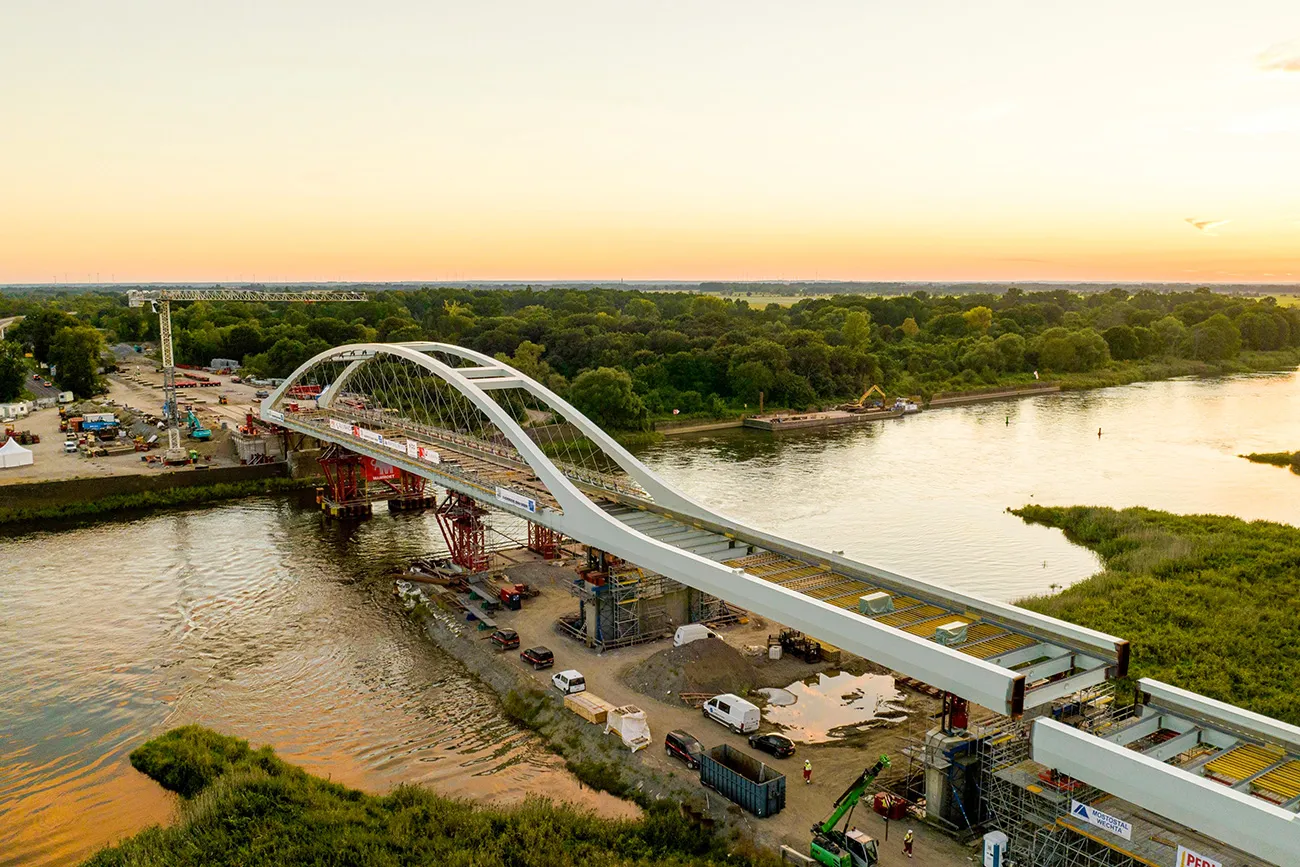
The 2,100-tonne, 180-metre-long bridge will help increase line capacity and reduce journey times by enabling a maximum permitted speed of 120 km/h.
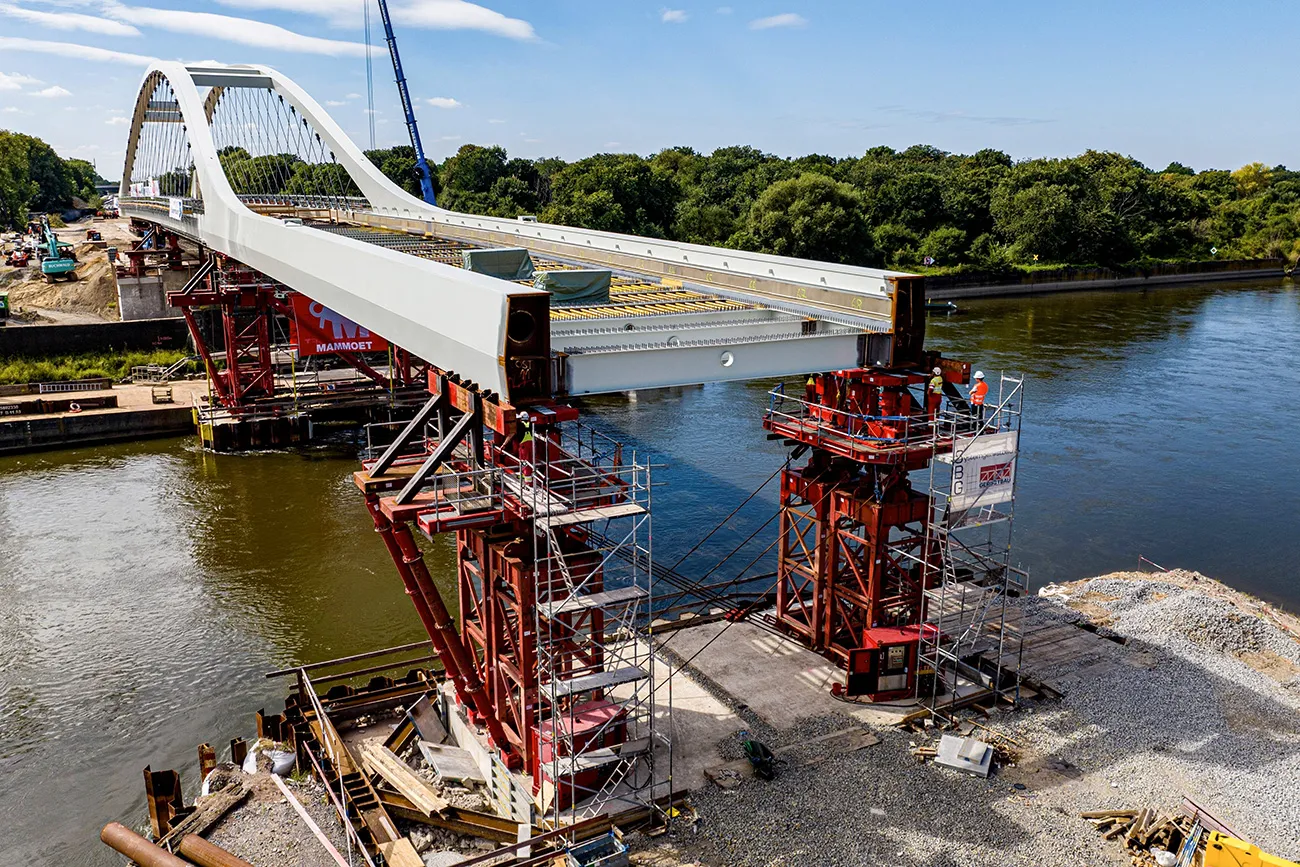
Mammoet has extensive experience in large-scale bridge launches and the specialist heavy-lifting equipment needed to move them as complete structures. This makes it possible to carry out preparatory work in parallel and saves time. Mammoet was therefore approached to install the bridge safely and with minimal disruption.
Challenging and changing water levels
The bridge was assembled on the German side of the Oder and then moved across the river as a complete structure by Mammoet to its final installation position. Koen Brouwers, Project Manager at Mammoet: “Most bridges are floated into position using a combination of Mammoet Self-Propelled Modular Transporters (SPMTs), launching skids and a pontoon. However, using a pontoon was not possible here because the river is shallow and its water levels fluctuate. Using a large crane capable of positioning loads over a long reach was also not feasible because of the bridge’s weight and length.” Mammoet’s engineers therefore came up with a solution that avoided using both a crane and a pontoon. This made it possible to work regardless of the water level and made the operation more flexible, safer and more efficient.
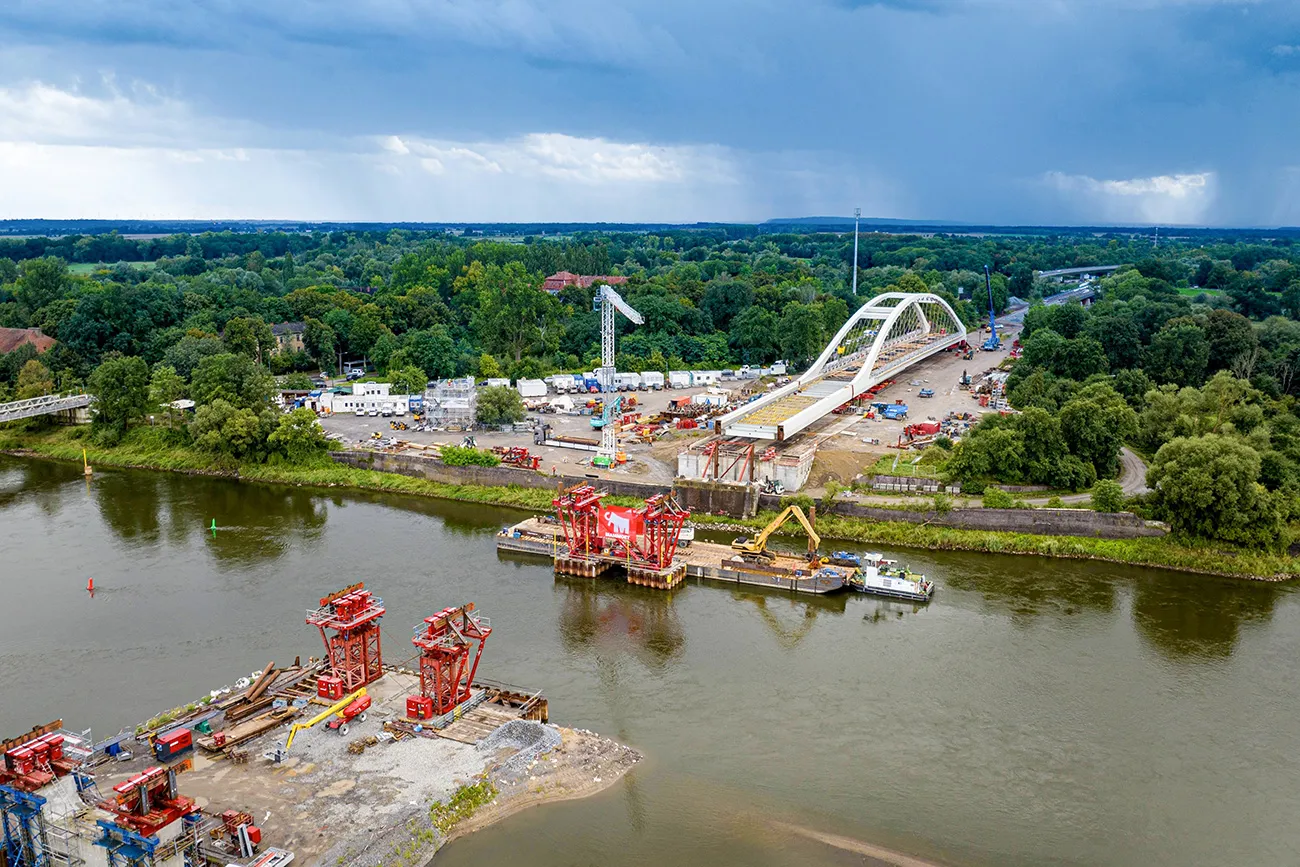
After the bridge had been jacked up to a height of 2 metres and the SPMTs positioned beneath it, it was transported to the riverbank and placed on the first of five temporary supports. The bridge was then launched using a combination of specially designed launching skids and strand jacks, which pulled the structure horizontally until it reached the next temporary support. This process continued until the bridge reached the opposite riverbank. The SPMTs at the rear of the bridge were then removed and sliding plates installed to move the bridge into its final position.
At this point, climbing jacks took over, allowing the temporary supports to be removed and the bridge to be lowered to its final resting height. Around 45 lorry loads of specialist heavy equipment were mobilised for the project, including 96 axle lines of SPMTs, 26 launching skids, 10 climbing jacks and 2 strand jacks.
Rotating skids
One of the main considerations in any bridge launch is the risk of structural deformation during the launch, which posed a major challenge for the engineering team. To address this, temporary supports with hydraulic cylinders were used at the riverbanks and in the water, along with modified launching skids. Jack van der Vloet, Lead Engineer at Mammoet: “It is a large bridge and wind loads had to be taken into account. It deflects considerably, so the launching skids had to be modified. Normally, they rotate in two directions. In this case, however, they had to rotate through 360 degrees. This gave us complete control over the operation at all times.”
All the sliding equipment had to be modified to carry out the operation from an engineering perspective. This meant fitting all the launching skids with spherical bearings so they could move in any direction. During the launch, the load on each tower and cylinder was monitored to ensure smooth and safe operation. Because of the bridge’s size, all the launching skids that Mammoet Europe had in stock had to be used. This was an engineering and logistical challenge, but easily managed thanks to Mammoet’s scale and network.
A new method for success
Infrastructure projects are crucial to supporting growing populations and economies, and as cities become busier, these projects are becoming more challenging. Mammoet’s experience in large-scale bridge projects and its technical capability to move bridges as complete structures make it possible to carry out preparatory work in parallel and save time and minimise disruption. Uwe Richter, Senior Sales Manager at Mammoet: “It is very important to involve Mammoet at an early stage so we can support the preparatory phase with engineering and feasibility studies. This allows us to explore the various execution options and determine the best solution together with the client.”
Compared with other bridge projects that use cranes or pontoons, Mammoet used a different method involving modified launching skids. This smart solution can now be adapted for other bridge projects where using a crane or pontoon is not possible or efficient.
Vraag over dit verhaal? Stel je vraag
Blijf dit volgen
Bij een nieuw verhaal krijg je een e-mail. Geen account nodig.
- ThemaBruggen en kunstwerken langer mee
- OnderwerpConnections & connection techniques