Sustainable projects using sheet piles made from scrap
Tekst Roel BijlardBeeld ArcelorMittal
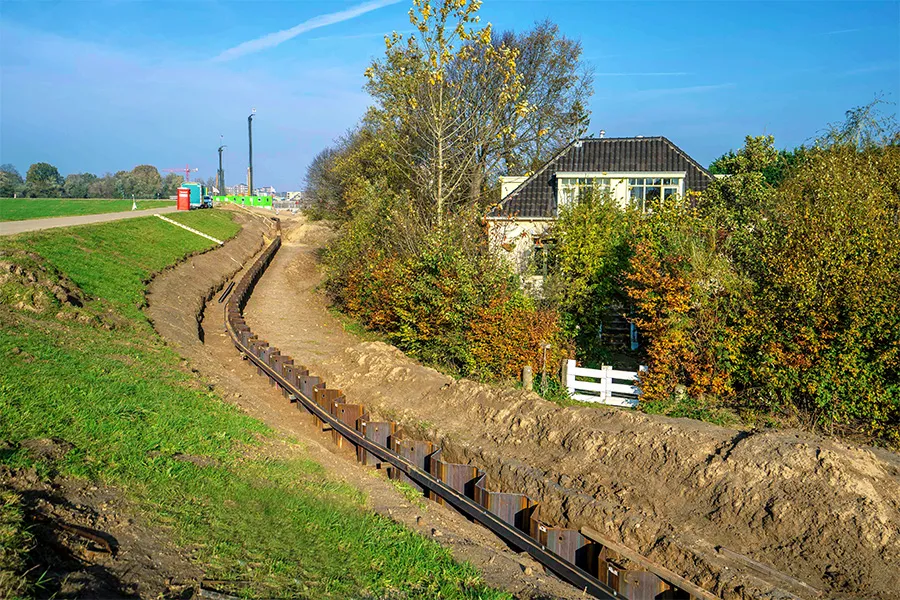
Making the Dutch construction sector more sustainable is essential. For many projects, the environmental impact of the chosen solution and structure needs to be assessed. This is done using Life Cycle Assessments (LCAs) and Environmental Product Declarations (EPDs). Both documents show emissions, including the CO2 emitted during the production of specific products. These emissions are converted into an Environmental Cost Indicator (MKI) so they can be compared and assessed consistently.
ArcelorMittal’s hot-rolled steel sheet piles from Luxembourg are the sustainable solution for foundations. EPDs specifically for the Dutch market are available for all AZ, AU and PU sections. As these sheet piles are produced in an electric arc furnace from approximately 100% scrap, their environmental impact is much lower than that of sheet piles produced from iron ore in a blast furnace.
Reducing CO2 emissions is an important element in every project, but an LCA also assesses other categories, including the depletion of (fossil) resources, eutrophication and acidification of the environment. The Netherlands has also specifically chosen to include four additional toxicological indicators in a product’s environmental impact assessment. Adding together the different stages for each emission makes it possible to determine the total environmental impact of the sheet pile over the course of the project. However, it is difficult to compare different types of emissions with one another. For this reason, the Netherlands applies a conversion factor to each emission, so that everything is expressed in euros as an MKI value.
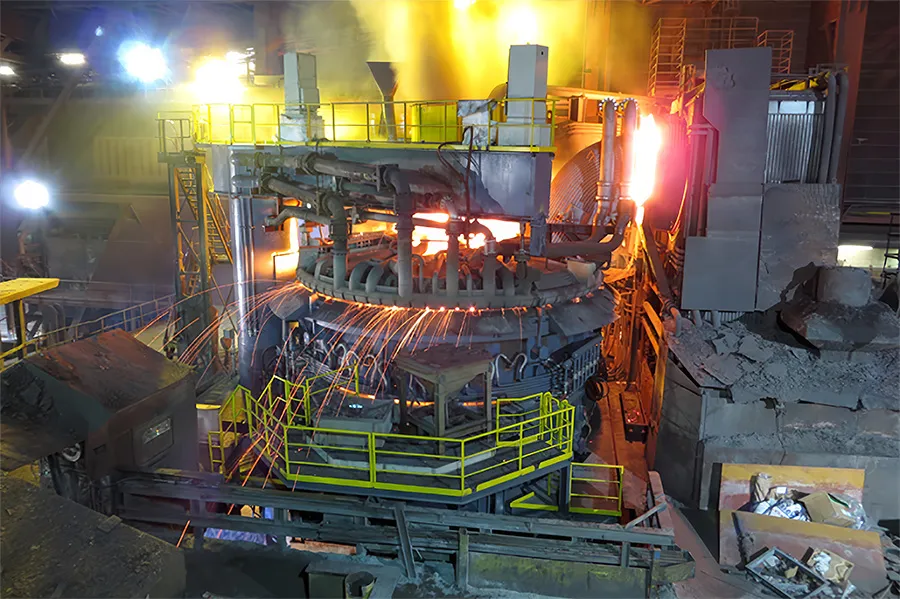
Sustainable and efficient steel production
All ArcelorMittal AZ, PU and AU sheet pile sections are produced in Luxembourg from scrap in an electric arc furnace, with no iron ore involved. This means no primary raw materials are extracted from nature, making it a sustainable way to produce steel. It also generates less waste than the blast-furnace process, with CO2 eq. emissions around five times lower.
A comparison of the Global Warming Potential (GWP, CO2 equivalent) and Environmental Cost Indicator (MKI) for generic sheet pile sections in the National Environmental Database shows the substantial gains that can be made by using ArcelorMittal sheet piles instead of the reference values. A sheet pile produced from blast-furnace steel has a GWP of 2,120 kg CO2-eq/ton, contributing to a total MKI of €275 per ton for the production phase. For the same type of sheet pile produced in Luxembourg, emissions can be as low as 359 kg CO2-eq/ton, contributing to a total MKI of €44.30 per ton for the production phase. The relatively short transport distance from the factory in Luxembourg to the Netherlands, by road or inland waterway, including HVO100, further enhances the sustainability of the solution. Choosing ArcelorMittal as the supplier can reduce CO2 emissions and the MKI value by 77% during the production phase (A1-A5). Electrically installing the sheet piles on site can cut CO2 emissions by a further +/-100 kg CO2-eq/ton, reducing emissions and the MKI by an additional 5%.
The total MKI over the product’s entire life cycle depends on the extent of recycling, reuse and disposal at end of life. These factors need to be determined for each project, as they depend on the application, environmental conditions and project lifespan. For example, a temporary sheet pile structure can achieve a reuse rate of up to 100%, further reducing its environmental impact over its life cycle.
Reduce, Reuse, Recycle
Environmental impact can be reduced not only through the production process. Another way to make environmental gains is to reduce the number of kilograms of steel driven into the ground. Thanks to innovations in sheet pile sections and steel grades, today’s sheet piles are on average 30% lighter than they were 30 years ago. The 800 mm-wide AZ sheet pile range has a unique strength-to-weight ratio. Every saving in material use leads to a more economical design, as well as substantial gains in sustainability and CO2 emissions.
Steel sheet piles are also highly suitable for reuse in temporary applications, such as temporary excavations. It is important to factor the sheet pile’s reusability into the design. A sheet pile in a fully optimised design may be less suitable for reuse than a heavier section. If a sheet pile that is 15% heavier can be reused up to eight times more often than the lighter version across one or more projects, this represents a major improvement in both cost and sustainability. ArcelorMittal supports this process by offering sheet piles under rental and buy-back contracts. However, used sheet piles are not often permitted in permanent works, even though they can often perform just as well as new ones. The key difference is that the full emissions from the production phase do not need to be counted for a used pile, as some of these emissions have already been accounted for in previous temporary applications.
After repeated reuse and/or damage caused by corrosion, sheet piles will eventually no longer meet the requirements for (re)use. The same applies to steel sheet piles removed from the ground after 100 years. All sheet piles that are no longer reused are fully recycled and used again as raw material in the electric arc furnace. The cycle from scrap to steel sheet pile and back to scrap is now complete, ready to begin again for the next project.
Vraag over dit verhaal? Stel je vraag
Blijf dit volgen
Bij een nieuw verhaal krijg je een e-mail. Geen account nodig.
- ThemaMinder CO2 in beton en staal
- OnderwerpSteel