Galvanised steel as a sustainable building block in the circular economy
Tekst ZinkinfoFotografie Zinkinfo
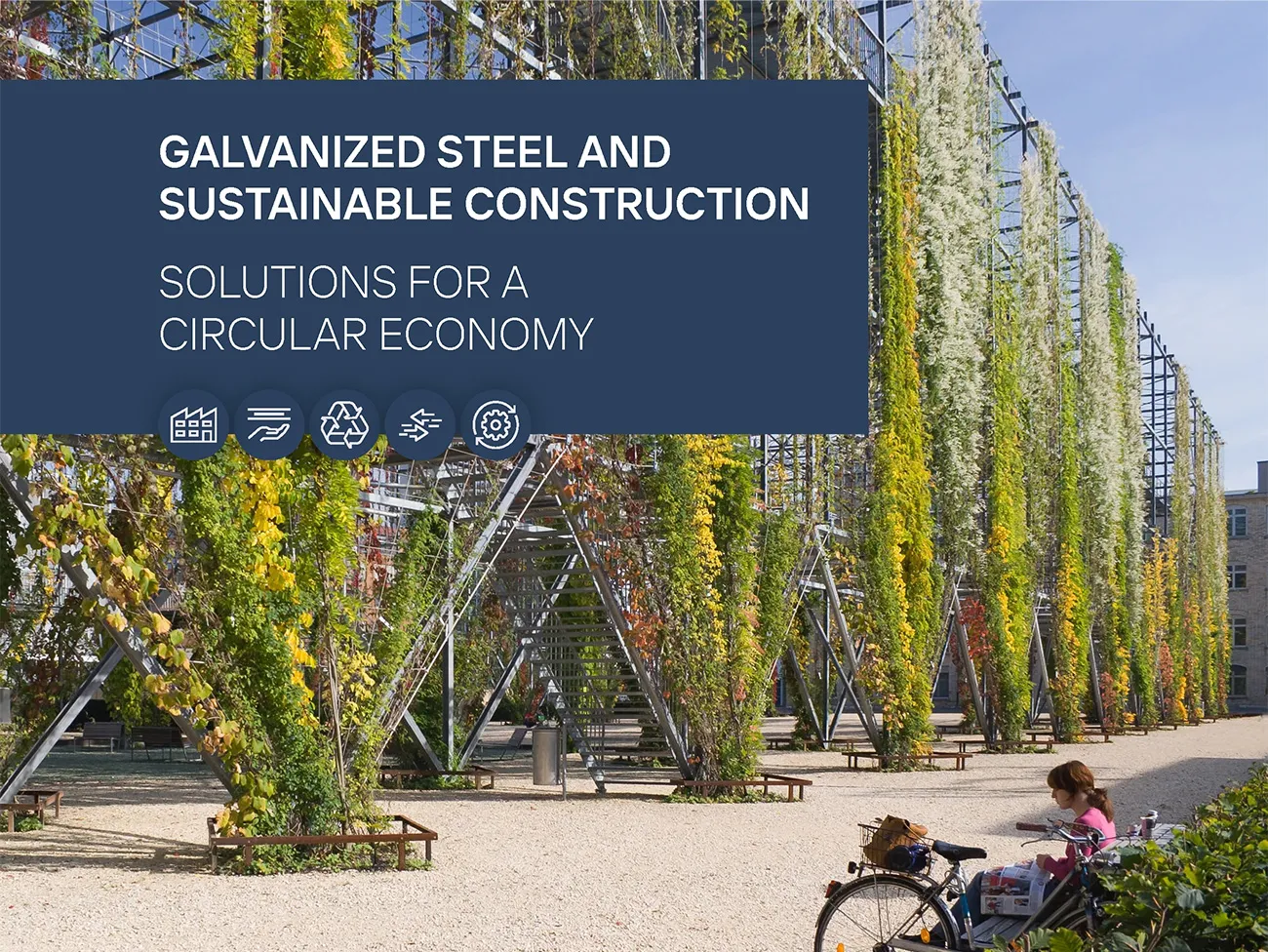
Galvanised steel is a textbook example of a circular building material. Assemble, dismantle, reuse or recycle? Once galvanised, steel can take more than a few knocks. It is a perfect fit for a future in which circular construction is taking centre stage. EGGA, the European trade association for hot-dip galvanisers, makes the case in black and white in a recent publication.
‘Galvanized Steel and Sustainable Construction: Solutions for a circular economy’
The European General Galvanizers Association (EGGA) has long been convinced that galvanised steel is one of the most sustainable building materials. And rightly so. A quick read of its latest publication makes that clear. In ‘Galvanized Steel and Sustainable Construction: Solutions for a circular economy’, the trade association sets out all the advantages of galvanised steel.
The construction sector: an essential link in the circular economy
To tackle the climate crisis, the EU has made the transition to a circular economy a top priority. Using materials and resources more thoughtfully helps our planet in two
ways: by making better use of scarce resources, we can also avoid large quantities of CO2 emissions.
The construction sector can also make a (very substantial) contribution. Looking at the entire life cycle of a building, we can see that construction has a major impact on the main environmental indicators.
50% of extracted raw materials;
50% of total energy consumption;
33% of water consumption;
35% of waste production.
Circular construction models, in which materials remain in a closed loop, can significantly reduce the environmental impact of the construction sector. We therefore need to find ways to preserve the value of building materials for as long as possible, rather than discarding them as waste after use. This would bring us a major step closer to a climate-neutral Europe by 2050.
Climate targets are not the only driver of circular strategies. More and more architects, developers and other construction professionals are also embracing a more future-oriented construction sector, in which climate, material use and reuse, waste reduction and functional adaptations are all considered from the design stage.
How does galvanised steel fit into the picture?
Steel and steel structures are perfectly suited to a wide range of applications across society, from technology, transport, agriculture and industry to infrastructure and buildings. Once galvanised, steel becomes a maintenance-free solution that extends the service life of all these applications.
What’s more, galvanised steel structures can easily be dismantled and reused elsewhere. They stand the test of time with flying colours and retain their value, strength and flexibility almost indefinitely.
Galvanised steel is therefore an exceptionally useful material for architects working on circular building designs. It performs particularly well in terms of reuse, repair and refurbish, three of the core principles of circular construction.
The Rs of circular construction
The Rs of the circular model show how to use and reuse resources as effectively as possible.
Conclusion: hot-dip galvanised steel is an ideal circular building material
The durability, robustness and, at the same time, flexibility of galvanised steel offer many opportunities for circular construction. It is easy to reuse, requires no maintenance and does not need replacing, making it a future-proof building material with minimal environmental impact.
You might think the hot-dip galvanising process was developed specifically for circular construction, but nothing could be further from the truth: it is almost two centuries old. It is the most efficient way to protect steel against corrosion, and likely to remain so.
A great example? The rebirth of this 1976 Dutch grandstand: a fine example of galvanised steel, the SV Gramsbergen grandstand
In 2011, Harry Haverkotte, a former board member of the Dutch sports club SV Gramsbergen, snapped up this old grandstand (pictured left) for just € 7.000. He rescued the structure from the scrap heap and, together with a group of enthusiastic volunteers, set to work restoring the 1976 gem to its former glory.
After 2 years and € 35.000 spent on rebuilding and finishing, the beautiful covered grandstand stood beside the pitch looking as good as new. A completely new grandstand would have cost the club € 200.000. Every part of the old stand was given a second life, apart from the bolts, nuts and wooden planks. Was it Dutch thrift, or did he have an eye for circular construction avant la lettre?
It just goes to show that even after 40 years of exposure to rain, wind and hail, the galvanised steel structures were still in excellent condition. Ready to shelter exuberant fans from the same weather for decades to come.
Want to know more about how galvanised steel supports circular construction?
Find out in ‘Galvanized Steel and Sustainable Construction: Solutions for a circular economy’, a clear, insightful publication packed with compelling case studies.
Read the full publication at www.zekerzink.com
Vraag over dit verhaal? Stel je vraag
Blijf dit volgen
Bij een nieuw verhaal krijg je een e-mail. Geen account nodig.
- ThemaMinder CO2 in beton en staal
- OnderwerpSustainability & circularity