The circular economy is coming
Tekst Tjerk van DuinenFotografie BetonOnderhoudsPlatform
The ambitions of the Dutch government-wide programme ‘The Netherlands Circular by 2050’ are high. The same goes for its target of halving consumption of primary raw materials by 2030. We will know for certain whether we have achieved these ambitions in 7 and 27 years. But we are making things difficult, if not impossible, for ourselves unless we pay more attention to maintenance, says the BetonOnderhoudsPlatform (BOP). That is why the concrete repair sector is organising the Zuidelijke Betonreparatiemiddag on 30 March, with the aim of showing policymakers, property owners and managers how they can make a greater contribution to a circular economy. “There can be no circular economy without concrete maintenance.”
Managing and maintaining concrete structures has a major role to play
Everyone is talking about circular thinking and a circular economy. Circular construction is also gaining ground. According to the BOP, the focus is usually on designing new sustainable, adaptable and long-lasting buildings, and new civil engineering structures with a low environmental cost indicator (MKI) score or even a fully climate-neutral footprint. “Maintenance is unfairly given too little attention,” say Anthony van den Hondel, chair of the BOP and KB-kenniscentrum, and Jelle Lecluijze, a board member of the BOP. Lecluijze says: “Everyone knows the butterfly diagram from the Ellen MacArthur Foundation. The right-hand side describes the technical cycle, covering structures and consumer goods. The inner circle of this technical cycle is about renovation and maintenance. This circle is what does most to preserve value, and therefore makes the greatest contribution to the circular economy. Yet maintenance is still not taken seriously and is too often seen as a cost to be minimised.”
Service life
Concrete has a special place in this story. It is the most widely used construction material worldwide and in the Netherlands. “It can have a very long service life,” says Van den Hondel. “The Pantheon in Rome has stood for 1,800 years, and in the Netherlands, too, much of our prosperity and wealth has been built with concrete over the past 150 years. But concrete quality is often mediocre, which means reinforcement corrosion is expected to develop when structures are just twenty to forty years old, even though they are intended to last at least a hundred years! In addition, the Netherlands faces a huge replacement challenge, for example in infrastructure, and a growing number of buildings are approaching or have already reached the end of their technical service life. It is far from certain that we will be able to meet this replacement challenge. Will Rijkswaterstaat have the budget to carry it out over the coming decade? And how will housing associations deal with the nitrogen crisis? With CO2 restrictions on the horizon and the expected disruption caused by construction work, the pressure to keep structures in service is growing. I think too little is being done at present to maintain buildings, civil engineering structures and other assets.”
‘It’ll last a bit longer’
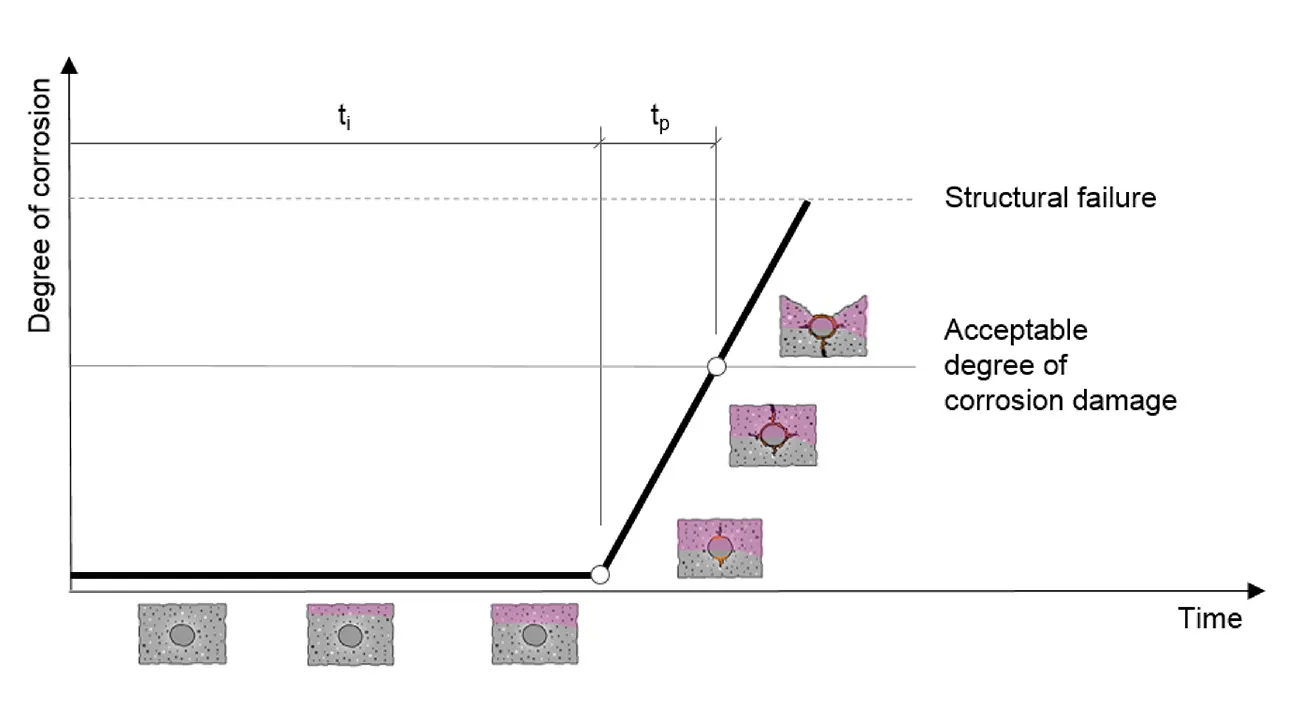
Lecluijze illustrates this with a graph showing maintenance costs over time. “Concrete structures remain in good condition for a very long time, until damage occurs. In 75% of cases, this damage is caused by reinforcement corrosion, commonly known as concrete cancer. This marks the start of the upward trend. Somewhere on this rising damage curve is the point at which action is taken, usually too late and under pressure because, for example, the structure has become too dangerous. Timely maintenance would have limited or even prevented the damage. Preventive maintenance would have shifted the entire curve to the right. That means a longer service life and less demand on scarce resources. What we still see too often is that damage is identified, while it is still low on the upward curve, but people then say: leave it as it is, it’ll last a bit longer. Especially when it poses little risk, nothing is done.”
Longer service life is penalised
According to Van den Hondel, maintenance is not sufficiently integrated into the system. “Take the Betonakkoord, which focuses almost entirely on new construction. The emphasis is mainly on the composition of concrete mixes, slimmer profiles in load-bearing structures or designing for disassembly, but not on the positive environmental impact of structures that are already standing. That is CO2 we have already emitted. Of course, sometimes putting up a new building makes more sense, for example if it will be much more energy-efficient in use. But when judged purely on the materials, keeping a building standing and maintaining it properly is always better. What bothers me is that all sustainability calculations for new construction reward a slightly slimmer structure with a smaller footprint, while a slightly heavier structure that lasts twice as long is penalised. Retention is not built into the system, and you are not compensated for it. But emissions you avoid, now or in the future, represent a real saving that should be made visible.”
Buildings need to last longer
The BOP also wants property managers to give greater priority to maintenance. “Billions more are spent on maintenance each year than on new construction,” Van den Hondel continues. “Yet in developers’ focus on returns, maintenance often still plays a subordinate role. You put something up and, after 50 years or even sooner, you demolish it. Economically, it has already served its purpose for the owner. This is no longer sustainable for a number of reasons. First, the cost of CO2 is still very low, but it will rise sharply before long. Short-term strategies based on demolition and new construction will then suddenly become unprofitable, making sensible maintenance much more attractive. Second, resources and materials are becoming increasingly scarce. The Netherlands aims to build around 900,000 homes by 2030. We are already unlikely to meet that target. So why would housing associations demolish tens of thousands of homes to replace them with new ones? That would add to the challenge. I would say: renovate as much as possible. That makes you circular in terms of the structure, and perhaps you need to be more creative about functionality, which is often a reason for demolition. Third, given the current rate of replacement, homes need to last not just a hundred years but as long as 150 years. That means maintaining them for longer and better. And not through the old approach to maintenance, which is mainly about firefighting and dealing with emergencies, but with more emphasis on preventive and predictive maintenance. That saves enormous costs.”

Engine trouble
Curiously, things often work differently when it comes to small things, Lecluijze says by way of comparison. “If the engine warning light comes on in the car, we drive straight to the garage, otherwise we might wreck the engine. We have wooden window frames painted every five years, or they will eventually rot. But this logical way of thinking does not seem to apply to buildings and civil engineering structures. There is relatively little budget for maintenance, even though every asset can be kept in service and small, timely investments prevent large expenses in the future.”
An afternoon for shaping the future
With the 2030 and 2050 deadlines approaching, we need to change course. Van den Hondel says: “We need to move from a linear economy to a circular one. The price we will soon have to pay for CO2 will force us to do so. By extending the service life of structures, we can make a substantial contribution to meeting these challenges. As a collective, the BOP has the expertise to make this happen, and we want to share it. That is why we have geared the programme for our upcoming Betonreparatiemiddag towards building managers and other people shaping the future, as Daan Fousert calls them. Before the break, the programme features talks on climate and leadership from a society-wide perspective: how can we respond to the Climate Agreement? After the break, attendees will hear success stories from practice. These include the high-quality reuse of the concrete girders from one viaduct in a new viaduct, a complex case in which housing association Bo-Ex reuses materials from old apartment blocks, Vestia’s innovative extension of the service life of thirteen residential blocks, and a project at Chemelot where research by TNO led to the service life of 60-year-old industrial columns being extended by at least 25 years. These are excellent examples from which policymakers, decision-makers, practitioners, property owners and developers can learn a great deal.”
Vraag over dit verhaal? Stel je vraag
Blijf dit volgen
Bij een nieuw verhaal krijg je een e-mail. Geen account nodig.
- ThemaMinder CO2 in beton en staal
- OnderwerpReinforcing steel