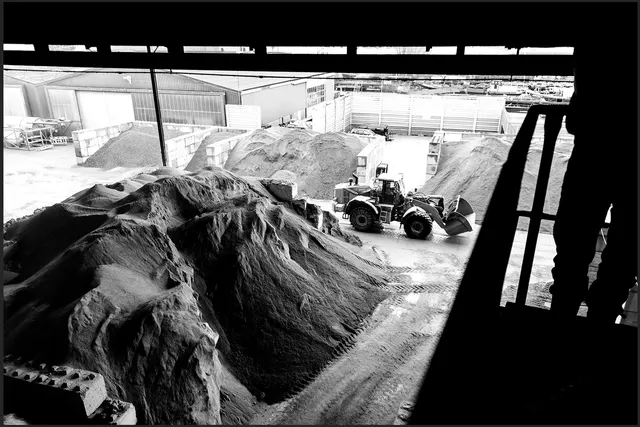
Building in concrete and steel…

… is not the sexiest thing to do at the moment. But that was not always the case. Take the 1970s, for example, when Brutalism was the ultimate expression of using concrete and steel to create architecture that was highly physical and, at the time, sexy too (at least for those who appreciated it). We have not built like that for a long time now, and many Brutalist buildings have been demolished or neglected to such an extent that there is little left to enjoy. What is striking, though, is that the younger generation appreciates Brutalism again.
Lars Zwart: CRKL architecten, Utrecht
Tired of all the design frippery and supposedly responsible sustainability, this generation apparently longs for the carefree 1970s. So, at his request, I recently went to London with my 23-year-old son Jorn to see what he calls Brutalist blockbusters. There is apparently a ‘Brutalist map’ of London, so we had our itinerary sorted in no time! The highlight was undoubtedly the Barbican Estate, a huge blot on the Brutalist map, made entirely of concrete and steel. And what a way to do it! Strangely enough, I had completely missed this complex during my studies in Delft. Brutalism was commonplace there at the time, with the aula at TU Delft (Van den Broek en Bakema), which we cycled past every day. I was totally unprepared for the spectacle of the Barbican Estate, which looked as if it had just been completed. We stepped straight into the 1970s, at their very best!
I think one of this project’s secrets lies in the fact that all the concrete surfaces were bush-hammered in situ (who would still think of doing this, let alone have it done?). This gives the buildings a softness that is often sorely lacking in concrete façades. Go and see it! But these buildings are actually just as relevant as the temples in Egypt. Beautiful, but we no longer build like that. Too much macho, and too much CO2. Surely everything has to be timber now?
Alongside another Brutalist blockbuster, the National Theatre, Jorn and I discovered a huge concrete frame beginning a second life. No problem at all in London! It got me thinking. Why make everything out of timber? Why do we so often veer towards extremes: all concrete, all glass, all timber, greenery everywhere? Certainly, such a bold choice is striking and sometimes sexy. And I, too, am passionate about building in timber. But will it really help the world? Sometimes I wonder.
I would like to share the following dream: suppose that from now on, we make building frames from steel and concrete structures that are 100% modular and demountable. A strong, stackable frame that can be fitted out with timber, among other materials. Ideally, there would be only a limited number of variants. A Building World Standard, just like shipping containers. These structures could be reused indefinitely and would remain the property of the manufacturer, who would lease them to the building owner. This would make them directly competitive with building frames that are demolished after 50 years. The modular frames would be fitted out with walls and technical installations, then dressed in contemporary architecture that comes and goes with the slow ebb and flow of the economy, use and style. They could be used to build homes and offices anywhere in the world.
Nothing new, of course: simply the support-and-infill concept devised by John Habraken in 1961, but applied across the world as a Building World Standard. And… an extreme, of course, but that is what makes it a dream…
Vraag over dit verhaal? Stel je vraag
Blijf dit volgen
Bij een nieuw verhaal krijg je een e-mail. Geen account nodig.
- OnderwerpConcrete