Eco-friendly foundation beam
Tekst Roel van GilsBeeld IJB Groep
A new step towards sustainable construction
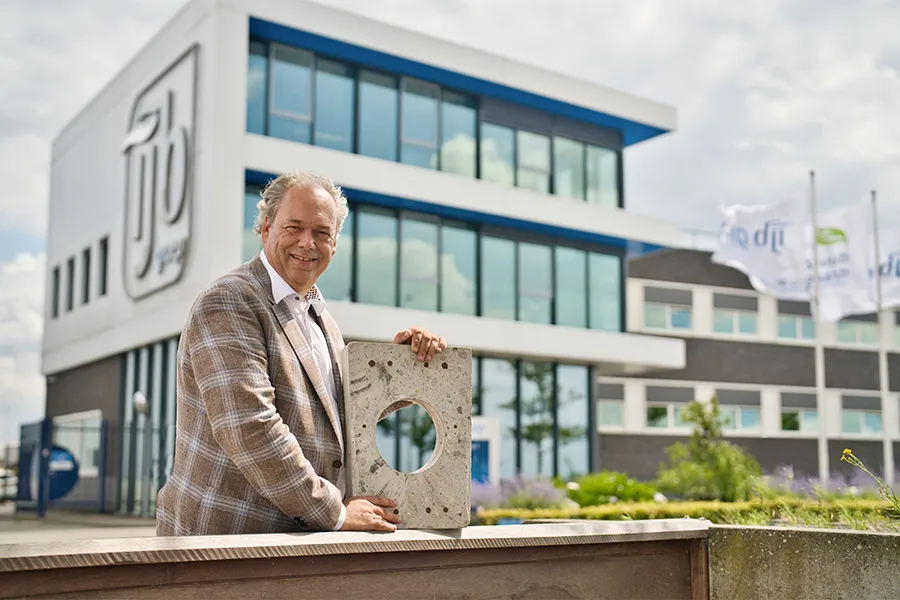
Following the successful introduction of the hollow driven pile, also known as ECO-paal®, IJB Groep is once again taking a major step towards making the construction sector more sustainable. This time, the innovation focuses on the foundation beam, a crucial component of the main load-bearing structure in housing construction. The launch of the ECO-funderingsbalk® marks the development of a product that not only meets all technical requirements, but also makes a significant contribution to reducing CO2 emissions.
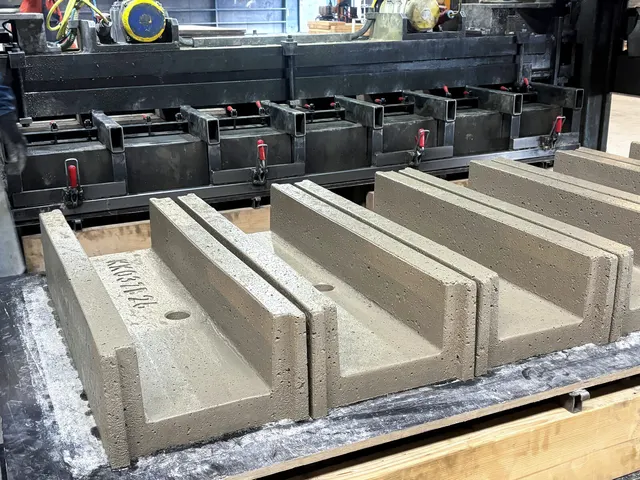
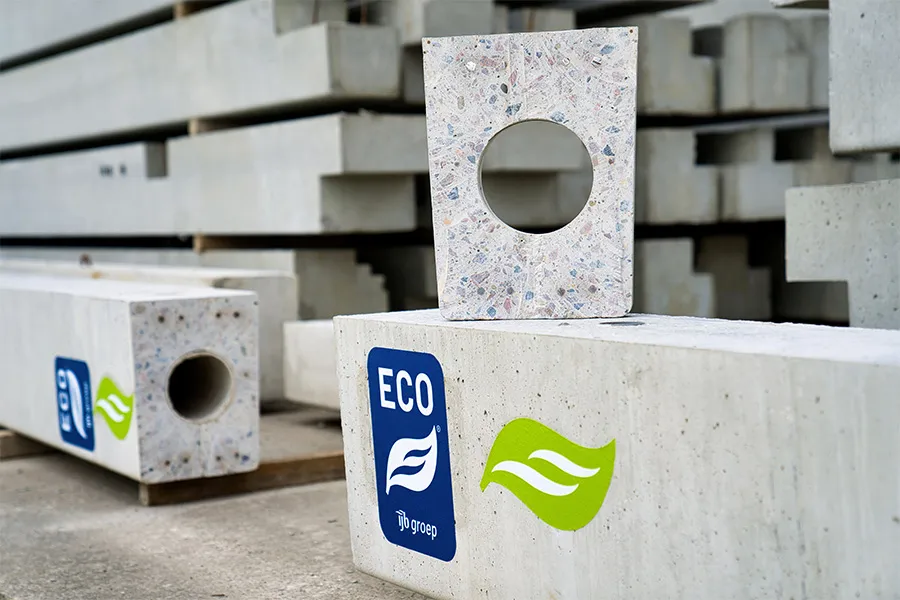
The ECO-funderingsbalk is a precast concrete element with a hollow core running through the centre of the beam. “This means 20% less concrete is used per element, directly resulting in 20% lower CO2 emissions,” says John Engelsman, managing director of IJB Groep. “This makes the beam not only more sustainable, but also lighter, and therefore easier to transport and handle on site.” The beam is primarily intended for use in large-scale housing developments. “The construction sector faces the challenge of significantly reducing CO2 emissions. The target for 2030 is to achieve a 55% reduction in emissions. The ECO-funderingsbalk is a concrete step in that direction.”
Extensive calculations and testing
By using materials and design more intelligently, a substantial reduction is achieved without compromising structural integrity. “The final design of the ECO-funderingsbalk was developed following extensive calculations and testing. In collaboration with TNO, we carried out destructive tests on the beam. The test beams were literally crushed to verify their load-bearing capacity and safety,” Engelsman emphasises. “The results were positive: the beams proved even stronger than the calculations had predicted. These guarantees mean the product can be used reliably in practice straight away, without compromising on quality.”
Practical benefits for contractors
According to Engelsman, large contractors responded enthusiastically to the launch. “They are looking for concrete, immediately applicable solutions that can be scaled up and are not confined to the laboratory. Our ECO-funderingsbalk offers exactly that: an innovative product that fits into existing construction processes, with no restrictions on dimensions or applications. The lighter structure also offers practical benefits in transport and installation. Crane operations are simpler, and because the beams are manufactured and delivered as precast elements, quality remains consistent and installation is efficient.”
Toekomstlab
The ECO-funderingsbalk concept was developed in IJB Groep’s Toekomstlab, an in-house hub for innovation. “Staff involved in the lab are given one day a week to experiment, brainstorm and develop new solutions,” Engelsman explains. “This generates not only creative ideas, but also tangible results that quickly find their way into practice.” According to Engelsman, the introduction of the ECO-funderingsbalk is only the beginning. Work is already under way on further development, including exploring the use of alternative aggregates instead of gravel, making the reinforcement more sustainable and designing the beams for disassembly, he reveals. “That last point would be a major step towards circular construction.”
With the introduction of the ECO-funderingsbalk, following the earlier launch of the ECO-paal (hollow driven pile), IJB Groep is demonstrating that sustainability and reliability can go hand in hand. The combination of reduced material use, lower CO2 emissions, practical benefits and proven load-bearing capacity makes the ECO-funderingsbalk an important innovation for housing construction. At the same time, it represents a significant step towards the 2030 climate targets and a more sustainable future for the construction sector.
Vraag over dit verhaal? Stel je vraag
Blijf dit volgen
Bij een nieuw verhaal krijg je een e-mail. Geen account nodig.
- ThemaMinder CO2 in beton en staal
- OnderwerpConcrete