Automated tying on site
Tekst Roel van GilsFotografie MAX Europe
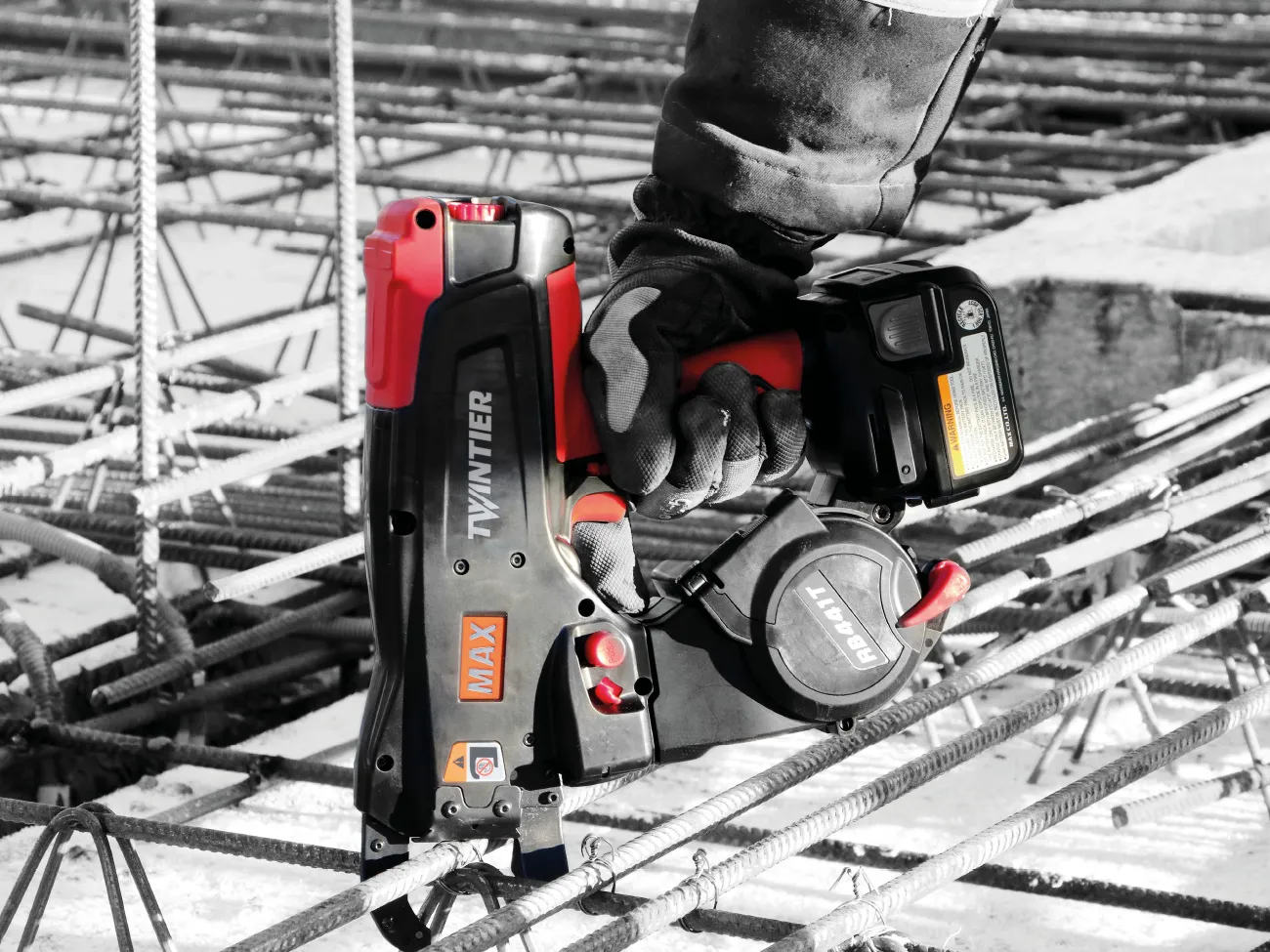
(Precast) concrete plants, underfloor heating installers and electrical contractors in the Netherlands have been benefiting from steel tying with compact, (battery-powered) tying tools for many years.
MAX’s Twintier tools are considered the benchmark in this field and offer significant opportunities for steel tying companies working on site, both in terms of efficiency and ergonomics. “The average business case is made in just three to four months,” says Paul Zieltjens, Regional Sales Manager for Scandinavia and the Benelux.
MAX is a pioneer in tying tools and introduced the world’s first battery-powered concrete tying tool back in 1995. The Japanese multinational operates worldwide and now offers a complete range of tying machines capable of tying steel up to 29 x 32 mm thick. “Our Twintier tools are popular with end users all over the world,” says Sales Manager Roy Sieberichs. “They regularly share their experiences on social media. That says a lot about the performance of our machines, which could also add value for steel fixers in the Netherlands.”
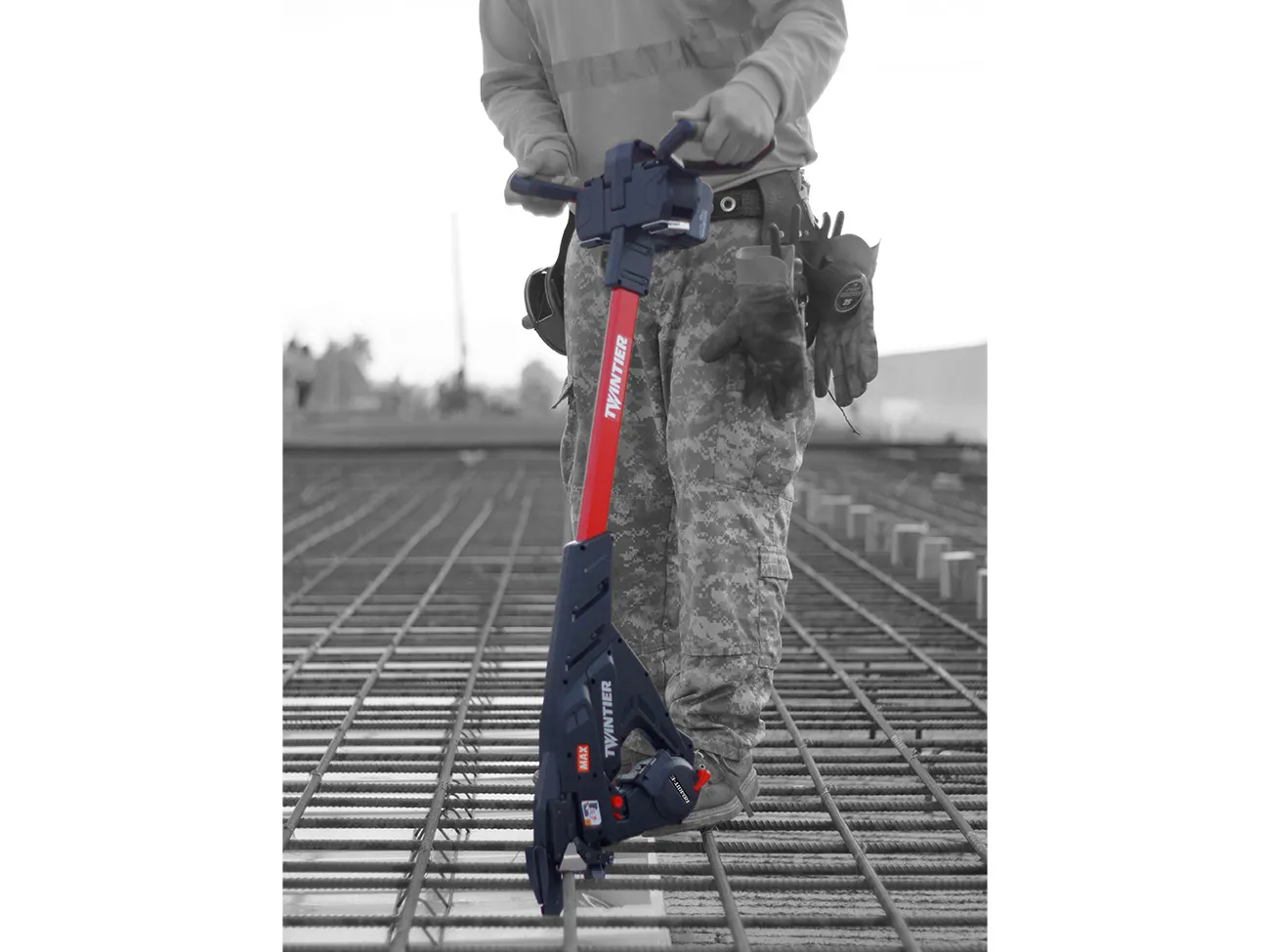
Improved ergonomics
Sieberichs notes that the benefits of the Twintier, particularly for steel tying on site, are somewhat underestimated in the Netherlands. “The Twintier is lightweight and easy to handle. It delivers the same quality as manual tying and ties just as tightly. In fact, the quality of a tie made by the Twintier at 6.00 in the morning is identical to one made at 20.00 in the evening. Naturally, there is no drop in performance due to fatigue. Ergonomics also improve significantly. Steel fixers often suffer from physical complaints caused by having to repeat the same movements time and again. The Twintier also provides much-needed relief in this respect.”
With more than 200 people in R&D, MAX is constantly developing its products to ensure the highest quality. End users’ experiences also play a very important part in product development, because MAX wants its products to reflect what the market wants. MAX has patented its equipment and wire coils worldwide.
Substantial savings
The two men are quick to counter the claim that tying with the Twintier costs more than manual tying. “You need to compare like with like, rather than looking only at the price per kilo of wire,” says Zieltjens. “Using the calculator on our website, any company can easily work out whether, and what, savings it can make with the Twintier by entering a few parameters. What we see is that an average company needs just 3 to 4 months to recoup its investment. After that, it is pure profit. Of course, it depends on production volumes, but substantial savings can also be made in the Netherlands.” Peter van Hemert of Beton-staal & Vlechtwerk Gebr. Van Hemert can confirm this. “We have been using the MAX RB441T for two years and are very pleased with it. It makes the work easier and faster, and our employees would not want to be without it.”
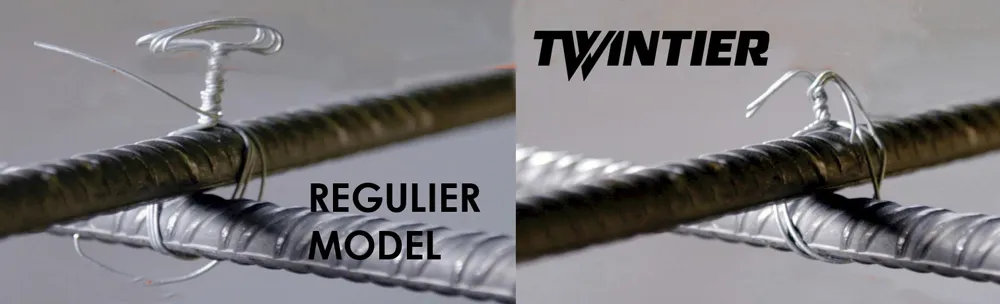
4,000 ties on a single battery charge
According to Sieberichs, tying with the Twintier can be up to three times faster than manual tying. “The steel fixer also always has one hand free. The tool cannot read drawings, so the steel fixer’s knowledge and experience remain essential, particularly for special ties. On the other hand, the tool is very easy to use. In fact, anyone can pick up the Twintier and make high-quality ties.” MAX supplies the Twintier in three variants: two compact tools and a standing model. “The latter is ideal for complex projects, such as tying on bridges and roads or large floor slabs in buildings,” says Zieltjens. “A unique feature of our tools is that the wire ends do not hang loose. The tool makes a complete loop. This is a major advantage, especially in tunnel construction projects, as it prevents rust spots that might become visible after plastering. A tie is made extremely quickly, in just 0.7 seconds. A single battery charge is enough to make 4,000 ties. The lithium-ion battery is fully charged again within an hour, and reaches 80% charge in 35 minutes.”
MAX is seeing growing interest in the Twintier. “We are receiving more and more requests for demonstrations,” says Sieberichs. “Interested companies can try the tool out for up to a week. Distribution, service and after-sales support in the Benelux are handled by our distributor Co-Fastening in Almere. The company has been doing this to our complete satisfaction for 28 years, and we maintain close ties. Every week, we go out on site together and give demonstrations to show interested companies the added value of the Twintier. In this way, we are working to improve efficiency and ergonomics across the sector.”
Vraag over dit verhaal? Stel je vraag
Blijf dit volgen
Bij een nieuw verhaal krijg je een e-mail. Geen account nodig.
- OnderwerpGeneral