A brutalist masterpiece in concrete
Tekst en beeld Tjerk van Duinen
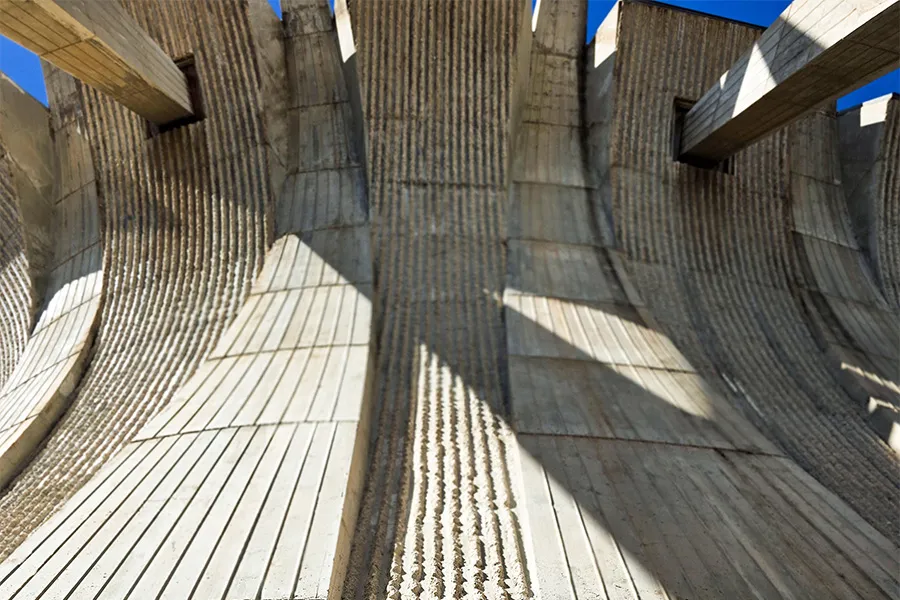
In the 1960s, the use of reinforced concrete in Spain was still developing rapidly. Yet a group of architects, Fernando Martínez García-Ordóñez, Dexeus Beatty, Bellot Port and Herrero Cuesta, and engineer Claudio Gómez Perretta dared to use the material to create an avant-garde church. The result, the Iglesia de Nuestra Señora de Loreto in Jávea, is a technical and aesthetic feat.
The twelve slender concrete pillars, symbolising the apostles, support an imposing roof with a curved structure reminiscent of an inverted ship’s hull. The design’s strength lies in its flowing, organic form and the seamless continuity of the concrete work, a technically demanding achievement at the time.
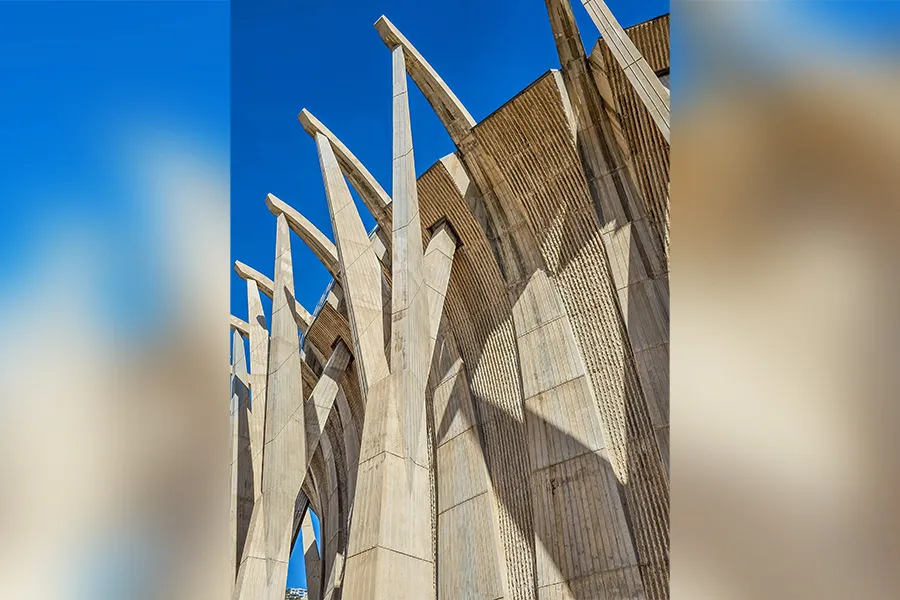
Block formwork
A block formwork system, a relatively new technique in Spain, was used for the construction. Realising the roof’s complex geometry required precision and craftsmanship. The supporting structure had to withstand not only the loads imposed by the heavy reinforced concrete, but also the coastal climate. The concrete quality and finish were crucial: the exposed concrete surfaces have a rough character typical of brutalist architecture, but were executed with the utmost care to minimise cracking and erosion.
A serene, spacious experience
Inside, the monolithic concrete structure contributes to a serene, spacious experience. The absence of corners is striking. The walls flow seamlessly into one another, enhancing the dynamism of the space. Strategically positioned openings admit light in a subtle interplay of light and shadow, while the wooden ceiling contrasts with the robustness of the concrete.
The innovative use of concrete and ingenious construction made this church a landmark project in Spanish construction history. In 1969, it was nominated for the Premio Nacional de Arquitectura. For the concrete and construction sectors, the project offers an inspiring example of how far the boundaries of reinforced concrete can be pushed.
Vraag over dit verhaal? Stel je vraag
Wie eraan werkte
Iglesia de Nuestra Señora de Loreto in Jávea
- architectFernando Martínez García-Ordóñez
- architectDexeus Beatty
- architectBellot Port
- architectHerrero Cuesta
- ingenieurClaudio Gómez Perretta
Blijf dit volgen
Bij een nieuw verhaal krijg je een e-mail. Geen account nodig.
- ProjectIglesia de Nuestra Señora de Loreto
- OnderwerpGeneral
- BedrijfFernando Martínez García-Ordóñez
- BedrijfDexeus Beatty
- BedrijfBellot Port
- BedrijfHerrero Cuesta
- BedrijfClaudio Gómez Perretta