A pile-supported concrete floor reinforced solely with steel fibres
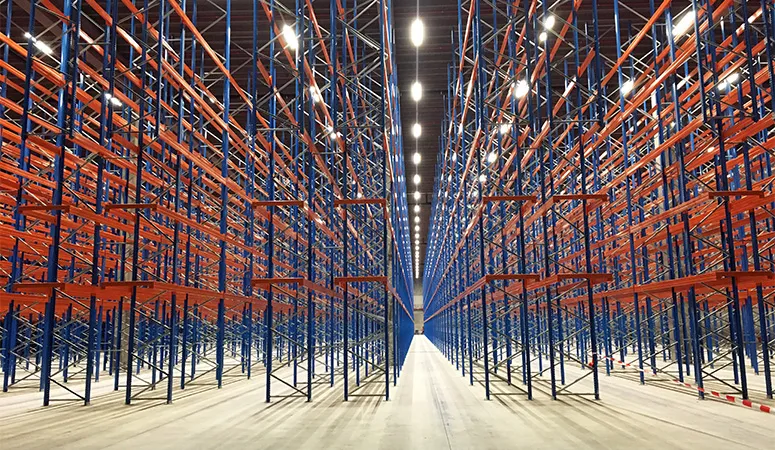
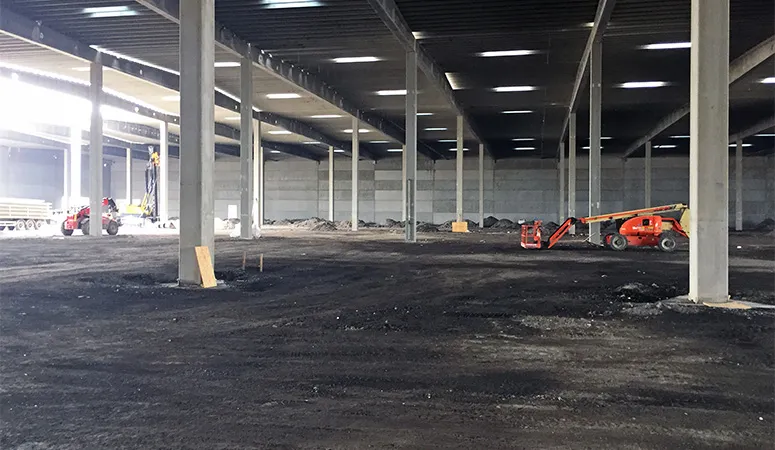
Pile-supported floors are becoming increasingly common in Belgium. The choice of this specific construction method is driven not only by increasingly stringent requirements for differential settlement and allowable loads. The growing scarcity of high-quality building land is also leading to concrete floors being built in combination with foundation piles more often. This was the case for the construction of the new distribution centre for sanitaryware group Van Marcke in Rekkem. More than 40,000 m2 of floor area was supported on piles. The floor was reinforced solely with steel fibres supplied by Bekaert, a global market leader in steel wire transformation and coating technologies.
Work on the floor is in full swing.
The new DC, located on the LAR-Zuid industrial estate, is one of the largest projects of its kind completed in Belgium in recent years. The fact that the joint-light floor, fitted with load-transfer profiles, rests entirely on foundation piles is remarkable in itself. But another feature that sets the building apart is the reinforcement of its extensive floor area. “The floor has no traditional mesh reinforcement. It is reinforced solely with the Dramix® steel fibres that we developed and produce,” says Ben Vanheuverzwijn, Dramix® sales engineer at Bekaert. “This so-called fibre-only solution was made possible primarily by the unique properties of Dramix® 5D steel fibres. In addition to 24 tonnes of Dramix® 4D steel fibres, around 260 tonnes of the 5D fibres were incorporated into the floor.”
A unique combination
Dramix® 5D steel fibres are revolutionising the world of steel fibre-reinforced concrete. Their combination of ultra-high tensile strength (2,200 N/mm2), perfect anchorage and highly ductile steel wire (more than 6% elongation before fracture) produces bending-hardening behaviour. “This means that, in a bending test, once the first crack has formed, the floor can withstand a load greater than the load required to form that first crack,” Vanheuverzwijn explains, describing what makes the product unique. “This clearly distinguishes the behaviour of Dramix® 5D from that of conventional steel fibre-reinforced concrete, which shows a degree of reduction in load-bearing capacity after reaching its initial cracking strength. This makes our product particularly suitable for fibre-only solutions in structural applications.”
Working in tandem
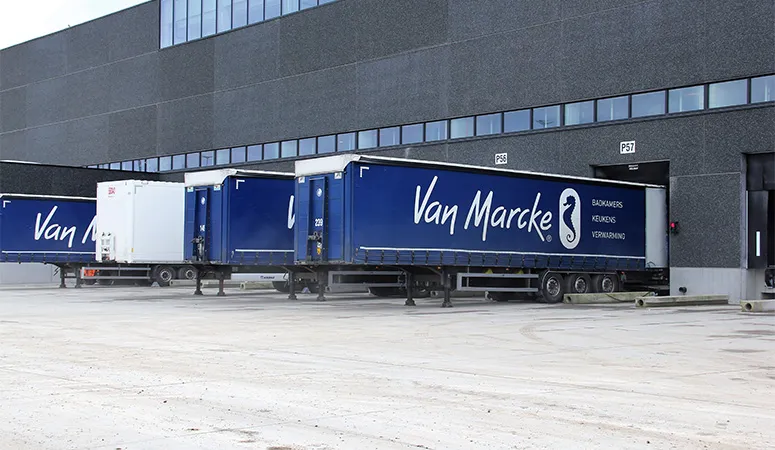
The new Van Marcke DC.
A close interaction between the foundation piles and the floor is crucial to achieving a reliable and, above all, cost-effective solution. This was once again evident in the project for Van Marcke, which used 5,215 foundation piles, each 34 centimetres in diameter, installed in a 2.9 x 2.9-metre grid. “If the piles are spaced further apart, fewer are needed, but the floor has to be thicker,” Vanheuverzwijn explains. “If you space them closer together, you need more piles, but the floor can be made considerably thinner. That is reflected in the final cost. The pile diameter also has a major impact on the overall cost. Piles with a larger diameter or an enlarged pile head can reduce the required floor thickness and therefore the amount of concrete needed to complete the job.”
Words | Chris Elbers Images | Bekaert
Vraag over dit verhaal? Stel je vraag
Blijf dit volgen
Bij een nieuw verhaal krijg je een e-mail. Geen account nodig.
- ThemaVloeren in beton en staal
- OnderwerpGeneral