Concrete for the future: Greener, stronger and more economical
The CO2 emissions of concrete can be reduced by 25 to 65%. That is the conclusion of Maarten Meek’s master’s thesis at TU Delft. There are several ways to achieve this reduction. The challenge is to find the best mix for environmentally friendly structural geopolymer concrete.
When Maarten Meek, a structural engineer at Van Rossum Raadgevende Ingenieurs, wrote his master’s thesis at TU Delft in 2019, the search for sustainable concrete was already well under way. The prevailing view was that cement, in particular, needed to be replaced with an environmentally friendly alternative because of its environmental impact. During his literature review, Meek discovered that there were potential benefits beyond CO2 reduction. Green geopolymer concrete could have more favourable properties, requiring less concrete and reinforcement. “That would kill three birds with one stone.”
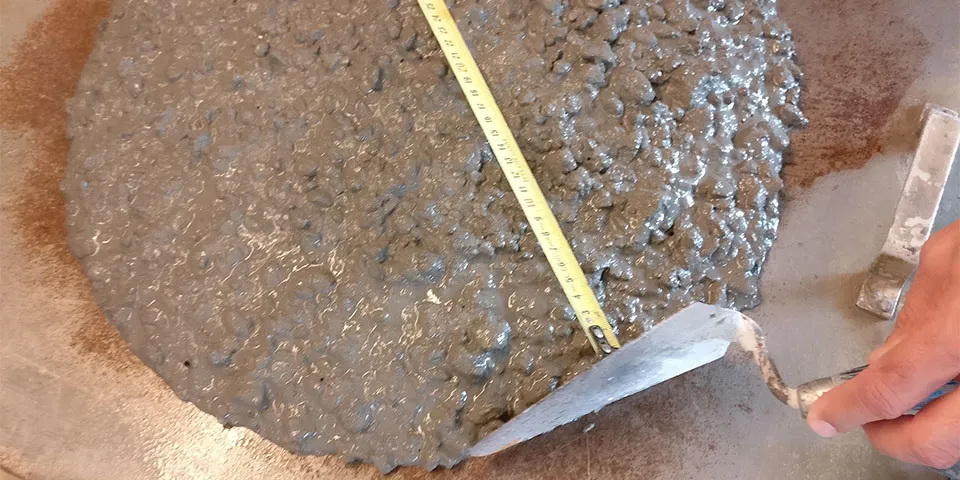
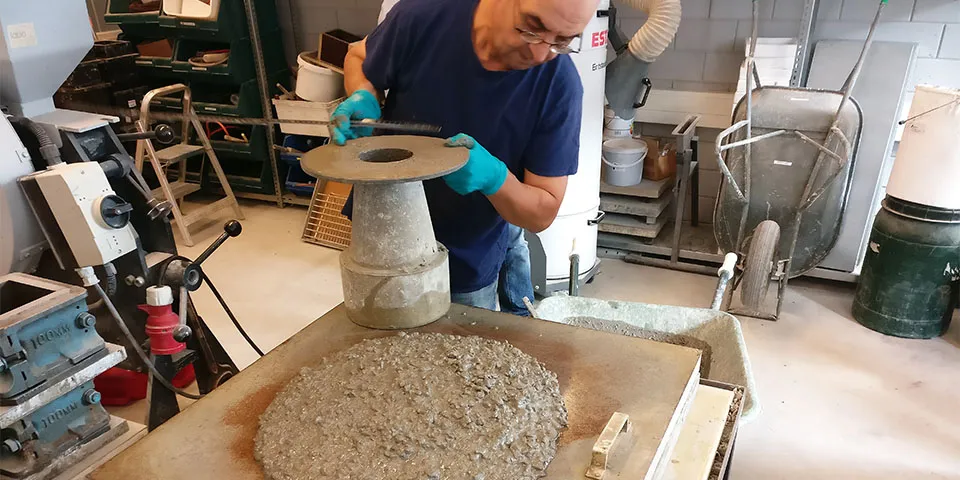
Measuring the flow spread to determine the consistency of the fresh concrete.
Traditional versus green concrete
For the uninitiated, Meek offers a brief explanation: “Traditional concrete is made by mixing sand and gravel with water and cement. The environmentally damaging cement binds the necessary constituents together and hardens. Materials that can take over the role of cement, also known as precursors, include fly ash and blast furnace slag. These by-products from other industries are also widely used to manufacture concrete in the Netherlands. In geopolymer concrete, a precursor is used instead of cement. When mixed with an alkaline activator, it provides the binding and hardening. Alkaline activators also have an environmental impact, but overall they still deliver a substantial reduction in CO2 emissions.”
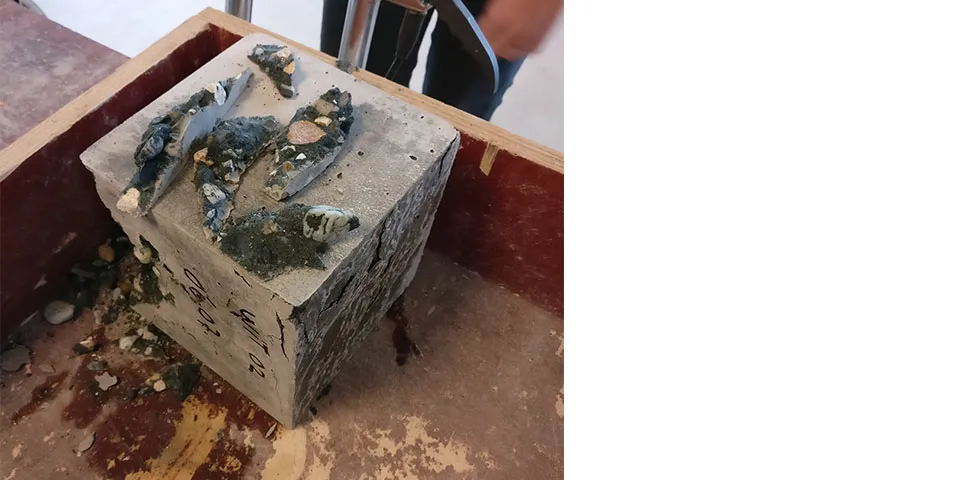
A geopolymer concrete cube tested in a compression testing machine.
Long service life
During his research, Meek discovered that geopolymer concrete has been used in Russia for more than 70 years. Because of a shortage of Portland cement, concrete structures such as fountains were made there from a type of concrete that is almost identical to geopolymer concrete and has excellent properties. “Because this type of concrete has been used there for 70 years, it was relatively easy to investigate its durability,” says Meek. “Geopolymer concrete structures still looked excellent compared with objects of the same age made from cement concrete, while the concrete in other objects was already deteriorating.”

ir. M.E. (Maarten) Meek.
Standards
In Australia, the search for sustainable types of concrete is a hot topic. Australians are already using a structural geopolymer concrete called Earth Friendly Concrete. Meek: “Australia is a frontrunner in this field. It sees cement as a major culprit. For this reason, standards for new types of concrete are now being established there. That is a big step forward.”
An alternative with potential
Meek concludes in his research that there are many possibilities. There are many different precursors and alkaline activators, after all, and they can be used in an almost unlimited number of proportions. “The different mixes will result in more or less favourable properties. Unfortunately, we cannot undo CO2 emissions, but there are certainly alternatives to Portland cement, and geopolymer concrete is one with potential. We will need extensive research to identify the best alternative.”
Vraag over dit verhaal? Stel je vraag
Blijf dit volgen
Bij een nieuw verhaal krijg je een e-mail. Geen account nodig.
- ThemaMinder CO2 in beton en staal
- OnderwerpGeneral