Concrete retaining walls set to become 100% circular
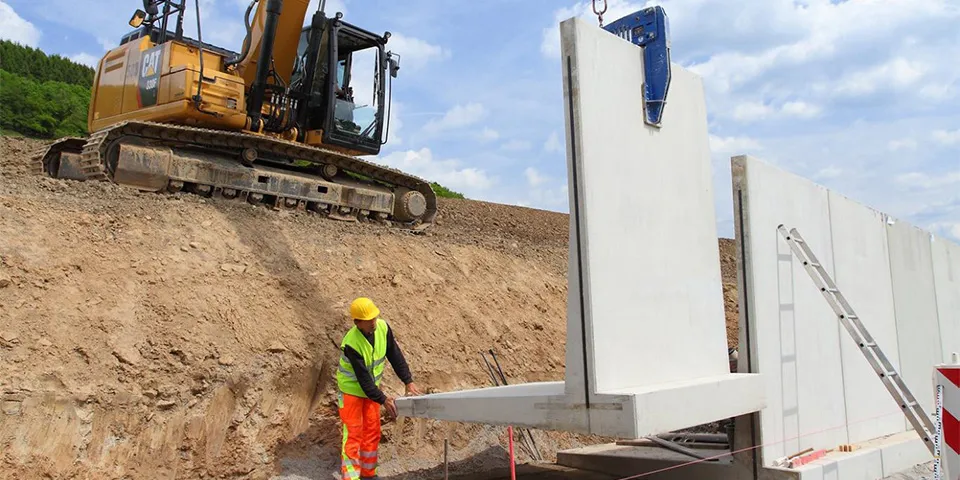
The ambition to achieve a 100% circular economy presents a range of challenges, particularly in the world of concrete. Current standards allow renewable raw materials to be used in structural applications only up to a maximum of 20%. Nevertheless, Bosch Beton has taken an important step by building a completely new factory that will eventually be capable of producing retaining walls on a 100% circular basis.
“We are seeing more and more opportunities to make concrete more sustainable, both in terms of its composition and its production,” says Brechtje van den Beuken-van den Bosch of Bosch Beton. “Our new concrete factory in Barneveld has been operational since 1 June this year and is entirely designed around a sustainable process. It is unique in the Netherlands.” Energy consumption is offset by more than 18,000 solar panels on the roof, and the production water is also part of a closed-loop system. It is collected, filtered and reused. The factory was designed to achieve BREEAM Outstanding certification. But the retaining wall manufacturer is going a step further.
High-strength concrete
Giving a product a second life requires high quality. Bosch Beton therefore favours high-strength concrete. “Retaining walls made with C60/75 concrete have a very fine pore structure and are more resistant to the ingress of acids, frost and de-icing salts. This may be slightly less relevant in the Netherlands, but it is an important factor in neighbouring countries. The higher the quality, the longer the product lasts. With a service life of fifty to as many as one hundred years, a retaining wall can easily be given a second life.
Another advantage of high-strength concrete is that it allows structures to be up to 40% slimmer. For example, Deutsche Bundesbahn specifies C30/40 concrete and a wall thickness of 25 centimetres to guarantee the intended service life. We can guarantee the same service life with a wall just 15 centimetres thick. The initial investment may be higher, but it ultimately delivers substantial savings.”
Geopolymer concrete
According to Van den Beuken-van den Bosch, achieving a circular economy will ultimately require a different approach to investment. “The initial investment should not be the deciding factor. Take the long-term view and give products a second life. Innovation is moving quickly, and exciting developments are taking place. We have high expectations for geopolymer concrete, which could eventually replace cement concrete. We also expect a shift towards custom-made products, using surplus materials supplied by the client. Our new factory is already equipped for this. After all, the journey towards a 100% circular economy is one we will have to take together with our clients and contractors.”
Bosch Beton
Grote Bosweg 1, 3771 LJ Barneveld
T 0342 44 1050
E keerwand@boschbeton.com
www.keerwand.nl
Vraag over dit verhaal? Stel je vraag
Blijf dit volgen
Bij een nieuw verhaal krijg je een e-mail. Geen account nodig.
- ThemaMinder CO2 in beton en staal
- OnderwerpGeneral