Discover Barli’s housing factory
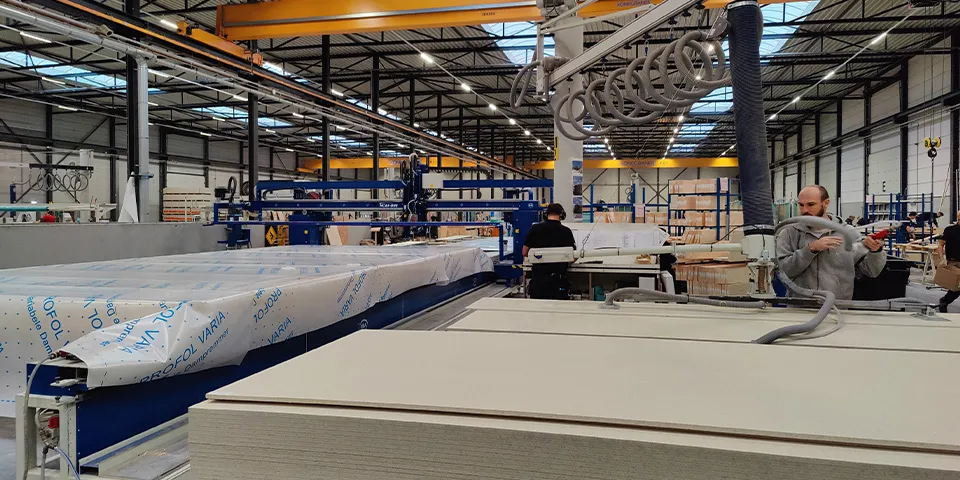
Barli builds modular timber homes, from affordable to exceptional. For more than thirty years, the company has been a pioneer in offsite construction. Its modular timber-building method and Barli Base housing concept show how construction can be more efficient and sustainable. These prefabricated elements are modelled in 3D using Tekla Structures. Bart van der Kallen, Senior Tekla Engineer and 3D team leader at Barli, explains: “Everything here is modelled in 3D, everything. Production is almost entirely paperless.” Last month, Construsoft visited the housing factory in Uden.
From timber to homes
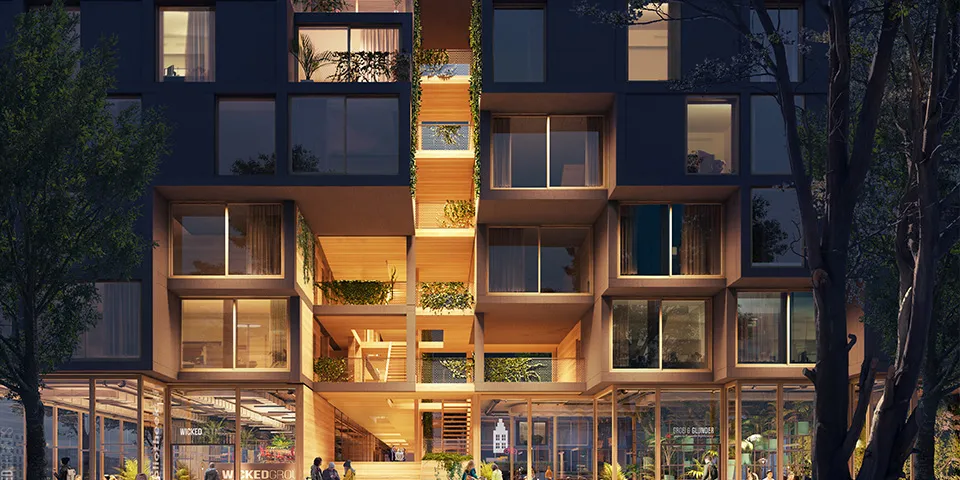
Barli focuses exclusively on housing for housing associations, property developers and the leisure sector. The prefabricated timber builder believes it is time to build differently, with greater efficiency and sustainability. The company does so by building modular timber homes. A fine example is the ‘Juf Nienke’ apartment building. Van der Kallen says: “This project is special in many ways, not least because its 61 apartments are being built modularly in timber, using a structural system that has never been used before. Alongside the technical complexity, it is a major challenge to work in a single model with many different partners, from the architect and co-contractor to the client and various subcontractors.”
Seamless collaboration
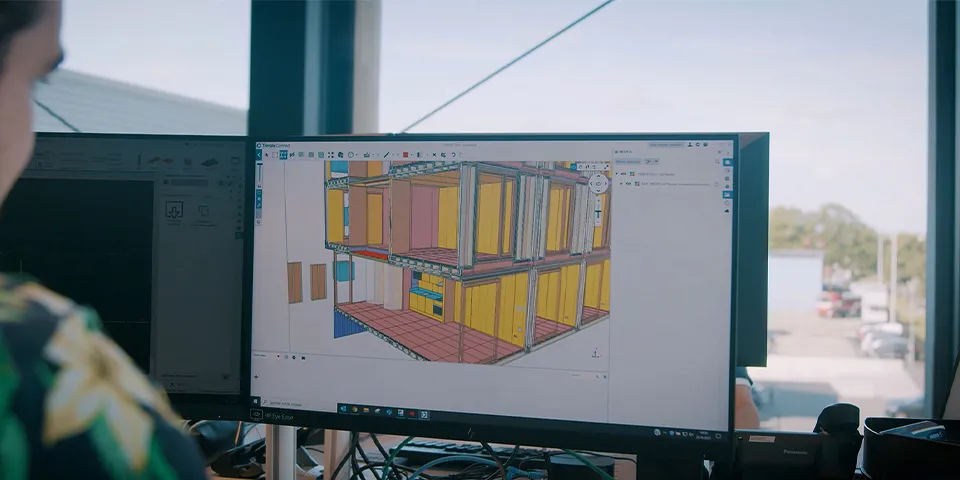
“Trimble Connect helps us visualise everything and share all the information with the partners involved,” says Van der Kallen. “You only really see how everything works and fits together in 3D. We also use the collaboration platform for clash detection, which gives us a clear view of potential clashes in the models from the different parties. Specific components supplied by vendors have to fit our model for the modules and the construction perfectly. By collaborating effectively in the model, we can make sure all the components fit together seamlessly.”
Automated production of 20 to 25 homes a week
Tekla Structures is increasingly being used to design fully detailed 3D timber structures, including at Barli. Van der Kallen explains: “We use Tekla Structures to model automatically with components we have developed ourselves. One major advantage of the software is that all the required production information can be generated directly from the 3D model. We then use the model internally at various stages of our production process: in the automated prefabrication of our timber-frame elements, during assembly in our factory halls and on the construction site in Amsterdam. We use Tekla Structures to control all our machines, from our speed-cut machines and an SCM Gabbiani GT2 to various other SCM machines and no fewer than three Mobi one machines, one of which is a complete production line.”
Every detail of a home in 3D
“Tekla Structures allows us to model everything as a whole,” says Van der Kallen. “Controlling machines directly from a 3D model requires every dimension to be accurate down to the smallest detail, and material and parts lists to be generated easily. Tekla Structures provides this functionality and also enables us to create building components. By preparing things in greater detail in the office, we save a lot of time in production, resulting in more consistent quality and a competitive advantage.” The way Barli uses BIM software creates a paperless digital process. Van der Kallen says: “For the ‘Juf Nienke’ project, for example, 13,000 working drawings were produced, of which only a handful were printed. We use tablets, and each employee has their own detailed drawings to carry out their part of the work.”
A little better every day
Barli currently builds almost 900 homes a year and aims to become the Netherlands’ leading housing factory by automating and digitalising further. Twan Vrijsen, who is responsible for marketing communications at Barli, says: “We see a huge need for affordable homes that are sustainable and can ideally be delivered as quickly as possible. Our construction method offers opportunities to meet that need. On the one hand, we build very sustainably using bio-based materials. On the other, our housing factory is organised efficiently, and we are not affected by weather conditions, for example. That is good for the quality of the homes and makes things easier for our people. For us, that too is an important aspect of sustainability.”
Prefab homes are sometimes thought to be all the same or less durable, but Barli proves otherwise. Vrijsen says: “We build a variety of homes, both houses and apartments. The standard house types in our housing concept provide the starting point, but each project is always tailored to the specific requirements of the site and the wishes of the target group.” And what about their lifespan? “Timber construction is not yet as established in the Netherlands as it is, for example, in Scandinavia. Timber homes last just as long as traditionally built homes. It is no coincidence that architects have named Juf Nienke a ‘Future Icon’ for Amsterdam!” says an enthusiastic Vrijsen.
Een zakelijke vraag aan Construsoft? Neem contact op
Bedrijven in dit verhaal
Blijf dit volgen
Bij een nieuw verhaal krijg je een e-mail. Geen account nodig.
- ThemaDigitaal van ontwerp tot montage
- OnderwerpGeneral
- BedrijfConstrusoft