Quality assurance for products and processes
Tekst Liliane VerwooldeFotografie KOMO

On komo-online.nl, KOMO publishes all its assessment guidelines and quality declarations. With the introduction of the Quality Assurance (Building) Act (Wkb), it also has them independently assessed for their contribution to risk management, giving quality assurance providers reliable declarations of conformity to support their assurance activities. The market does, however, expect them to apply these consistently and uniformly. The intrinsic value of a certificate is independent of the scheme used to assess and assure quality.
In preparation for the Wkb, KOMO developed a quality assurance instrument (KiK). In practice, however, it became clear that there was a need for a general, independent assessment of declarations of conformity, extending beyond KOMO or KiK. In response, KOMO, together with the Vereniging Kwaliteitsborgers Nederland (VKBN) and the participating instrument providers, further generalised the assessment system. The result is the Wkb performance ladder.

Based on two pillars
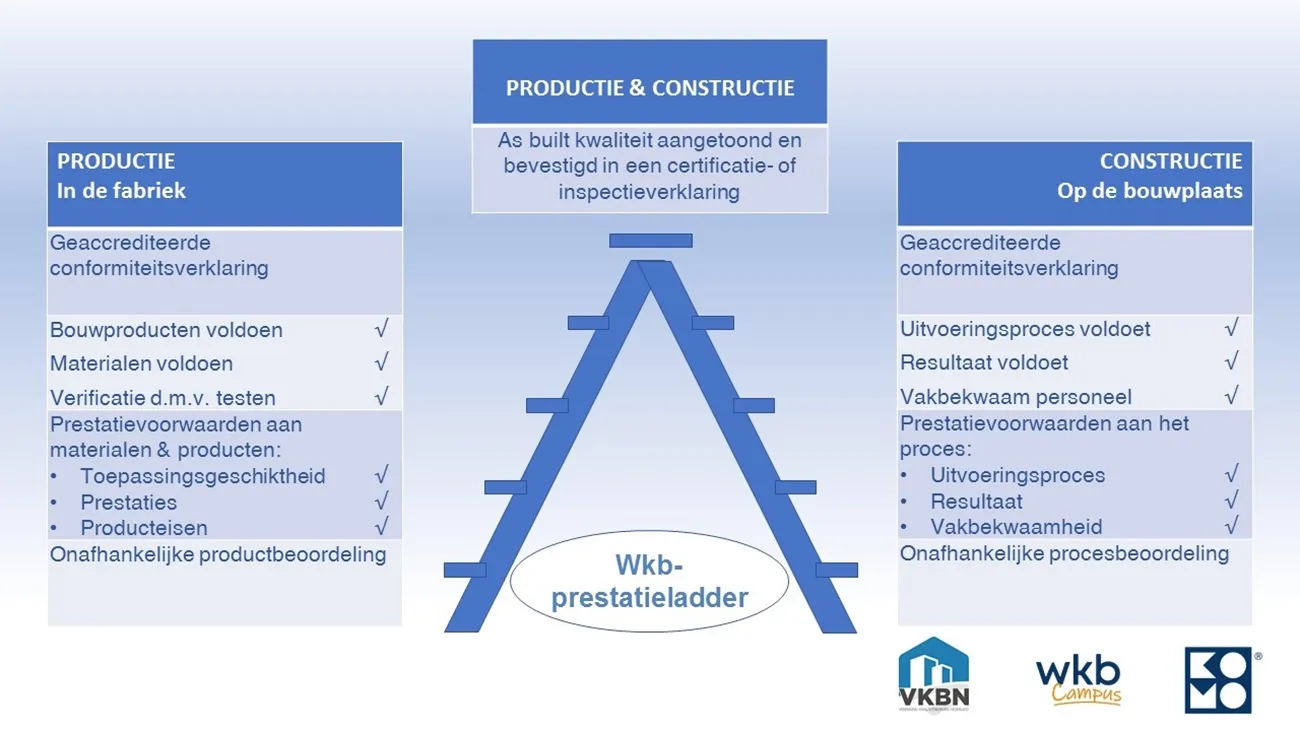
The Wkb performance ladder follows logically from the way building regulations are structured in the Netherlands. They are based on the completed building and the minimum performance that its components must deliver. These performance requirements translate into two types of quality requirements. One type covers the quality requirements for the materials and products used; the other covers the conditions that the construction process must meet. Building regulations therefore rest on two pillars. Once it can be demonstrated that a construction project, in whole or in part, meets the performance requirements and conditions of both pillars, a declaration of conformity can be issued for that project, in whole or in part.
One ladder for both pillars
Several quality schemes are currently in use, and they differ considerably from one another. In particular, they vary in the extent to which they ensure that all the conditions under the two pillars have been met. This difference is reflected in how each scheme is rated as a risk management measure. The Wkb performance ladder addresses this variation. It brings together the quality schemes for both pillars in a single, two-sided ladder. The highest rung can only be reached if the requirements for both the products used and the construction process have been met. This is where the two sides of the ladder meet.
Other quality schemes
Quality schemes are assessed against the Wkb performance ladder by an independent committee. It reports objectively, presents the result on the Wkb performance ladder diagram and identifies opportunities to improve the scheme. A summary of the report is published on a central platform, providing an overview of how various construction-related quality schemes contribute to risk management in construction processes. The platform is open to everyone.
The Wkb performance ladder has the support of quality assurance providers, instrument providers and managers of quality schemes. KOMO, as the initiator, has now begun developing it in detail.
Een zakelijke vraag aan Stichting KOMO? Neem contact op
Bedrijven in dit verhaal
Blijf dit volgen
Bij een nieuw verhaal krijg je een e-mail. Geen account nodig.
- ThemaNormen, testen en aansprakelijkheid
- OnderwerpGeneral
- BedrijfStichting KOMO