Genuine safety requires tailored rules
Tekst Liliane VerwooldeFotografie BHV.NL

Safety within the company and on the construction site is extremely important. But where do you start when developing an effective safety policy?
Simply complying with government regulations is not enough, as Franco Verberkt, product innovation & training manager at BHV.NL, has learned from experience. A safe construction site requires a tailored approach with regular training and exercises.
Government safety regulations provide a foundation, but in practice they do not guarantee sufficient safety in the workplace. “Genuine safety is not achieved by requiring emergency response officers, team leaders and prevention officers to comply with government regulations. It requires professional risk-based thinking,” says Verberkt. BHV.NL supports companies in putting an optimal safety policy into practice through risk assessments, modular safety training and exercises.
Risk-based thinking
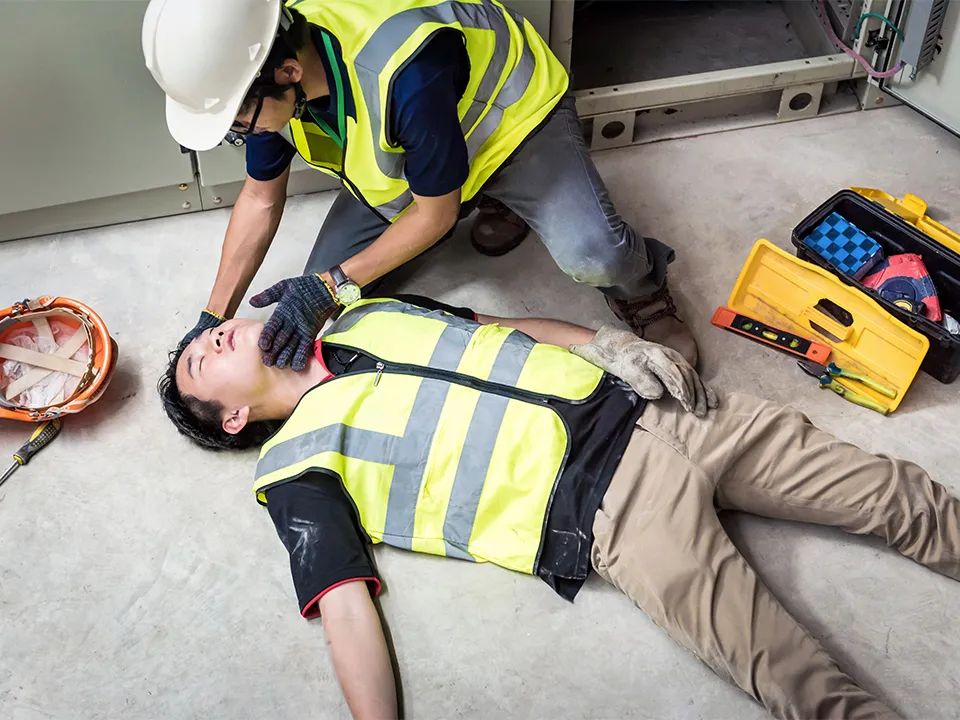
This practical approach starts with looking at things from a different perspective, namely through risk-based thinking. BHV.NL’s safety experts first investigate where risks arise within the company. Where are the danger zones? Once these have been mapped, they draw up a plan to prepare the organisation as effectively as possible for these risks. They then train employees to deal with hazardous situations as safely as possible.
Modular training
The modular safety training courses are an important part of the safety policies BHV.NL helps companies develop. BHV.NL has gained extensive experience in this area across a wide range of sectors. It combines this knowledge with information gathered from its analysis of the specific company, enabling it to develop modular, interactive training tailored to that particular organisation. The training is preferably held in the workplace. If that is not possible, it takes place in BHV.NL’s training rooms, where working conditions are replicated as closely as possible. During each module, professional trainers assess whether participants have mastered the required competencies and can be awarded the emergency response certificate.

Embedding safety in policy
To maintain knowledge and skills, the emergency response training is followed by exercises. This both reinforces what participants have learned and allows them to discover whether they can work together in a crisis. Verberkt says: “The exercises are announced in advance, announced at short notice or take place completely unexpectedly, in cooperation with external emergency services such as ambulance services, the fire brigade and the police. This creates an ongoing process. Embedding the entire process in the safety policy helps improve safety throughout the organisation.”
Awareness
BHV.NL’s tailored approach, training and exercises give companies a well-considered safety policy. And BHV.NL would not be BHV.NL if it had not also devised a way to keep this policy constantly in the spotlight. Safety games, which every employee can play as part of a team on their smartphone, help create a continuous state of awareness. BHV.NL has also developed a solution for VCA. Participants can quickly study the theory in quiz format in their own time, then sit the exam at a location.
“Companies decide for themselves how ambitious they want to be about safety. Do they apply the safety policy only within the emergency response team? Or do they aim to raise safety awareness throughout the entire organisation? BHV.NL provides the toolboxes they need to achieve their ambitions.”
Vraag over dit verhaal? Stel je vraag
Blijf dit volgen
Bij een nieuw verhaal krijg je een e-mail. Geen account nodig.
- ThemaVeilig werken
- OnderwerpGeneral