Second Maasvlakte: the choice of concrete for the 17 km CER route was well considered
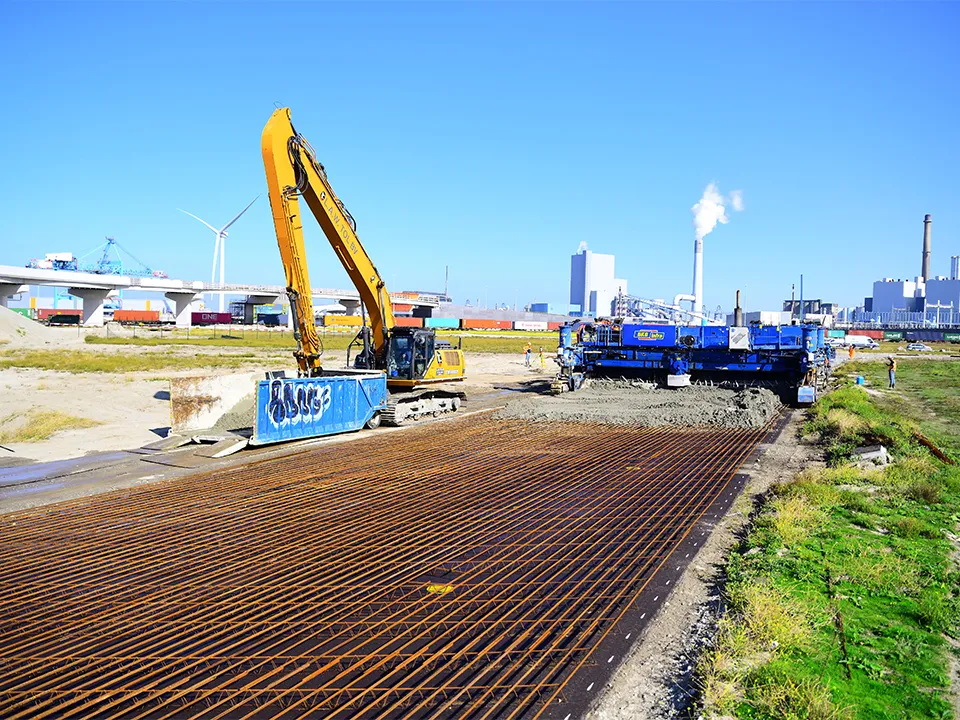
If all goes according to plan, the first unmanned container transport will take place on the CER route at the Second Maasvlakte in early 2022.
CER stands for Container Exchange Route. The route provides an uninterrupted connection between the main container companies and facilities on the Maasvlakte. This 17-kilometre stretch of digitised port infrastructure will bring significant efficiency gains and cost savings to Europe’s largest container cluster. The CER route is being built for the Port of Rotterdam Authority by Combinatie CER, comprising KWS and Van Hattum en Blankevoort.
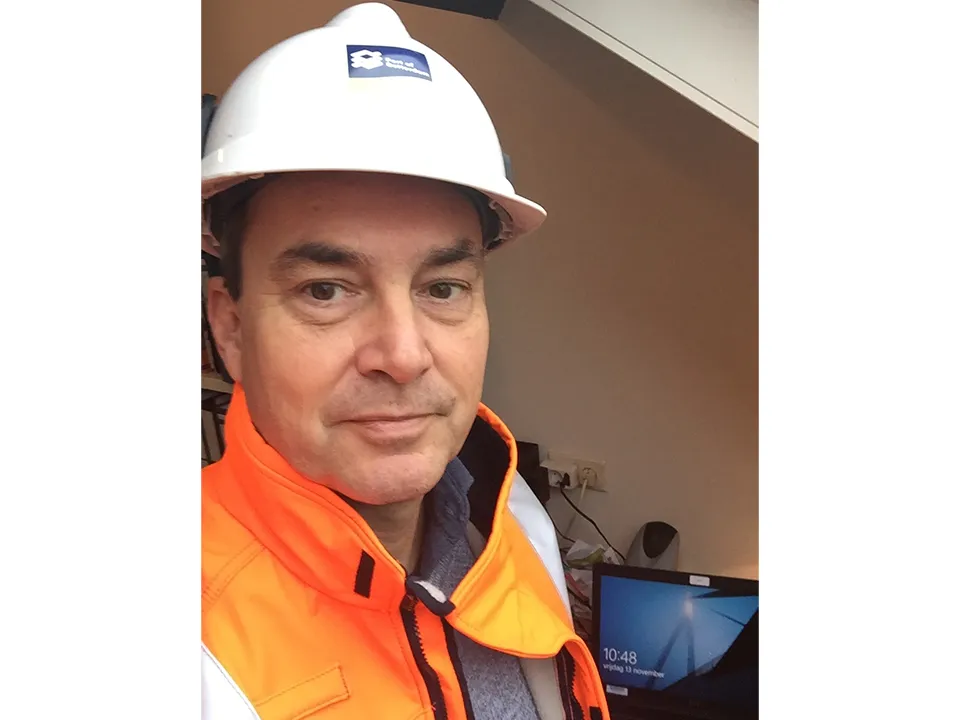
Mathieu de Ruiter, Manager Techniek CER en TWT (Theemswegtracé) for the Port of Rotterdam Authority, describes the CER route as part of a wider system. “It will connect all terminals, container depots, distribution centres and customs facilities via a seamless, continuous route, with a positioning system guiding the unmanned vehicles. This system is currently being tested. The same applies to the planning system, which, together with a container recognition system, will ensure that containers arrive at the right place at the right time.”
Axle loads
You might expect a lot of electronics to be built into the route, but that is not the case. It has instead become a ‘standard’ concrete road. De Ruiter: “At the start of the development process, we did not yet know what type of vehicle would use the route. It could be AGVs, automated vehicles used at terminals, or Multi Trailer Systems, trailers that can carry ten containers, as well as standard unmanned trucks. We decided to design the route to accommodate all these vehicles and to withstand all axle loads for 80 years, with high availability. For the latter, we set a requirement of 99% availability. The starting point was a commercial operation running 24/7. Resurfacing with a new layer of asphalt every few years was therefore not an option.”
Thick concrete road
The result is a 17-kilometre-long, ten-metre-wide, jointless concrete road. De Ruiter: “The entire structure is no less than 90 centimetres thick and has been laid directly on the Maasvlakte sand. The foundation consists of a layer of approximately sixty centimetres of lean concrete, a stiff mix of cement, sand and recycled crushed concrete. A thin layer of asphalt levels this coarse foundation layer and prepares it for the surface course, a 26-centimetre-thick continuously reinforced concrete layer. The reinforcement in this surface course is straightforward, making the concrete easy to pour.” BKB Infra is carrying out the work, using large slipform pavers. It can lay around 250 metres per day, pouring 650 cubic metres of concrete.
Failsafe
The end result is a low-maintenance road capable of withstanding the 50-tonne axle load of an AGV. At the start of operations, however, AGVs will not be used. Instead, the route will initially be served by an Automated Truck. This is the first time continuously reinforced concrete pavement has been used on this scale. “But the choice of concrete was well considered,” De Ruiter continues. “The system cannot tolerate being taken out of service, not even for a few hours to repair asphalt. The system’s electronics are also being designed and implemented to be failsafe. The route has several crossings with roads and railway lines, where the unmanned vehicles will receive signals telling them to slow down in good time. We have to assume that they cannot read traffic lights, so the traffic control system must be supported by equipment that informs the vehicles of the traffic light status, allowing them to stop in time. The system must remain safe if anything fails. So no signal means stop. The operator in the traffic control centre will receive an alert and can intervene.”
Betonhuis
Betonhuis is the trade association for the cement and concrete industry, the construction sector’s largest supplier. By sharing knowledge, Betonhuis addresses current issues such as circular construction, climate adaptation and sustainable building.
Want to know more? Betonhuis.nl
Vraag over dit verhaal? Stel je vraag
Blijf dit volgen
Bij een nieuw verhaal krijg je een e-mail. Geen account nodig.
- OnderwerpGeneral