Urbanisation & concrete
For as long as people can remember, concrete has been used to build new places to live, work and relax in urban settings. The associated infrastructure also depends on concrete structures. Today’s urbanisation, however, presents new challenges for the use of concrete.
New opportunities for the material, or its applications, to reinvent themselves. Are there better alternatives for today’s challenges, or should new concrete concepts be developed in combination with other or new (construction) materials?
Today’s cities are facing unprecedented growth in demand for diversity, comfort and safety, as well as improved technical and living conditions. Current themes such as multiple land use, circularity, heat stress and inclusivity are shaping tomorrow’s needs.
Can concrete contribute to further greening the hard landscape of today’s cities? Are there new opportunities for water storage and for creating raised ground-level areas in the form of green, landscaped flat roofs and elevated city squares? What can the concrete industry contribute to the demand for tomorrow’s city?
WELL certification guarantees a safe and healthy building and environment
WELL is the first and only certification system specifically focused on the health and wellbeing of building occupants. This is no luxury, given that we spend an average of around 90% of our time in buildings. Employees working in sustainably certified buildings experience less stress and perform and sleep better. The certification focuses on seven areas: air, water, light, nourishment, fitness, comfort and a healthy mind. Plenty of challenges for the design-and-build contractor!
Green roofs are an asset in tackling heat stress
Climate change is leading, among other things, to an increase in the number of heatwaves. And in cities, the effects are always more severe. Introducing nature into the city can provide some cooling. Roofs account for a significant proportion of a city’s surface area and are directly exposed to heat from the sun. One plus one makes three, you might say! The Rooftop Award 2020 was recently awarded to the roof of the Depot van Boijmans van Beuningen in Rotterdam. Among other things, 72 trees have been planted on this concrete roof. The roof also offers visitors a spectacular view.
Smart buildings make a smart city
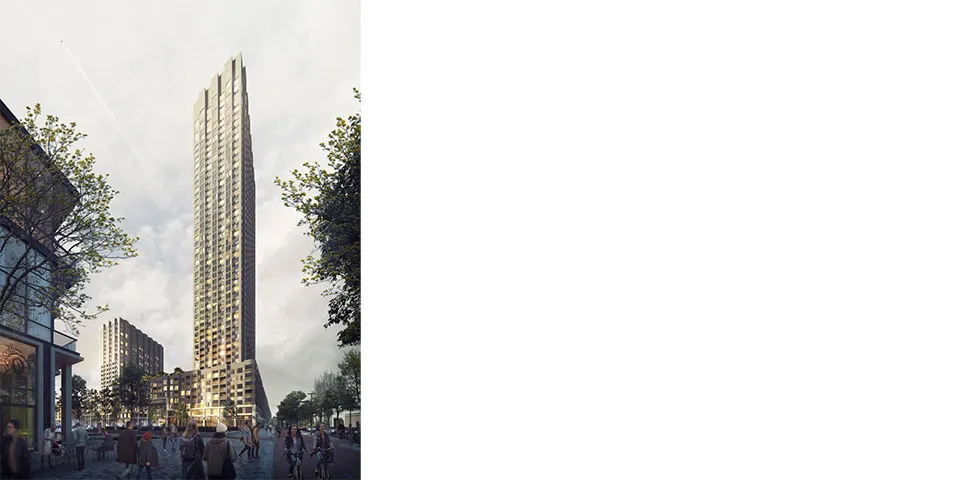
The rise of smart cities is driven by various developments. First, advances such as the Internet of Things and the falling cost of hardware are making technology all-encompassing and ubiquitous. In addition, very large cities in particular tend to seek to establish a distinct profile. The image of a ‘smart city’ can bring economic benefits. A third driver is sustainability: technology makes it possible to manage energy demand much more precisely and achieve savings.
The city of the future
What we build today must also be fit for tomorrow. It is a matter of long-term planning. Five test sites, each covering 1 km2, in Amsterdam, Rotterdam, The Hague, Utrecht and Eindhoven were used to explore new ways of building a city.
The underlying question was how, in the next wave of urban densification, we can link construction challenges to the energy transition, transport innovations, the circular economy and other system and network innovations.
Vraag over dit verhaal? Stel je vraag
Blijf dit volgen
Bij een nieuw verhaal krijg je een e-mail. Geen account nodig.
- OnderwerpGeneral