De site is nu in het Nederlands. Engels, Frans en Duits volgen.
media met MEERWAARDE
Beton & Staalbouw hoort bij Louwers Mediagroep: 45+ vakplatformen in Nederland, Vlaanderen en Wallonië. Vakbladen, websites, nieuwsbrieven, video en podcasts, sinds 1987.
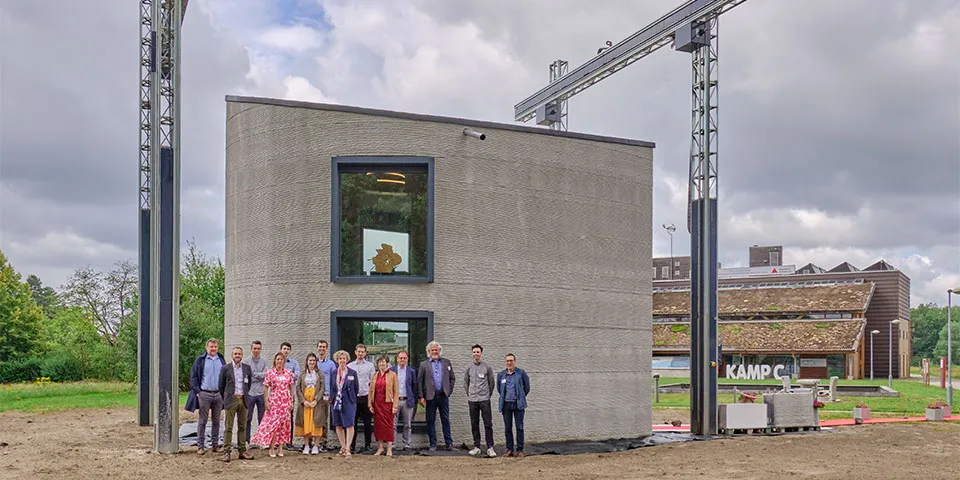
A house has been printed at Kamp C, the provincial Centre for Sustainability and Innovation in Construction in Westerlo, using Europe’s largest 3D concrete printer. The 90-square-metre house was printed in one piece using a stationary printer. This is a world first.
The first 3D-printed demonstration home in Flanders is now a reality. It is located on the Kamp C site in Westerlo. The house has two storeys, measures 90 square metres and is 8 metres high. It is the size of an average terraced house in the Campine region.
“What makes this unique is that we printed the house as a single structure using a stationary 3D concrete printer,” says Emiel Ascione, project manager at Kamp C. “Houses already printed elsewhere in the world have only one storey and are often printed in sections at a factory and assembled on site. We printed the entire building envelope as one structure on site.”
The house was printed as part of the European C3PO project, with support from the ERDF (the European Regional Development Fund). Through this achievement, the project partners aim to encourage the construction sector to incorporate 3D concrete printing into its building techniques.
Kathleen Helsen, Provincial Executive Member for Housing and Chair of Kamp C “There is already considerable interest from the construction industry. 3D printing in construction is expanding rapidly around the world. A host of applications, from printing temporary accommodation to entire apartment buildings, are already being developed, but this is new in Flanders. Yet the construction sector faces enormous challenges: we need to reduce material and energy consumption, cut CO2 emissions and reduce waste, while meeting growing demand for high-quality, affordable homes, among other things. At Kamp C, we believe that new technologies such as 3D concrete printing can help address these challenges. That is why we have created this unique facility on our site, where construction companies can experiment with 3D printing alongside research and education institutions.”
De video laadt pas als je op afspelen klikt.
Three times stronger
The printed house is three times stronger than a house built with hollow clay blocks. “The compressive strength of the material is three times higher than that of a conventional hollow clay block,” explains Marijke Aerts, project manager at Kamp C. This first house is a test building, and its strength will be monitored over time.
In addition to the fibres in the concrete, only minimal shrinkage reinforcement was used. The printing technique eliminates the need for concrete formwork. This is estimated to save 60 per cent of materials, time and money. In future, a house could be printed in two days. Adding up all the printing days, the house at Kamp C was printed in just under three weeks.
Demonstration home
The house is a demonstration building designed to showcase as many of the techniques and possibilities of 3D printing as possible. “We printed an overhang, incorporated heavily curved walls and used different types of wall, among other features. We also devised solutions for conventional building junctions to ensure they are completely free of thermal bridges,” explains Ascione. “The house is being developed into a low-energy home equipped with every comfort: it has underfloor and ceiling heating, special solar panels on the façade and a heat pump, and a green roof is being added.”
“When we started construction, we did not know what function the building would serve. The aim was to print a building with the floor area, height and shape of an average modern home, but as a demonstration building with multifunctional potential. This is an example of circular construction. It can serve as a home, meeting room, office or exhibition space. The building will be open to visitors by appointment from September,” says Piet Wielemans, architect at Kamp C.
Project
The house is part of the European C3PO project, which aims to accelerate the introduction of this innovative technology in Flanders. Eight partners from the fields of science and business are joining forces: Beneens, ETIB/CONCRETE HOUSE, Groep Van Roey, Thomas More, Trias architecten, Ugent and Vicré. Saint-Gobain Weber is also participating in the project.
This article is part of the C3PO project. Through the ERDF-funded C3PO project (‘Co-creation: 3D Printing with Businesses’), the partners received €668,320 in support from the European Union. The project is part of the Kempen Integrated Territorial Investment (ITI), an integrated strategy for a specific area that brings together funding and programmes from various European sources.
Vind het juiste bedrijf in de beton- en staalbouwZoek op product, vakgebied, regio of project, in de bedrijvenindex en in alle artikelen van Beton & Staalbouw.
We gebruiken cookies om de site goed te laten werken. Met je toestemming gebruiken we ook cookies voor statistieken en voor banners van derden. Lees meer in ons privacy- en cookiestatement.