Platform on concrete and steel in construction

In civil engineering, it’s always about striking a balance between accuracy, efficiency, and insight. Engineers have long understood the importance of factors such as dynamic loads, vibrations, torsion, phased construction, and compliance with building codes. The challenge was to integrate all these considerations into day-to-day project execution in a practical and transparent way.
That is now changing. As projects become more demanding and expectations regarding performance, usability, and traceability continue to rise, structural analysis software is moving beyond isolated checks and idealized models. The trend is increasingly moving toward tools that help engineers simulate structural behavior in real-world conditions in a more cohesive manner within a single analytical environment, without sacrificing speed or control. SCIA Engineer 2026 was specifically developed to support this broader shift toward a more integrated, insight-driven structural analysis. Read on to find out how.
For many years, structural analysis was based on simplified global models, with more complex behavior checked separately. Although this approach is effective, it leads to fragmentation. As projects become more demanding—with longer spans, lighter structures, and stricter performance expectations—effects such as moving loads, vibrations, and construction phases are more likely to become critical to the design. By evaluating these factors outside the main model, it becomes more difficult to maintain clarity and confidence in decision-making.
This encourages a shift toward a more integrated analysis. Modern tools bring these processes together into a single, cohesive workflow, allowing engineers to evaluate the performance of structures in practice within the same model used for the design. In practice, this shift manifests itself in three key ways: a more intelligent approach to complex loading, an earlier assessment of the design under actual conditions, and better alignment with evolving design standards. SCIA Engineer 2026 aligns with this direction and supports a more continuous and transparent process in which engineers can focus on what truly defines the structure—and make decisions with greater confidence.
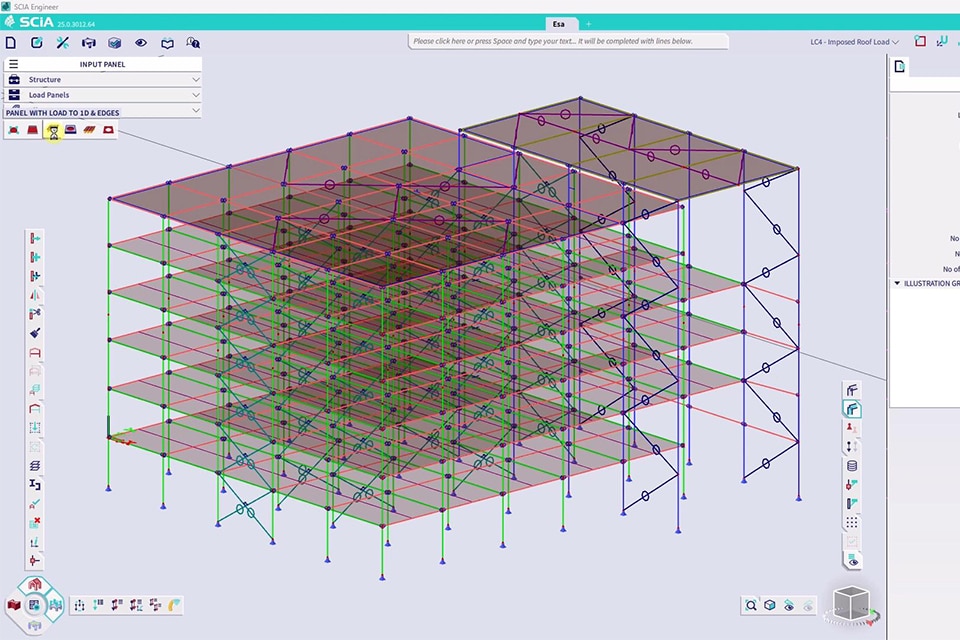
One of the most notable shifts in structural analysis is the way complex loads are handled. Scenarios such as moving loads, wind, and torsional effects can generate a vast number of load cases, which often require time-consuming manual setups or conservative simplifications. This not only increases the workload but can also obscure which conditions actually determine the design.
Modern analysis tools address this by making the handling of loads more intelligent. In SCIA Engineer 2026, for example, moving load systems can be evaluated through automatic identification of critical positions prior to the calculation, thereby reducing unnecessary combinations and focusing the analysis on what matters most. Similarly, automated generation of wind loads and improved beam elements that account for torsion and camber enable engineers to capture complex behavior more accurately without increasing the model’s complexity. The result is a more efficient workflow, in which engineers spend less time managing load cases and more time understanding structural performance.
Usability is often treated as a late-stage check, particularly for issues such as vibrations and user comfort. Although this is well understood, these assessments are typically not conducted until after key design decisions—such as span lengths, materials, and construction depth—have already been made. When problems come to light at that stage, resolving them may require significant redesigns or compromises.
This is changing: performance-based checks are being integrated earlier and earlier in the design process. SCIA Engineer 2026 supports this by integrating live load and vibration analyses directly into the structure’s core model, allowing engineers to evaluate both the dynamic response and the strength and stiffness from the very beginning.
Crucially, this also extends to the behavior of structures over time. Features such as construction-phase analysis and the modeling of external prestressing cables enable engineers to simulate how loads, stresses, and deformations evolve during the construction process and throughout the structure’s service life. By integrating both performance and lifecycle behavior into the same analytical environment, engineers can make more informed decisions while design flexibility is still high—thereby reducing risks, avoiding late-stage changes, and delivering structures that perform as intended in practice.
Structural design does not take place in a static regulatory environment. Standards evolve, projects span several years, and engineers often must demonstrate compliance with both current and emerging standards. Managing this transition can create uncertainty, particularly when comparing different versions of standards requires duplicate models or additional verification steps.
Modern analysis tools are beginning to address this by building flexibility regarding standards directly into the workflow. In SCIA Engineer 2026, support for the second generation of Eurocodes is integrated in such a way that engineers can switch between code versions, compare results, and understand the impact of changes without having to rebuild their models. As a result, compliance shifts from a final check to an active part of the design process—enabling engineers to navigate changes with greater clarity, mitigate risks, and maintain confidence in their decisions as standards continue to evolve.
These trends show that it’s not about adding more layers of analysis, but about making the analysis more targeted—by focusing on what truly determines structural performance and incorporating that insight into day-to-day design decisions. To do this, the ability to simulate realistic behavior within a single, cohesive model becomes essential.
SCIA Engineer 2026 illustrates how this shift is taking shape in practice. By enabling a more intelligent handling of complex loads, an earlier assessment of in-service and lifecycle performance, and greater clarity in navigating changing design codes, it supports a more integrated and trust-based approach to structural analysis. In this sense, it reflects a broader trend in the industry—one in which engineers are better equipped to link design intent to real-world results and to deliver structures that perform as expected, from concept through construction to operation.