Geopolymer concrete on foamed glass aggregate
Tekst Tjerk van DuinenBeeld Bouwbedrijf Versteegden, arch3o
Pioneering at Klein Oers
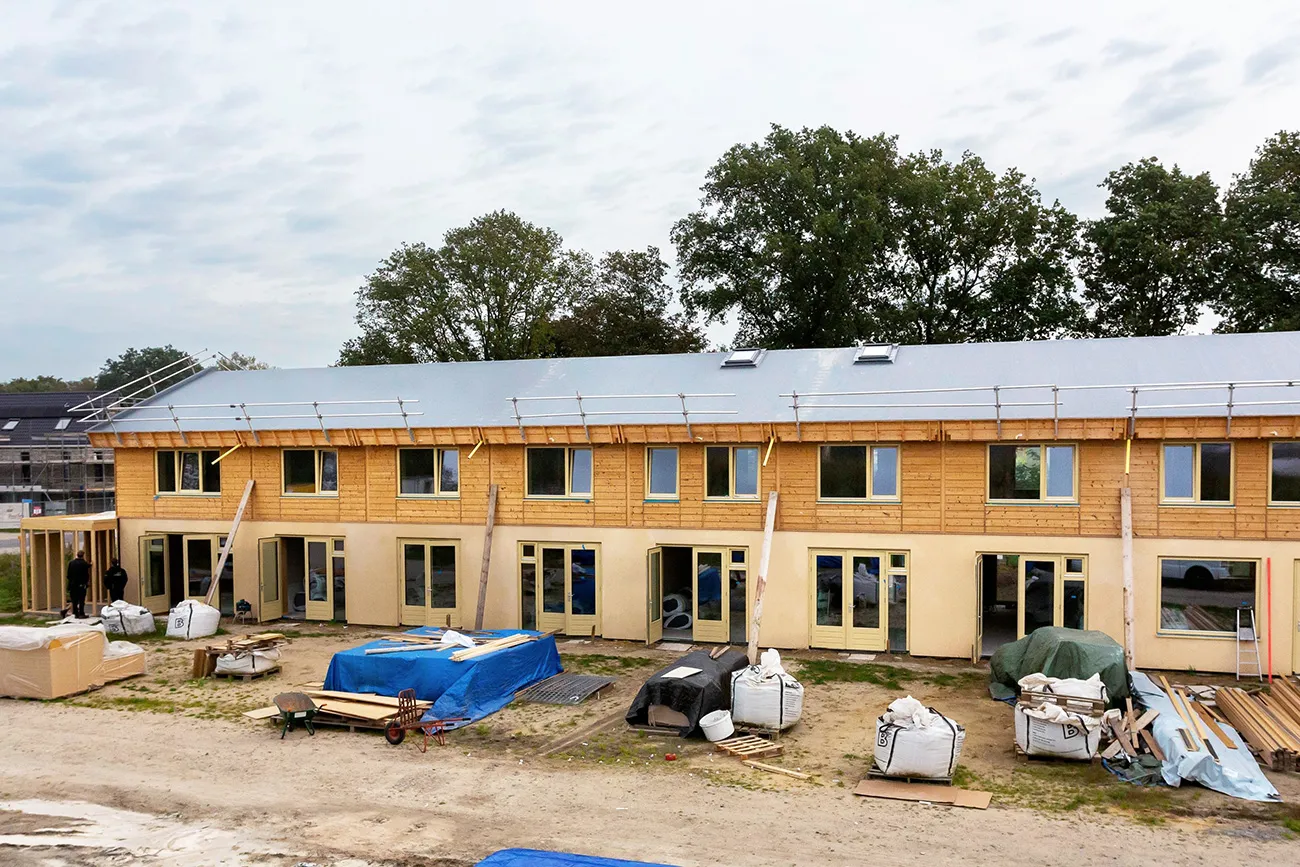
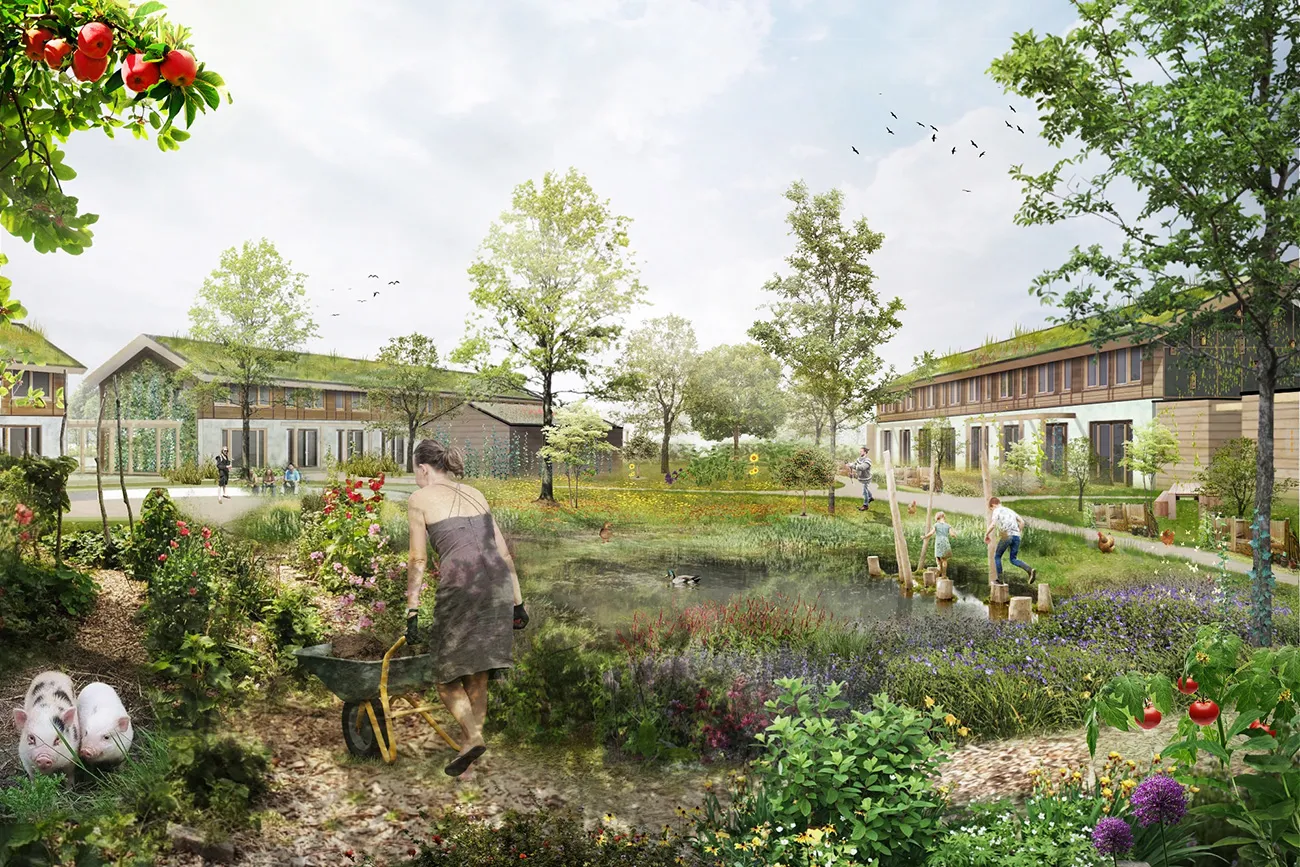
In Zilverackers, the newest district of Veldhoven, work is progressing enthusiastically on the ecovillage of Klein Oers. Forty homes are being built here from wood, clay and straw, with residents taking part in the construction. The foundations on which the homes stand are also highly sustainable: the ground-floor slab, made of geopolymer concrete, was cast on an insulating layer of foamed glass aggregate.
After a fairly long preparation period, contractor Versteegden was able to start work on site in April 2023, on a site of approximately 1 hectare. Klein Oers comprises five residential blocks (24 social housing units and 16 owner-occupied homes) and a village hall. The owner-occupied homes are being built under collective private commissioning (CPO), with residents taking on part of the construction work themselves. “They are only filling the walls with straw and finishing them with clay,” explains Mark Versteegden, director of the construction company that bears his name. “We hand over the homes to the client in shell condition, the client does their part and then hands them back to us. We check everything, of course, and ensure that the Building Decree and safety regulations are complied with. That sounds straightforward, but CPO and the high level of sustainability being pursued here make this a very different kind of work from traditional construction.”
A venture requiring courage
Construction company Versteegden, based in Erp in Brabant, is a traditionally minded builder by origin, employing many bricklayers and other tradespeople. Versteegden says: “On average, we have around sixty to seventy people working on site. The management team of this family business is very compact for a company of its size, and our very flat organisational structure means we approach things differently from other builders. By that I mean we are more inclined to take risks that larger contractors in particular prefer to avoid. And we take on unusual projects, such as Klein Oers. You have to deal with very high sustainability ambitions and residents who think differently, and are more outgoing and assertive. It is pioneering work, but we have found that it suits us.”
Foundations
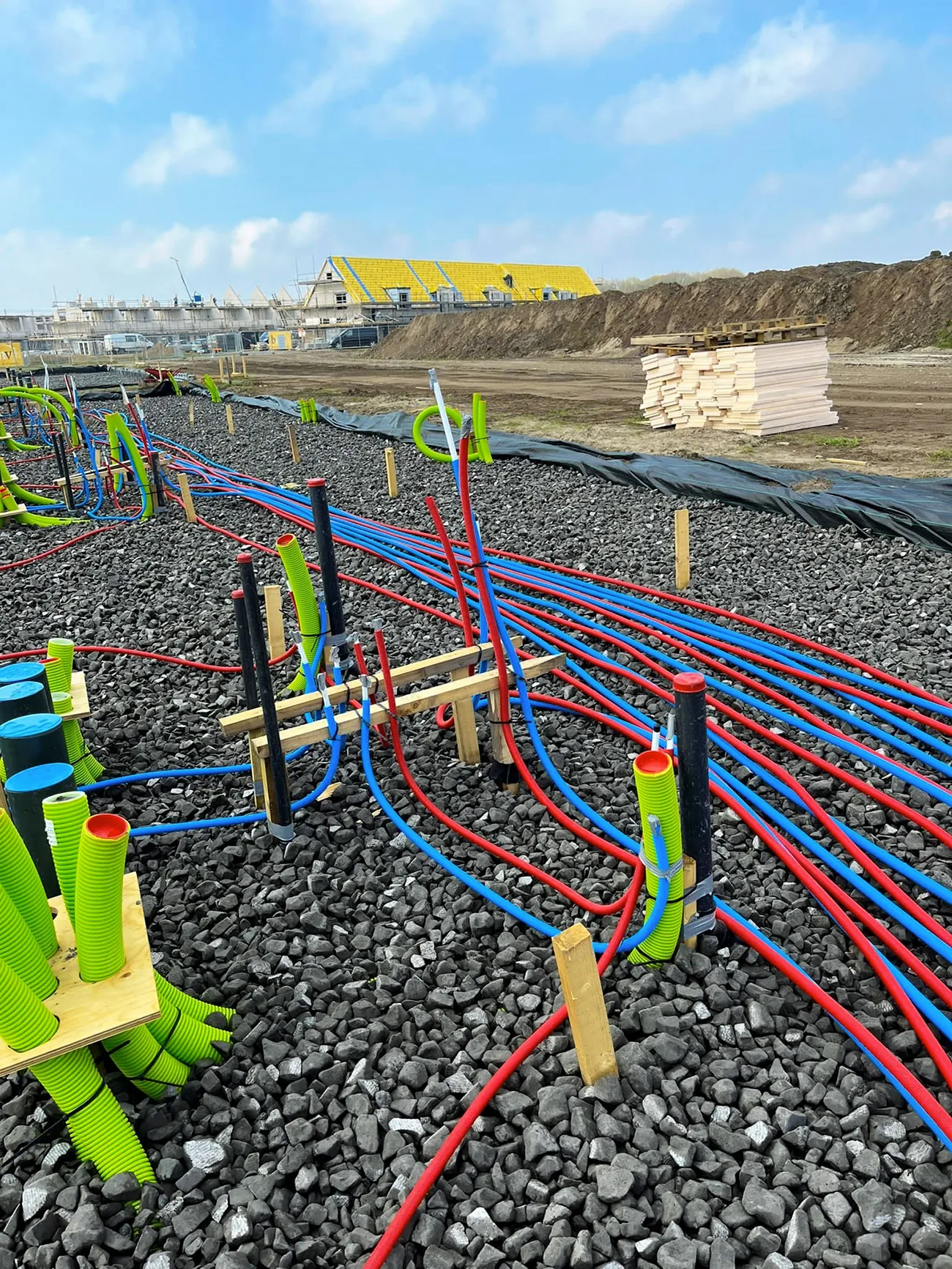
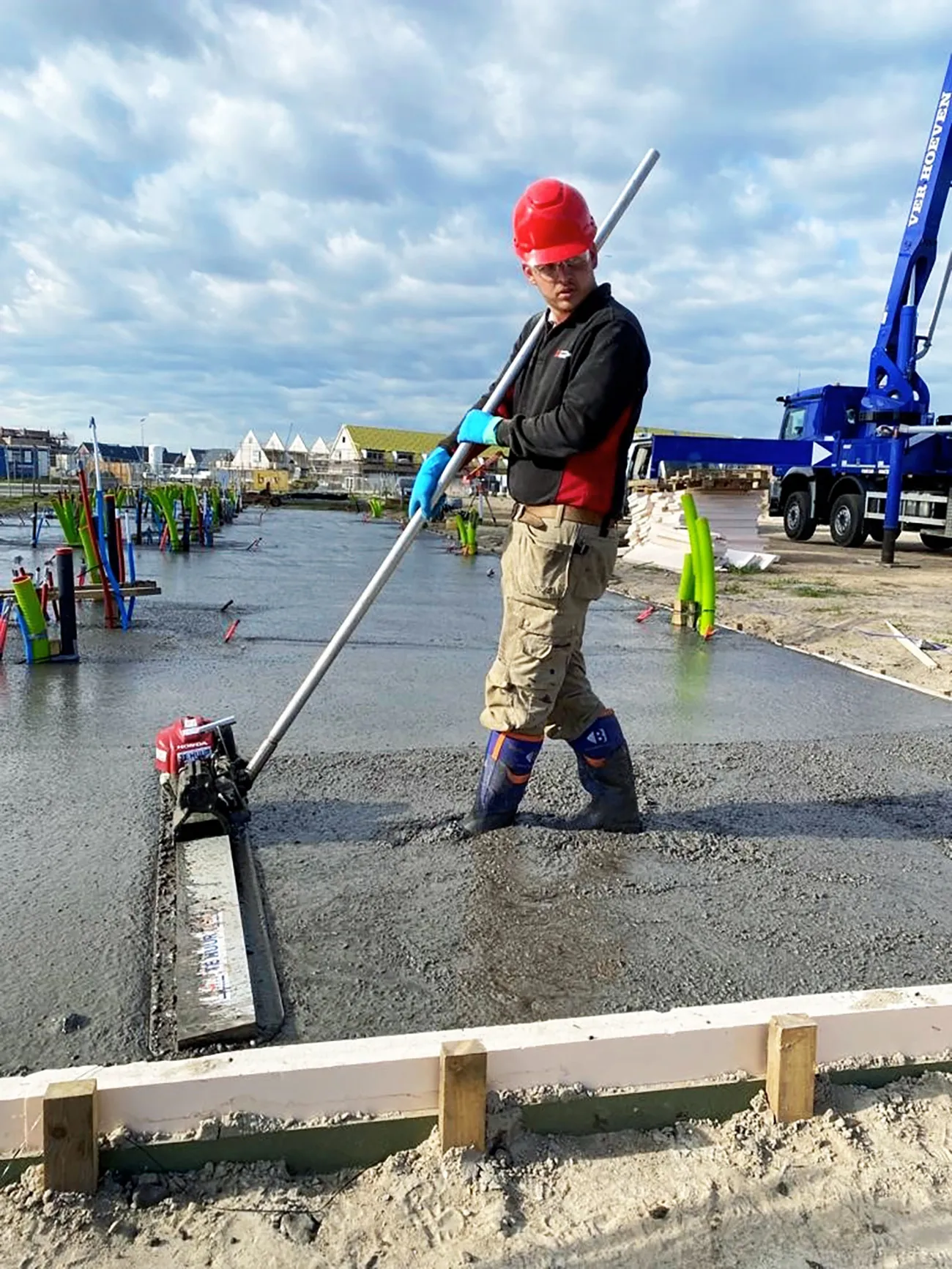
That pioneering starts right at the foundations. Versteegden says: “A shallow foundation on foamed glass aggregate was chosen. This is a waste product from glass production, which is placed in excavated trenches in the ground. Because the material contains a colouring agent that must not enter the groundwater, we lay a waterproof membrane underneath it. It is fully circular, by the way, and there is no need for frost-protected edges. Slabs made of geopolymer concrete supplied by Jansen Beton were then cast on this thermally insulating sub-base. It is strong, requires just one reinforcing mesh instead of two and, because the homes are joined together, less edge reinforcement was also needed. This allowed us to make considerable savings on materials.” The buildings were constructed using timber-frame construction, straw from rye grown in Flanders, and clay for the wall finish.
Compression tests
Pioneering often leads to debate and disagreement, but Klein Oers avoided that. Versteegden says: “The collaboration with the architect, residents and suppliers went remarkably well. Because so much is new, we test everything ourselves, including carrying out compression tests after casting the floors. We are also very pleased with the geopolymer concrete, which we used here for the first time. You can run all the services through it, it dries extremely quickly and it is easy to finish. The only thing is that staff have to wear gloves and goggles because of the glass fibres. It is a shame that materials such as foamed glass aggregate and geopolymer concrete have not yet been included in the environmental databases. This means that it is not possible to calculate their environmental impact or the building’s environmental performance. In that respect, the construction industry is still lagging a long way behind when it comes to these kinds of sustainable innovations.”
Environmental cost indicator calculated
Bert Busgen of Jansen Beton BV: “The fact that this product has not yet been included in the National Environmental Database does not mean that we at Jansen Beton BV cannot calculate an environmental cost indicator (MKI). We previously supplied similar geopolymer concrete for the Ecodorp Boekel project, where an MKI of € 5,54 per m3 was calculated. In addition to using geopolymer concrete, the aggregate was 100% replaced with thermally cleaned sand and gravel. This results in a very low environmental impact compared with conventional concrete.”
Vraag over dit verhaal? Stel je vraag
In dit verhaal
- ClientWoonstichting Thuis (24 huurwoningen), cpo (16 koopwoningen)
- Architectarchi3o
- CoordinationDe Loods
- ConstructionBouwbedrijf Versteegden
- GEOPOLYMER CONCRETEJansen Beton BV
Blijf dit volgen
Bij een nieuw verhaal krijg je een e-mail. Geen account nodig.
- ThemaMinder CO2 in beton en staal
- OnderwerpGeneral
- BedrijfJansen B.V.