A new approach to infrastructure challenges is the way forward
Tekst Chris ElbersBeeld DYWIDAG
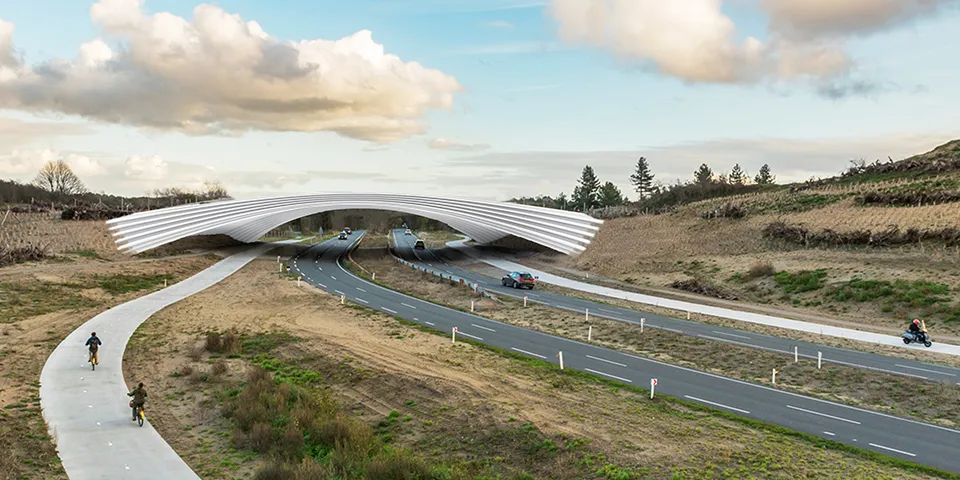
As a partner in prestressing and geotechnics, DYWIDAG works every day to make infrastructure construction projects safer, stronger and smarter.
The company does not do this primarily for its own gain. The main reason for taking an alternative approach to infrastructure challenges is the obligation to make the world a little more environmentally friendly, both today and tomorrow. “We must make the best possible use of our expertise, people and resources in terms of sustainability and circularity,” says Robert Jansen, Post-Tensioning Manager Benelux.
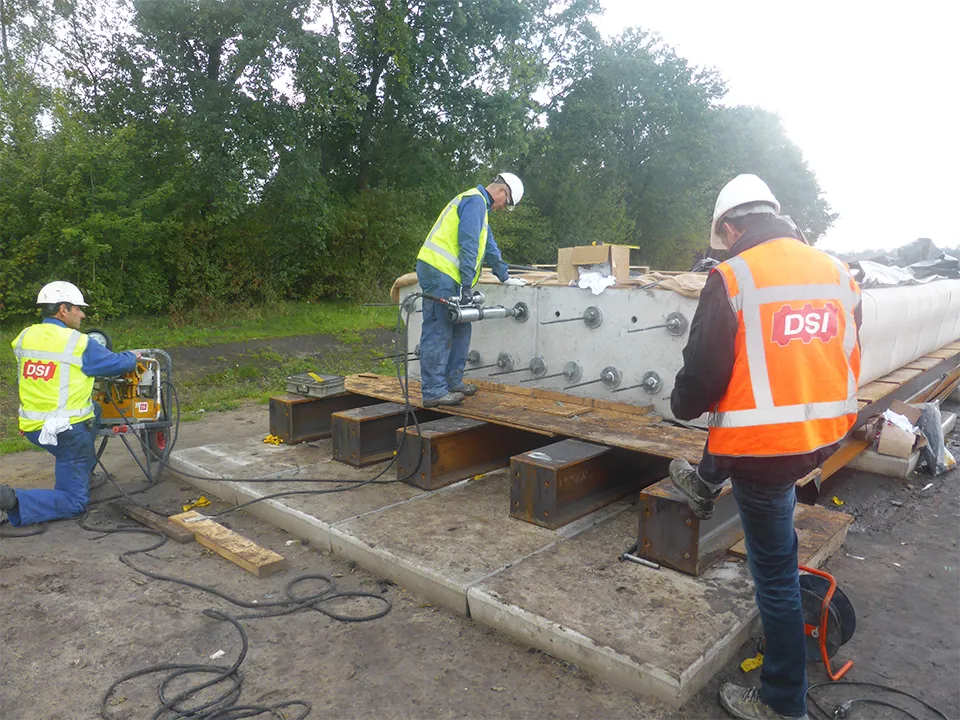
With specialist knowledge and innovative techniques, DYWIDAG drives progress in the construction industry. Its work encompasses prestressing and geotechnics, as well as formwork anchors and arch support in tunnels and mines. These disciplines serve primarily the civil engineering and concrete construction, commercial construction, mining, tunnelling and foundation sectors. DYWIDAG also provides expert advice, first-class installation and excellent aftercare.
Alternatives
With its focus on sustainable and circular construction, DYWIDAG is making its mark on the construction sector ever more often, as a pioneer, initiator and delivery partner. “As we work towards more sustainable construction, we are constantly looking for alternative applications for our products,” says Jansen. “In civil engineering, this is mainly about prestressing. It is a speciality that we like to combine with another field: 3D printing. In recent years, we have contributed to various projects in this area, including the world’s first 3D-printed cycle bridge. We have been involved in both the development and delivery. The aim throughout is to do things differently. What matters is reducing the environmental impact through a smart combination of techniques and disciplines. This can be achieved by cutting CO2 emissions and reducing the use of raw materials, or by reusing them. A recent example is a fully demountable and re-erectable bridge we built in Kampen. It is a textbook example of flexible, circular construction.”
A learning process
DYWIDAG has everything needed in terms of structural engineering to further develop and deliver sustainability-focused initiatives such as 3D printing and demountable and re-erectable construction.
“We have the service, expertise and products in-house,” says Jansen. “We also invest in them continuously. On the one hand, because we have a duty to look after our planet, and on the other, because they offer great potential for the future. At the same time, we realise that we are still learning in these areas. But you have to be brave enough to venture into uncharted territory. Only then can you really achieve something. And if you stumble, you need the strength to get back up. There is still a great deal to discover and achieve when it comes to sustainable construction.”
Floating office
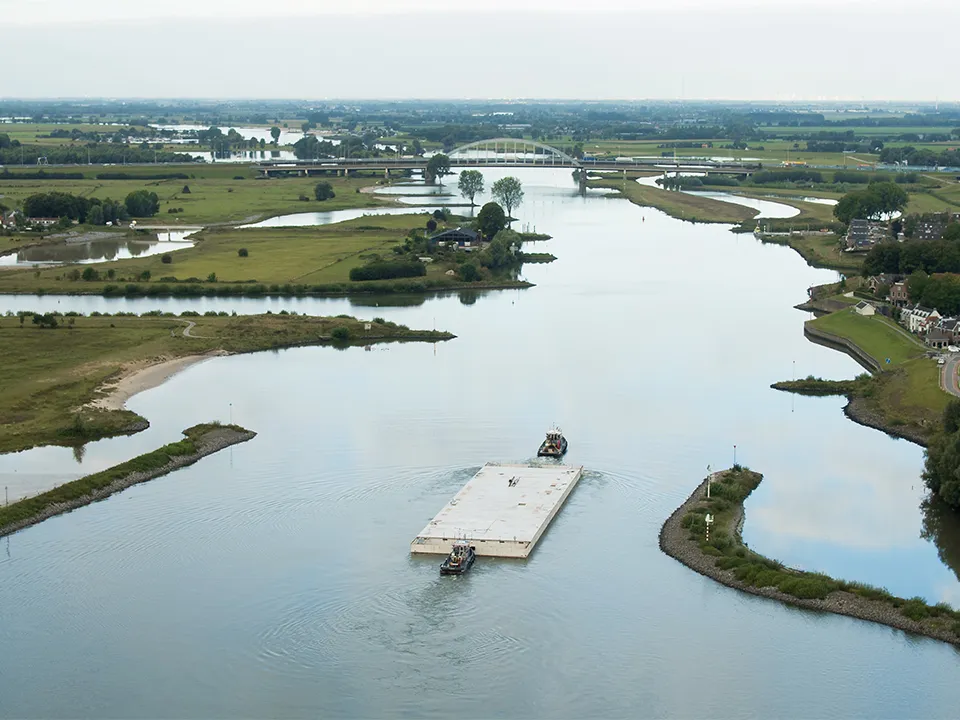
In Rotterdam’s Rijnhaven, DYWIDAG is contributing to the world’s first floating office. The building, constructed entirely from timber, will house the headquarters of GCA (Global Commission on Adaptation), as well as a restaurant with a large outdoor terrace and a floating swimming pool. “The office needs a floating concrete foundation to support it,” says Robert Jansen. “It consists of 15 units, each 24 metres long, 6 metres wide and 3.5 metres high. The units are connected by prestressing cables to form a foundation measuring 24 by 90 metres.”
Because water offers no resistance to the structure, the foundation must absorb all the forces transferred down from the office. As a result, the structure required a considerable amount of prestressing. “The units were also precast and then floated into position next to one another,” Jansen continues. “This construction method led us to choose external prestressing.”
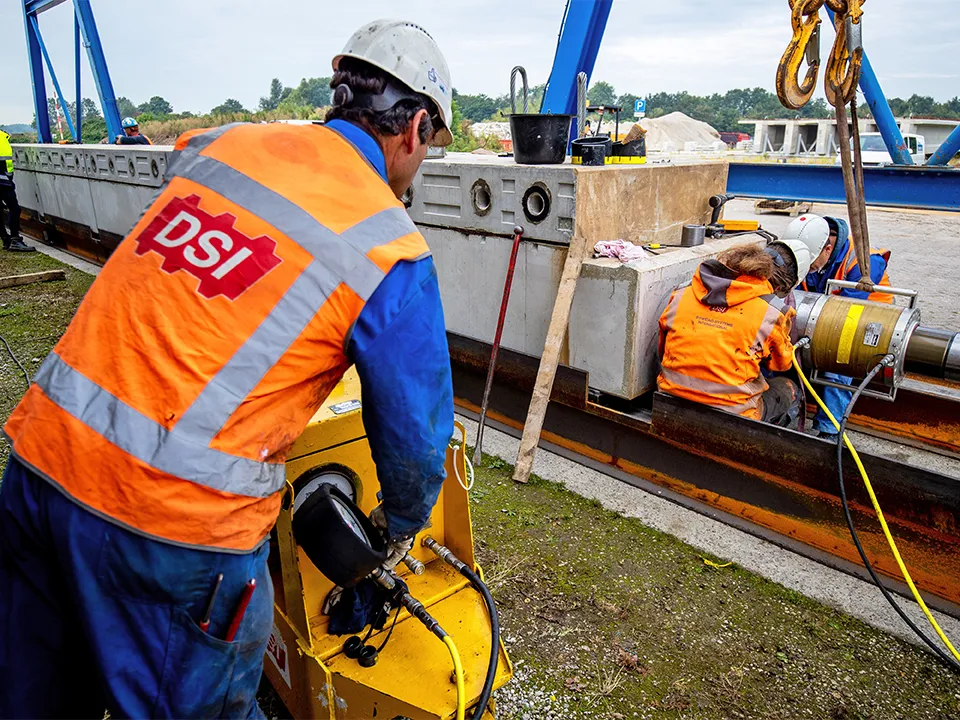
The base contains 6 cables with 27 strands and 3 cables with 22 strands. Each wall also contains 2 cables with 15 strands. The system was built in accordance with ETA certification 13-0979. To keep the units watertight despite the prestressing cable ducts, high-quality rubber was used, and the units were temporarily drawn together with bars during construction. “Once the PE ducts had been installed, the strands were fed through and the wedge plates fitted. The structure was then tensioned in stages. Finally, the cables were grouted to ensure durability,” Jansen concludes.
Een zakelijke vraag aan Jansen B.V.? Neem contact op
Bedrijven in dit verhaal
Blijf dit volgen
Bij een nieuw verhaal krijg je een e-mail. Geen account nodig.
- OnderwerpGeneral
- BedrijfJansen B.V.