Tegenbosch cycle bridge improves traffic flow: An icon for Eindhoven
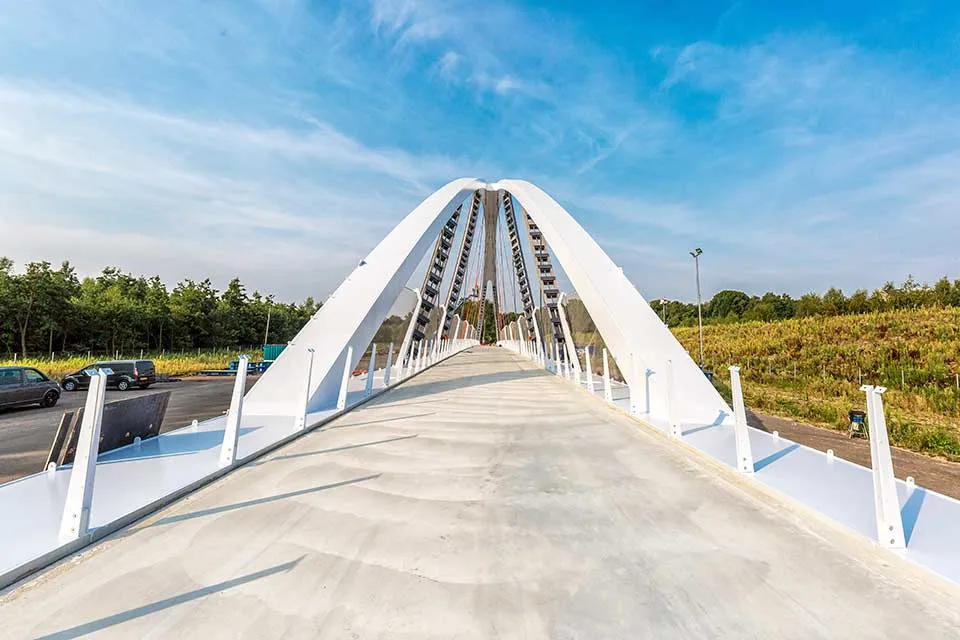
“Tegenbosch has turned out beautifully”, says Kees Smaling, project manager at Dura Vermeer.
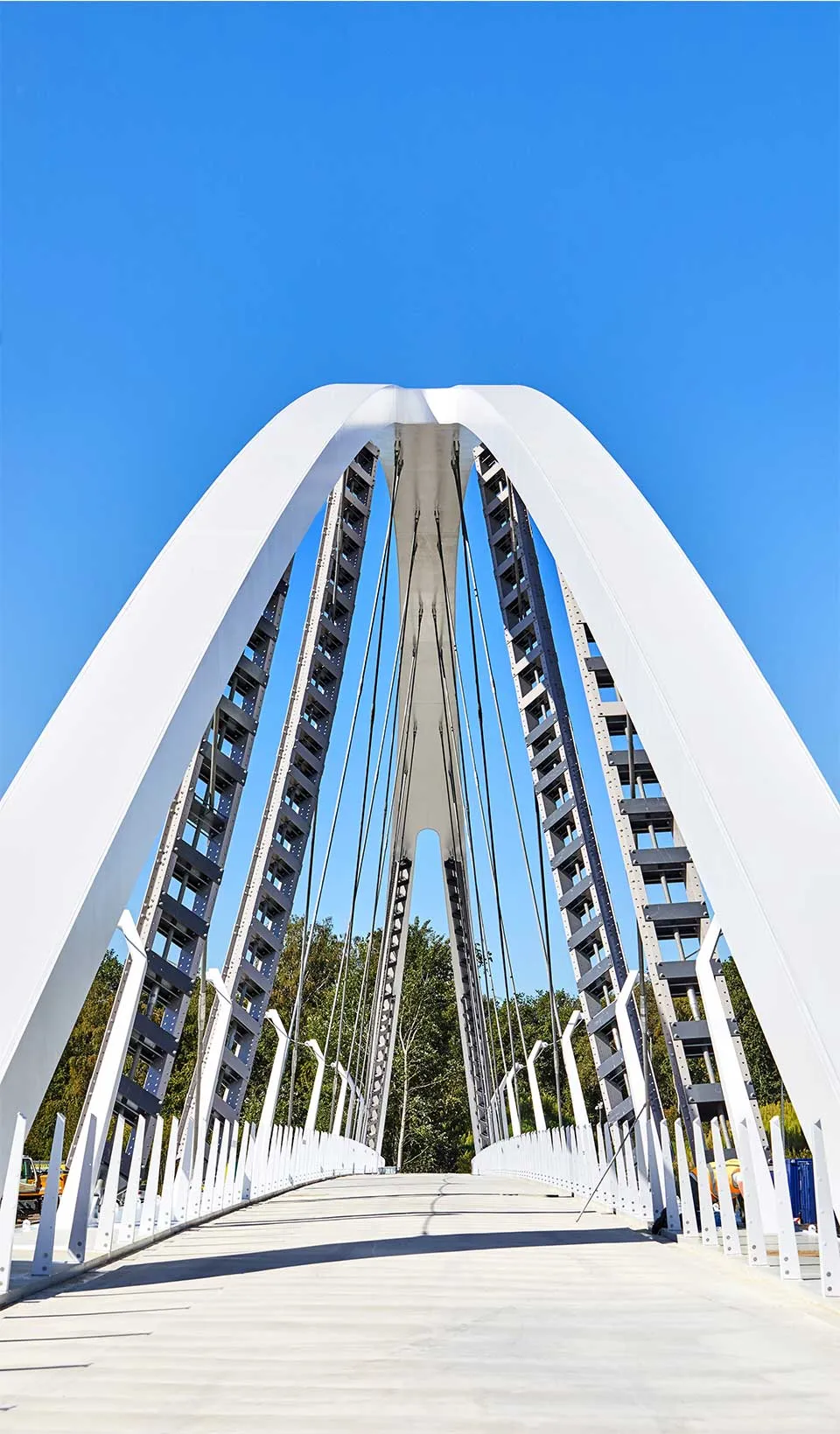
“The bridge spans the entire motorway in one go, without any supports. Its striking design makes it stand out, as does its lighting. The bridge’s colours can be seen from a long way off. Tegenbosch is already an icon for Eindhoven and the surrounding area.”
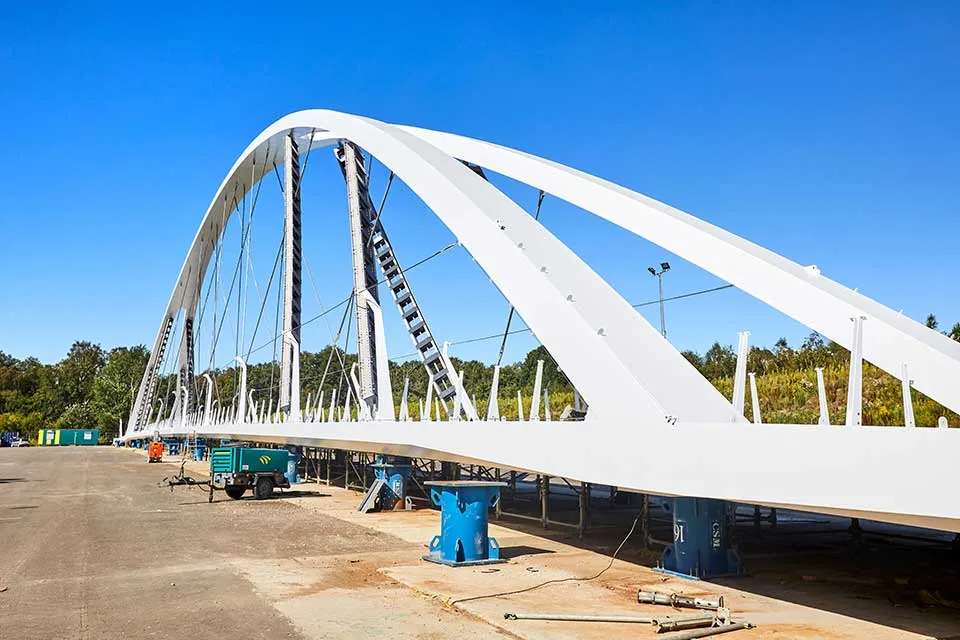
Anyone driving along Anthony Fokkerweg in Eindhoven at the moment passes underneath it. Tegenbosch cycle bridge is already regarded as one of the finest structures in the south of the Netherlands. The bridge not only has a beautifully slender form, its lighting is also remarkable. As cyclists cross the bridge, the arch and deck are illuminated according to their speed. The colours change with the seasons.
Contract awarded for collaborative strengths
When the contract for Tegenbosch cycle bridge was put out to tender, Dura Vermeer and Ploegam were both keen to win the work. After all, it was an important link in the new road network in north-west Eindhoven. Tegenbosch cycle bridge, near Eindhoven Airport, was intended to improve traffic flow on Anthony Fokkerweg, create an east-west route for cyclists and improve access to Brainport Industry Campus. The existing cycle path along Anthony Fokkerweg was sacrificed to make way for an extra lane for motor traffic. The Dura Vermeer-Ploegam joint venture was awarded the contract on the strength of the collaborative approach set out in its proposal.
Coming together in a project team
“That was new for us,” says Joris Bevaart, project manager at Ploegam. “Our collaborative strengths earned us a place in a project team with a partner we didn’t know.” The team comprised three project managers from the municipality and three from Dura Vermeer-Ploegam. At that stage, nothing had yet been put down on paper apart from the bridge and the existing roads. That is not to say the project managers were left to fend for themselves. A coach guided the team-building process, established each person’s core values and defined the aim of the collaboration. This enabled the project managers to become the designers and creators of the best possible result, setting aside individual interests.
Pressure cooker
“I was trained in calculation formulas,” says Bevaart. “I usually work with engineers. Working in a project team was new and, at the same time, a breath of fresh air. I can already say that this approach has been one of the best experiences of my career. Of course, it was a pressure cooker. Under intense pressure, and having to carefully weigh up countless interests, we had to make crucial decisions together. We spent a year preparing the work.” When the design phase gave way to construction, some members of the project team changed, and the steel contractor was given the go-ahead to begin preparations.
The practical work
Everything that had been prepared was now put into practice. While steel fabricator CSM designed and manufactured the steel components, Dura Vermeer and Ploegam carried out the earthworks on site. They poured the concrete foundations for the abutments, replaced the crash barriers with ones that could be easily removed when the bridge was installed, and levelled the entire construction site so the Mammoet trolleys, the SPMTs, could cross it without difficulty.
Installation in just a few hours
In January 2020, CSM brought the steel components to the construction site and welded them together there. “A huge job,” says Bevaart. “Stacks of components were delivered and joined together on site until the intended structure had taken shape. This took place alongside the A2/N2 near the Novotel. On Friday evening, 28 August, the only road closure began and the motorway was shut. We were then able to excavate the exit ramp, which was also too high. That same evening, we took the SPMTs out for a test run, and at around midnight on the night of 29 to 30 August, the bridge was in place over fourteen lanes!”
The real work
Although installing the bridge felt like the completion of the work, for Dura Vermeer-Ploegam the major task was only just beginning. The excavated exit ramp had to be restored to its original condition. All the city’s diversions had to be removed, and the N2, Eindhoven’s only north-south route, had to be returned to optimal condition. The coronavirus pandemic helped in this respect. “The N2 is Eindhoven’s busiest road. It was certainly far from quiet, but traffic levels were considerably lower because of the pandemic.”
An icon for Eindhoven
The connection between the bridge and Anthony Fokkerweg could then be completed. The final section of Anthony Fokkerweg was finished, and the existing structure was upgraded to accommodate the increased traffic intensity. The first cyclists crossed the bridge at the end of October.
Vraag over dit verhaal? Stel je vraag
Wie eraan werkte
Fietsbrug Tegenbosch in Eindhoven
- staalbewerkerCSM
Blijf dit volgen
Bij een nieuw verhaal krijg je een e-mail. Geen account nodig.
- ProjectFietsbrug Tegenbosch
- ThemaBruggen en kunstwerken langer mee
- OnderwerpProjects
- BedrijfCSM