









22 12-ton yokes delivered on schedule
Tekst Tjerk van DuinenBeeld Dijkstaal B.V.
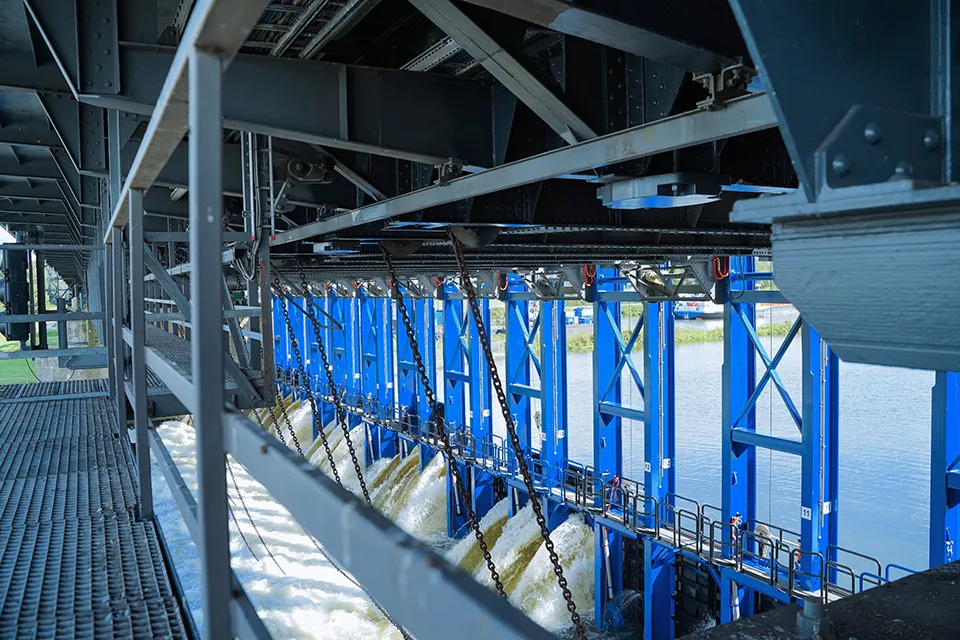
Major maintenance at the weir near Grave
The weir near Grave needed major maintenance sooner than expected. Rijkswaterstaat brought forward the work, originally scheduled for 2028, after cracks were found in the yokes. These support the gates that perform the actual weir function. On behalf of the Mourik-SWARCO contractor consortium (CMD), Mourik Infra B.V. awarded Dijkstaal B.V. of Maassluis the contract to manufacture all 22 yokes. It was a project involving large components and very tight tolerances.
The yokes for the weir near Grave are a close replica of the original yokes at this national monument. “A yoke is 16 metres long, 2.8 metres wide, weighs around 12 tonnes and is manufactured in accordance with NEN-EN-1090 EXC. 3 and Rijkswaterstaat’s Guidelines for the Design of Civil Engineering Structures (ROK),” says Mark Pilon, Head of Business Office at Dijkstaal. “When we were approached about the project late last year, the key questions were whether we could meet these requirements and deliver on time. Capacity was not the issue, but getting the right materials on time was. The requirements meant we had to go directly to the rolling mill to secure the right HEB sections in time. After a brief assessment, we accepted the contract and earned Mourik’s trust. The schedule was very tight, so we got straight to work on the design together.”
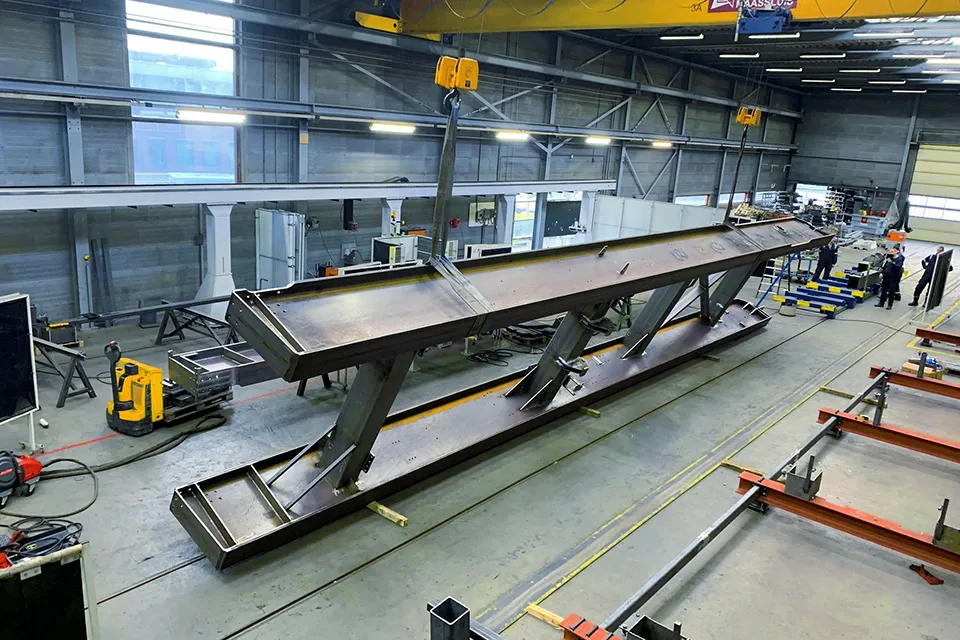
Production flow
A yoke is a frame made up of two large HEB 900 sections and various sizes of hollow sections. Pilon explains: “It was designed by the client. We made changes based on our input, including welding details to make fabrication easier. The design was then converted into production drawings, the welding details were developed and production was set in motion. With 22 yokes weighing 12 tonnes each and sections weighing 4.5 tonnes, logistics were also a challenge. To minimise handling during production, we planned a route through the various operations: preparation, assembly, welding and final assembly. First, as much as possible of the HEB 900 sections and intermediate hollow sections were welded separately, together with plates and other components. These manageable parts were then assembled in a special jig, fully welded and finished. They were then transported one by one, 22 times in total, by road to GSB, the blasting and coating company with which Mourik works closely.”
Line boring
The most critical part of the yokes is the pivot point. “The entire assembly of the yoke, gates and mechanisms is supported there,” says Pilon. “A one-millimetre deviation in the shaft position would cause a significant misalignment at the bottom, preventing the yoke from seating in the lugs. The shaft through the pivot points therefore required an H7 fit, meaning a tolerance of one thousandth of a millimetre. To achieve this, each frame was first fully surveyed digitally and the exact shaft position was determined. We then hired a specialist to line-bore the holes, which we had made to 190 mm, to the correct diameter of 220 mm and the required fit, at our premises.”
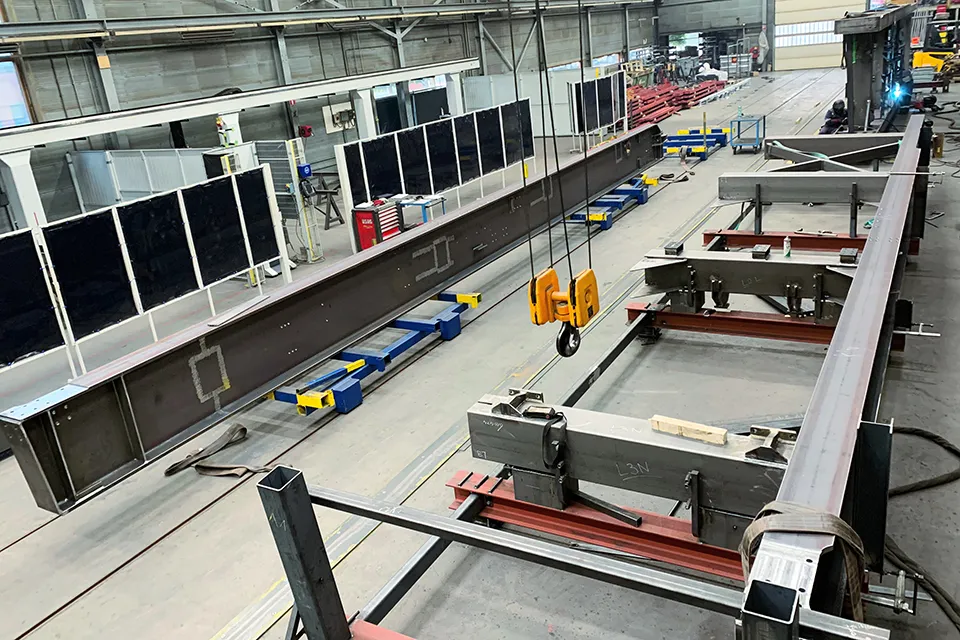
Transport
“You also want to maintain that accuracy when a yoke goes to the coating company,” Pilon continues. “That takes careful preparation too. Based on our delivery specifications, the coating company had indicated that handling the yokes at its site would be difficult. We therefore transported them on the back of a lorry fitted with air suspension, which could be lowered on arrival. This meant the yoke could be placed straight onto supports. We also made a special tool that was inserted through the shaft, with plastic rings to protect the bushes.” Engineering and production went very quickly and smoothly. “We were still doing the calculations at Christmas, the first yoke was shipped in May and the last in early October. The result of an impressive feat of teamwork.”
Vraag over dit verhaal? Stel je vraag
Blijf dit volgen
Bij een nieuw verhaal krijg je een e-mail. Geen account nodig.
- OnderwerpProjects